A Nacha compliance program is the set of owners, procedures, training, monitoring and audit through which a bank or credit union meets the Nacha Operating Rules and the federal rules that sit around them. Its fixed parts are public: an annual ACH rules compliance audit completed by December 31, contacts registered in Nacha's ACH Contact Registry, return-rate monitoring of originators by every ODFI, and, since 2026, risk-based processes to spot ACH entries initiated by fraud. Its hidden part is the daily one: staff asking whether a debit can still be returned, which code to use or whether a procedure is current, and getting answers from whoever is nearby. That part has outgrown one rulebook, because the answer can sit in the Nacha rules, Regulation E, Regulation J, Article 4A or a Reserve Bank circular, each on its own edition. Botminds' Nacha & Payment Rules Search takes the first reading of those rulebooks off people, and leaves interpretation, approvals and the audit with them.
The roles and examples below come from the solution's fictional sample credit union, Norrell Federal; program requirements come from Nacha's public pages and the FFIEC examination handbook, linked where used.
Who owns what in a Nacha compliance program, before and after the rules desk changes
Today
Works returns, NOCs and disputes; on the few that turn on an unclear rule, asks a colleague and counts days on a desk calendar.
With agents
Asks in plain words, opens the passage behind each claim, gets the deadline dated on the Federal Reserve calendar, and prepares the return.
Still theirs: the facts, the member, preparing the return
Today
Follows the wire procedure as written, even where it names a message format the network has retired.
With agents
Is told before sending when the procedure and the network rule disagree, with the safe step to take now.
Still theirs: every message sent
Today
Takes rule questions by phone and email with no shared record; finds a stale procedure when something goes wrong.
With agents
Receives only the questions that need judgement, each with its reason, draft and clock; approves editions, procedure changes and reusable answers.
Still theirs: interpretation and every approval
Today
Hears the same question from new staff again and again, with no view of the pattern.
With agents
Sees what new staff repeat and approves short lessons drafted from their own questions.
Still theirs: training and staffing
What is a Nacha compliance program?
It is how an institution shows that it follows the rules it agreed to by joining the ACH Network, and Nacha's own position is that every participant in the network is bound by its rules (Nacha, How ACH Payments Work; whether Nacha is a regulation explains why that binds). A program that would satisfy an auditor in 2026 has at least these parts, each of them traceable to a public requirement.
The parts of a Nacha compliance program, and where each requirement is published
| Part | What it requires | Source |
|---|---|---|
| Annual rules compliance audit | Completed by December 31 by every financial institution, third-party sender and third-party service provider; attested on request | Nacha, Risk Management Portal |
| ACH Contact Registry | "All ODFIs and RDFIs are required to register contact information for ACH Operations and ACH Risk/Fraud" | Nacha, Risk Management Portal |
| Third-party sender registration | Every ODFI registers its third-party sender relationships, or acknowledges it has none | Nacha, Risk Management Portal |
| Return-rate monitoring | ODFIs "are responsible for the continued monitoring of return rates of their Originators and Third-Party Senders" | Nacha, Calculating Unauthorized Return Rate |
| Fraud monitoring | Risk-based processes to identify entries initiated due to fraud, for ODFIs, RDFIs (credits), non-consumer originators and third parties, phased in March and June 2026 | Nacha, A Busy 2026 Ahead; Summary of Upcoming Rule Changes |
| Staff knowledge | Examiners determine whether "management and personnel display adequate knowledge and technical skills" in ACH duties | FFIEC, Retail Payment Systems booklet |
The fraud monitoring duty changed the program's shape more than any rule in years. Nacha's chief executive described it as a first: "for the first time, Receiving Depository Financial Institutions (RDFIs) will have a defined role in transaction monitoring" (Nacha, A Busy 2026 Ahead). Building that monitoring is the work of ACH Fraud Monitoring; the program's job is to own it, document it and audit it.
Who is responsible for Nacha compliance?
The institution is, as a network participant, and inside it the board and a named owner. The FFIEC's procedures ask examiners to check that the board or one of its committees reviewed and approved the audit, and to judge "the independence and competence of the party performing the audit" (FFIEC, Retail Payment Systems booklet; the evidence an ACH rules compliance audit asks for), which puts the board at the top and internal audit outside the line. Day to day, ownership usually sits with a payments compliance officer for interpretation and approvals and a payments operations manager for the people doing the work.
An ODFI's responsibility reaches further, to its originators and third-party senders: their return rates, their registration and, on request, proof of their audits. Nacha's enforcement record shows where gaps land: of 242 fines assessed in 2025, 174 fell on small-asset institutions (Nacha, 2025 ACH Rules Compliance Snapshot), the ones least likely to have a full-time rules specialist.
What rulebooks does a payments team need?
More than the one in the program's name. A desk that answers ACH, Fedwire and FedNow questions works from the Nacha Operating Rules & Guidelines, Regulation E for consumer rights, Regulation J and Article 4A for wires and instant payments, and the Reserve Banks' Operating Circulars 4, 6 and 8, each of which was re-issued at least once in 2026 (FRFS, Operating Circulars), plus its own procedures. Each binds in a different way, which whether Nacha is a regulation, and what actually binds a payment, sets out.
The program question is not whether staff can find these books, but whether the answer they give names the right one, in the edition in force on the right date. That is the part of the program most institutions run on memory.
Who answers ACH rule questions today, and why it breaks
In most institutions, the most experienced specialist within earshot, a compliance officer by email, or a payments association helpline. Each can give a good answer. None leaves a record of what was asked, what was answered and from what source, and none sees that the same question has come up twenty times this quarter.
One month of rule questions at the sample credit union
652
rule questions in October from 124 payments and member services staff
4.1%
routed to the Payments Compliance Officer instead of answered by the agents
202
asked by the 9 staff in their first 90 days
58
approved answers the agents reuse, each approved by a second person
The figure that matters to a program owner is the third. Nine new staff asked nearly a third of a month's questions; seven of the nine people who asked the R10 or R11 question this quarter had joined in the last 90 days. That is a training program writing itself, if anyone can see it.
The operating model after agents: what moves and what stays
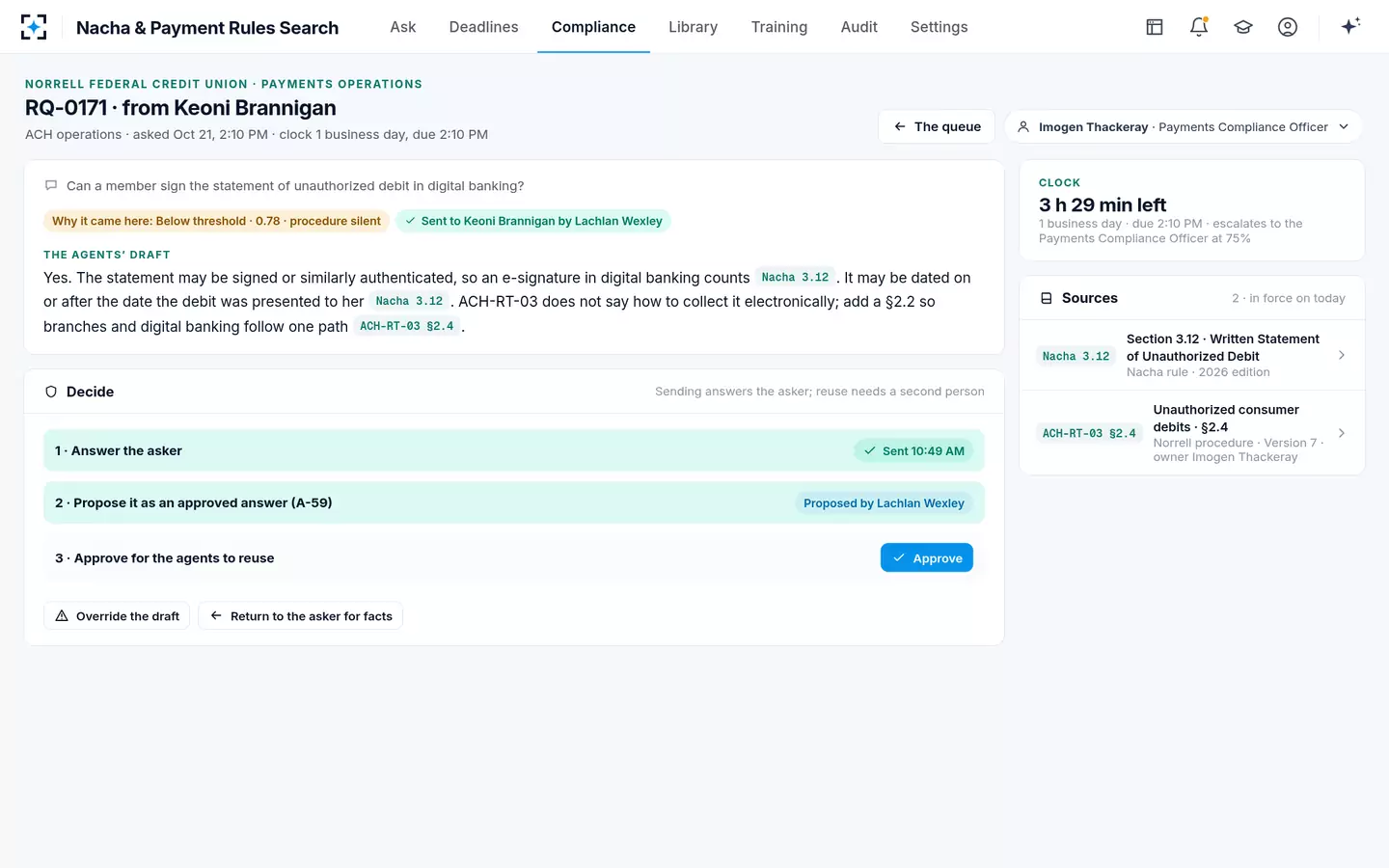
What moves to agents is the first reading: finding the rulebook and edition in force, citing the passage, asking for the missing fact, counting the days on the approved calendar, drafting the return entry or the procedure change. What stays with people is everything someone has to answer for: interpreting a rule where sources disagree, approving an edition or a procedure, releasing a return, signing the audit.
The rules desk, before and after
Before: Asked aloud or by email; answered from memory; no record
With Nacha & Payment Rules Search: Answered in two or three cited sentences; every claim opens its passage; on the trail
Before: Counted on a desk calendar
With Nacha & Payment Rules Search: Dated on the approved Federal Reserve calendar, with the counting shown
Before: Found when something goes wrong
With Nacha & Payment Rules Search: Refused, both passages shown, routed to compliance with a clock
Before: Read once; procedures updated at the annual review
With Nacha & Payment Rules Search: Loaded with its effective date; dependent procedures and answers listed for approval
Before: A course once a year
With Nacha & Payment Rules Search: Short lessons drafted from the questions new staff actually ask, approved by the manager
Before: Rebuilt in the fourth quarter
With Nacha & Payment Rules Search: Exported from the trail for the period
A routed answer: the analyst sends it, a second person approves it for reuse
What Nacha compliance training do staff need?
Training that answers the questions staff actually get wrong, and that changes when the rules do. The FFIEC's examiners judge whether personnel "display adequate knowledge and technical skills"; an annual course run from last year's binder tests attendance, not that. Nacha's accreditations, the Accredited ACH Professional, the Accredited Payments Risk Professional and the Accredited Faster Payments Professional, which 161 people passed in its inaugural 2025 exam (Nacha), give a specialist depth; they do not tell a manager which of this quarter's new hires confuse R10 with R11.
In Nacha & Payment Rules Search the training agent groups repeated questions, especially from staff in their first 90 days, and drafts four-minute lessons and quizzes from them for the payments operations manager to approve. A lesson that depends on a procedure change waits until the change is approved, so new staff are never taught yesterday's step.
How do banks keep up with Nacha rule changes?
By treating each change as a dated unit of work rather than an annual reading. Nacha amends its rules several times a year, five times in 2026 alone, and the Reserve Banks re-issue their circulars on their own schedule. A program that reviews procedures once a year is, on average, months behind each change. The Nacha rule change calendar to 2028 shows the dates; the program needs an owner who loads each one with its effective date, finds the procedures and answers that depend on it, and approves the change. Nacha's own consultants add that the 2026 risk management rules are meant to be lived with, not met once, with an annual review of the processes built into the rules (Nacha, Next Steps for the New Risk Management Rules; see the ACH fraud monitoring policy).
How to tell whether the program is working
Measure the daily part, not just the audit. The table lists the measures we would put in front of a payments compliance committee each quarter, with what the sample credit union's configuration shows where it has one.
Quarterly measures for a Nacha compliance program
| Measure | Why it matters | At the sample credit union |
|---|---|---|
| Share of rule questions answered with a citation | An answer without a source cannot be checked or audited | Every agent answer cites its passages |
| Share routed to compliance, by reason | Disagreeing sources and stale editions are program defects | 4.1% in October: 9 refused, 11 below threshold, 5 routing rules, 2 restricted |
| Routed questions answered within their clock | A late answer to the wire room is a late recall | 30 minutes for wire questions; escalation at 75% |
| Procedures older than a rule they implement | Each is a conflict waiting for a question | One found in October: a wire procedure unreviewed since March 2024 |
| Repeat questions from new staff | The training gap, by topic | R10 or R11: 23 times by 9 people this quarter |
| Answers when sources disagree | Should be none | Zero is the design target |
Where the solution fits in the program, and where it does not
Nacha & Payment Rules Search fits the daily part of the program: the questions, the deadlines, the procedure changes, the training gaps and the record of all of them. It does not run the audit, monitor transactions for fraud, register contacts in Nacha's portal or calculate originator return rates; those belong to internal audit, a fraud monitoring system and ACH operations, and ACH Return & NOC Management covers the return work itself. What it changes is that the people who own those parts start from a cited answer and a dated record instead of a recollection.
Questions people ask
Do credit unions need a Nacha compliance program?
Yes, if they send or receive ACH payments. The rules apply to every participant, including credit unions that are not members of a payments association, because the Reserve Banks' Operating Circular 4 incorporates the Nacha rules for every FedACH item. The annual audit, the contact registry and the 2026 fraud monitoring duties apply to credit unions as to banks.
Is there a Nacha compliance certification?
Nacha offers accreditations rather than a program certification: the Accredited ACH Professional, the Accredited Payments Risk Professional and the Accredited Faster Payments Professional. Separately, Nacha Certified is a voluntary certification for third-party senders that want to show sound risk and compliance programs.
What is the ACH Contact Registry?
A Nacha database of contacts, held in its Risk Management Portal, so institutions can reach each other about ACH operations, exceptions and risk. All ODFIs and RDFIs must register contacts for ACH operations and ACH risk and fraud; from July 24, 2026 the U.S. Treasury's Bureau of the Fiscal Service also participates.
How often should a Nacha compliance program be reviewed?
At least once a year, through the rules compliance audit due by December 31, and at every rule change for the procedures it touches. The 2026 fraud monitoring rules add their own requirement to review the risk-based processes at least annually.
Who should answer staff questions about the Nacha rules?
The first reading can come from anyone, or anything, that cites the passage and the edition; the decision on anything unclear should come from the person accountable for payments compliance, and both should be recorded. What matters is that the answer can be traced to its source when an auditor or an examiner asks.