An AI compliance assistant for payment rules answers staff questions about the Nacha Operating Rules, Regulation E, Regulation J, UCC Article 4A and the Reserve Banks' operating circulars in plain words. The ones worth buying do five things a general chat tool cannot: they answer only from the rulebooks and procedures your institution has licensed and approved, in the edition in force on the date that matters; they cite every claim to a passage a person can open; they ask for the facts that change the answer before giving it; they refuse when two sources disagree; and they keep a record an auditor can read. Payment rules make those demands unusually sharp, because the Nacha rulebook is licensed text, it changed on five dates in 2026, and a wrong answer shows up as a late return or a late wire. Botminds' Nacha & Payment Rules Search is built to that list, and this guide is the list, with how to test any assistant against it.
Rule facts come from Nacha's public pages, the Reserve Banks, the FFIEC and federal regulators, linked where used. Product examples are sample data from the solution's fictional credit union.
The same rule question, answered by a general chat tool and by a cited assistant
General chat tool: Whatever text it saw in training or finds on the open web: public summaries, forum posts, old guides
Cited assistant built for payment rules: The licensed Nacha edition you own, the federal rules and circulars, and your procedures, each approved for use
General chat tool: Unknown; often a blend of several years
Cited assistant built for payment rules: The edition in force on the settlement or payment date, named in the answer
General chat tool: Section numbers it may have inferred, which cannot be opened
Cited assistant built for payment rules: A chip on every claim that opens the passage, its edition and who approved it
General chat tool: Assumes the common case
Cited assistant built for payment rules: Asks: consumer or business, entry type, settlement date; reads them from your systems where it can
General chat tool: Says "60 days" or "two banking days"
Cited assistant built for payment rules: Dates the deadline on the approved Federal Reserve calendar and shows the counting
General chat tool: Picks one, or averages them
Cited assistant built for payment rules: Refuses, shows both passages, says what is safe now, routes to compliance with a clock
General chat tool: A chat history, if anyone saved it
Cited assistant built for payment rules: Question, answer, sources, edition, confidence, approver: on the audit trail
Can ChatGPT answer Nacha rules questions?
It can talk about them; it cannot reliably answer them. The consolidated Nacha rule text is sold each year, $75 for members and $110 for others in 2026 (Nacha, Rules Your Way), so a general model has, at best, seen Nacha's free summaries and other people's descriptions of the rules. It has no way to know which edition its knowledge reflects, and the rules do not stand still: sixteen amendments take effect on eight dates between March 2026 and March 2028 (Nacha, Summary of Upcoming Rule Changes).
Three real changes show what that costs. A model that read Nacha's new-rules page may suggest return code R90 for a sanctions return; the code is approved but not in effect until March 17, 2028 (Nacha, New Rules). A model trained before October 2024 will give one deadline for an unauthorized consumer return where there are now two. And a model that learned the old definition of Banking Day will count a credit union's own holiday closure as a non-banking day, which Nacha removed on January 1, 2026 so that every institution counts the same days (Nacha, Minor Topics Rule Changes; the banking day definition has Nacha's reasons).
GAI outputs may also include confabulated logic or citations that purport to justify or explain the system's answer, which may further mislead humans into inappropriately trusting the system's output.
NIST AI 600-1, Generative AI Profile (July 2024)
That is the specific risk for payment rules. A citation to "Section 3.8" looks authoritative whether or not the section says what the answer claims, and a reviewer under time pressure will rarely check. An assistant worth buying makes the check the default by showing the cited words next to the claim.
What should an AI compliance assistant cite?
Four things for every claim: the passage the claim rests on, the edition that contains it, the date that edition took effect, and who approved it for use. For public law, such as Regulation E or Regulation J, the passage can be the regulation's own text. For the Nacha rules, the institution's licensed copy is the source; the assistant should cite it and show an approved summary rather than republish the rulebook, and say so on the screen.
What a citation should open: the passage, the edition, the date and the approver
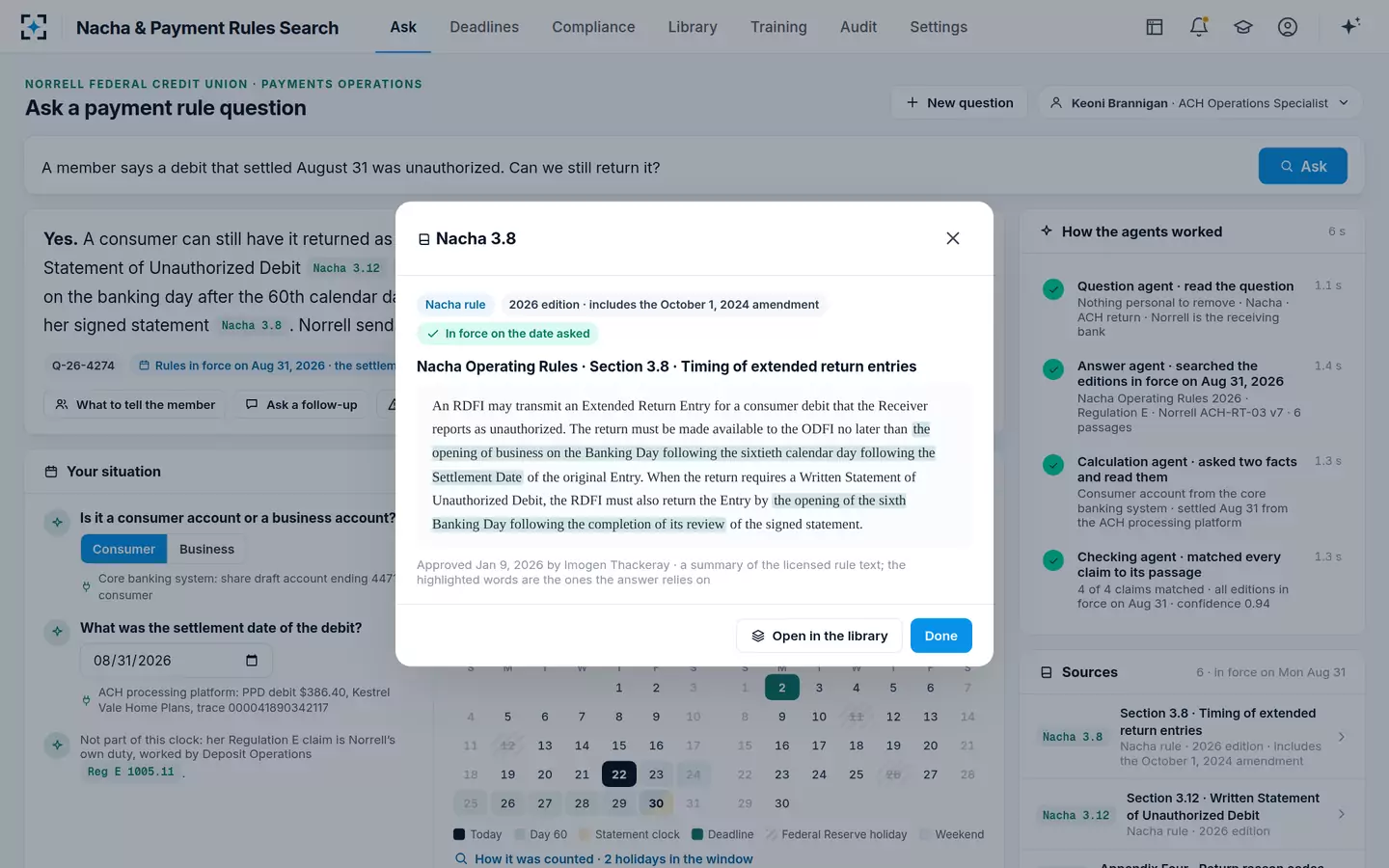
Ask a vendor to show a citation opening on a question you choose, not one from their demo script, and to show what happens when the passage does not support the claim. In Nacha & Payment Rules Search a checking agent matches every claim to its passage before the answer is shown and scores its confidence; below the institution's threshold, the question goes to compliance with a draft instead of an answer going to the asker.
Are AI answers about payment rules reliable?
Some are, for some questions, and the only way to know which is to measure on your own. We found no regulator or independent study that publishes an accuracy figure for AI answers on payment-rule questions, and a vendor's figure measured on its own test set tells you about its test set. The fair test is a replay: last year's real questions with the answers your compliance team settled, scored on the rule, the edition, the date and whether the assistant asked for the facts it needed. How to test a Nacha rules assistant on questions you already answered sets out the scoring sheet.
Two design choices raise reliability more than any model choice. The first is a confidence threshold below which the assistant does not answer: the sample credit union routes anything under 0.85 to compliance with a draft, and gives no answer at all below 0.70. The second is refusal on conflict: when a procedure contradicts the rule in force, or an edition is out of date, the assistant shows both passages and stops. Zero answers given when sources disagree is the solution's design target; a replay is how you check it on your questions.
Who is accountable for an AI answer?
The institution, exactly as it is for an answer a colleague gives. The FFIEC's examiners put the exposure plainly: an institution that breaks the Nacha rules faces contractual liability and fines (FFIEC, Retail Payment Systems booklet; see whether Nacha is a regulation). That exposure does not move to a vendor because a tool produced the answer, so the design question is which decisions the tool may never make.
In Nacha & Payment Rules Search the agents answer, cite, count and draft. They never release a return, send a wire message or a notice, recredit a member or approve anything. A specialist prepares a return and a different, senior specialist releases it; the Payments Compliance Officer approves every edition, procedure change, reusable answer and setting; nobody approves their own work. Ask any vendor for the equivalent list, in writing.
Is an AI compliance assistant a model under model risk guidance?
Partly, and the split matters for governance. The banking agencies' revised model risk guidance of April 17, 2026 leaves generative and agentic AI outside its scope as too new and fast-moving, and also excludes from its definition of a model the deterministic, rule-based software that rests on no statistical, economic or financial theory (OCC Bulletin 2026-13; how to use AI for regulatory compliance on wires quotes both passages). An assistant that drafts answers with a language model sits in the first group; the part that counts banking days on an approved calendar sits in the second.
Neither group is a safe harbour. Outside the model guidance, the institution still has to govern the tool under its own risk management, and the agencies have said they plan a request for information on banks' use of AI. In practice, govern the language parts by testing, thresholds, refusal and human approval, and the deterministic parts by testing the calendar and the counting rules once per edition.
What to demand before buying: the checklist
Ten demands for an AI compliance assistant for payment rules
- It answers only from sources you approved, by edition
A library listing each rulebook, circular and procedure with its edition, effective date and approver, which you can compare with the publishers' pages.
- It uses the edition in force on the date that matters
Settlement date for a return, payment date for a wire; it says which edition it used.
- Every claim opens its passage
Click any citation on a question you chose; the supporting words are shown.
- It asks before answering
Consumer or business, entry type, settlement date; reads them from your systems where it can, and never assumes one it could not read.
- Deadlines are dated on your approved calendar
Federal Reserve holidays by year, your own file and wire cutoffs on top, the counting shown.
- It refuses when sources disagree
Shows both passages, what both agree on and what is safe now, and routes the question with a clock.
- People make every decision
It drafts; it never releases, sends, recredits or approves. Maker and checker are different people.
- New editions are loaded with effective dates and approved before use
And the procedures and answers that depend on a change are listed for review.
- Sensitive questions stay restricted
Member identifiers removed before storage; anything touching a SAR visible only to the BSA officer.
- Everything is on an exportable trail
Question, answer, sources, edition, confidence, routing, approvals and overrides, for the audit and the examiner.
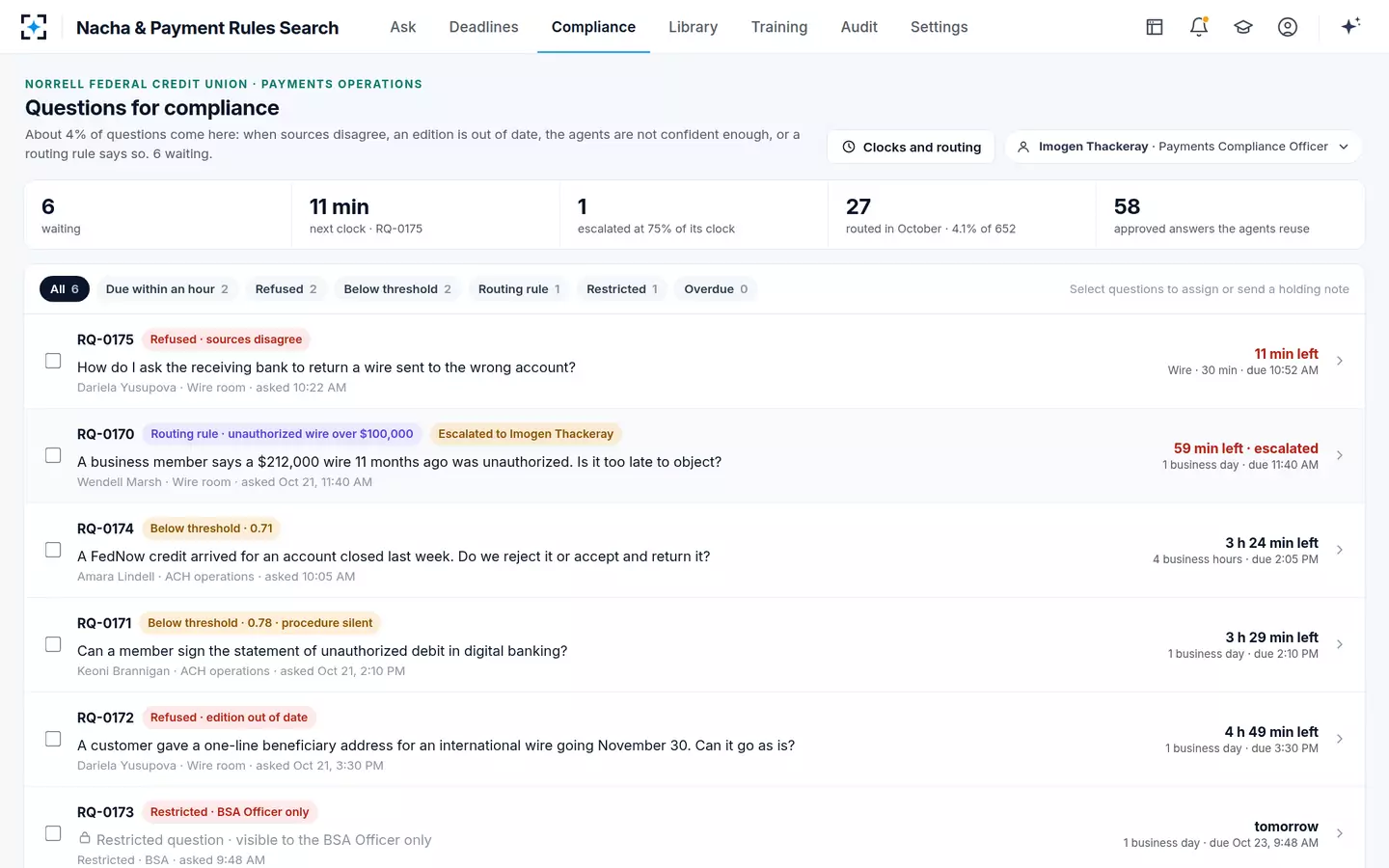
The ninth line is not a courtesy. Under FinCEN's rules a SAR is confidential, and so is anything that would reveal that one exists (31 CFR 1020.320(e); what a bank may say about a held wire shows the rule at work). A rules assistant whose open log shows a wire-room question about a report to FinCEN has disclosed something it should not. The sample credit union routes any such question to its BSA Officer only, and it never appears on a member view or in the open log.
The questions an assistant should not answer alone, each with its reason and clock
How do you evaluate an AI compliance assistant in practice?
In three passes, each on your own material. First, the library: load your licensed Nacha edition, the federal rules and circulars and your procedures, and compare the assistant's edition list with the publishers' own pages; the Reserve Banks alone issued ten new circular and procedure versions in 2026 (FRFS, Operating Circulars). Second, the replay: 150 to 200 closed questions, including date-sensitive pairs around a rule change and questions where your procedure is known to conflict with a rule. Third, a live month with a small team, every answer on the trail, every routed question reviewed by compliance.
Score the third pass on what changes for people, not only on accuracy: how many questions reached compliance and why, how many deadlines were dated, which procedures turned out to be stale, which questions new staff repeated. Those are the numbers a program owner will be asked for after go-live.
Where Nacha & Payment Rules Search fits, and where it does not
Fit, honestly: what the solution is for and what it is not
| If you need | Fit | Why |
|---|---|---|
| Cited answers to staff questions across Nacha, Reg E, Reg J, Article 4A, the circulars and your procedures | Strong | It is what the solution is built to do, with editions, citations and refusals |
| Return and wire deadlines dated on the Federal Reserve calendar | Strong | A deterministic count on the approved calendar, with your cutoffs, shown day by day |
| Keeping procedures in line with rule changes | Strong | New editions loaded with dates; dependent procedures and answers listed for approval |
| A record for the annual Nacha audit and examiners | Strong | Every question, answer, source, approval and release on an exportable trail |
| Transaction fraud monitoring | Not this | Use a monitoring system; see ACH Fraud Monitoring |
| Working Regulation E claims or return queues end to end | Partial | It answers the rule questions and drafts the return; claims and queues run elsewhere |
| Legal advice or a replacement for the licensed rulebook | Not this | It never gives legal advice, and it answers from the edition you license |
For the neighbouring work, see ACH Fraud Monitoring, Reg E Dispute Management and ACH Return & NOC Management. For what a team hands over to go live, see what you bring to go live on the Nacha 2026 operating rules.
Questions people ask
How do you cite the Nacha rules?
Name the rulebook, the edition and the provision, for example the 2026 Nacha Operating Rules with the section and the amendment date where one applies. Because the text is licensed, an internal answer should cite the institution's own copy and quote only what the licence allows; Nacha's free rule pages can be cited for effective dates and summaries.
Can an AI compliance assistant be trained on our procedures?
It does not need to be trained on them; it needs to search them as approved sources, by section, version and review date. Searching rather than training means a changed procedure takes effect when it is approved, and an outdated one can be found and refused rather than remembered.
Should an AI assistant answer member-facing questions about ACH?
Not without a person in the loop. A staff-facing assistant whose answers a specialist reads, checks and acts on is a different risk from one that speaks to members directly, where the member's rights under Regulation E are at stake and a wrong answer cannot be caught first.
What happens when the Nacha rules change after go-live?
The new edition or amendment is loaded with its effective date and is not used until the payments compliance officer approves it. Answers about items before the date keep using the old text; answers after it use the new, and the procedures and approved answers that cite the changed section are listed for review.
How much of a payments desk's work can an assistant take?
The first reading, not the decisions. At the sample credit union about 96% of a month's questions were answered by the agents with citations and 4.1% went to compliance, but every return, release, approval and interpretation stayed with a named person.