The Nacha rules, formally the Nacha Operating Rules, are the private rulebook every ACH payment in the United States runs on: who may originate an entry, when it settles, which return reason codes exist and how long a receiving bank has to use each one. The full text is licensed and sold each year, while Nacha publishes rule summaries, effective dates and FAQs free on its website. Because the rules change several times a year and sit beside Regulation E, Regulation J and the Federal Reserve Banks' operating circulars, a correct answer has to cite the right passage in the edition in force on the date that matters. Botminds' Nacha & Payment Rules Search answers payments staff's rule questions in two or three sentences, each claim tied to its passage, and this guide shows how to test it, or anything else that answers from the Nacha rules, before you trust it.
The examples below use the solution's fictional sample credit union, Norrell Federal Credit Union, and its October questions. Rule facts come from Nacha's free public pages, the Reserve Banks' operating circulars and federal regulations, each linked where it is used.
The Nacha rules in four numbers
35.2billion
ACH Network payments in 2025, worth $93 trillion, all under the Nacha rules
$110
for a 2026 edition of the Nacha Operating Rules & Guidelines at the non-member price ($75 for members)
16
approved amendments taking effect on eight dates between March 2026 and March 2028
1974
the year the rules began; Nacha says there is never a final edition
Where can you read the Nacha rules?
You read the Nacha rules in the Nacha Operating Rules & Guidelines, which Nacha sells each year in print and as an online resource, and which regional payments associations also sell to their members. The 2026 edition costs $75 for Nacha members and $110 for everyone else in either format (Nacha, Rules Your Way). Nacha's own description of who may buy is short: "Anyone can get one at the Store" (Nacha, How the ACH Rules Are Made).
The book has two halves that answer different questions. The Operating Rules are the obligations; the Operating Guidelines explain how participants apply them. A desk that keeps only the rules ends up re-deriving practice the guidelines already set out, and a desk that keeps only an old guidelines binder is reading last year's explanation of rules that may since have changed.
One wrinkle surprises people who think of the rulebook as one current text. For ACH payments the federal government sends and receives, Treasury's regulation at 31 CFR Part 210 incorporates a named edition by reference: the 2021 Operating Rules & Guidelines with Supplement #1-2021. Treasury says that "to enforce any edition other than that specified in this section", its Bureau of the Fiscal Service must publish a document in the Federal Register (31 CFR 210.3). A benefits payment and a payroll credit can arrive in the same file and be governed by different editions.
Are the Nacha rules free? What is public and what is licensed
The Nacha rules are not free, but a great deal about them is. Nacha publishes every approved rule change on a page of its own, displayed by effective date, usually with a details section, the technical sections of the rulebook it changes, an impact assessment and FAQs (Nacha, New Rules). A request for comment can reproduce the proposed wording in full, as the 2026 request on the definition of Banking Day does. What stays behind the licence is the consolidated text: the articles, the return reason code tables and the guidelines.
What a payments desk can read free, and what it has to license
| Source | What it gives you | Public or licensed |
|---|---|---|
| Nacha New Rules and rule pages | Each approved change with its effective date, the rule sections it touches, an impact note and FAQs | Public |
| Nacha Proposed Rules | Requests for comment, often with the proposed wording and a proposed effective date | Public |
| Nacha risk and compliance pages | The audit deadline, attestation requests, enforcement process and the annual compliance snapshot | Public |
| Nacha Operating Rules & Guidelines | The consolidated rule text, the return reason code tables, the guidelines | Licensed, $75 or $110 a year |
| Reserve Banks' Operating Circular 4 | How FedACH applies the Nacha rules, and where the circular overrides them | Public |
| Regulation E, Regulation J, Article 4A | Consumer rights on ACH debits; Fedwire and FedNow law | Public |
The public pages are good enough to tell you that something changed and when. They are not enough to answer most operational questions, because the answer usually turns on a defined term or a timing provision in the consolidated text. That is why Nacha & Payment Rules Search keeps the licensed edition the institution owns in its library, and shows rule passages as approved summaries rather than reproducing the rulebook: the source is cited, the text stays where the licence puts it.
Why a Nacha rules answer has four parts, not one
A defensible answer to a Nacha rules question states four things: the rule, the edition that contains it, the date that edition applies to, and the facts that make the rule apply. Drop any one and the answer can be correct in general and wrong for the item in front of you.
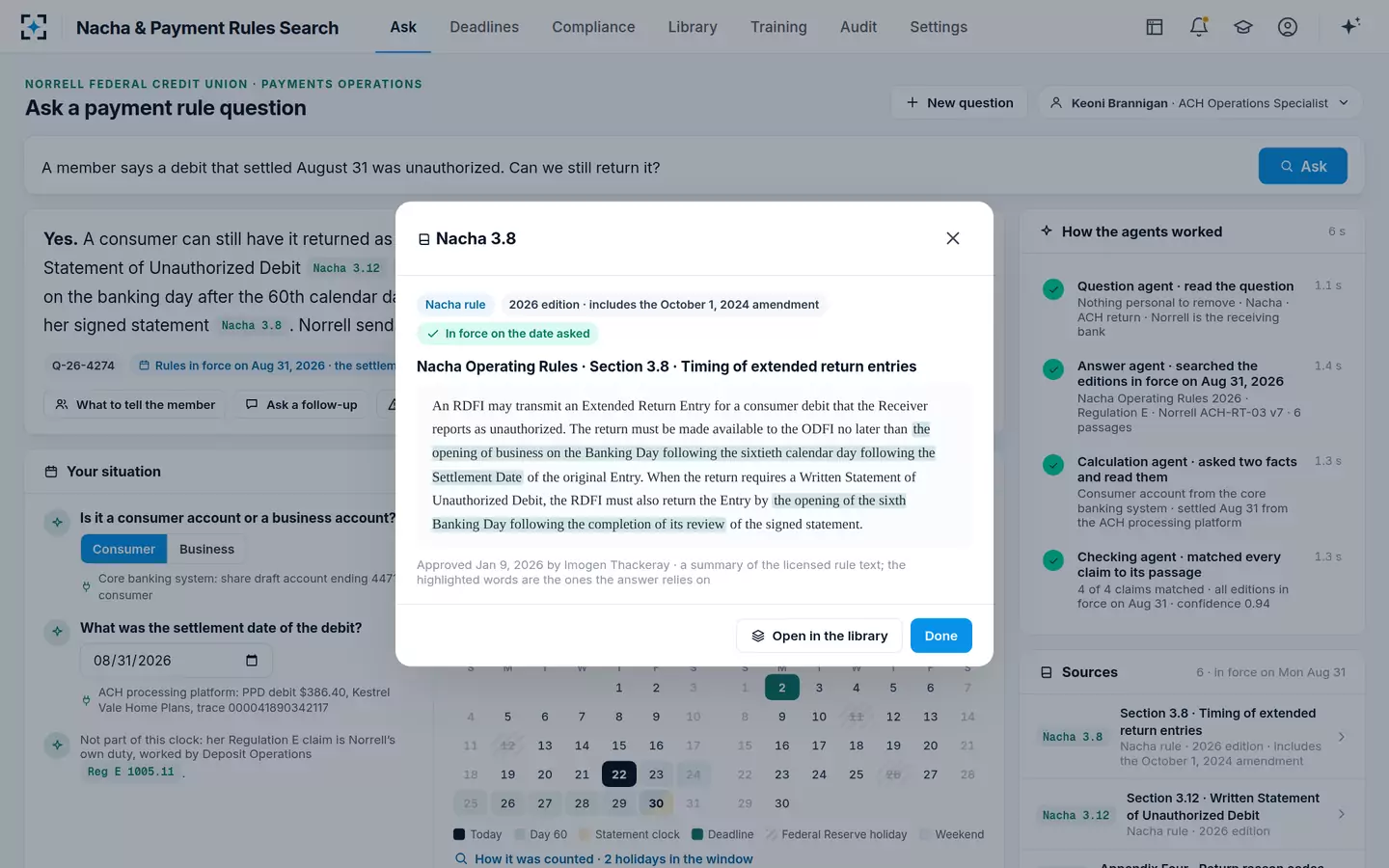
Take the question Norrell's ACH operations specialist asks in the solution's sample: a member says a debit that settled on Monday, August 31 was never authorized; can the credit union still return it? The rule is the extended return for an unauthorized consumer debit. The edition is the one in force on the settlement date. The facts are whether the account is a consumer account and when the entry settled. Change the member's story from "I never authorized this company" to "I authorized it, but not for this amount" and the return reason changes from R10 to R11, which lets the originator correct the error and send a new entry without a new authorization. The rule did not change; a fact did.
The date matters as much as the facts, because Nacha amends timing rules in the middle of a year. Since October 1, 2024, an unauthorized consumer debit returned in the extended timeframe must also go back by the opening of the sixth banking day after the bank finishes reviewing the customer's signed statement (Nacha, Risk Management Topics, October 1, 2024; the ACH return time frame quotes the rule). An answer drawn from a 2023 summary gives one clock where there are now two. The questions an answer to the 60-day rule has to ask first walks through both clocks on that same debit.
How do you test a Nacha rules assistant? Replay questions you already closed
The fairest test of a Nacha rules assistant is a replay: take questions your team answered in the past year, whose answers compliance has already settled, and ask them again. The assistant has never seen your answers, the ground truth is yours rather than the vendor's, and the questions are in your staff's own words, with the gaps and shorthand real questions have.
Building the set takes an afternoon, not a project. Pull 150 to 200 closed questions from email, the compliance mailbox and helpline notes. Remove member names and account numbers. For each, write down the settled answer, the source the answer rested on, the edition and the date that mattered, and whether a fact had to be asked. Keep the questions where the first answer given turned out to be wrong: they are the ones the test exists for.
Then set the pass marks before the first run. A test whose threshold is chosen after seeing the scores measures the evaluator's optimism. Decide in advance which errors are disqualifying (a wrong deadline, a cited passage that does not support the claim) and which only cost points (a correct answer that asked one question more than it needed).
Build the test set from where your questions actually land
A replay set should mirror the mix of questions your staff ask, not the mix a demo shows. In the solution's sample month, most questions touch the Nacha rules, but more than a third of the source citations go to Regulation J, Article 4A and the Fedwire and FedNow circulars. A test drawn only from ACH returns would miss the questions where a procedure is most likely to be out of date.
Where one month of rule questions lands, by the source each answer cited
Weight the replay the same way. If 60% of real questions touch ACH returns and NOCs, 60% of the test should too; if wire questions are rarer but carry larger amounts, oversample them and score them separately. A single headline accuracy number across a mixed set hides exactly the category you were worried about.
Include questions with no good answer. A replay set without them rewards a tool that always answers. At Norrell, 27 of October's 652 questions went to the Payments Compliance Officer instead of being answered, and the reasons are worth copying into a test design.
Why one month's routed questions were not answered by the agents
27 routed questions
- Refused: sources disagree or edition out of date (9) · 33%
- Below the confidence threshold (11) · 41%
- Routing rule, such as an unauthorized wire over $100,000 (5) · 19%
- Restricted to the BSA Officer (2) · 7%
Score the answer, the edition and the question it should have asked
Score each replayed question on more than its conclusion. A yes that cites the wrong passage is a lucky guess, and a tool that is lucky 90% of the time will be unlucky on an item worth recovering. The checklist below is the scoring sheet we would use; each line can be marked by a compliance analyst in under a minute per question.
A scoring sheet for one replayed Nacha rules question
- The conclusion matches the settled answer
Yes or no, return or not, which code. Score it last, so the reviewer reads the reasoning first.
- Every claim cites a passage that actually supports it
Open each citation. A real section that says something else is worse than no citation.
- The edition cited was in force on the date that matters
The settlement date for a return, the payment date for a wire, the date asked for a procedure.
- It asked for the fact the question left out
Consumer or business, settlement date, SEC code, which network. Count a guess as a miss even when it guessed right.
- The deadline is dated and the counting is shown
Calendar days, banking days, which holidays fell in the window, and the institution's own file cutoff.
- It refused when your procedure and the rule disagree
And said what both sources agree on, and what is safe to do while compliance decides.
- Nothing that identifies the member was kept
Names and account numbers removed before the question is stored.
What a passing answer looks like: the passage behind the citation, its edition and its approver
The failure that matters most: the right rule on the wrong date
The most damaging error in a Nacha rules answer is not an invented rule; it is a real rule applied on a date it was not in force. It survives review because it reads correctly, and it is precisely what a model trained on last year's text, or a colleague with last year's binder, produces.
Three changes from the last two years show how it happens. On January 1, 2026, Nacha removed the reference to the receiving institution from the definition of Banking Day, so that a banking day in the rules is a day the ACH Network, and so the ACH Operator, is open; Nacha's reason was that the old wording left institutions with their own holiday closures unsure whose banking day set their return and NOC deadlines (Nacha, Minor Topics Rule Changes; the banking day definition quotes both). A credit union that closes on a day the ACH Operator is open now counts that day.
On September 18, 2026, the funds availability rule for non-Same Day ACH credits dropped its 5:00 p.m. receipt condition, so funds are due at 9:00 a.m. local time on the settlement date for all of them (Nacha, New Rules). And a new return reason code for sanctions, R90, is approved but not effective until March 17, 2028. An assistant that has read Nacha's new-rules page without checking the dates will cheerfully suggest a code no ACH Operator accepts yet. The full calendar of Nacha rule changes to 2028 lays out every date a replay set should straddle.
So put date-sensitive pairs in the test: the same question asked about an item before and after a change. A tool that gives the same answer to both has not understood that rules have editions.
Where a good assistant refuses, and why that should score as a pass
A replay should reward a refusal when the sources genuinely disagree. If a credit union's own wire procedure still tells staff to send a message format the network has retired, the right answer is neither the procedure nor a confident paraphrase of the network rule. It is: these two disagree, here is what both say, here is what is safe now, and compliance owns the decision.
A refusal that a replay should score as correct
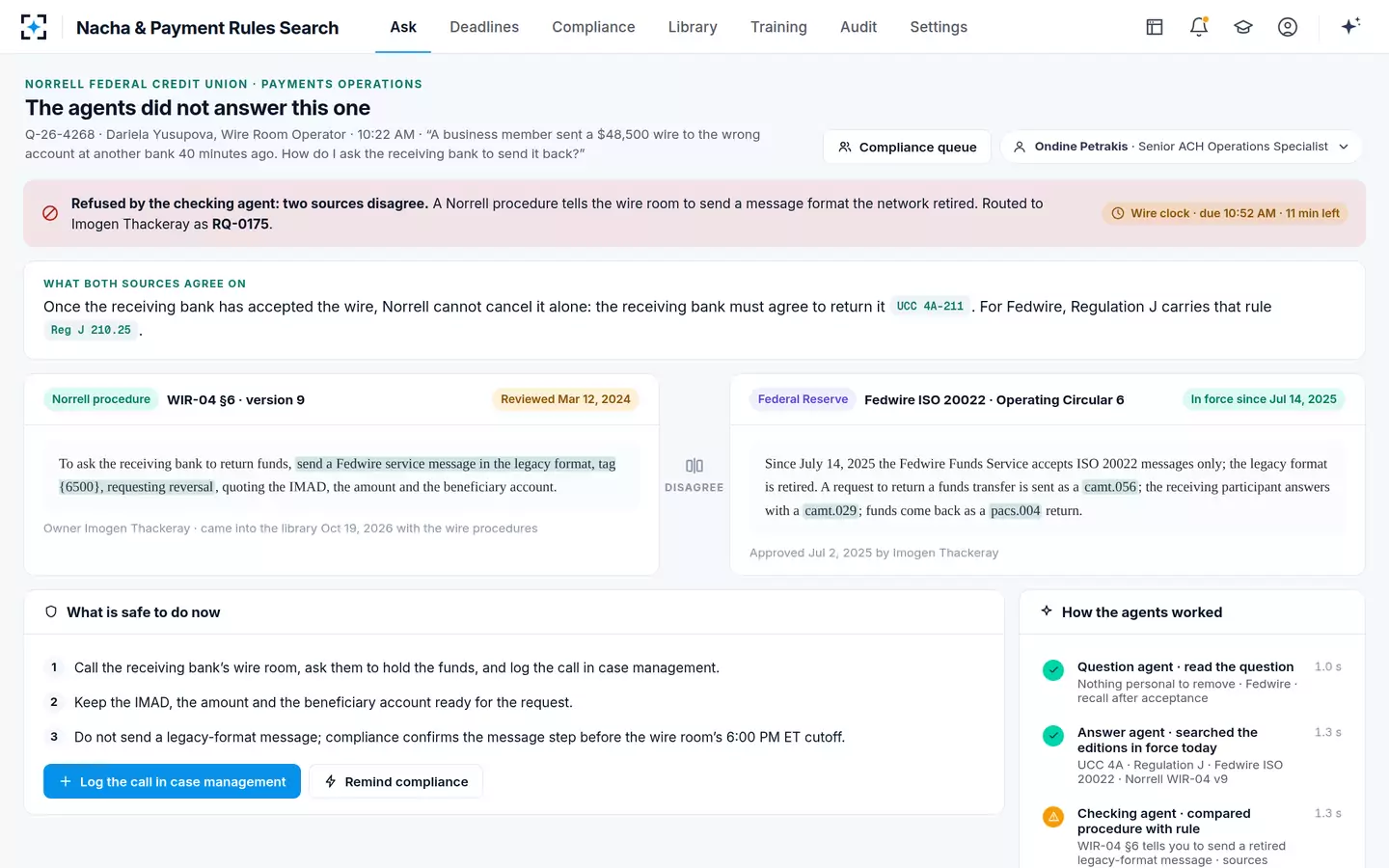
Score the refusal on three things: did it name the conflict correctly, did it say what is safe while the question waits, and did the question reach a person with enough time left to act. A refusal with no safe next step leaves the operator exactly where a wrong answer would, minus the risk.
What a replay test cannot tell you
A replay measures answers to questions someone already thought to ask. It cannot measure the question nobody asked because everyone assumed the old procedure was right, and that is where the expensive errors live. Pair the replay with a check on the library itself: every rulebook, circular and procedure the assistant may use, with its edition, effective date and approver, compared with the publishers' own lists. The Reserve Banks re-issued Operating Circulars 4 and 6 effective January 5, 2026 and Operating Circular 8 for FedNow effective April 1, 2026 (Federal Reserve Financial Services, Operating Circulars); a library that still holds the earlier editions will pass a replay of last year's questions and fail this year's.
It also cannot tell you who is accountable. The FFIEC's examiners note that an institution that breaks the Nacha rules exposes itself to contractual liability and fines (FFIEC, Retail Payment Systems booklet), and that exposure does not move to a vendor. A replay tells you whether the tool deserves to be the first reader of the rulebook. Who signs the answer is a design decision, and what to demand of an AI compliance assistant covers it.
Re-run the replay after every edition change. The design target in Nacha & Payment Rules Search is zero answers given when two sources disagree or an edition is out of date; a target is a promise to measure, and the replay is how you measure it on your own questions.
Questions people ask
Are the Nacha rules free?
No. The Nacha Operating Rules & Guidelines are sold each year; the 2026 edition is $75 for Nacha members and $110 for others, in print or online. Nacha publishes each approved rule change, proposed rules and its compliance and audit pages free, which is enough to track what changes and when, but not the consolidated text.
Where can I find the Nacha rules online?
Nacha sells an online edition of the Operating Rules & Guidelines alongside the print book, and payments associations sell both to their members. The free rule-change pages on nacha.org list every approved amendment by effective date, with the sections of the rules each one changes.
What edition of the Nacha rules is current?
The 2026 Nacha Operating Rules & Guidelines, as amended by changes that took effect during 2026 on March 20, June 22 (in practice), July 24 and September 18. Federal government ACH entries are an exception: 31 CFR Part 210 still incorporates the 2021 edition, with its own listed exceptions.
Can AI cite the Nacha rules?
It can cite the passages of an edition the institution has licensed and loaded, and it should show the cited words, the edition and its effective date. A general chat tool that has not been given the licensed text can only paraphrase public summaries, and cannot show the passage it relied on.
How accurate are AI answers on payment rules?
We found no regulator or independent study that measures AI accuracy on payment-rule questions. The only number worth trusting is the one you measure on your own closed questions, scored on the rule, the edition, the date and the facts asked, and re-measured after each edition change.
How often do the Nacha rules change?
Several times a year. Sixteen approved amendments take effect on eight dates between March 2026 and March 2028, and Nacha's own description is that the rules have been "a living document" since 1974, with "never a 'final edition'".