The ACH return time frame is the deadline by which a receiving bank's return must reach the originating bank. For most returns, such as insufficient funds or a closed account, it is the opening of business on the second banking day after the entry settled. For a consumer's claim that a debit was unauthorized, revoked or not as authorized, the bank may return it until the opening of business on the banking day after the 60th calendar day from settlement, but only with the customer's signed written statement of unauthorized debit. Business accounts get the two days, not the sixty. These clocks are hard to run because they count different kinds of days from different starting points, and because Regulation E runs a separate 60 days for the customer. Botminds' ACH Returns & NOC Management sorts every return, claim and correction by the clock it actually runs on, so the item due today is never behind one due next month.
Worked dates come from a fictional sample bank, Tessaly Community Bank, in October and November 2026. The rules are quoted from Nacha's public rule pages, Regulation E and the Federal Reserve, linked where they appear.
The ACH return time frame in four numbers
2banking days
most returns, and every business-account unauthorized return, after settlement
60calendar days
consumer unauthorized debits with a signed statement; due by the next banking day’s opening
6banking days
to send that extended return once the bank has finished reviewing the statement
5banking days
for an originator’s reversal of an erroneous entry, after its settlement
How long does a bank have to return an ACH?
Two banking days for most entries: the return must be available to the originating bank by the opening of business on the second banking day after the settlement date. Nacha put it in exact words when it explained the timeframe for R17 returns in 2024: the RDFI "must transmit the return in such time that it is made available to the ODFI no later than the opening of business on the second banking day after the settlement date of the original entry" (Nacha, Risk Management Topics 2024). The FFIEC's examiners' handbook says the same for any properly authorized entry (FFIEC, Retail Payment Systems).
That covers insufficient funds (R01), closed accounts (R02), unknown or invalid account numbers (R03, R04), frozen accounts, stop payments and most other codes, and returns of suspected fraud under R17. It also covers a business account holder's claim that a corporate debit was unauthorized, which goes back as R29. The longer window is reserved for consumers, and it has conditions.
Each return clock, measured from the day the entry settled
When does the ACH return clock start, and what is a banking day?
The clock starts on the settlement date of the original entry, the day money moved between the two banks, not the day the customer saw it or the day the core posted it. It counts banking days for the two-day window and calendar days for the 60-day window. Nacha defines a banking day in its licensed rules; in practice the days on which FedACH settles follow the Federal Reserve's holiday schedule, which for 2026 included Columbus Day on October 12, Veterans Day on November 11 and Thanksgiving on November 26 (Federal Reserve Financial Services, Holiday Schedules).
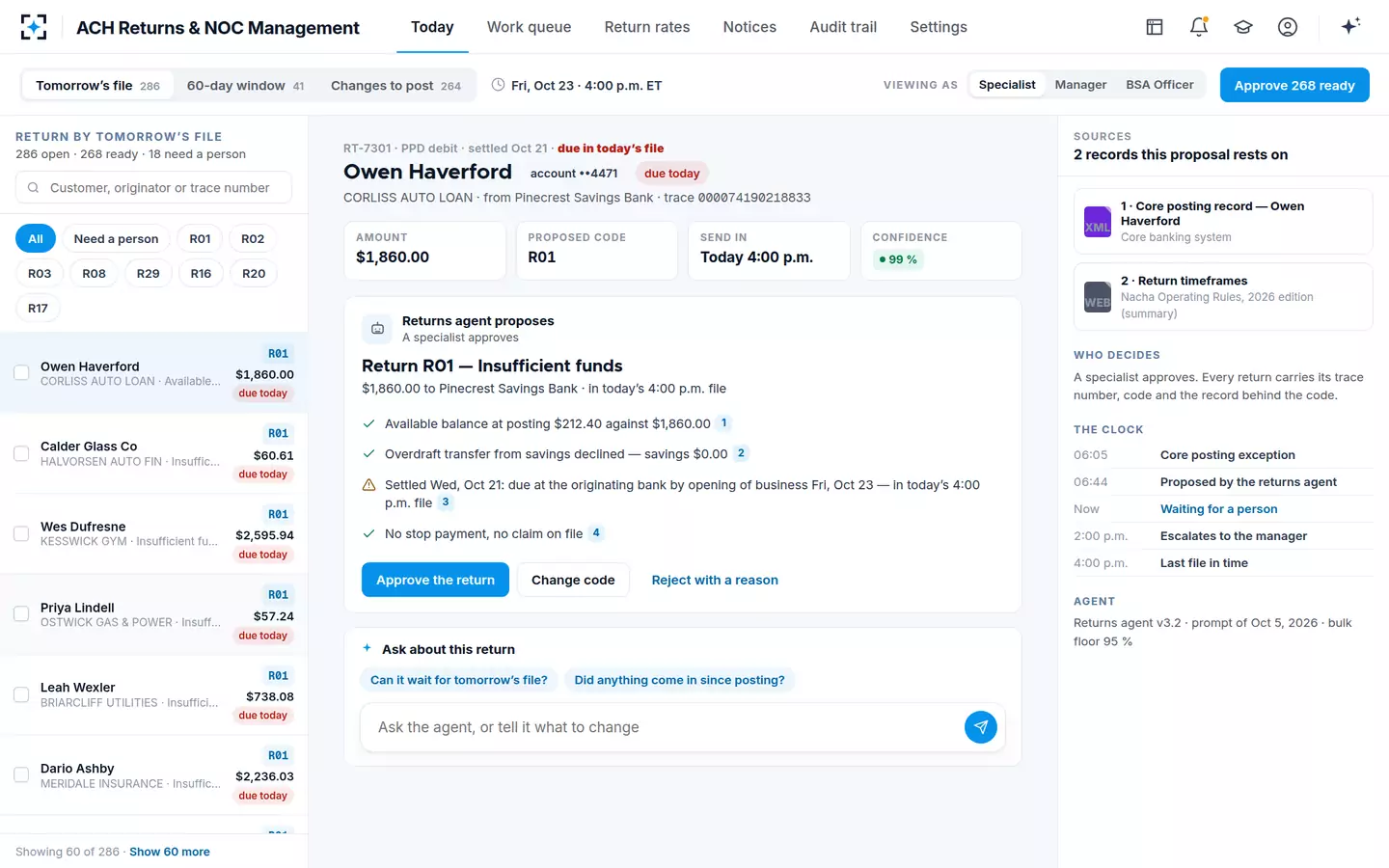
Being "made available to the ODFI no later than the opening of business" means the return has to be through the operator before the ODFI opens. At the sample bank, Owen Haverford's $1,860.00 PPD debit settled on Wednesday, October 21, and came back for insufficient funds. Thursday, October 22, was the first banking day after settlement and Friday, October 23, the second, so the return had to be available to the originating bank by the opening of business on Friday. The bank put it in Thursday's 4:00 p.m. file; FedACH's last same-day window for electronic returns that day closed at 4:45 p.m. ET (FedACH Processing Schedule).
Regulation E uses a different unit for its own deadlines: the business day, any day the consumer's bank is open to the public for substantially all of its business (12 CFR 1005.2(d)), the count the Regulation E error-resolution calculator runs on. A bank open on Saturdays can have business days that are not banking days for ACH, which is one more reason the two sets of clocks should not share a spreadsheet column.
What is the 60-day ACH return rule?
The 60-day rule lets a receiving bank return a consumer's debit that the customer says was unauthorized, revoked or not in accordance with its authorization, up to the opening of business on the banking day following the 60th calendar day after settlement, provided the customer has signed a written statement of unauthorized debit. Nacha's warranty-rule FAQ confirms both halves: the return has to be in the ODFI's hands by that opening of business, and it needs the signed statement (Nacha, Limitation on Warranty Claims). The Nacha 60-day return rule quotes Nacha's wording of the deadline and counts it on a real calendar.
The codes that use it are the consumer unauthorized codes: R10 when the customer does not know or never authorized the originator, R11 when an authorized debit broke the authorization's terms, which Nacha moved from a two-day to a "60-day return timeframe" in 2020, and R07 when the customer had revoked the authorization (Nacha, Differentiating Unauthorized Return Reasons). It does not cover a customer's dispute about the goods or services, which stays with the merchant.
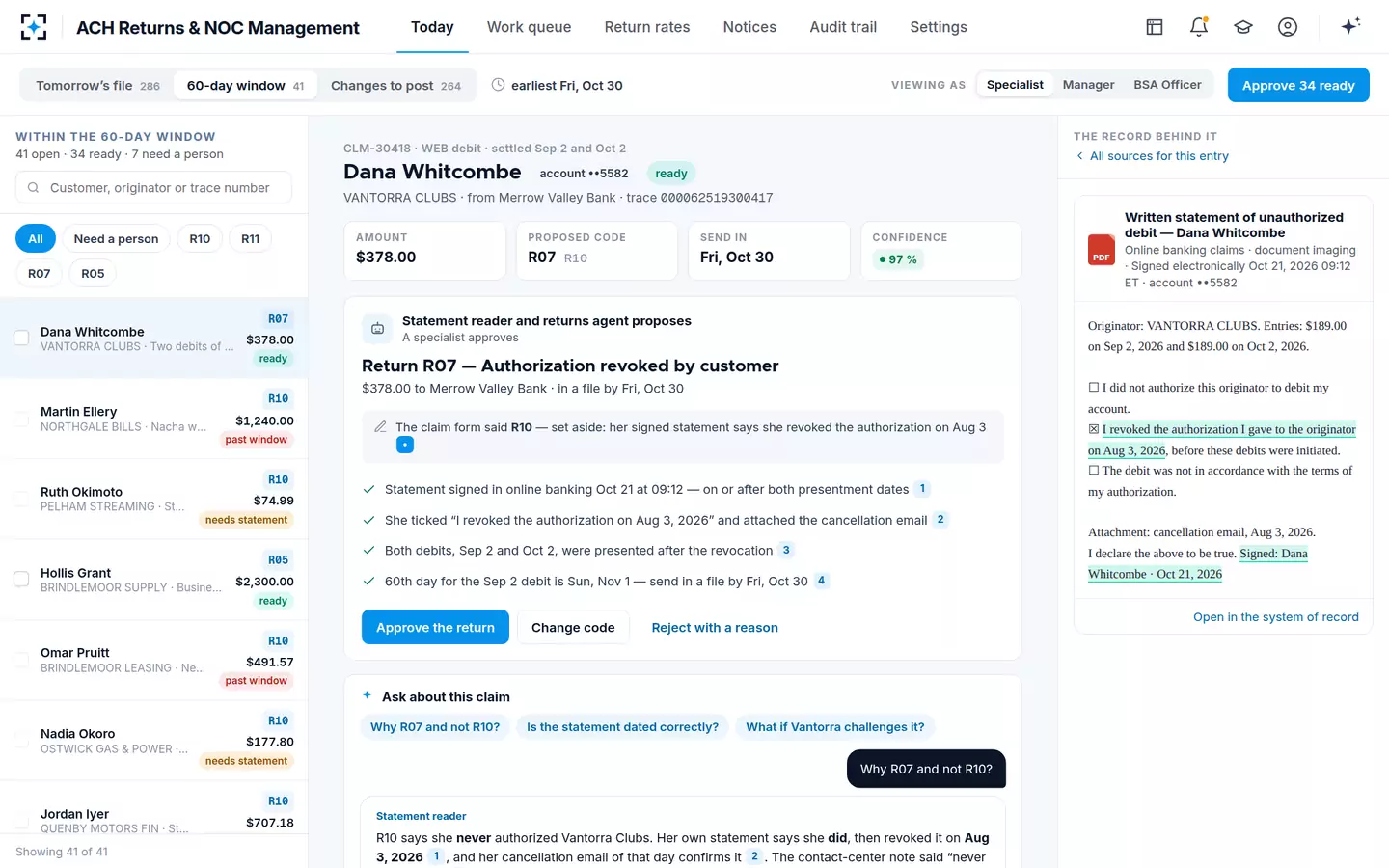
Counting it on the sample claim: Dana Whitcombe's first $189.00 debit settled on Wednesday, September 2. The 60th calendar day was Sunday, November 1; the banking day following it was Monday, November 2, so the return had to be available by Monday's opening of business. The bank set Friday, October 30, as its last file for the claim, which leaves the weekend as margin rather than risk.
The 60th day, counted on the claim in ACH Returns & NOC Management
Does the 60-day rule apply to business accounts?
No. A business account holder's unauthorized claim on a corporate debit goes back as R29 on the two-banking-day timeframe. Nacha's FAQ is explicit: an RDFI returning an unauthorized debit to a non-consumer account "must transmit the return in such time and manner that the return entry is made available to the ODFI no later than the opening of business on the second banking day following the settlement date of the entry" (Nacha, Limitation on Warranty Claims).
The practical effect is that a business customer who notices an unauthorized debit on Monday about an entry that settled the Friday before has, at most, until Tuesday's opening of business for the bank to get it back through the network. After that, the bank's route is a claim against the ODFI's warranty, which for a non-consumer account runs one year from settlement and is not guaranteed to succeed. Regulation E does not cover business accounts, so neither its notice period nor its provisional credit applies.
Six banking days after the review: the clock inside the 60
Since October 2024 the 60 days are a ceiling, not a target. Nacha added a rule that the extended return must go promptly once the bank has the customer's statement and has looked at it.
“When returning a consumer debit as unauthorized in the extended return timeframe, the RDFI must do so by the opening of the sixth Banking Day following the completion of its review of the consumer’s signed WSUD.”
Nacha, Risk Management Topics, effective October 1, 2024
Nacha's reasons are about recovery: "The prompt return of an unauthorized debit alerts an ODFI and an Originator to a potential problem," including first-party fraud where the person disputing the debit benefited from it. For operations the rule creates a second date on every claim. The 60th-day deadline still caps it; the review-complete date plus six banking days now usually comes first. A claim that sits signed but unreviewed does not start that clock; the 60th day still runs.
The same 2024 package moved the other end of the claim. A customer may now sign the statement once the debit has been presented to them, whether it has posted or only shows as pending, so a bank with alerts can take the statement before the debit even posts. The written statement of unauthorized debit, element by element sets out what that statement must contain.
What is the difference between an ACH return and a reversal?
A return is the receiving bank's: it sends an entry back, with a reason code, inside the return time frame. A reversal is the originator's: it sends a new entry that undoes its own erroneous one. Nacha limits reversals to specific errors, a duplicate, the wrong receiver, the wrong amount or, since 2021, the wrong date, and to a short window: "An Originator or ODFI must still transmit a Reversal in such time that it is made available to the RDFI within 5 banking days following the Settlement Date of the Erroneous Entry" (Nacha, Reversals and Enforcement).
The two clocks meet when a reversal is improper. Nacha lets the receiving bank send it back: an improper reversal to a consumer account as R11 within the 60-day extended timeframe with the customer's statement, and one to a business account, or one the bank spots itself, as R17 within two banking days. Failure to fund a credit file is not a permitted reason to reverse, a misuse Nacha singled out when it wrote the 2021 rule.
The clocks around the return window
A return deadline rarely runs alone. The table below lists the clocks that touch an ACH return, who owns each and where it is written. Several sit in the licensed Nacha Operating Rules; where Nacha has not published the count, the table says so instead of guessing.
Seven clocks that touch an ACH return, and where each is written
| Clock | Runs from | Length | Source |
|---|---|---|---|
| Standard return | Settlement date | Opening of business, second banking day | Nacha public rule pages |
| Extended consumer return | Settlement date | Opening of business, banking day after the 60th calendar day | Nacha public rule pages |
| Prompt extended return | Bank completes its review of the signed statement | Opening of the sixth banking day | Nacha, effective October 1, 2024 |
| Customer’s notice of error | Bank sends the periodic statement showing the debit | 60 days | Regulation E, 12 CFR 1005.11(b) |
| Bank’s Regulation E investigation | Bank receives the notice of error | 10 business days, or up to 45 days with provisional credit | Regulation E, 12 CFR 1005.11(c) |
| ODFI request for return (R06), proof of authorization | Receipt of the request | RDFI answers an R06 request within 10 banking days; ODFI provides proof or agrees to a return within 10 banking days | Nacha 2024 and 2021 rule pages |
| Originator’s correction after a notification of change | Receipt of the correction | Six banking days, or before its next entry if that is later, in most cases | Nacha, RMAG Originator Essentials (2024) |
| Dishonor, contest; the ODFI passing a correction to its originator | Receipt of the return or correction | Fixed counts in the licensed Nacha Operating Rules | Not published by Nacha; not stated here |
The Regulation E row is the one that catches teams out. The customer's 60 days run from the statement, not from settlement, so they end later than the network's, and a customer can be inside Regulation E after the bank's right to return has gone. What a missed return window costs follows that gap to its loss.
Every clock on one tray in ACH Returns & NOC Management
The solution computes each item's deadline from its own settlement date, its return code and the Reserve Bank calendar, and sorts the work into three trays: returns due in tomorrow's file, consumer claims inside the 60-day window, and notifications of change to post. Items due in today's file sit at the top and escalate to the ACH operations manager at 2:00 p.m. if they are still open; anything past its window goes to the manager as a loss decision, never into the batch.
Due today, at the top, with its clock
The rule passages behind each clock are summaries of the Nacha Operating Rules, because the rule text is licensed, and each clock is a setting the bank's ACH operations manager approves when the rules change. The solution as a whole is at ACH Returns & NOC Management.
Questions people ask
How long can an ACH be returned?
Two banking days after settlement for most entries and for business accounts; up to the banking day after the 60th calendar day for a consumer's unauthorized, revoked or not-as-authorized debit with a signed statement. After that, recovery depends on the originating bank agreeing to accept a late return or on a warranty claim.
What is the time frame for an unauthorized ACH return?
For a consumer account, 60 calendar days from settlement, available to the ODFI by the opening of the next banking day, and since October 2024 no later than the sixth banking day after the bank completes its review of the signed statement. For a business account, two banking days, using R29.
Do weekends count in the ACH return time frame?
Not for the two-day window, which counts banking days, so a debit settling on a Friday is due by the opening of business on Tuesday unless Monday is a holiday. The 60-day window counts calendar days, weekends included, but its deadline moves to the next banking day's opening.
Can a Same Day ACH entry be returned the same day?
Yes. The Federal Reserve's ACH circular says "a receiving bank may return a same day item on the day the receiving bank received the item," and FedACH settles electronic returns sent by its 10:30 a.m., 2:45 p.m. and 4:45 p.m. ET deadlines the same day (Operating Circular 4).
Can a customer dispute an ACH debit after 60 days?
Under Regulation E a consumer has 60 days from the statement showing the debit, which can end later than the network's 60 days from settlement. A dispute inside Regulation E but outside the network window leaves the bank owing the customer without an automatic way to return the debit.