ACH returns are the entries a receiving bank sends back because it cannot post them or because its customer disputes them, and for an operations team they arrive every morning as one long exception report. Behind that report are eleven distinct tasks, from reading the overnight files to deciding whether to restrict an originator, each with its own clock and its own owner. Some are pure reading and arithmetic that an agent can do whole; some need a person's signature on an agent's preparation; two should stay with people however good the software gets. Botminds' ACH Returns & NOC Management is built on that split: agents read, sort, propose and cite, and specialists and managers approve. This guide lays out the eleven, so a bank can judge any ACH returns software against them.
The examples come from a fictional sample bank, Tessaly Community Bank, as it runs through the solution on Thursday, October 22, 2026. Its hours figures are Botminds' estimates for one specialist at the sample bank's design volume, not measurements at a customer.
One morning's ACH returns at the sample bank
286
returns for tomorrow’s file, $412,880.47, seven of them due in today’s file
268of 286
proposed at 95% confidence or more and inside their window, ready to approve at once
18
that need a person: 11 waiting for the 2:00 p.m. overdraft sweep, 4 business claims, 3 suspected-fraud returns
What are ACH returns, and why do they arrive as an exception report?
An ACH return is an entry the RDFI sends back to the ODFI with a return reason code, either because the entry could not post or because the account holder says it was not authorized. The first kind comes from the core: overnight, every entry that hit a closed account, an empty balance or an account number that does not exist lands on the posting exceptions report. The second kind comes from customers, who can dispute a consumer debit for up to 60 days after settlement with a signed statement.
The exception report is the core's view, not the rule's. It lists items in the order the posting run met them, usually by account or by batch. Nothing on it says which item must be in today's 4:00 p.m. file and which can wait for a customer's statement, and nothing on it links today's claim to the notification of change the bank received on the same originator last week. The report is where the work starts; it is not a plan for the work.
Most of what lands on it is routine. A Federal Reserve study of 2006 FedACH data found that "insufficient funds account for about 70 percent of all returned items" of consumer debits, with administrative problems next at 10 to 15 percent (Armantier et al., Federal Reserve Bank of Minneapolis, 2010). The routine items are where an agent's speed pays. The rest are where its care has to.
The eleven tasks in one returns morning
Written out, the morning has eleven tasks, and each can be judged on two questions: does it need judgment the rules do not settle, and does it move money or bind the bank? Where both answers are no, an agent can do it whole. Where either is yes, a person signs.
Eleven tasks behind the ACH exception report, and who should hold each
| Task | What it involves | Who holds it |
|---|---|---|
| 1. Read the overnight files | Return and correction files from the ACH operator, the core’s posting exceptions, new claims | Agent, whole |
| 2. Sort by deadline | Due in today’s file, due in tomorrow’s, inside the 60-day window, past it | Agent, whole |
| 3. Check each entry | Balance at posting, account status, stop payments, earlier claims, overdraft sweeps | Agent prepares; cited |
| 4. Choose the return code | R01, R02, R03 and the rest for posting exceptions; the code the evidence supports for claims | Agent proposes; specialist approves |
| 5. Read the signed statement | Box ticked, date signed, entries named, attachments | Agent prepares; specialist decides |
| 6. Post and pass on corrections | Match each notification of change to the entry sent, update the template, tell the originator | Agent prepares; a second person for routing changes |
| 7. Test returns received | Late, duplicate or malformed returns on entries the bank sent | Agent proposes; manager decides a dishonor |
| 8. Measure originator rates | Unauthorized, administrative and overall over 60 days, with returns still to come | Agent, whole |
| 9. Draft letters and replies | Returned-item notices, claim letters, Nacha inquiry replies | Agent drafts; a person signs and sends |
| 10. Restrict an originator | Holds, caps, suspension of a channel or a client | People only, two signatures |
| 11. Decide a late claim | Credit the customer, ask for a late return or indemnity, book the loss | People only, the manager |
Can ACH returns be automated?
Yes, in part: the reading, sorting, measuring and evidence-gathering can be automated end to end, while the decisions that bind the bank should stay with a person who sees the agent's working. Four of the eleven tasks fit the first description. Reading the files and sorting by deadline is mechanical once the rules are written down. Return rates are arithmetic over the bank's own returns and originations. Assembling the evidence for the examiner or the annual Rules compliance audit is retrieval.
Those four are also where people lose the most time for the least judgment. In Botminds' estimate for the sample bank, working the exception report one code at a time takes three of a specialist's 7.5 working hours, and building return-rate reports and inquiry answers another hour. With the solution preparing them, the same specialist spends about 1.6 hours on the whole list, most of it on the items that need her.
One specialist's day on ACH returns, by hand and with agents preparing (Botminds estimate)
By hand · 7.5 hours
- Exception report, one code at a time · 40%
- Signed statements · 20%
- Corrections · 13%
- Return rates and inquiries · 13%
- Late and duplicate checks · 7%
- Evidence · 7%
With agents preparing · 1.6 hours
- Exception report · 31%
- Signed statements · 25%
- Corrections · 13%
- Return rates and inquiries · 19%
- Late and duplicate checks · 6%
- Evidence · 6%
The shares shift as well as the totals. By hand, the exception report swallows the day. With agents preparing, the signed statements take a quarter of the remaining time, because that is the work where a person's reading still decides the outcome.
Who decides the ACH return reason code?
The RDFI decides, and inside the RDFI a specialist should approve every code; an agent can propose it, with the evidence, and should defer below a confidence the bank sets. For a posting exception the evidence is in the core and the proposal is rarely in doubt. For a claim it is in the customer's own words, and the choice matters to the originator. Under Nacha's rules an R11 lets the originator fix the error and send a new entry without a new authorization, while an R10 tells it the customer never authorized the debit at all (Nacha, Differentiating Unauthorized Return Reasons).
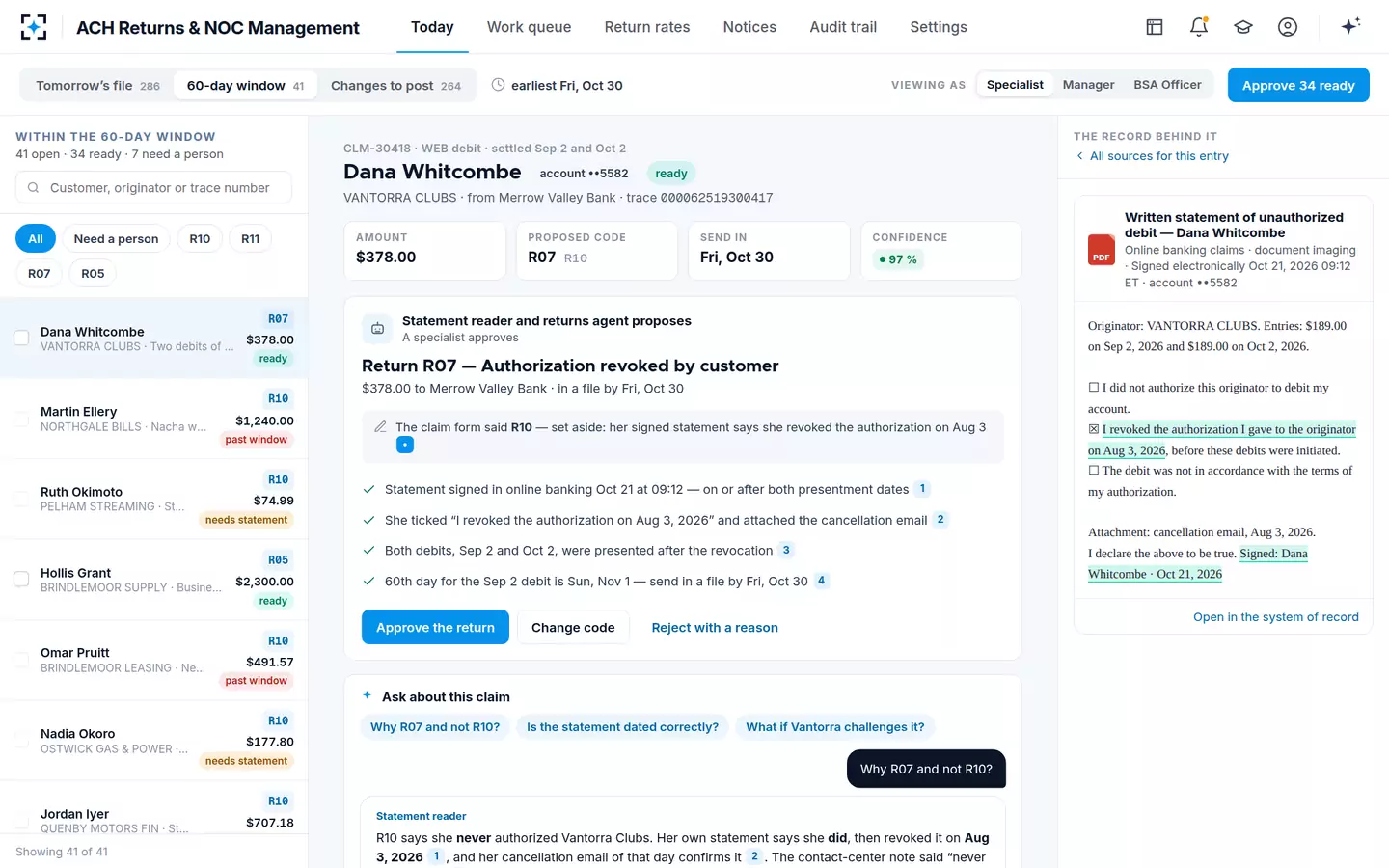
At the sample bank, Dana Whitcombe's claim form said R10 for two $189.00 WEB debits from VANTORRA CLUBS. Her signed statement said she had revoked the authorization on August 3, and she attached her cancellation email. The agent proposed R07, authorization revoked, set the claim form aside, and showed the box she ticked.
The code comes from the customer's statement, not from the claim form
What is a notification of change, and why is it the forgotten task?
A notification of change is a message from the RDFI telling the ODFI that an entry carried wrong or outdated account data, such as the account number, the routing number or the account type, and giving the corrected value. It carries no money: the Federal Reserve's ACH operating circular lists a "notification of change" among the "nonvalue" messages (Operating Circular 4, 2026). The Treasury's guide for federal ACH payments describes it as "the name for Nacha's Standard Entry Class (SEC) code COR," and lists change codes such as C01 for an incorrect account number, C02 for an incorrect routing number and C05 for an incorrect transaction code (Treasury, Green Book, chapter 6).
It is forgotten because nothing bounces: no money comes back, so no settlement difference forces anyone to look. The ODFI must pass the correction to its originator within a deadline set in the licensed Nacha Operating Rules, and the originator then has its own. Nacha's free guide for originators states it: "In most cases, the Originator must make the requested changes within six banking days or prior to initiating another Entry, whichever is later" (Nacha, RMAG Originator Essentials, 2024). When either step is missed, the next entry goes out with the old data and comes back as a return or another correction. The one exception Nacha has widened is the one-time payment: its 2024 minor rules give originators discretion "to make NOC changes for any Single Entry, regardless of SEC Code" (Nacha, Minor Rules Topics 2024). For recurring debits, the correction is the originator's to make.
The useful automation is not posting the correction, which most ACH platforms already do. It is the follow-through: matching each correction to the entry sent, refusing a correction whose new data is wrong, and checking later files for originators still sending to the old account. The Federal Reserve's FedACH tools allow several corrections on one forward item and a refused notification as its own message type, which tells you how often both happen (Federal Reserve Financial Services).
What should ACH returns software do? Seven tests
Good ACH returns software orders the work by the rule's clock, shows its evidence for every proposal, and cannot send a return on its own. The seven tests below separate tools that speed up the exception report from tools that change how the work is controlled; any bank evaluating ACH returns automation, ours included, should run them on a sample of its own past returns.
Seven tests for ACH returns software, run on your own past returns
- It sorts by deadline, not by the core’s print order
Items due in today’s file come first, and the deadline shown is computed from settlement date and the banking-day calendar.
- Every proposed code shows its checks and their sources
Balance at posting, account status, stop payments and claims, each opening the source behind it.
- It reads the customer’s signed statement, not only the claim form
R07, R10 and R11 are told apart by the customer’s words; a tool that codes from the form will repeat the form’s errors.
- It finishes corrections, not just posts them
Matches each notification of change to the entry sent, proposes refusals, and finds originators still using the old data.
- It tests the returns the bank receives
Late, duplicate and malformed returns on the bank’s own entries are found while a dishonor is still possible.
- It measures originator rates every day, with returns still to come
Against 0.5%, 3% and 15%, at the level Nacha measures, with a forecast rather than last month’s figure.
- It keeps people in the decisions that bind the bank
It never sends a return, restricts an originator or writes to Nacha; overrides need a reason and the original proposal is kept.
The fifth test is the one most often missed. The Treasury's Green Book lists the codes an ODFI uses to dishonor a bad return, among them "R67 - Duplicate Return" and "R68 - Untimely Return" (Treasury, Green Book, chapter 4), and a dishonor is only possible inside a short window of its own. What a late return costs, from both sides works through that window and the losses behind it.
Where ACH Returns & NOC Management stops
Being clear about the limits is part of evaluating any tool. ACH Returns & NOC Management is not an ACH processing platform: it reads the bank's files and writes approved returns, corrections and dishonors back to the platform the bank already runs, and it does not connect to the ACH operator on its own. It does not originate payments, underwrite originators or set exposure limits; that review belongs to ACH Originator Risk Assessment. It does not run Nacha's fraud-monitoring program for credits and debits; that is ACH Fraud Monitoring.
The same eleven tasks, by hand and with the solution
By hand, from the exception report: The core’s print order; the item due today can sit behind one due in sixty days.
With ACH Returns & NOC Management: Three trays by deadline: tomorrow’s file, the 60-day window, corrections to post.
By hand, from the exception report: Typed per item; the claim form’s code is often taken as given.
With ACH Returns & NOC Management: Proposed with each check cited; below the confidence floor the agent asks.
By hand, from the exception report: Posted; follow-up depends on someone remembering.
With ACH Returns & NOC Management: Matched, posted, refusals proposed, and later files checked for the old data.
By hand, from the exception report: Posted without a look at timing or duplicates.
With ACH Returns & NOC Management: Each tested; dishonors proposed for the manager.
By hand, from the exception report: A monthly spreadsheet; an inquiry letter can arrive first.
With ACH Returns & NOC Management: Measured every morning with a forecast and the likely cause.
By hand, from the exception report: Assembled from email and exports when an examiner asks.
With ACH Returns & NOC Management: Every proposal and decision on one trail, exported by audience.
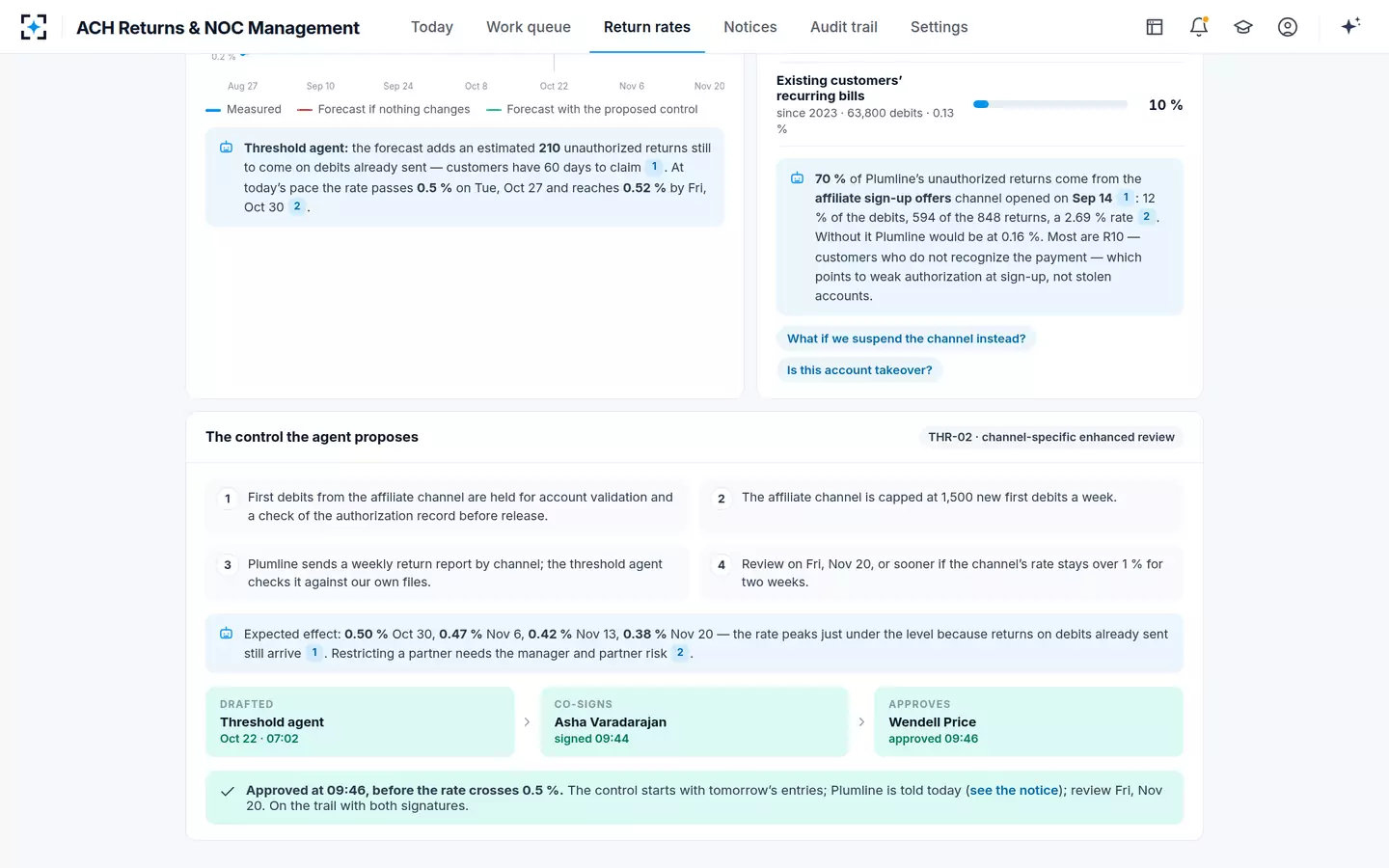
Nor does it decide. The agents never send a return, never restrict or suspend an originator, never send anything to Nacha and never edit the audit trail. A specialist approves in-window returns and corrections; the ACH operations manager checks late returns, R17 returns of suspected fraud, code changes, dishonors and Nacha replies; and a restriction on an originator needs the manager and the fintech partner risk manager.
In ACH Returns & NOC Management, the tasks that stay with people: a control signed twice
Which ACH returns tasks to hand over first
Hand over first the tasks where an agent's mistake costs time rather than money, and keep a person on every decision until the bank has evidence the proposals hold up. That order follows from the table above. Reading the files, sorting by deadline and measuring originator rates move no money and are easy to check against what the team did by hand, so a bank can run them alongside its current process for a few weeks and compare.
Correction follow-up comes next, because it closes a gap rather than replacing work people already do well. Code proposals follow, with a high confidence floor and a second specialist re-checking a sample of approved returns each day; the floor can come down only as the re-check agreement holds. Reading signed statements comes last, because it is where the customer's own words choose between R07, R10 and R11 and where a wrong reading reaches the originator. The two tasks at the bottom of the table, restricting an originator and deciding a late claim, never move.
Two measures tell a bank whether the order is working. One is the share of each day's returns sent in their first eligible file; the other is agreement between the agent's proposed code and the re-checking specialist's, family by family. Measuring whether each return code was right sets out how to score the second.
What the specialist's day looks like after
At the sample bank, the specialist approves the 268 ready returns in one batch and keeps the 18 that need her: 11 insufficient-funds items waiting for the 2:00 p.m. overdraft sweep, four business claims waiting for a signer, and three suspected-fraud credits that go to the manager. In the afternoon a second specialist re-checks a 2% sample of the approved returns, which is what keeps a 95% confidence floor honest over time.
The quieter change is in what the specialist knows. Each tray says how many items are ready and how many need a person, and one line above names the originator heading toward a Nacha line. How the four seats of the return process divide the work shows the same morning from the manager's and the partner risk manager's chairs. The full solution, with its seven agents and governance, is at ACH Returns & NOC Management.
Questions people ask
What is an ACH exception report?
It is the core system's list of incoming entries it could not post automatically, typically for insufficient funds, closed or unknown accounts, stop payments or frozen accounts. Examiners expect such reports, with rejects, returns and the age of open items, to get real attention from management (FFIEC, Retail Payment Systems), a test the ACH return process, seat by seat assigns to a named manager.
How fast must ACH returns be sent?
Most must be made available to the originating bank by opening of business on the second banking day after settlement. A consumer's unauthorized debit may be returned up to the banking day after the 60th calendar day, with a signed statement, and since October 2024 within six banking days of the bank finishing its review of that statement (Nacha, Risk Management Topics 2024).
Can an agent send ACH returns on its own?
Technically any system with access to the return file can. In ACH Returns & NOC Management it cannot: agents propose and a specialist approves, and late or high-value returns need the manager. Examiners look for separation of duties across origination, adjustments, posting and investigations, and an unsupervised machine sending returns would blur it.
Does automating returns change the bank's liability?
No. The Nacha Rules and Regulation E apply to the return and the customer's claim whoever prepares them, and the bank remains responsible for its timing and code. What changes is the evidence: each proposal, its sources and the person who approved it are kept together.
Do ACH returns software tools replace the ACH processing platform?
Not in this case. The ACH platform still exchanges files with the ACH operator and settles them; ACH Returns & NOC Management reads those files, prepares the decisions and writes only approved returns, corrections and dishonors back. Under the Federal Reserve's own ACH circular the receiving bank remains accountable for a debit it fails to return by the deadline, whichever tool built the file (Operating Circular 4).
What return codes do business accounts use for unauthorized debits?
R29, for corporate debits such as CCD and CTX to non-consumer accounts, on the ordinary two-day timeframe; R10 and R11 are for consumer receivers or consumer entry codes (Nacha). A business account holder therefore has no 60-day window, and the claim has to reach the specialist the day it is raised. ACH return codes, and how to measure their accuracy quotes Nacha's rule and scores each code family.