ACH late returns are returns a receiving bank sends after the Nacha deadline: for most entries, after the opening of business on the second banking day after settlement, and for a consumer's unauthorized debit, after the banking day following the 60th calendar day. The cost is direct. The Federal Reserve's ACH operating circular says "the receiving bank is accountable for the amount of a debit item if the returned item is not received by that deadline," and the originating bank may dishonor a return that arrives late. What is left is a request to the originating bank, a warranty claim, or a loss. Botminds' ACH Returns & NOC Management puts every return, claim and correction in a tray ordered by its own deadline and escalates what is due today, so that late becomes an exception a manager decides rather than an accident someone finds. This guide prices the misses so a bank can decide what preventing them is worth.
Worked examples use a fictional sample bank, Tessaly Community Bank, in October 2026. Dollar figures for it are our arithmetic on its sample items, not a measured loss.
Where late ACH returns come from
98%
of consumer debit returns were processed within five days of the original entry in the Fed’s matched 2006 data
Federal Reserve Bank of Minneapolis, 2010
60days
the network window for a consumer’s unauthorized debit, counted from settlement
60days
Regulation E’s window for the consumer’s notice of error, counted from the statement
What is a late ACH return?
A late ACH return is a return that reaches the originating bank after the deadline the Nacha Operating Rules set for its return reason code. For an authorized entry that cannot post, the return must reach the ODFI by the opening of business on the second banking day after settlement. For a consumer's unauthorized debit, with a signed statement, it is the opening of business on the banking day following the 60th calendar day. The ACH return time frame in plain words sets out each clock and how to count it.
Most returns are never at risk. In the Federal Reserve's matched FedACH data, "over 98 percent of all returns were processed within 5 days," most of them for insufficient funds or account problems; the rest were "mostly processed between 6 and 60 days after their forward item was processed, and mostly because they were unauthorized" (Armantier et al., 2010). So the late returns that hurt are not the routine ones. They are the customer claims that sit in the wrong queue, the claims that arrive after the network's 60 days, and the routine items a holiday or a missed cutoff pushes one day too far.
The consequence is set in the Federal Reserve's own terms for the network it runs. A receiving bank may return items "in accordance with the applicable ACH rules and by the deadline set forth in the FedACH Processing Schedule," and "the receiving bank is accountable for the amount of a debit item if the returned item is not received by that deadline" (Federal Reserve Banks, Operating Circular 4, January 2026).
Can an ODFI dishonor a late return?
Yes. An originating bank that receives a return outside its timeframe can send it back as a dishonored return, with code R68, "Untimely Return." The U.S. Treasury's guide for federal ACH payments lists the dishonor codes an ODFI uses: R61 misrouted return, "R67 - Duplicate Return," R68 untimely return, R69 field errors and R70 permissible return entry not accepted (U.S. Treasury, Green Book, chapter 4).
A dishonor has its own deadline, and so does the RDFI's answer to it; both are set in the licensed Nacha Operating Rules and are not repeated here. What is public is the settlement mechanics. Under the Federal Reserve's circular, "if a sending bank disputes the propriety of a returned item one time in accordance with applicable ACH rules," the Reserve Banks provisionally settle the disputed return, and reverse that settlement if the receiving bank disputes the claim in turn. One dishonor, one answer, and the money follows each step.
The same tool protects the bank as an ODFI. At the sample bank, the timeliness agent tested all 668 returns received on entries the bank sent and found two that should not stand: an R01 that arrived late and an R03 that arrived twice. It proposed them as R68 and R67, worth $508.50 back to the originators, for the ACH operations manager to approve. A bank that posts every return it receives without testing its timing gives up that money by default.
What is a contested dishonored return?
A contested dishonored return is the receiving bank's answer to a dishonor: it says the original return was proper after all, or corrects the error the dishonor pointed out. The Treasury's guidance to banks returning federal payments is direct: "If a financial institution receives a dishonored return, the financial institution should correct the information in the return and originate a contested return in accordance with Nacha Operating Rules & Guidelines" (U.S. Treasury, Green Book).
The Federal Reserve's FedLine tools treat both as ordinary work items: "both dishonored and contested dishonored return items can be derived," each by selecting the return reason code from a list (Federal Reserve Financial Services). The practical point for operations is that the exchange is short and final. The settlement date and the return date are both in the file, so whether a return was late is seldom in doubt; a contest is the receiving bank's remedy when the dishonor itself was wrong or the return can be corrected.
Three roads once the return window has closed
Once the window has closed, an RDFI that still needs the money back has three roads: ask the originating bank to accept a late return, make a claim against the ODFI's warranty that the entry was authorized, or absorb the loss. Nacha's 2021 rules opened the first road formally: when an RDFI asks for proof of authorization, "the ODFI will have the option within 10 banking days to either provide proof or agree to accept a return. If the ODFI chooses to accept the return, the RDFI will have 10 banking days to make that return" (Nacha, Meaningful Modernization).
After the window closes: what each road needs, and where it ends
What the RDFI must do: Request proof of authorization; the ODFI may answer by agreeing to accept a return instead. Nacha says an ODFI "need not agree to accept a late return."
Where it ends: If the ODFI agrees, the RDFI has 10 banking days to send the return and the money comes back through settlement.
What the RDFI must do: Claim that the entry was not authorized. For a consumer account, within two years of settlement, and always for the first 95 days after the first unauthorized debit; for a business account, within one year.
Where it ends: Not guaranteed. The ODFI may defend the claim, "including, but not limited to, a defense that the entry was properly authorized."
What the RDFI must do: Credit the customer where Regulation E or the account agreement requires it, and book the loss.
Where it ends: Final, unless a later recovery from the originator or the customer succeeds.
The warranty road is narrower than many teams assume. Before June 2021 Nacha's warranty language "does not limit itself to the time frame for automated returns," so an ODFI's exposure ran as long as the state statute of limitations for breach of contract. Now an RDFI has a two-year look-back for consumer accounts, with "the first ninety-five (95) calendar days from the settlement date of the first unauthorized entry" always covered, and one year for business accounts (Nacha, Limitation on Warranty Claims). And a timely claim is only a claim: Nacha's own FAQ asks whether a timely warranty claim guarantees the return of funds, and answers "No."
Who bears the loss on a late ACH return?
The receiving bank bears it, unless the originating bank agrees to take the return or pays a warranty claim. The customer usually does not: for a consumer's electronic fund transfer, Regulation E's error-resolution duties run from the bank's statement, not from the network's settlement date, and Nacha says plainly that its warranty rule "does not affect an RDFI's obligations to its account holder." Nacha even anticipates the outcome: "the RDFI may make a business decision to compensate its customer for any of the debits based on its customer relationship."
That is the trap in a late consumer claim. The bank must investigate and, where Regulation E applies, provisionally credit the customer within ten business days of the notice if it needs longer to decide (12 CFR 1005.11(c); the Regulation E error-resolution clock counts it day by day). It has lost the automatic way to recover the money from the network. Everything after that is negotiation with the other bank.
The originating side has its own late-return loss. The FFIEC notes that an ODFI "will normally charge back a returned ACH debit to the originator," but "may suffer a loss if the originating account has insufficient funds, is closed, or is frozen because of bankruptcy or other legal action" (FFIEC, Retail Payment Systems). An untimely return the ODFI accepts without a dishonor lands in exactly that position.
Regulation E's 60 days and the network's 60 days are different clocks
The network's 60 days run from settlement; Regulation E's run from the statement. A consumer's notice of error is timely if the bank receives it within 60 days of sending the first periodic statement that shows the error (12 CFR 1005.11(b)(1); see the Regulation E 60-day rule). Because the statement goes out after the debit settles, the Regulation E window always closes later, and a customer can be fully inside it after the bank's right to return has expired.
One claim, two clocks: inside Regulation E, outside the network's window
- Return window60 days to Oct 13
- Closed17 days to Oct 30
- Before the statement17 days
- Notice window60 days to Oct 30
At the sample bank, the agent could not return Martin Ellery's debit through the network, so it proposed the loss path: credit him $1,240.00, ask the originating bank to accept a late return or indemnify, and book the loss as pending recovery under reason LATE-01. The specialist prepared it; the approval waited for the ACH operations manager, because it moves money outside the network's rules.
Pricing a missed window by failure type
Each kind of miss leaves a different amount with the bank, and the largest is not always the one that gets attention. The figures below price four failures on the sample bank's own items. They are illustrations of the arithmetic, not averages: a bank should run the same calculation on a quarter of its own late items and recoveries.
What each kind of miss would leave with the bank, on four sample items
The order in the chart is the useful part. The routine NSF item that slips one day can cost more than the dramatic disputed claim, because here it is larger, and because recovering an overdraft from a customer who was short of funds is uncertain. Routine items are also where volume is: a small miss rate on insufficient-funds returns adds up faster than a miss rate on claims.
The FFIEC adds a cost that does not show in any one item: breaking the Nacha rules exposes a bank to contractual liability and to fines, the point behind whether Nacha is a regulation. Nacha's enforcement process sits apart from any one item, but its top class is severe. Since 2021, an egregious violation, "willful or reckless" and involving at least 500 entries or $500,000, can be sanctioned "up to $500,000 per occurrence" (Nacha, Reversals and Enforcement).
How do you prevent late ACH returns?
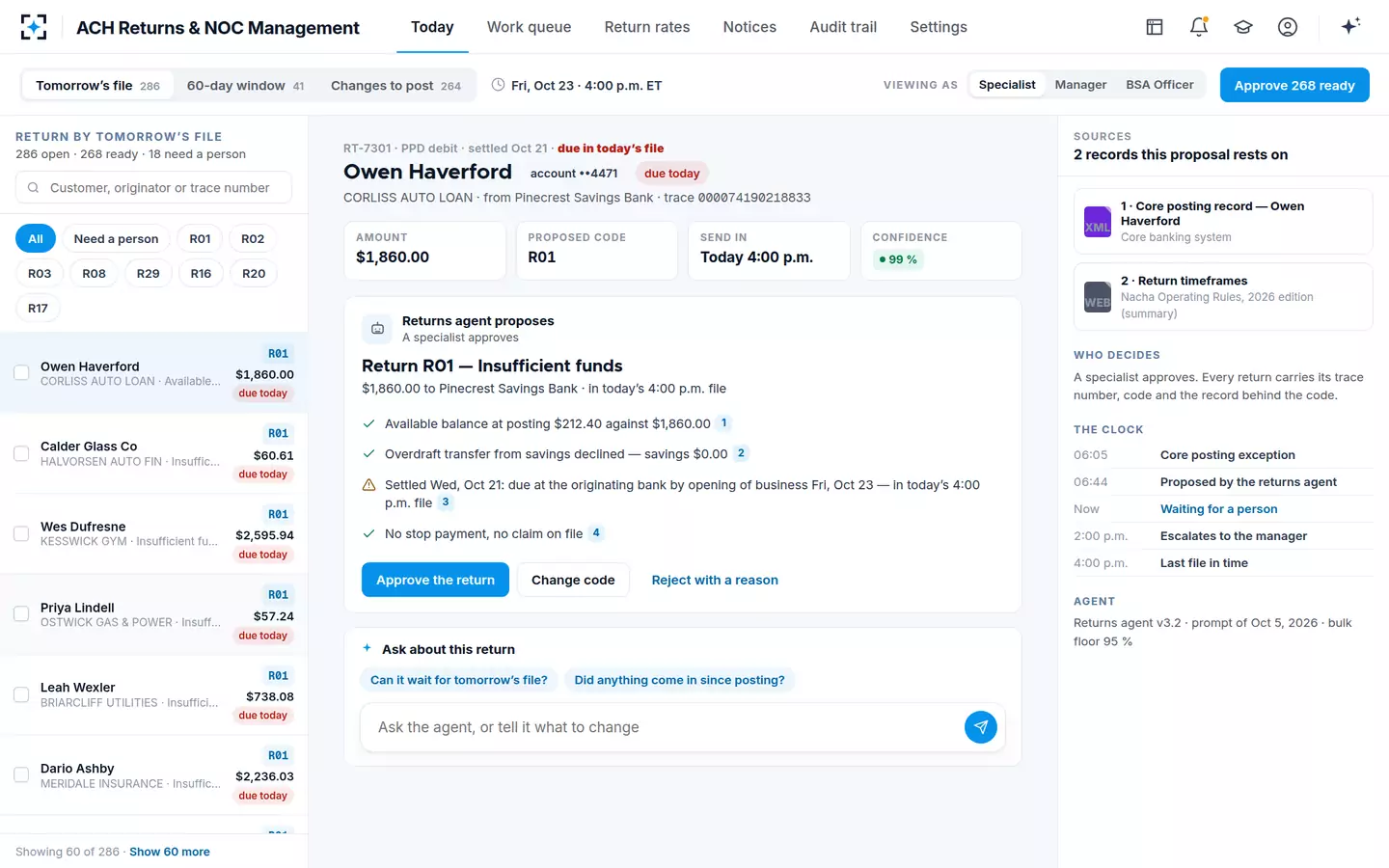
Prevent late returns by sorting every item by its own deadline, counting banking days against the Federal Reserve's holiday calendar, and escalating what is due today early enough to fix it. The checklist below is what ACH Returns & NOC Management does each morning; most of it can be done by hand with discipline.
Seven controls that keep ACH returns inside their windows
- Order the work by deadline, not by the exception report
Due in today’s file first, then tomorrow’s, then the 60-day window, then anything already past it, which goes straight to the manager.
- Count banking days on the Federal Reserve calendar
In late 2026, Columbus Day (October 12), Veterans Day (November 11) and Thanksgiving (November 26) are Reserve Bank holidays; each moves a two-day deadline.
- Know the operator’s last return window
FedACH’s last same-day settlement window for electronic returns is 4:45 p.m. ET; a bank file cutoff should sit ahead of it.
- Escalate items due today at a fixed hour
The sample bank sends anything still open at 2:00 p.m. to the ACH operations manager, two hours before its 4:00 p.m. file.
- Take the signed statement at presentment
Since October 2024 a customer may sign as soon as the debit is presented, before it posts, which removes days from the claim.
- Return extended claims promptly after review
Nacha now expects the return by the opening of the sixth banking day after the bank completes its review of the signed statement.
- Test every return received, every day
Untimely and duplicate returns on the bank’s own entries can only be dishonored inside their own short window.
The clock on every item: due in today's file, escalated at 2:00 p.m.
Where ACH Returns & NOC Management fits, and where it does not
The solution prevents the avoidable late return and prepares the unavoidable one. Its timeliness agent tests every return the bank receives and proposes dishonors with their code; its returns agent flags items due in today's file and anything past its window; and the loss path for a late consumer claim is drafted with the dates of both clocks, for a specialist to prepare and the manager to approve. It never sends a return, never dishonors without the manager, and never decides a loss.
ACH Returns & NOC Management’s morning run finds the late and the duplicated
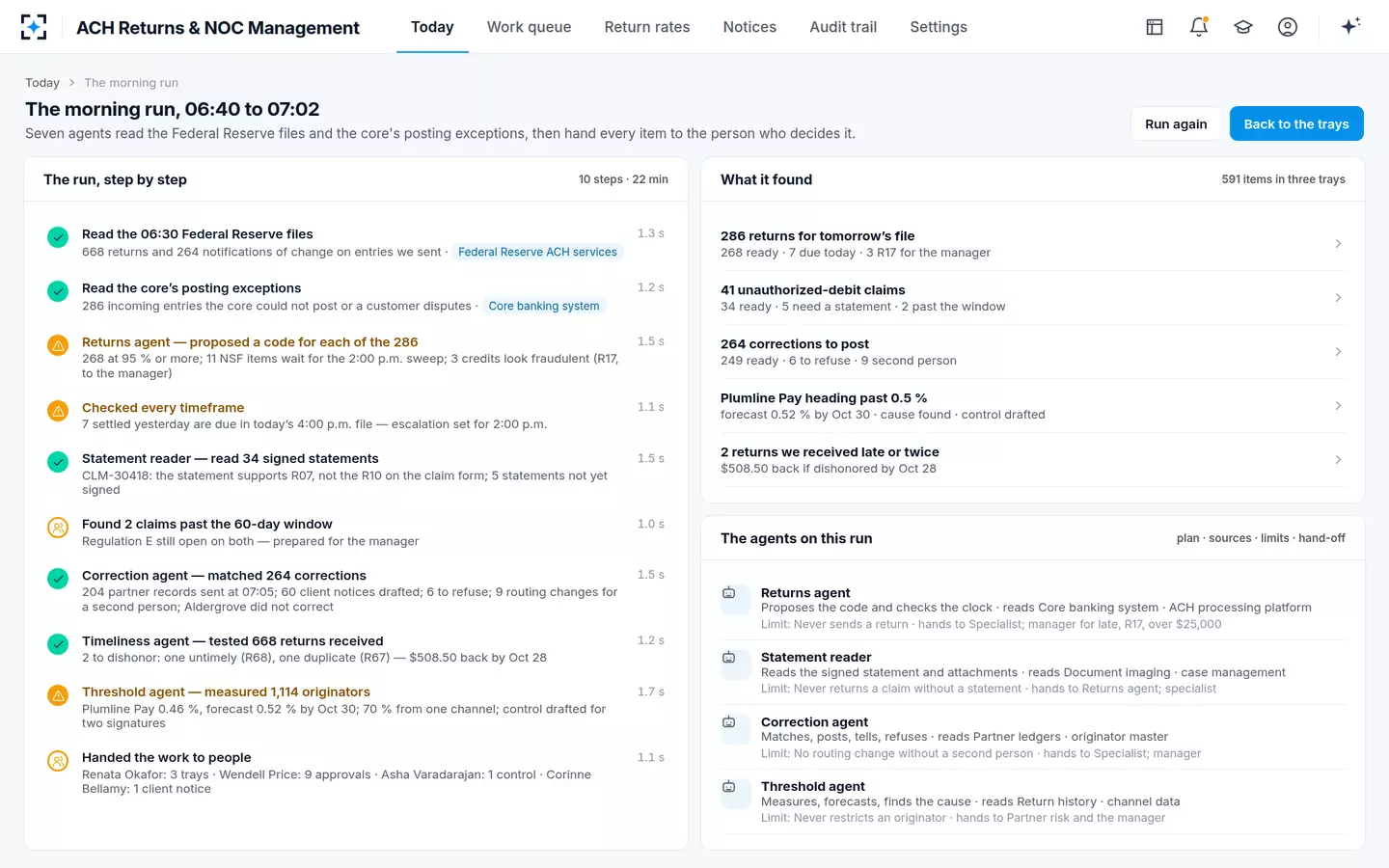
It does not negotiate with the other bank, file warranty claims on its own, or change a customer's Regulation E rights; those stay with people. It also does not replace the bank's ACH platform or the operator's processing schedule. For the volume behind the windows, and which tasks an agent can take whole, see the eleven tasks behind ACH returns. The solution itself is at ACH Returns & NOC Management.
Questions people ask
Can a bank return an ACH after 60 days?
Not through the normal return process. After the banking day following the 60th calendar day from settlement, a consumer's unauthorized debit can only come back if the originating bank agrees to accept a late return, or the RDFI recovers through a warranty claim within Nacha's look-back limits. The bank's duties to its customer under Regulation E continue regardless.
What is an ACH request for late return?
It is an RDFI asking the ODFI to accept a return after the window. Since September 2021, when an RDFI asks for proof of authorization, the ODFI may choose to agree to accept a return instead, within 10 banking days, and the RDFI then has 10 banking days to send it. The ODFI is not obliged to agree.
How long does an ODFI have to dishonor a return?
The dishonor timeframe, and the RDFI's timeframe to contest it, are set in the licensed Nacha Operating Rules, which this page does not quote. What a bank needs operationally is to test returns on the day they arrive, because both answers have to move quickly.
Is a late return a Nacha rules violation?
Sending a return outside its timeframe is not compliant with the rules, and it lets the ODFI dishonor it. Nacha's enforcement process targets violations, with its heaviest sanctions reserved for egregious, willful or reckless ones involving at least 500 entries or $500,000. For a single item the immediate consequence is financial: the ODFI may dishonor it, and the receiving bank is accountable for the amount.
Does the Federal Reserve accept a return after its deadline?
FedACH processes returns against its published schedule, with same-day deadlines for electronic returns at 10:30 a.m., 2:45 p.m. and 4:45 p.m. ET. Its operating circular makes the receiving bank accountable for a debit item "if the returned item is not received by that deadline."