The ACH return rate calculation divides the number of an originator's debit entries returned in the preceding 60 days or two calendar months by the number of its debit entries originated in the same period. Nacha uses three versions: the unauthorized return rate (codes R05, R07, R10, R11, R29 and R51), held to a 0.5% threshold; the administrative return rate (R02, R03 and R04), with a 3% level; and the overall return rate (every debit return except RCK), with a 15% level. The originating bank must monitor all three for each originator and third-party sender. The arithmetic is simple; what makes it hard is choosing the window, the level of measurement and the treatment of returns that have not arrived yet, each of which can move an originator across a line. Botminds' ACH Returns & NOC Management measures every originator's three rates each morning and forecasts eight days ahead. This guide works the calculation for one originator.
The worked originator is Plumline Pay, a fictional bill-pay and subscriptions partner of a fictional sample bank, Tessaly Community Bank, as measured by the solution on October 22, 2026. The rules are from Nacha's public rule pages and calculation sheets.
Three ACH return rates, one denominator
Unauthorized return rate
debits returned R05, R07, R10, R11, R29, R51 ÷ debits originated
Over the preceding 60 days or two calendar months. Threshold 0.5%; above it, the ODFI has rules obligations to reduce it.
Nacha threshold
Administrative return rate
debits returned R02, R03, R04 ÷ debits originated
Same window. Level 3.0%; above it, Nacha may open a preliminary inquiry. Returned credits are not counted.
Nacha level
Overall return rate
all debit returns, any code ÷ debits originated
Same window. Level 15.0%. RCK entries and RCK returns may be left out of both sides.
Nacha level
How do you calculate the ACH unauthorized return rate?
Count the originator's debits returned with an unauthorized code during the preceding 60 days or two calendar months, and divide by its debits originated in that period. Nacha's own sheet works an example: 300 unauthorized returns in April and 200 in May, 500 in all, against 60,000 debits originated in April and 40,000 in May, 100,000 in all, gives exactly 0.5% (Nacha, How to calculate unauthorized return rate). The codes, the sheet notes, "include R05, R07, R10, R11, R29 and R51."
The codes in the numerator changed in 2020. When Nacha re-purposed R11 for debits that broke the terms of an authorization, it counted the new R11 in the Unauthorized Entry Return Rate from April 1, 2020 (Nacha, Differentiating Unauthorized Return Reasons), one of the codes behind the 0.5% unauthorized return rate threshold. Before that, the same claims were mostly coded R10, so the change moved returns between codes without, in principle, changing the rate. A spreadsheet built before 2020 that counts only R05, R07, R10, R29 and R51 now undercounts.
Two methods, and why they give different answers
Nacha allows two denominators, and the bank should pick one and keep to it. The risk-and-enforcement rule says an unauthorized return rate may be calculated by "dividing the number of debit Entries returned as unauthorized for the preceding sixty days or two calendar months by the total number of debit Entries contained within the ACH File(s) in which the original Entries were transmitted," or by dividing the same returns "by the total number of debit Entries originated for the preceding sixty days or two calendar months, respectively" (Nacha, ACH Network Risk and Enforcement Topics).
The first method ties the denominator to the files the returned entries came from; the second uses everything the originator sent in the window. Nacha's sheet uses the same 100,000 for both. In our reading, a steady originator gives close answers either way, while one that is growing fast, or has just opened a new sales channel, does not: the period method counts recent debits in the denominator that have not yet had time to come back as returns, so it reads lower. That is not a reason to prefer the flattering method; it is a reason to know which one the number used.
Which return codes go into each Nacha rate, and what is left out
| Rate | Counts | Leaves out | Line |
|---|---|---|---|
| Unauthorized | R05, R07, R10, R11, R29, R51 on debits, any entry code | Credits returned as unauthorized | 0.5% threshold |
| Administrative | R02 account closed, R03 no account, R04 invalid account number; debit prenotes included | Credits; R17 “QUESTIONABLE” returns | 3.0% level |
| Overall | Every debit return for any reason; debit prenotes included | Credits; RCK entries and RCK returns may be excluded from both sides | 15.0% level |
What counts in the administrative and overall return rates?
The administrative rate counts debits returned because the account data was wrong: R02, R03 and R04. The overall rate counts every debit returned for any reason, including insufficient funds, which is why its line sits at 15%. Two details catch people out. Prenotes count: Nacha says "prenotes with debit transaction codes are included in the monitoring and return rate calculations for Return Rate Levels," on the reasoning that a prenote returned for bad data prevents a live debit from being returned later. And R17 "QUESTIONABLE" returns do not count in the administrative rate, because R17 also serves other purposes and is optional for the RDFI (Nacha, Return for Questionable Transaction).
RCK, the electronic re-presentment of a returned check, is the one exclusion from the overall rate. Nacha's reason is in its FAQ: "by definition, an RCK is a representment of a check payment that has already been returned for insufficient funds," which makes a meaningful rate impractical. The calculation sheet says RCK entries and RCK returns "may be excluded from both the numerator and denominator" (Nacha, How to calculate administrative or overall return rate).
Worked: one originator's three rates
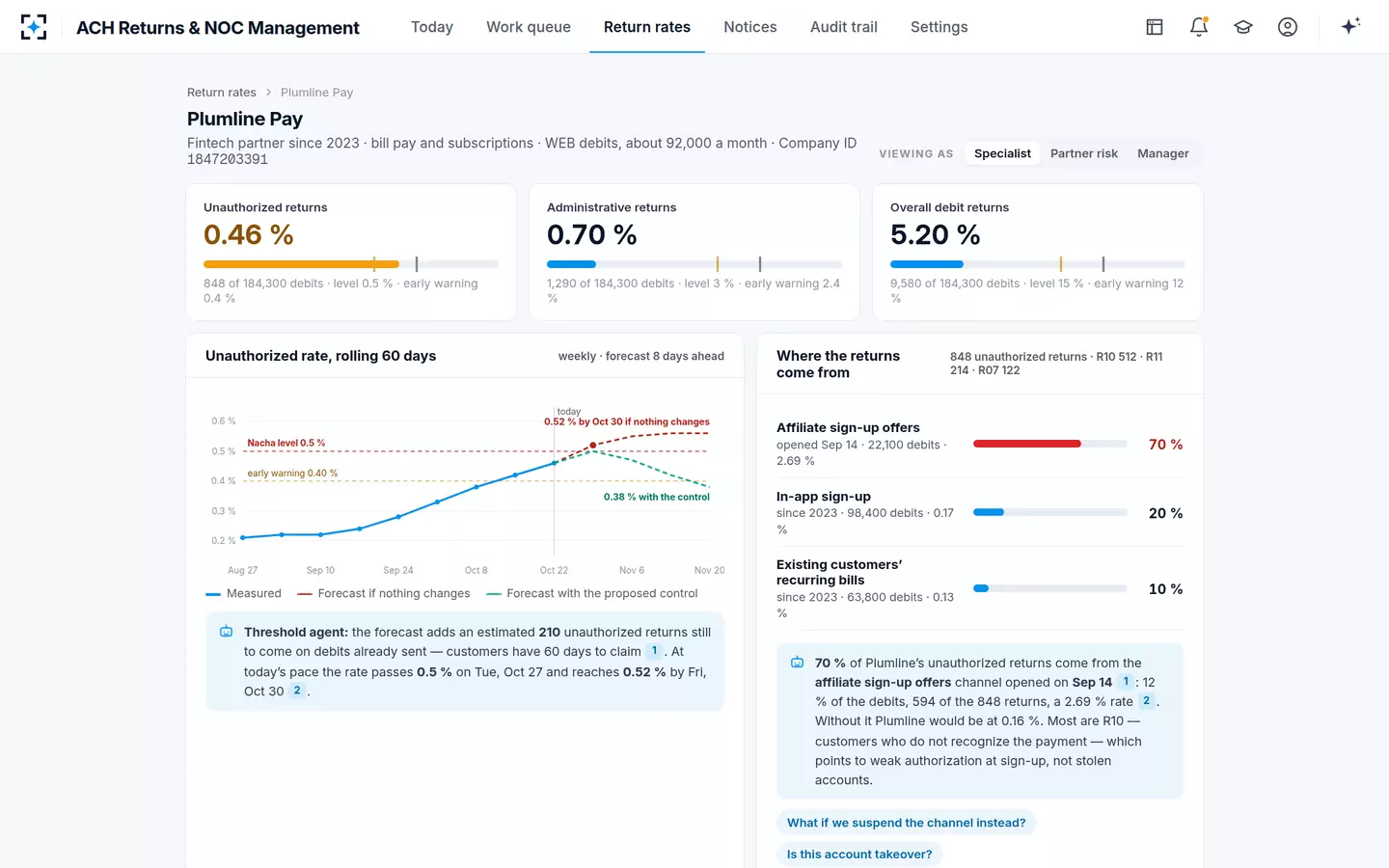
On October 22, 2026, the sample bank's partner Plumline Pay had sent 184,300 debits in the preceding 60 days, WEB debits for bill pay and subscriptions at about 92,000 a month. Its returns in the same window gave three rates, each against its line.
Plumline Pay, rolling 60 days to October 22, 2026
0.46%
unauthorized: 848 of 184,300 debits, against the 0.5% threshold
0.70%
administrative: 1,290 of 184,300 debits, against the 3% level
5.20%
overall: 9,580 of 184,300 debits, against the 15% level
Read alone, the administrative and overall rates say nothing is wrong: 0.70% against 3% and 5.20% against 15%. The unauthorized rate is the one under strain, at 92% of its line, and it had been 0.21% on August 27. The mix inside it matters too. R10, customers saying they do not know Plumline or never authorized it, was 512 of the 848, which points at how authorizations are captured rather than at billing errors, which would show up as R11.
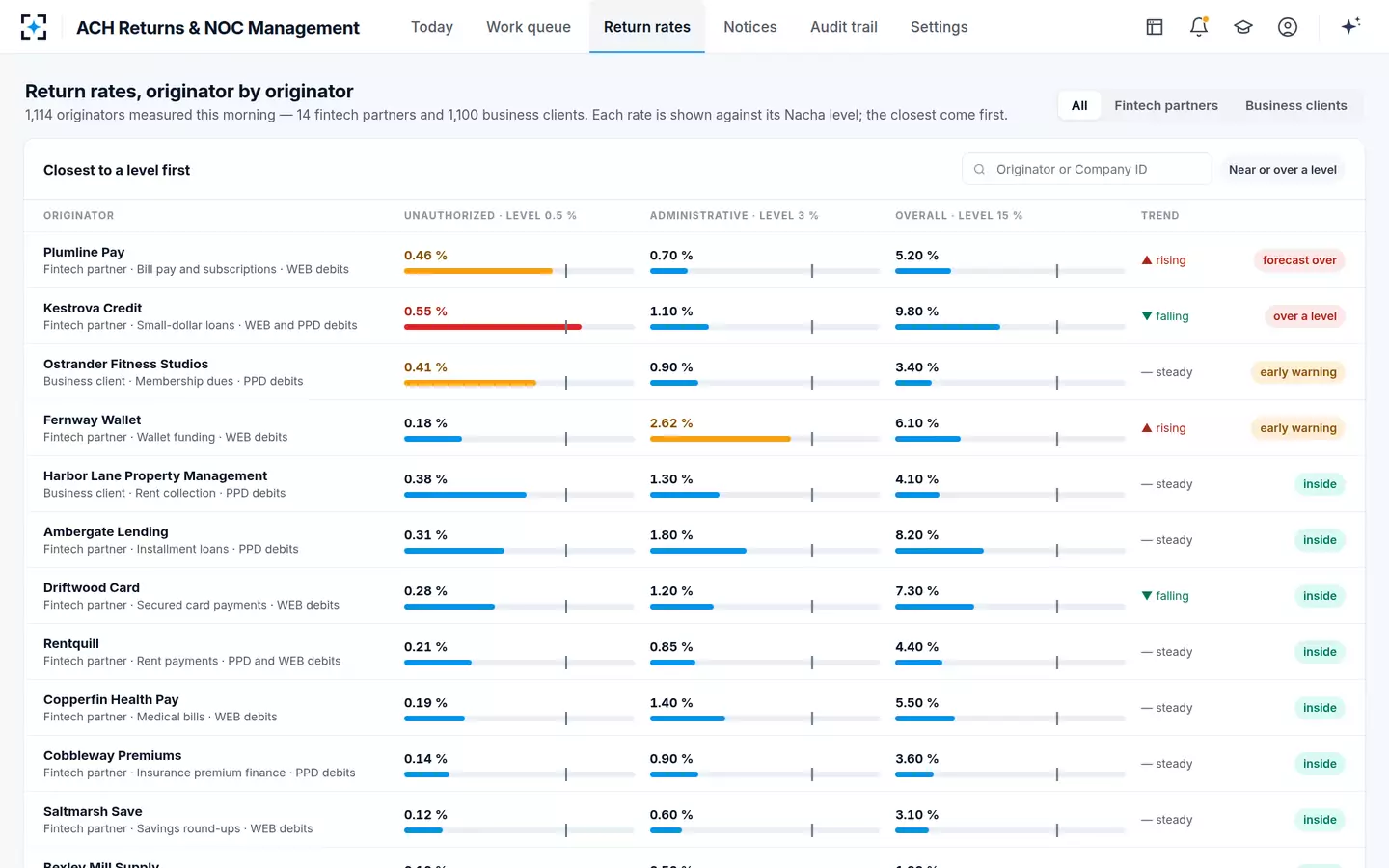
The bank's other originators show why a single bank-wide rate would hide this. At the sample bank, one partner was already over the line and falling, one business client sat steady just above the early warning, and most were well inside.
Unauthorized return rates across the sample bank's closest originators
The returns still to come
A return rate measured today is a floor, because unauthorized returns arrive late and the debits sent in the last few weeks have not had their full chance to come back. In the Federal Reserve's matched FedACH data, returns that took longer than five days were "mostly because they were unauthorized," processed between 6 and 60 days after the forward entry (Armantier et al., Federal Reserve Bank of Minneapolis, 2010). Insufficient-funds returns are back within days; unauthorized ones trickle in for two months.
The FFIEC builds the same lag into its examination procedures for ODFIs. Examiners check whether the bank's monitoring of entries "accumulates entries for a period at least as long as the average ACH debits return time (60-75 days)" (FFIEC, Retail Payment Systems). A rate built on the same 60 days that the returns are still arriving in will drift upward even if nothing changes at the originator.
For Plumline, the threshold agent estimated 210 more unauthorized returns still to come on debits already sent, since customers have 60 days to claim. Counting them, at the current pace the rate would pass 0.5% on Tuesday, October 27, and reach 0.52% by Friday, October 30. Measured the old way, at month end, it would have looked fine on October 22 and been over the line a week later.
One originator's three rates, the 60-day trend and the returns still to come
Company ID, originator or third-party sender: where to measure
Measure at the level Nacha will measure, which can be narrower than the client relationship. Nacha's implementation checklist for these rules told ODFIs to "review return rates at Company ID and Third-Party Sender/Originator level," and noted that preliminary research "may begin when any Company ID exceeds" an administrative or overall level (Nacha, DFI Checklists, 2015). An originator with several Company IDs, one per product or channel, can have one ID over a line while its blended rate looks healthy.
The OCC sets the floor from the supervisory side: "At a minimum, returns rates should be reviewed at the originator level for all originators," and where third-party senders are used, for them too (OCC Bulletin 2006-39). Below the Company ID, the useful cuts are by sales channel, entry description and sign-up date, because that is where a cause shows. At Plumline, one affiliate sign-up channel opened on September 14 carried 22,100 debits and 70% of the unauthorized returns, a 2.69% rate; without it the partner stood at 0.16%. What return rate monitoring has to show Nacha follows that breakdown into an inquiry reply.
Five calculation errors that move a rate across a line
Most wrong return rates come from a handful of choices made once in a spreadsheet and never revisited. Each of the five below moves the number in a predictable direction, and each can be tested against Nacha's own definitions in an afternoon.
Five ways a return rate calculation goes wrong, and which way each one moves it
- Leaving R11 out of the unauthorized count
Understates it. R11 has counted since April 2020; a pre-2020 formula that stops at R05, R07, R10, R29 and R51 misses every not-as-authorized claim.
- Mixing windows
Returns counted over 60 days against originations for one calendar month, or the reverse. Nacha’s methods use the same period on both sides.
- Blending Company IDs or channels
Hides the outlier. A single Company ID or sales channel over a line can sit inside a healthy blended rate.
- Counting credits or R17 “QUESTIONABLE” returns where they do not belong
Overstates. All three rates are debit rates, and R17 “QUESTIONABLE” is outside the administrative rate.
- Treating today’s rate as final
Understates. Unauthorized returns keep arriving for up to 60 days after the debits that caused them.
The last error is the one a better spreadsheet cannot fix, because it is about time rather than arithmetic. It needs an estimate of what is still to come, built from how the bank's own past returns arrived, which is what the forecast above adds.
How often should ACH return rates be calculated?
Often enough to act before Nacha does. Nacha's public pages do not set a frequency, but they say how Nacha finds originators: by identifying those "potentially above unauthorized return threshold through ACH Operator-provided return data" (Nacha, Risk and Quality Rules summary sheet). The operator sees every return as it settles. A bank that calculates monthly is working from data older than the network's.
Daily calculation also changes what the number is for. A monthly rate is a report; a daily rate with returns still to come is a forecast, and a forecast gives the bank and the originator time to change something. The FFIEC adds a credit reason: its procedures expect that "increases in an originator's ACH debit return volume trigger a re-evaluation of the exposure limit," the separate review that ACH Originator Risk Assessment handles.
From a rate to a forecast in ACH Returns & NOC Management
Each morning the threshold agent measures every originator's unauthorized, administrative and overall rates over 60 days, adds an estimate of the returns still to come on debits already sent, and forecasts eight days ahead. When a rate passes the bank's early warning, it breaks the returns down by channel, entry description and date to find the cause, and drafts a control for two people to sign. It never restricts an originator itself, and every figure cites the returns and originations it was computed from.
ACH Returns & NOC Management: every originator's three rates against the lines
Why the unauthorized line sits at 0.5%, and what a rate well under it can still mean, is the subject of the unauthorized return rate threshold guide. The solution is at ACH Returns & NOC Management.
Questions people ask
Do R11 returns count toward the unauthorized return rate?
Yes, since April 1, 2020, when Nacha re-purposed R11 for debits not in accordance with the terms of the authorization. R11 returns also carry the unauthorized entry fee from April 1, 2021. The full unauthorized list is R05, R07, R10, R11, R29 and R51.
Do prenotes count in the ACH return rate?
Debit prenotes count in the administrative and overall return rates. Nacha's reasoning is that a prenote returned R02, R03 or R04 prevents a later live debit from being returned, so including it "likely would have no material effect on the calculation of a return rate."
Is the return rate calculated per Company ID?
It can be, and Nacha's own checklist told ODFIs to review rates at Company ID as well as originator and third-party sender level. An originator using several Company IDs should be measured on each, because Nacha's inquiry can start from one.
Are credits included in the return rate calculation?
No. All three Nacha rates are debit rates. Nacha says the unauthorized threshold leaves out credits returned as unauthorized, and the administrative and overall levels do not apply to returned credit entries either.
Is exactly 0.5% over the unauthorized threshold?
Nacha's calculation sheet shows 500 returns on 100,000 debits as exactly 0.5%, the threshold itself. Nacha's rules attach obligations to rates above the threshold, so a rate sitting on the line leaves no margin for the returns still to come.