The Nacha 60-day return rule lets the receiving bank or credit union send back a debit its consumer member says was unauthorized for up to 60 days after the entry's settlement date, using return reason R10 or R11, once the member has signed a Written Statement of Unauthorized Debit. Nacha's public summary is five words, "The return timeframe is 60 days" (Nacha, Differentiating Unauthorized Return Reasons), and that is the trouble: the honest answer to "can we still return it?" depends on facts the question rarely states. Is it the payment or the purchase being disputed? Did the member authorize the company at all? What kind of entry hit what kind of account? When did it settle, and when did someone finish reviewing the signed statement? Botminds' Nacha & Payment Rules Search asks those questions before it answers, reads the ones it can from the core banking system and the ACH processing platform, and dates the deadline on a banking-day calendar.
The worked example is the solution's own sample: a fictional credit union, Norrell Federal, and a $386.40 debit that settled on Monday, August 31, 2026. Rule facts come from Nacha's free rule pages, the FFIEC examination handbook and Regulation E, linked where used.
The question tree: seven things the Nacha 60-day return rule needs to know
- 1
Is the member disputing the payment, or the goods or service behind it?
A quarrel about quality, delivery or a refund is not an unauthorized debit. Nacha says R11 "does not include disputes about goods and services, just as with the current definition and use of R10". Stop here; the member's remedy is with the company.
- 2
Did the member authorize this company at all?
Never heard of it, or never authorized it: R10. Authorized, but the debit was for the wrong amount, too early, part of an incomplete transaction or improperly reinitiated: R11.
- 3
What kind of entry hit what kind of account?
R10 and R11 are used for consumer receivers and for consumer entry types to non-consumer accounts. CCD and CTX entries to non-consumer accounts are returned as R29, outside the 60-day window the FFIEC describes for consumer debits.
- 4
Has the member signed a Written Statement of Unauthorized Debit?
An R10 or R11 return needs it. Since October 1, 2024 it may be signed once the entry is presented, even before the debit posts.
- 5
What was the settlement date of the debit?
The 60 days run from settlement, not from the statement and not from the day the member called.
- 6
When did you finish reviewing the signed statement?
That starts the second clock: the return must go back by the opening of the sixth banking day after the review is complete.
- 7
What is your own file cutoff?
The earlier rule limit, less your last return file before it, is the date that matters to the specialist.
What is the Nacha 60-day return rule?
It is the extended return timeframe for unauthorized debits to consumer accounts: where the ordinary return window is two banking days after settlement, a debit the member says was not authorized can be returned for 60 days. The FFIEC's examiners describe it from the originating bank's side: "If not properly authorized, the return time frame for consumer debits under NACHA rules extends to 60 days from the settlement date" (FFIEC, Retail Payment Systems booklet). The same booklet explains why an ODFI cares: for debits it originates, its credit exposure lasts as long as the receiving bank can still return them.
Two return reason codes use the window, and both require the member's signed statement. The rule-maker's public page lists the requirements in a short block: the RDFI "will be required to obtain the Receiver's Written Statement of Unauthorized Debit", the return timeframe is 60 days, R11 returns count toward the unauthorized return rate, and the codes do not cover disputes about goods and services. The exact moment comes from the rule text. Nacha's free 2023 request-for-comment materials reproduce the return-timing language: the return must be "made available to the ODFI no later than the opening of business on the Banking Day following the sixtieth calendar day following the Settlement Date of the original Entry" (Nacha, ACH Risk Management 2023, proposed modifications). A desk should still cite its own licensed edition for that wording, since it is the edition, not a 2023 proposal document, that governs.
Which 60 days is it? The settlement date, not the statement
The Nacha 60 days run from the settlement date of the debit. They are often confused with a different 60 days, in Regulation E, which run from the statement and govern something else: the member's liability, not the credit union's right to send the debit back. Even the examiners' handbook states both. In one place it says the window "extends to 60 days from the settlement date"; in another, describing the same exposure, it says:
If not authorized properly, the financial institution exposure can be up to 60 days from when it sends a periodic statement to the consumer.
FFIEC, Retail Payment Systems booklet (April 2016)
Both sentences are true of something. The settlement-date clock is Nacha's and decides whether the return can go back. The statement clock is Regulation E's: a consumer "must report an unauthorized electronic fund transfer that appears on a periodic statement within 60 days of the financial institution's transmittal of the statement to avoid liability for subsequent transfers" (12 CFR 1005.6(b)(3)). When a staff member asks "is it within 60 days?", the first thing a good answer does is ask which one.
Two 60-day rules on one unauthorized debit
Nacha extended return: Nacha, in its licensed Operating Rules
Regulation E notice: The CFPB, 12 CFR 1005.6, federal law
Nacha extended return: The settlement date of the debit
Regulation E notice: When the institution transmits the statement showing it
Nacha extended return: Calendar days, with the deadline landing on a banking day
Regulation E notice: Days, with extensions for extenuating circumstances
Nacha extended return: Whether the RDFI can return the entry to the ODFI
Regulation E notice: How much of the loss the consumer can be made to bear
Nacha extended return: The member's signed Written Statement of Unauthorized Debit
Regulation E notice: Notice: the consumer taking steps reasonably necessary to give the institution the pertinent information
Nacha extended return: ACH operations
Regulation E notice: Deposit operations or the claims team
The member's claim under Regulation E is its own workflow with its own clocks, and it belongs to the people who run disputes, and the Regulation E 60-day rule covers that side. For the rules desk, the job is to keep the two apart in every answer; why one is a private rule and the other federal law is set out in is Nacha a regulation, and what actually binds a payment.
Does the 60-day rule apply to business accounts? It depends on the entry, not only the account
Not in the way most people expect. The extended window is for consumer debits, but Nacha decides which return reason applies by the kind of entry as well as the kind of account. Its FAQ says that "R10 and R11 will both be used for consumer Receivers or for consumer SEC Codes to non-consumer accounts", while R29 stays the code for corporate CCD and CTX entries to business accounts (Nacha, Differentiating Unauthorized Return Reasons). A corporate entry to a business account goes back as R29, on the standard return window rather than the 60-day one.
So "is it a business account?" is the wrong question on its own. A complete answer needs the account type and the entry's standard entry class code, and for the in-between case, a consumer entry class to a business account, the licensed text is the authority on which clock applies. An assistant that answers from account type alone will be right most of the time and wrong on exactly the cases that end up in front of compliance.
R10 or R11? The member's own words decide the code
R10 is for a debit from a company the member does not know or never authorized: Nacha's definition is "Customer Advises Originator is Not Known to Receiver and/or Originator is Not Authorized by Receiver to Debit Receiver's Account". R11 is for a company the member did authorize, where the debit did not follow the terms: "Customer Advises Entry Not in Accordance with the Terms of the Authorization", covering an incorrect amount, a debit earlier than authorized, an incomplete transaction or an improperly reinitiated entry (Nacha).
The clock is the same; the consequence for the originator is not. Nacha's page puts the difference in one line: after an R11, the originator may fix the error and send a new entry without asking for a new authorization; after an R10 it may not (Nacha; ACH return codes and how to measure their accuracy quotes it). Choose R10 for a debit that was merely for the wrong amount and you end an authorization the member wanted to keep; choose R11 for a debit the member never authorized and the company may simply correct and resend it.
This is the most repeated question at the solution's sample credit union, asked 23 times in a quarter by nine people, seven of them in their first 90 days. It is a question about the member's words, not about the rulebook, which is why the answer has to ask what the member actually said.
When does the 60 days start, and how is it counted?
The 60 days start on the settlement date of the debit and are counted in calendar days, not banking days, so weekends and holidays inside the window do not extend it. Where the 60th day lands matters only for working out when the return must be in the originating bank's hands, which is a banking-day question. In the sample, a debit that settled on Monday, August 31, 2026 reaches day 60 on Friday, October 30; the member called on Thursday, October 22, day 52, with eight calendar days and six banking days left.
The counting shown day by day, with the holidays it skipped
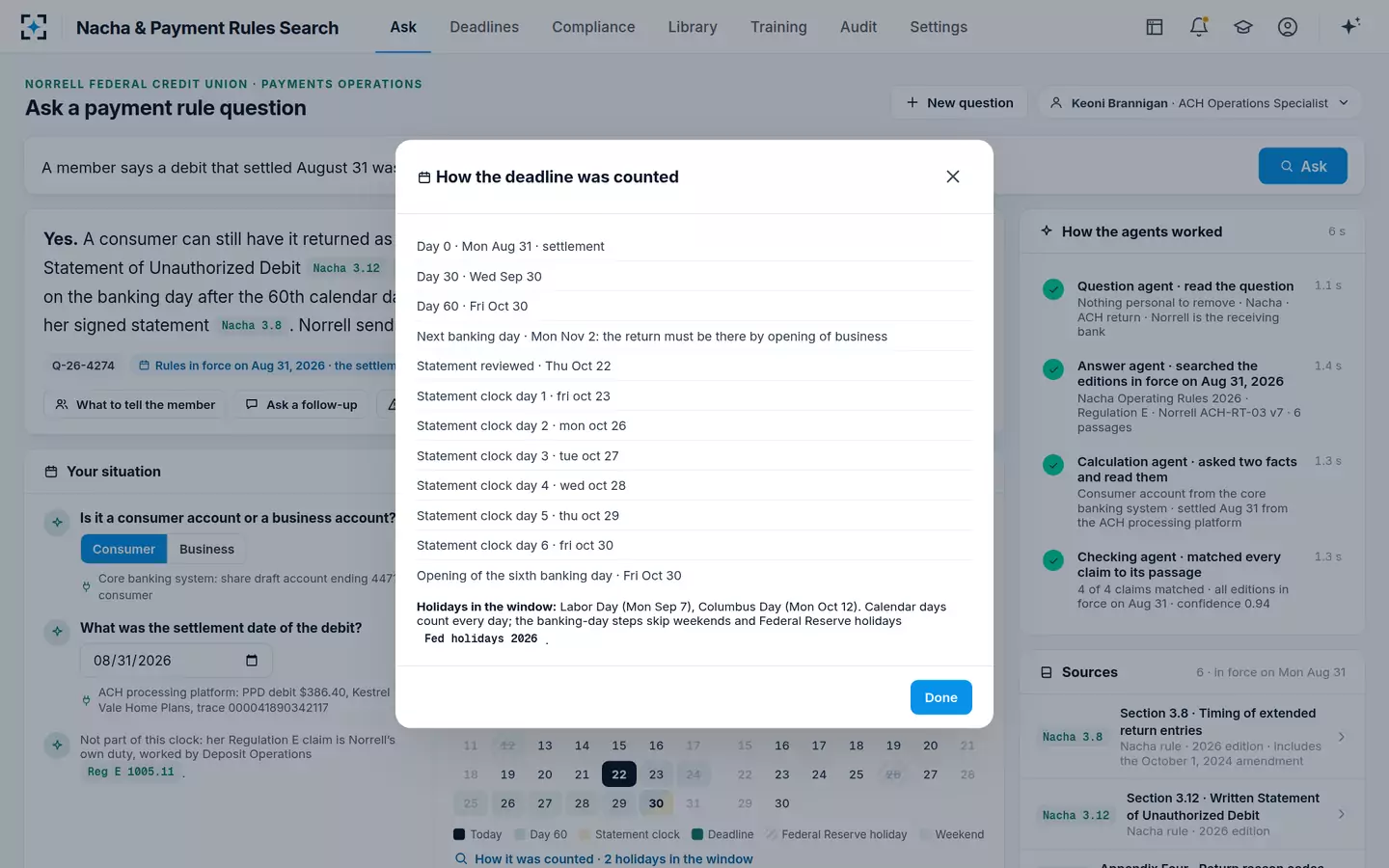
The holidays are the trap. A calendar-day window ignores them; a banking-day window skips them, and the two counts sit side by side in this one question. On January 1, 2026 Nacha also settled whose banking days count, removing the receiving institution from the definition so that banking days in the rules are the days the ACH Network is open (Nacha, Minor Topics Rule Changes). The banking day definition, and what one miscounted day costs, goes through the definitions behind each count.
The second clock: six banking days after you review the statement
Since October 1, 2024 there is a second, shorter limit. When an RDFI returns a consumer debit as unauthorized in the extended timeframe, it must now do so by the opening of the sixth banking day after it finishes reviewing the member's signed statement (Nacha, Risk Management Topics, October 1, 2024; the rule's words are in the ACH return time frame). Nacha's reason is speed of recovery: "In the days immediately following posting of an unauthorized debit Entry, any delay in processing a return may expose the ODFI or Originator to additional risk."
The same package moved the statement itself earlier. A WSUD may now be signed and dated as soon as the debit is presented to the member, by posting or as a pending item, even before it posts; before, it had to be dated on or after the settlement date (the written statement of unauthorized debit quotes the rule). A member who sees a pending debit in the app can sign straight away.
So a correct answer carries two dates and takes the earlier. In the sample, the specialist reviewed the signed statement on October 22, and the six-banking-day clock ends at the opening of Friday, October 30, before the 60-day limit. The member signed electronically in digital banking, which Nacha's own impact note anticipated when it suggested RDFIs "explore ways to use electronic notifications and alerts, and electronic WSUDs".
What if the member reports on day 61?
Then the extended return window has closed, and the answer has to say so plainly and say what is still open. The credit union's obligations to its member under Regulation E do not close with the Nacha window: they run from the statement, as above. What closes is the right to send the debit back through the network as R10 or R11.
The rules do provide other routes between institutions, and their limits are in the licensed text. One example is the RDFI's claim against the ODFI's authorization warranty, whose time limit Nacha itself narrowed in a 2021 rule that "limits the length of time in which an RDFI will be permitted to make a claim against the ODFI's authorization warranty" (Nacha, Rules Archive). An answer about day 61 should name the route, cite the licensed passage and send the decision to compliance, not improvise a time limit. What a missed window costs, and the routes left after it, are in ACH late returns.
Why a good answer asks before it answers
A headline answer, "yes, you have 60 days", is right for the common case and wrong for every case on the question tree's side branches: the goods dispute, the CCD to a business account, the statement not yet signed, the review done a week ago. Each of those is a return refused or a loss kept. Asking costs seconds; not asking costs the item.
How Nacha & Payment Rules Search handles one 60-day question
Agent
Question agentRemoves the member's name and account number, classifies the question as ACH, receiving side, unauthorized return.
Never: Never stores member identifiers
Agent
Calculation agentAsks the facts that change the answer, and pre-fills them: account type from the core banking system, settlement date from the ACH processing platform.
Never: Never assumes a fact it could not read
Agent
Answer and checking agentsAnswer in two or three sentences from the editions in force on the settlement date; match every claim to its passage.
Never: Refuse when sources disagree or an edition is out of date
A person decides
ACH operations specialistConfirms the facts, sends the statement for signature, reviews it, which starts the second clock, and prepares the return.
A person decides
Senior specialistReleases the return someone else prepared, in the institution's return file before both limits.
The answer, with the two facts that change it and the deadline on a calendar
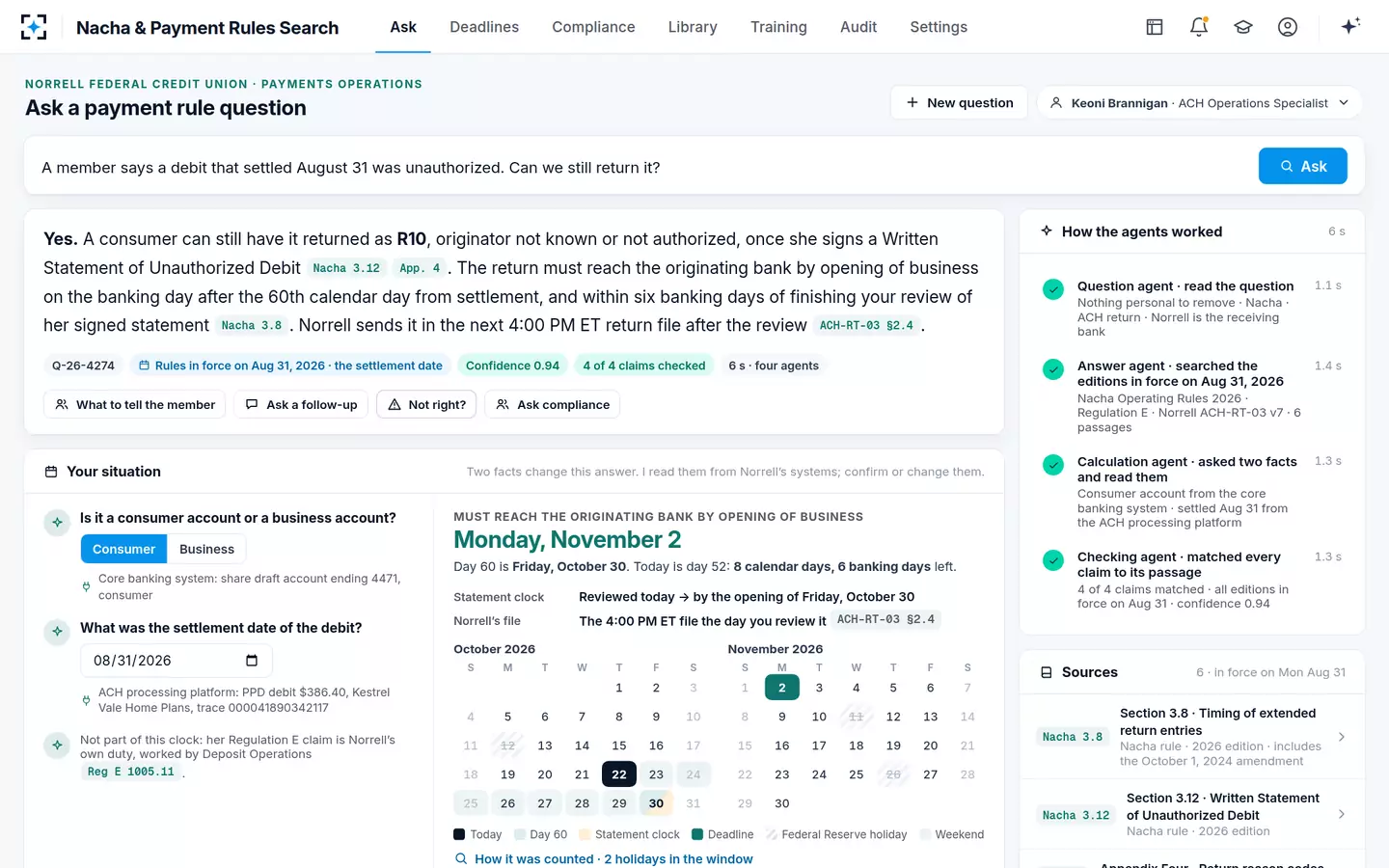
What a complete answer to a 60-day question states
- The return reason, and why
R10 or R11 from the member's own account of what happened; neither for a goods or service dispute.
- The entry and account facts it relied on
Consumer or non-consumer account, and the entry class, read from the systems where possible.
- Both limits, dated
Day 60 from settlement, and the sixth banking day after the review of the signed statement; the earlier wins.
- The last file that meets it
Your own return file cutoff, applied after the rule limit.
- What it does not decide
The member's Regulation E claim, which runs on its own clock with another team.
Questions people ask
Is the Nacha 60-day window counted in calendar days or banking days?
Calendar days, from the settlement date, so weekends and holidays inside the window do not extend it. The second limit added on October 1, 2024, the sixth banking day after the review of the signed statement, is counted in banking days, which skip weekends and Federal Reserve holidays.
Can a member sign the Written Statement of Unauthorized Debit before the debit posts?
Yes, since October 1, 2024. Nacha's amendment lets the statement be signed and dated on or after the date the entry is presented to the member, by posting or by notice of a pending transaction, even if the debit has not yet posted. Before that, it had to be dated on or after the settlement date.
Do R11 returns count toward the unauthorized return rate?
Yes. Nacha's rule page counts R11 returns in the Unauthorized Entry Return Rate and charges the Unauthorized Entry Fee on them; see the ACH unauthorized return rate threshold. That is one reason the choice between R10 and R11 is not cosmetic for the originator.
Can the originator send the debit again after an R11 return?
Yes, if it can correct the error. Nacha's page says an originator may correct the error and transmit a new entry that conforms to the original authorization without re-authorization, and that "The new Entry must be Transmitted within 60 days from the Settlement Date of the Return Entry".
Does the Nacha 60-day rule apply to ACH credits?
No. The extended return timeframe is for debits the member says were unauthorized. Questions about credits, such as one sent in error or under false pretenses, fall under other rules, including the 2026 fraud monitoring duties for receiving institutions.