The Federal Reserve holidays in 2026 are New Year's Day (Thursday, January 1), Martin Luther King Jr. Day (Monday, January 19), Washington's Birthday (Monday, February 16), Memorial Day (Monday, May 25), Juneteenth (Friday, June 19), Independence Day (Saturday, July 4, so the Reserve Banks open on Friday, July 3), Labor Day (Monday, September 7), Columbus Day (Monday, October 12), Veterans Day (Wednesday, November 11), Thanksgiving (Thursday, November 26) and Christmas (Friday, December 25). On those days FedACH does not settle and Fedwire is closed, so none of them is a banking day for a return or wire deadline. That calendar has an expiry date: the Federal Reserve Board has approved Fedwire operating on Sundays and weekday holidays, from 2028 at the earliest, while ACH settlement keeps its weekday calendar. Botminds' Nacha & Payment Rules Search counts every deadline on the holiday schedule the institution approves for each year, and will need a separate calendar for each service once the two diverge.
Dates come from the Federal Reserve Banks' published holiday schedule for 2026 to 2030 and its FedACH processing schedule, read on 26 October 2026. Product examples use the solution's fictional sample credit union.
Today's Fedwire calendar and the one the Board has approved
Fedwire today: Monday through Friday, excluding holidays
Fedwire once expanded (no earlier than 2028): Sunday through Friday, including weekday holidays
Fedwire today: 22, from 9:00 p.m. ET the evening before to 7:00 p.m. ET
Fedwire once expanded (no earlier than 2028): 22; the Board says the hours each day stay the same
Fedwire today: Closed
Fedwire once expanded (no earlier than 2028): Closed; a seven-day week would need a new proposal and public comment
Fedwire today: Not a funds-transfer business day
Fedwire once expanded (no earlier than 2028): An operating day
Fedwire today: Same days as Fedwire, 21.5 hours
Fedwire once expanded (no earlier than 2028): Expands with Fedwire, 21.5 hours
Fedwire today: Settles Monday to Friday except federal banking holidays
Fedwire once expanded (no earlier than 2028): Not part of the announcement
What are the Federal Reserve holidays in 2026?
Eleven, listed on the Reserve Banks' holiday schedule with two footnotes that do most of the work: "For holidays falling on Saturday, Federal Reserve Banks and Branches will be open the preceding Friday", and "For holidays falling on Sunday, Federal Reserve Banks and Branches will be closed the following Monday" (FRFS, Holiday Schedules). The same page gives FedACH's processing hours around each holiday, which is where file timing actually changes.
Federal Reserve holidays 2026, with FedACH processing around each
| Holiday | Date | FedACH processing ends | FedACH processing resumes |
|---|---|---|---|
| New Year's Day | Thu Jan 1 | Dec 31, 2025, 11:30 p.m. ET | Jan 1, 5:30 p.m. ET |
| Martin Luther King Jr. Day | Mon Jan 19 | Sat Jan 17, 3 a.m. ET | Jan 19, 5:30 p.m. ET |
| Washington's Birthday | Mon Feb 16 | Sat Feb 14, 3 a.m. ET | Feb 16, 5:30 p.m. ET |
| Memorial Day | Mon May 25 | Sat May 23, 3 a.m. ET | May 25, 5:30 p.m. ET |
| Juneteenth | Fri Jun 19 | Jun 18, 11:30 p.m. ET | Sun Jun 21, 5:30 p.m. ET |
| Independence Day | Sat Jul 4 (open Fri Jul 3) | Fri Jul 3, 11:30 p.m. ET | Sun Jul 5, 5:30 p.m. ET |
| Labor Day | Mon Sep 7 | Sat Sep 5, 3 a.m. ET | Sep 7, 5:30 p.m. ET |
| Columbus Day | Mon Oct 12 | Sat Oct 10, 3 a.m. ET | Oct 12, 5:30 p.m. ET |
| Veterans Day | Wed Nov 11 | Nov 10, 11:30 p.m. ET | Nov 11, 5:30 p.m. ET |
| Thanksgiving Day | Thu Nov 26 | Nov 25, 11:30 p.m. ET | Nov 26, 5:30 p.m. ET |
| Christmas Day | Fri Dec 25 | Dec 24, 11:30 p.m. ET | Sun Dec 27, 5:30 p.m. ET |
Two rows deserve a second look. Juneteenth fell on a Friday in 2026, which made a three-day ACH weekend; Nacha moved the practical effective date of two fraud monitoring rules dated June 19 to Monday, June 22, because "June 19 is a federal holiday" (Nacha, New Rules). And Independence Day fell on a Saturday, so the Reserve Banks were open on Friday, July 3, a day many people assumed was a holiday.
Is the Fed open on Veterans Day?
No. Veterans Day, Wednesday, November 11, 2026, is a Federal Reserve holiday, so Fedwire is closed and FedACH does not settle. FedACH stops processing at 11:30 p.m. ET on November 10 and resumes at 5:30 p.m. ET on November 11 to prepare the next banking day's files. Columbus Day, Monday, October 12, works the same way.
These two are the holidays a desk is most likely to count wrongly, because they are not closures for everyone. Under the Nacha rules an institution's own hours no longer matter: since January 1, 2026, banking days mean the days the ACH Network is open, not the days a receiving institution is, which is the subject of the banking day definition, and what one miscounted day costs. At the solution's sample credit union, staff asked 11 questions in one October about deadlines near Columbus Day.
Saturday and Sunday holidays: the rule that moves the calendar
When a holiday falls on a Saturday the Reserve Banks stay open the Friday before; when it falls on a Sunday they close the Monday after. The rule is simple and the effect is uneven: some years lose a weekday closure, others gain one. The schedule the Reserve Banks publish runs to 2030, and the next four years carry seven weekend holidays between them.
Weekend holidays from 2026 to 2029, and what the Reserve Banks do
Independence Day, Saturday July 4
Reserve Banks open Friday July 3
Juneteenth, Saturday June 19
Open Friday June 18
Independence Day, Sunday July 4
Closed Monday July 5
Christmas Day, Saturday December 25
Open Friday December 24
New Year's Day, Saturday January 1
Open Friday December 31, 2027
Veterans Day, Saturday November 11
Open Friday November 10
Veterans Day, Sunday November 11
Closed Monday November 12
Regulation CC handles the Sunday case in its own words, "If January 1, July 4, November 11, or December 25 fall on a Sunday, the next Monday is not a business day" (12 CFR 229.2(g)), but its list of holidays, as the eCFR publishes it, does not include Juneteenth. A check availability count and a Fedwire count can therefore disagree on June 19, which is one more reason to keep a calendar per rulebook rather than one per institution.
The day a desk calendar gets wrong: Friday, July 3, 2026
The costly mistake is not forgetting a holiday; it is inventing one. Counting a holiday as a working day makes a deadline look earlier than it is, which is safe. Treating a working day as a holiday pushes the deadline a day too far, and the return goes out late. July 3, 2026 was exactly that trap: Independence Day fell on a Saturday, so the Reserve Banks were open on the Friday.
One six-banking-day count, done right and done on a desk calendar
| Banking day | Counted on the Federal Reserve schedule | Counted with July 3 taken as a holiday |
|---|---|---|
| Day 1 | Tue Jun 30 | Tue Jun 30 |
| Day 2 | Wed Jul 1 | Wed Jul 1 |
| Day 3 | Thu Jul 2 | Thu Jul 2 |
| Day 4 | Fri Jul 3 | Mon Jul 6 |
| Day 5 | Mon Jul 6 | Tue Jul 7 |
| Day 6 | Tue Jul 7: return due by the opening | Wed Jul 8: one day late |
The same trap recurs. In 2027 the Reserve Banks are open on Friday, June 18, Friday, December 24 and Friday, December 31, each the eve of a Saturday holiday. A count that treats any of them as closed lands a day late.
Federal Reserve holidays 2027
The 2027 schedule is already published: New Year's Day (Friday, January 1), Martin Luther King Jr. Day (January 18), Washington's Birthday (February 15), Memorial Day (May 31), Juneteenth (Saturday, June 19, so open Friday, June 18), Independence Day (Sunday, July 4, so closed Monday, July 5), Labor Day (September 6), Columbus Day (October 11), Veterans Day (Thursday, November 11), Thanksgiving (November 25) and Christmas (Saturday, December 25, so open Friday, December 24).
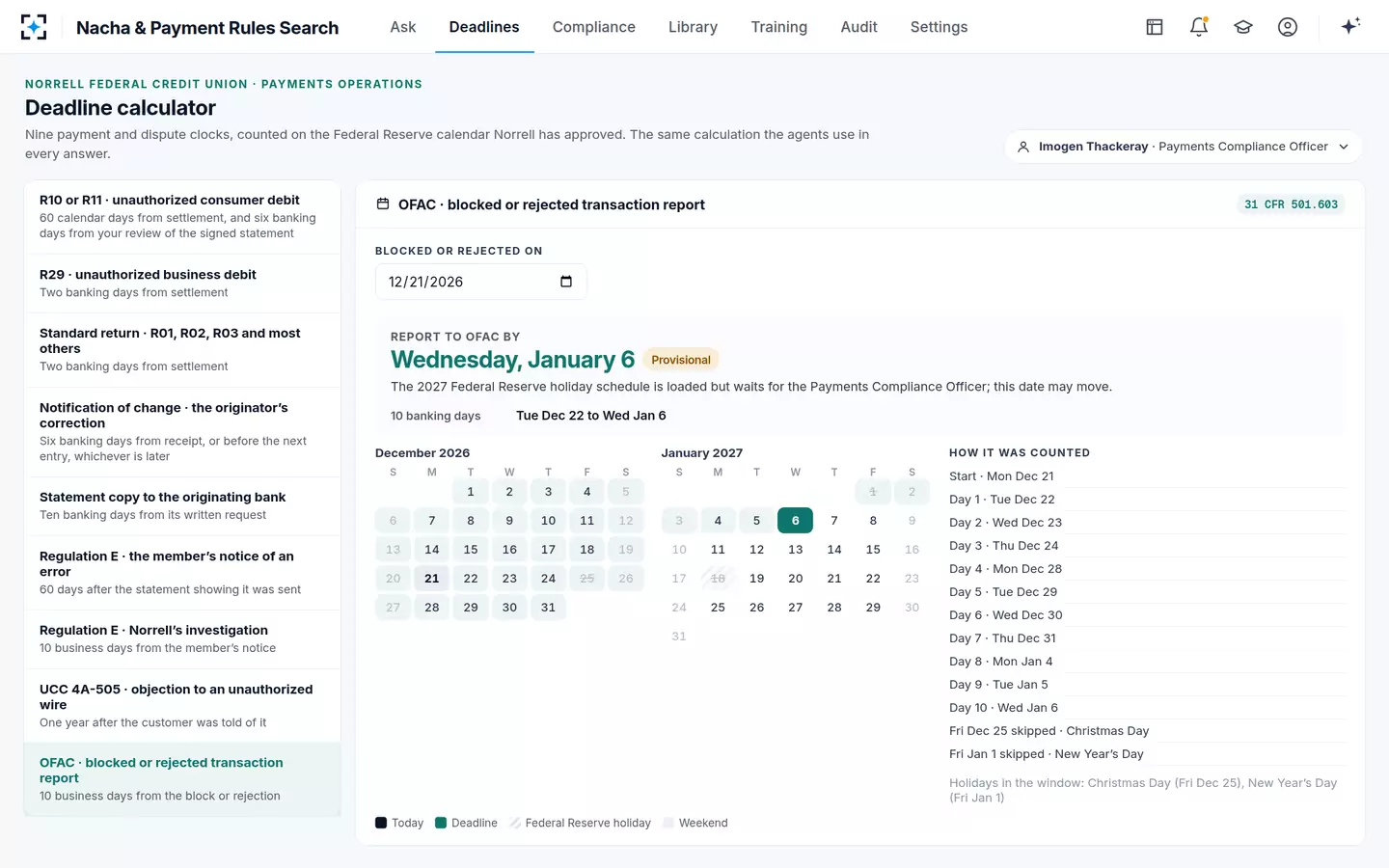
Published is not the same as approved for use. A deadline counted today that falls in 2027 rests on a schedule the institution has not yet reviewed. Nacha & Payment Rules Search marks such a date provisional until the Payments Compliance Officer approves that year's schedule.
A deadline in a year whose calendar is not yet approved is marked provisional
Does ACH process on holidays?
FedACH does not settle on Federal Reserve holidays, but it does process around them. The 2026 schedule shows processing ending the night before or the Saturday before a holiday and resuming at 5:30 p.m. ET on the holiday itself, so that files are ready for the next banking day. Nacha's request for comment on the Banking Day definition states the settlement position plainly: "Currently, ACH settlement occur only on Mondays-Fridays except Federal banking holidays" (Nacha, Banking Day RFC).
FedNow is the exception. Under Operating Circular 8, "The FedNow Service has a 24-hour business day each day of the week" (FRFS, Operating Circulars), so a FedNow question never needs a holiday calendar at all. A desk answering ACH, Fedwire and FedNow questions already runs on three calendars; after 2028 it will run on three different ones.
What happens to a payment due on a holiday?
It moves, and the direction depends on what it is. Nacha describes the common industry practice: "Paydays that otherwise would be on a weekend or holiday are paid on the prior Friday, while bill payments are due and collected on the next business day, in each case favoring the employee/consumer" (Nacha, How ACH Payments Work). Payroll on a Friday is available "by 9 a.m. on that day in virtually all cases", Nacha adds, even on a long weekend.
Deadlines are different from payments. A return window counted in calendar days does not stop for a holiday; one counted in banking days skips it. The 60 days for an unauthorized consumer debit run straight through Labor Day and Columbus Day, while the six-banking-day clock after a signed statement is reviewed steps over them. The 60-day return rule, and the questions to ask before answering it, counts both on one debit.
Will Fedwire run on Sundays? Yes, from 2028 at the earliest
The Federal Reserve Board announced on October 9, 2025 that Fedwire and the National Settlement Service will add Sundays and weekday holidays. On timing it was careful: the Reserve Banks will make the change in several years, not before 2028, so that operators and banks are ready (Federal Reserve Board, press release, 9 October 2025). The Fedwire cutoff time and the move to 22x6 follows what the longer week means for a wire room.
The hours do not change: Fedwire stays open 22 hours a day and the National Settlement Service 21.5. Saturdays stay closed, and the Board says it will "monitor demand for a potential further expansion of operating hours to seven days per week", which would come with a new proposal and public comment. FedACH is not part of the announcement.
For anyone who counts days, the important consequence is that "Federal Reserve holiday" stops being one list. A weekday holiday will be a Fedwire funds-transfer business day and still not an ACH settlement day. Article 4A deadlines measured in funds-transfer business days, such as the beneficiary's bank's duty to notify by midnight of the next one, are then likely to run through holidays that ACH deadlines skip; the implementation notice will settle it.
Why every day count now needs an edition date
A day count is only as good as the calendar it was counted on, and from 2028 the right calendar depends on the date of the payment as well as the service. A procedure that says "two business days" without saying whose will be wrong after the change, and an answer counted on the 2027 Fedwire calendar will be wrong for a wire in 2028.
So treat calendars the way you treat rulebooks: one per service, one per year, each with an effective date and an approver, and the change itself loaded as an edition when the Reserve Banks announce the implementation date. In Nacha & Payment Rules Search each year's Federal Reserve schedule is approved before use, the calculation agent marks provisional any date in a year not yet approved, and the edition agent will load the expanded Fedwire calendar, when it is published, beside the ACH one rather than over it. The full run of upcoming changes is in the Nacha and Federal Reserve change calendar to 2028.
Questions people ask
Is Good Friday a Federal Reserve holiday?
No. The Reserve Banks' schedule lists eleven holidays, and Good Friday is not among them, so it is a banking day for FedACH and Fedwire. Individual institutions may close their branches, but since January 1, 2026 the Nacha rules count the ACH Operator's banking days, not the institution's.
Does Fedwire open on Sunday evening?
Yes, for Monday's business. The Reserve Banks' example is that "on a Sunday preceding a Monday funds-transfer business day, the Fedwire Funds Service will open at 9:00 p.m. ET on Sunday for the Monday funds-transfer business day". Sunday itself becomes a business day only once the expansion is implemented, no earlier than 2028.
Is Juneteenth a Federal Reserve holiday?
Yes. June 19 is on the Reserve Banks' schedule every year from 2026 to 2030; in 2027 it falls on a Saturday, so the Reserve Banks open on Friday, June 18. It is not among the holidays listed in Regulation CC's definition of business day as the eCFR publishes it.
Where is the official Federal Reserve holiday schedule?
On the Federal Reserve Financial Services Holiday Schedules page, which lists the holidays for 2026 through 2030, the FedACH processing times around each 2026 holiday, and a pointer to foreign banking holidays for FedGlobal ACH payments, because, as the page says, "Foreign country banking holidays are not identical to U.S. banking holidays".
Does Same Day ACH settle on a Federal Reserve holiday?
No. All ACH settlement, same-day and next-day, happens on banking days; Nacha's own summary is that ACH settlement currently occurs "only on Mondays-Fridays except Federal banking holidays". A Same Day ACH entry submitted on a holiday settles on the next banking day at the earliest.
Does FedNow work on Federal Reserve holidays?
Yes. Operating Circular 8 gives FedNow "a 24-hour business day each day of the week", on a schedule the Reserve Banks publish. FedNow handled 6,376,467 payments in the third quarter of 2026, according to the Reserve Banks' FedNow statistics.