"FI approval pending" on a wire transfer means the wire has been approved on the customer's side and is waiting for the financial institution, the FI, to approve and release it. It is a status label in business online banking, not a term defined in the rules that govern wires, and it covers the ordinary checks a bank runs before a wire leaves: verifying the request, often by callback, confirming the money is available, checking limits, screening against sanctions lists, and sometimes a closer review. Whether the bank will say which of those is holding a wire depends on the reason: its own processing it can describe, another bank's compliance reason it should not repeat, and anything that could reveal a suspicious activity report it may never disclose. Botminds' Wire Inquiry & Payment Tracking turns that line into written, versioned disclosure rules and drafts the sentence staff may say.
This page is for the front-line and service staff who take the call and the compliance officers who decide what they may say. The rules quoted are the eCFR's, the FDIC's and the UCC's; the examples come from a fictional sample bank, Tessaly Community Bank, in the solution.
What a bank may say about a held wire, and what it may not
May be said, by the officer on the call: "Your wire is waiting for our verification call-back." "It was released at 3:04 p.m. and settled at 3:06 p.m."
May not be said, or not without a second person: Nothing here needs holding back; this is the customer's own transaction.
May be said, by the officer on the call: "A bank on the route has asked for the invoice and the supplier's full street address."
May not be said, or not without a second person: Which bank's screening raised it, or why: another bank's compliance reason stays with staff.
May be said, by the officer on the call: Standard wording: "Your payment is in progress. We will contact you when it completes."
May not be said, or not without a second person: Any hint of a suspicious activity report, or of why a wire is restricted.
May be said, by the officer on the call: "Expected Friday", with the basis available to staff.
May not be said, or not without a second person: "It will arrive Friday", or a threat of return, without a basis.
May be said, by the officer on the call: Drafted from approved wording.
May not be said, or not without a second person: Sent without the wire operations supervisor's approval.
What does FI approval pending mean on a wire?
In the business banking platforms that use the label, a wire passes two sets of approvals. The customer's own users enter and approve it, which is what "approval pending for user" refers to, and then the bank, the FI, approves and releases it. "FI approval pending" means the first set is done and the second is not. The money may or may not have been debited yet, depending on when the bank posts; in the sample bank, the debit and the release happen together.
The bank's side is not a formality. Under UCC Article 4A a bank has no general duty to send a wire just because a customer asked: absent an express agreement, a receiving bank has no duty to accept a payment order, or to do anything about it before it accepts (UCC 4A-212; whether a bank can hold a wire transfer quotes the section). For the customer's own bank, acceptance happens when it executes the order (UCC 4A-209(a)). Until then, the wire is a request.
Why is my wire transfer pending? The checks a bank runs before release
Most pending wires are waiting on ordinary controls that examiners expect a bank to have. The FDIC's procedures ask whether a bank's funds transfer policies cover "Callback requirements", "Collected funds versus uncollected funds", "Credit standards and overnight and daylight overdrafts limits", "Office of Foreign Assets Control (OFAC) compliance" and "authorizing dollar limits", among others (FDIC, Electronic Funds Transfer Risk Assessment). Each one is a reason a wire can sit in a queue for minutes or hours.
Why a wire waits for the bank, and who may explain each reason
| Reason | What the bank is doing | Usually told to the customer? |
|---|---|---|
| Callback or verification | Confirming the request with an authorised signer, by a channel the bank chose | Yes; the customer is part of it |
| Funds not yet available | Waiting for collected funds or an approved overdraft | Yes |
| Over a limit | Waiting for the officer who can approve a larger amount | Yes, as "a second approval" |
| Sanctions screening | Clearing a possible match against sanctions lists | That a review is under way, not the match |
| Fraud review | Checking signs that the customer is being deceived or the account is compromised | Often, because the customer can help; with care |
| A review that may lead to a report | Anything connected with a suspicious activity report | Never anything that would reveal it |
Callbacks deserve a word, because customers find them slow and fraud teams find them essential. When the Federal Reserve's 2026 survey of risk officers asked what respondents were doing about wire fraud losses, the first answer listed was blunt: make callbacks and PIN codes mandatory (Federal Reserve Financial Services, 2026 Risk Officer Survey, answers as respondents gave them; the wire fraud detection buying questions quote the list).
A pending wire can also be pending at the Federal Reserve. Fedwire reports a payment it is still processing, or one the Reserve Banks have stopped, with a PDNG status, and resolves it by the end of the day as settled or rejected (Fedwire ISO 20022 Format FAQs). That status is for the bank, not the customer, and it does not say why.
Can the bank tell me why a wire is held?
Sometimes. A bank can tell a customer about its own processing: the callback, the limit, the funds, and that a review is under way. It should not repeat another bank's compliance reason, which is that bank's to give. And it may never say anything that would reveal a suspicious activity report, whoever asks and however reasonable the question.
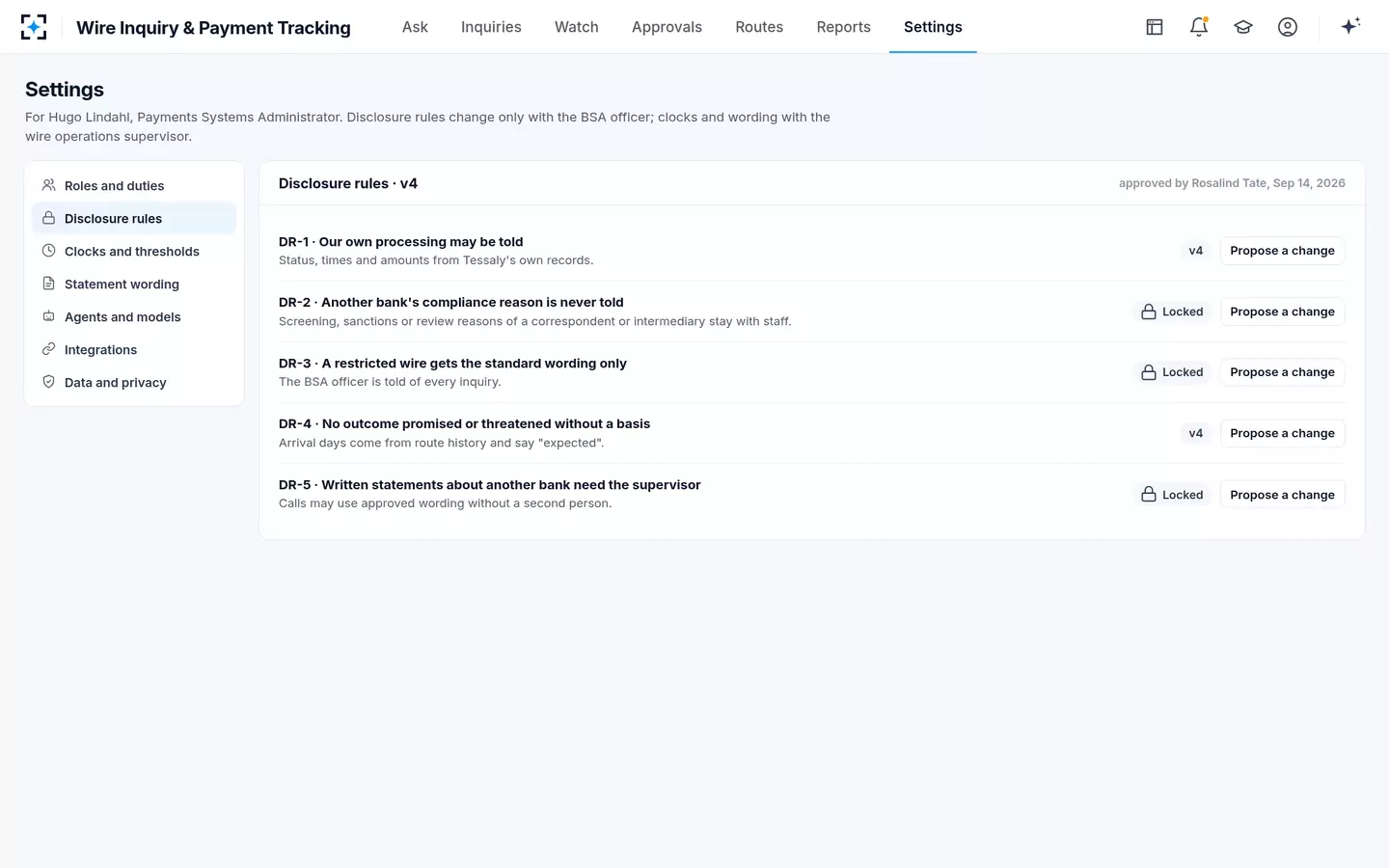
The sample bank writes these as five rules. Its own processing may be told. Another bank's compliance reason is never told. A restricted wire gets the standard wording only, and the BSA officer is told of every inquiry on it. No outcome is promised or threatened without a basis, so an arrival day says "expected" and a return risk is not mentioned unless it is real. And any written statement about another bank needs the wire operations supervisor. Who holds each of those decisions at a small bank is its own question.
The line the law draws: SAR confidentiality, word for word
The only part of this that is law rather than policy is short and absolute. "A SAR, and any information that would reveal the existence of a SAR, are confidential and shall not be disclosed", and the bar covers everyone at the bank, from directors to agents (31 CFR 1020.320(e)(1)(i); the payment investigation tool shows what that rules out in a reply).
The rule names a few exceptions, none of them for customers: disclosure to FinCEN, law enforcement and the bank's examiners; sharing "within the bank's corporate organizational structure"; and the underlying facts, transactions and documents for a joint SAR or certain employment references, all "Provided that no person involved in any reported suspicious transaction is notified that the transaction has been reported" (31 CFR 1020.320(e)(1)(ii)). For an inquiry desk that means the safe wording for a restricted wire must be indistinguishable from the wording for any slow wire. The sample bank's standard reads, in full: "In progress. We will contact you when it completes."
Disclosure rules in Wire Inquiry & Payment Tracking: versioned, owned and locked
How long can a wire transfer stay pending?
At the bank, only as long as its controls take, and not indefinitely: Article 4A cancels an order nobody accepted: it lapses at the close of the receiving bank's fifth funds-transfer business day after the execution or payment date (UCC 4A-211(d)). A wire still held when the Fedwire customer cutoff of 6:45 p.m. ET passes cannot go that day, and waits for the next funds-transfer business day (Fedwire operating hours).
Further down the route, holds at other banks have no such clock the customer can see. The sample bank's own clocks are settings: an inquiry is answered within 15 minutes on a call or two business hours in writing, an open inquiry older than an hour goes to the supervisor, and a wire held 24 hours at another bank opens an investigation by itself.
When a consumer's international transfer is held for a BSA or OFAC review
For a consumer's remittance transfer, a hold for a required review does not make the transfer late in law. A missed Date Available is not an error if it resulted from "Delays related to a necessary investigation or other special action by the remittance transfer provider or a third party as required by the provider's fraud screening procedures or in accordance with the Bank Secrecy Act, 31 U.S.C. 5311 et seq., Office of Foreign Assets Control requirements, or similar laws or requirements" (12 CFR 1005.33(a)(1)(iv)(B)).
That exception protects the provider's remedy obligations; it does not license an explanation. The customer can be told the transfer is delayed and when the bank will update them, not why a review is under way. When a status call on a consumer wire becomes a notice of error covers the rest of the clock.
When the wire is pending at another bank, not yours
A customer's screen can say "sent" while the payment is in fact waiting at a correspondent, an intermediary or the beneficiary's bank. The same rule applies there as at home: until that bank accepts the order it owes no one a duty to act on it, absent an agreement, and an order no bank accepts is cancelled by operation of law at the close of its fifth funds-transfer business day after the execution or payment date, so the money comes back rather than sitting forever (UCC 4A-212 and 4A-211(d)). What the sending bank can learn is that the other bank has the payment and what it wants; what it cannot pass on is that bank's reason.
In the sample bank, seven of 38 wires in flight were held at other banks one afternoon, for a purpose code, an invoice, a foreign exchange declaration, a review and screening. For each, the officer could say which country the payment had reached and, where a bank there had asked for something, what the customer could send to help. None of the other banks' reasons reached a customer screen.
Written statements: who signs what is said about another bank
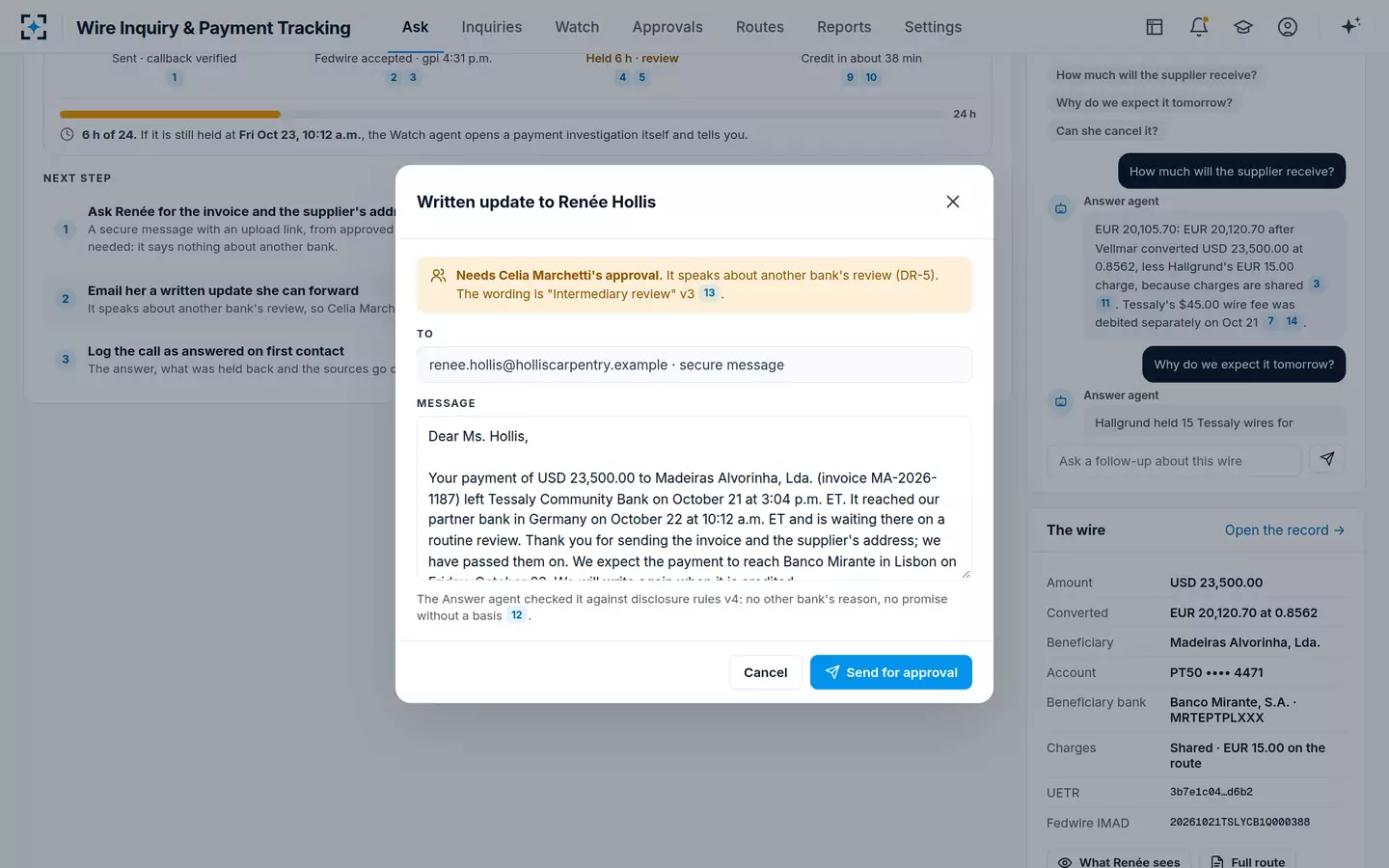
Spoken words fade; written ones are quoted back. The sample bank lets an officer use approved wording on a call without a second person, but any written update that speaks about another bank's actions goes to the wire operations supervisor, who can edit it, return it with a reason code such as "Says too much about another bank", or approve it. The officer who drafted it cannot approve it.
A written update about another bank's review waits for approval in Wire Inquiry & Payment Tracking
Before you tell a customer why a wire is pending
- Is the reason ours?
Callback, funds, limit and our own queue can be told plainly.
- Is it another bank's?
Say that a bank on the route has asked for information, and what it needs; not its reason.
- Could it touch a SAR?
Use the standard wording only, and tell the BSA officer someone asked.
- Am I promising a day?
Say "expected", and only with a basis the bank can show.
- Is it going in writing?
A statement about another bank needs a second person before it is sent.
- Is the wire really held at all?
Check the release and the Fedwire status first: many "pending" questions are about wires that have already gone.
Some holds belong to specialist teams, and the customer conversation follows their rules. Holds for a possible sanctions match are covered in why a bank would hold a wire transfer, and holds for suspected fraud in can a bank hold a wire transfer. For everything else, Wire Inquiry & Payment Tracking shows the sentence, the sources and what was held back on one screen.
Questions people ask
Who can I ask about a held wire?
Your own bank's treasury services or wire team, through the channel your wire agreement names. The bank can tell you about its own steps and whether a bank on the route has asked for information; other banks will not answer a customer directly.
What is a compliance hold on a wire?
A pause while a bank checks the payment against its legal obligations, such as sanctions screening or a fraud review. The bank may tell you a review is under way; it may not tell you anything that would reveal a suspicious activity report, under 31 CFR 1020.320(e).
Can I cancel a pending wire transfer?
Usually, if the bank has not yet executed it. Under UCC 4A-211(b) a cancellation works if it reaches the bank in time, and in a form, that gives the bank a fair chance to act on it before acceptance (what a wire recall is), and it must be verified under any agreed security procedure; after acceptance it needs the bank's agreement.
Can a bank refuse to send a wire?
Yes. Without an express agreement to accept, a bank has no duty to accept a payment order under UCC 4A-212, and a bank must not send a payment its sanctions obligations forbid. Your wire agreement may set out when the bank will tell you it has rejected a request.
Why did my bank ask me for an invoice after the wire was sent?
Because a bank further down the route asked for it. Intermediary and beneficiary banks can hold a payment until they understand its purpose; the FSB found incomplete supporting documents among the main causes of long processing times in the slow corridors it studied (FSB, 2025). Your bank may tell you what the other bank needs, and should pass your answer on quickly; in the sample, the invoice and address went back to the correspondent two minutes after the customer uploaded them.
Does pending mean the money has left my account?
Not necessarily. Banks differ on when they debit the account; the money has left the bank only once the wire is released, and on Fedwire it is settled when the Reserve Banks record the payment. Ask the bank which applies to your account.