A wire inquiry is a customer's or another bank's question about a funds transfer: where it is, whether it arrived, why it has not, or what happened to part of the amount. At a community bank the wire inquiry can land on one desk, where a treasury services officer or a deposit operations specialist must find the wire, read what Fedwire and the correspondent say about it, and decide on the phone what can be told. That is hard because the evidence sits in four or five systems and the law limits what may be said about some holds. Botminds' Wire Inquiry & Payment Tracking exists for that desk: agents trace the wire across the systems the bank already has, cite each stop, and draft the one sentence the officer may say, while a supervisor approves anything written about another bank.
The examples come from a fictional sample bank as it runs through the solution: Tessaly Community Bank, a $3.4 billion bank that sends and receives about 640 wires and answers about 110 wire questions on an ordinary day. The rules and figures are from the Federal Reserve, the FDIC, the OCC and the eCFR, linked where they appear.
Every inquiry is about a payment that was meant to be final
217.3M
Fedwire Funds transfers in 2025
869,187
Fedwire transfers on an average business day
$5.28M
average value of one Fedwire transfer
What is a wire inquiry, and who handles wire inquiries at a bank?
A wire inquiry is any question about a specific transfer that someone has to answer from the bank's own evidence. At a larger bank the work can be split across a contact center, a wire room, an investigations unit and a compliance team. At a community bank the same work can meet in one seat, and the person in it handles customers, the Fedwire messages and the correspondent all at once.
The inquiries come in four shapes. An outgoing customer asks where the money is. An incoming beneficiary asks whether it has arrived. A correspondent or an intermediary bank asks for information before it will move a payment on. And the bank's own staff ask why a wire is still in the queue. Each needs a different source, and each carries a different limit on what may be said.
The examiners' view of this seat is older than the tools. The FDIC's electronic funds transfer procedures ask whether the bank has policies for "Callback requirements", "Use of customer confirmations and advices" and "Maintenance of wire log", and whether management "issues customer advices in a timely manner" (FDIC, Electronic Funds Transfer Risk Assessment). An inquiry is what happens when one of those did not reach the customer, or did not answer the question the customer had.
One officer, and the people a wire inquiry depends on
Today
Takes the call, finds the customer in the core and the wire in the payments hub by date and amount, then opens a ticket and promises a callback.
With agents
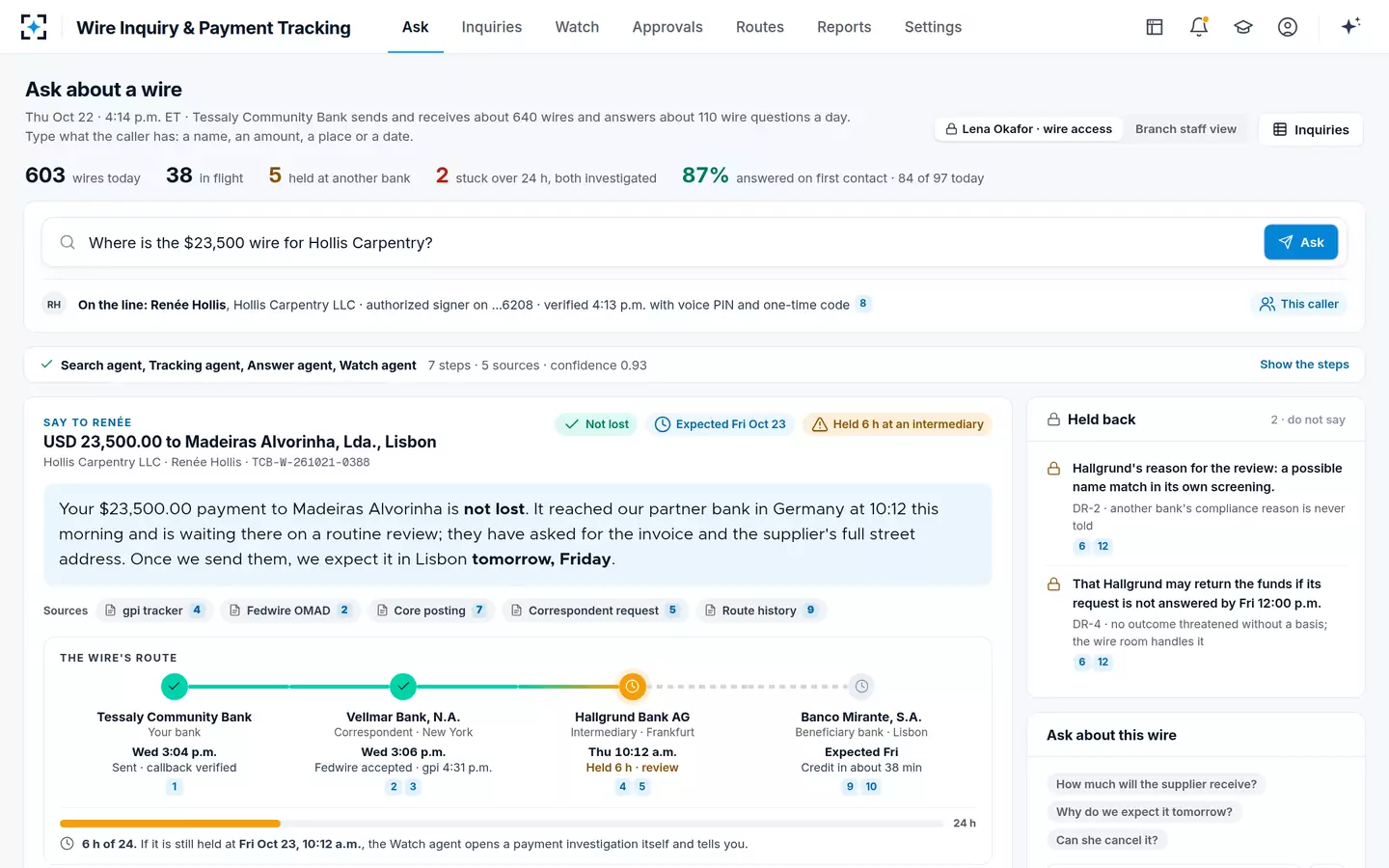
Types what the caller said and reads one sentence she may say, with the route and its sources, while the caller is still on the line.
Still theirs: what is said, and whether to escalate
Today
Reads the Fedwire messages, logs in to the correspondent portal, and answers the other bank's request for information, between releasing wires.
With agents
Opens one timeline of every event on the wire and spends the afternoon on the wires that are really held.
Still theirs: answers to correspondents and every release
Today
Insists nobody writes about another bank's review without her, with no queue to make sure of it.
With agents
Approves, edits or returns each written statement and escalation, with the evidence beside it.
Still theirs: the second signature
Today
Relies on every officer to know, on the phone, what must never be said about a review or a restricted wire.
With agents
Owns the disclosure rules as a versioned setting and is told of every inquiry on a restricted wire.
Still theirs: what may never be said
What information is needed to trace a wire?
To trace a wire, the bank needs to identify one transfer and then read what each system along its route recorded. The caller rarely has a reference. They have a name, an amount, a place and roughly a day, and the first job is to turn that into one wire without guessing.
What a trace needs, where it lives, and what it proves
| Piece of evidence | Where it lives | What it proves |
|---|---|---|
| Customer, account and caller verification | Core banking system, contact center platform | That the person asking may be told about this wire |
| The wire itself: amount, date, beneficiary, release time | Payments hub | What the bank was asked to send and when it let it go |
| Fedwire acknowledgment, status and the IMAD and OMAD | Fedwire gateway | That the Reserve Banks accepted and settled the message, and when |
| UETR status and requests for information | Correspondent portal and tracker | Where the payment is beyond the first bank, and what that bank wants |
| Posting and fee | Core banking system | That the customer's account was debited, and by how much |
| Earlier answers and approvals | Case notes, email, the wire log | What this customer has already been told |
The Fedwire evidence is the strongest piece and the easiest to misread. Under Operating Circular 6 the Reserve Banks settle an accepted payment order between the two banks' accounts, advise the receiver of the credit and may acknowledge the sender, and their records settle any argument about when that happened (OC 6, sections 8.2.6 and 8.2.7). That proves the first interbank leg. It does not prove that the correspondent has sent the payment on, or that the beneficiary has been credited, and an officer who says "the Fed shows it was received" about a cross-border wire is answering a different question from the one asked. The numbers on a wire, and what each one proves, are set out separately.
Why separation of duties is hard when the wire room is one desk
Examiners expect the duties around a wire to be split, and a one-desk wire room cannot split them by itself. The FDIC's procedures ask whether "the person reviewing rejects and exceptions is not involved in receiving, preparing, or transmitting funds", whether the bank separates "receiving instructions, posting to a customer's account, and mailing customer credit advices", and whether each wire can be traced from receipt to posting (FDIC EFT Risk Assessment, items 21, 26 and 27; a payment tracking system for wires keeps that trail).
The OCC frames the same expectation for every payment channel: internal controls "should include dual controls and segregation of duties throughout the bank's payment operations", and "When dual controls and separation of duties are not well-designed, implemented, and enforced by the bank, the bank's operational risk increases significantly" (OCC Comptroller's Handbook, Payment Systems, 2021). Inquiries are where that is easiest to forget, because an answer to a customer does not move money.
It can still do harm. An answer can promise a day the bank cannot keep, repeat another bank's compliance reason, or tell a customer something that reveals a suspicious activity report. In a one-person seat, the second look that a larger bank gets from its structure has to come from somewhere else: a written rule, a queue, and a supervisor who sees every written statement before it goes.
Separation of duties for a wire inquiry desk, when the desk is small
- Whoever answers the customer does not approve their own written statement
A second person approves anything written about another bank, an escalation or a recall request.
- Exceptions are reviewed by someone outside the release chain
The FDIC asks this of rejects and exceptions; an aged inquiry is an exception.
- What may be said is a written, versioned rule
Owned by the BSA officer, so it does not live only in the memory of the person on the phone.
- Every answer is kept with its evidence
Who asked, what was told, what was held back and why, and which message it rested on.
- Aged inquiries are reported to management
A wire nobody has looked at for a day is a finding waiting to happen.
- Correspondent requests have an owner and a clock
A request for information unanswered by its deadline can turn a held wire into a returned one.
Who do you call when a wire is missing?
When a wire is missing, the sending bank calls the next bank in its route, and the customer calls the sending bank. The customer cannot query Fedwire, a correspondent or a foreign bank directly, and the Federal Reserve is not a help desk for a payment it has already settled: once it has delivered the message, the trail continues at the receiving bank.
The next bank may not answer quickly, and nothing in the Fedwire rules makes it. Operating Circular 6 counts requests for payment, for information and for the return of funds among the nonvalue messages the Reserve Banks carry, and then says plainly that it puts no duty on anyone to answer them (OC 6, section 8.1.3; the payment investigation job description quotes the section). The obligation to respond comes from the banks' agreements, their correspondent relationships and their own interest in keeping a customer, not from the network.
For wire transfers, [it is being] unable to contact [the] RDFI in [a] timely manner.
A large community bank, Federal Reserve Financial Services 2026 Risk Officer Survey
The survey quote above is about fraud, where hours matter most, but the operations problem is the same: the other bank is reachable only through a contact list, a portal or a message, and a one-person desk has no time to chase. Where the bank itself is missing something, the circular is specific: a participant that sends a payment order and hears nothing back, neither acknowledgment nor rejection, should tell the Reserve Bank's staff at once (OC 6, section 8.6.1).
Who to contact about a missing wire, and what each can tell you
| Contact | When | What they can tell you | What they cannot |
|---|---|---|---|
| Your own payments hub and core | First, always | Whether the wire was released, debited and sent | Anything past the first bank |
| Federal Reserve Bank staff | Only when your own Fedwire message has no acknowledgment or rejection | Whether the Reserve Banks received and processed the message | Where the receiving bank sent it next |
| The correspondent or receiving bank | When Fedwire shows the payment settled but the beneficiary has not been paid | Its own processing, its tracker status, and what it needs from you | Another bank's compliance reasons, which it may not share |
| The beneficiary's bank, through the chain | When the payment reached it but no credit is confirmed | Whether and when it credited the account | Its screening decisions |
What can a bank tell a customer about a wire?
A bank can tell a customer what its own records show: when the wire was released, that it was debited, that the Reserve Banks settled it, and where the next bank says it is. What it may not tell is set partly by law and partly by policy. The law is short and absolute: a suspicious activity report, and anything that would reveal that one exists, may not be disclosed outside the narrow exceptions the rule lists (31 CFR 1020.320(e)).
Policy covers the rest, and each bank writes its own: whether another bank's screening reason may be repeated, and on what basis an arrival day may be given. The sample bank writes these down as five versioned disclosure rules, owned by its BSA officer: its own processing may be told; another bank's compliance reason is never told; a restricted wire gets standard wording only; no outcome is promised without a basis; and written statements about another bank need the supervisor. What a bank may say while a wire is held walks through each line.
Wire Inquiry & Payment Tracking on the call: the sentence, the sources and what is held back
How long does a wire inquiry take?
We found no regulator or public body that publishes how long a wire inquiry takes; the figures quoted for it come from vendors and networks. What can be said is where the time goes. The product team's own estimate for the sample bank, kept deliberately modest, splits a hand trace into five pieces: finding the customer and the wire, confirming the Fedwire leg with the wire room, logging in to the correspondent's portal, deciding what may be said about another bank's review, and calling back and writing the note. The portal and the decision are the slow parts, and the decision is the one that cannot be hurried safely.
On the sample data, the median from a wire question to the sentence the officer may say was 2 minutes 10 seconds over 30 days, and 84 of the 97 wire questions on the sample day were answered on first contact. The design target is 88% of wire status questions answered on first contact with no callback. Those are sample and target figures, not a customer's results.
The clock that matters to an examiner is different: how long an open inquiry sits. The FFIEC's retail payments procedures ask examiners to judge how well the investigation unit handles customer inquiries and whether it reports the age of open items to management at regular intervals (FFIEC IT Handbook, Retail Payment Systems, April 2016; quoted in the payment investigation job description). Those procedures sit in the booklet's ACH section, but the expectation travels: an inquiry desk should be able to show its oldest open items.
What Wire Inquiry & Payment Tracking changes for a one-person wire room
The solution does not add a person; it adds the structure a bigger bank gets from having more of them. Six agents split the mechanical part. A Search agent finds the wire from whatever the caller has and asks back when two wires fit. A Tracking agent reads the payments hub, the Fedwire gateway, the correspondent's tracker and messages and the core posting. An Answer agent writes the sentence under the bank's disclosure rules and lists what it held back. A Watch agent follows every wire in flight and opens an investigation at the bank's stuck mark, 24 hours by default for an international wire. An Investigation agent drafts the request to the correspondent, and a Records agent keeps every answer with its evidence.
The people keep the decisions. The officer decides what to say and what happens next. The supervisor approves every written statement about another bank, every escalation and every recall request, and makers never approve their own work. Below a confidence of 0.85, or when the correspondent's tracker is not answering, the agents hand the wire to a person. One trace, step by step, shows the sequence on a single wire.
Every inquiry kept with what was told, what was held back and why
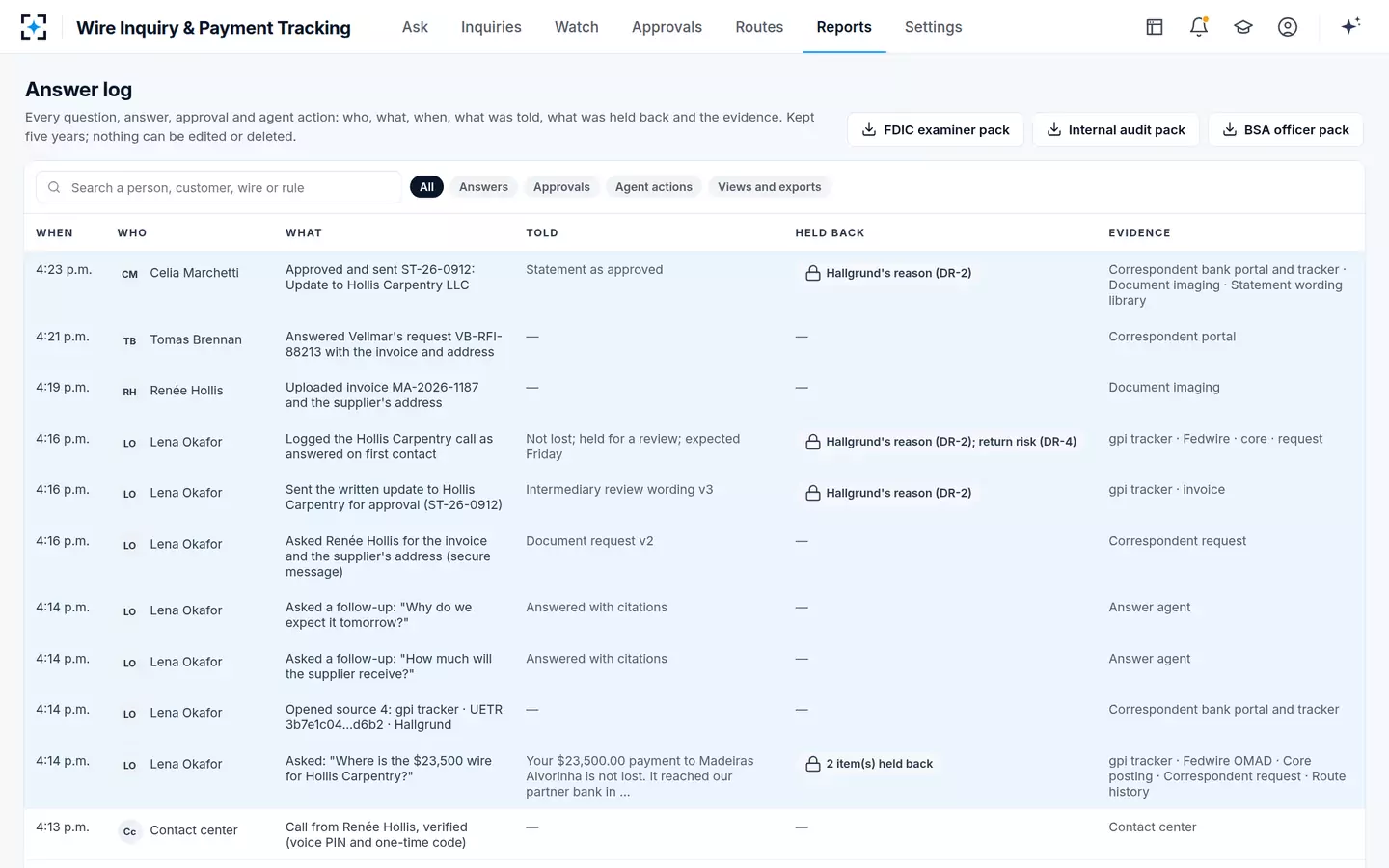
Five years is not arbitrary. The Bank Secrecy Act rules keep every record they require for five years (31 CFR 1010.430(d)), and a bank that keeps its inquiry answers alongside its funds transfer records can retrieve both together. To see the whole flow on one wire, start from Wire Inquiry & Payment Tracking.
Questions people ask
How do I make a wire inquiry?
Contact the bank that sent the wire, or your own bank if you are expecting one, with the amount, the date, the beneficiary or sender and any reference you have. Only the sending bank can trace an outgoing wire through the next bank in its route; the Federal Reserve, a correspondent or a foreign bank will not take the question from the customer directly.
Does a wire inquiry stop a wire?
No. An inquiry asks where a payment is; stopping it needs a cancellation request, which works only under the rules of UCC Article 4A, section 4A-211. Before the receiving bank accepts the order a timely cancellation can work; after acceptance it needs that bank's agreement (UCC 4A-211). Recalls are a different process with their own risks; what a wire recall is covers them.
How long must a bank keep wire records?
Five years for the funds transfer records the Bank Secrecy Act requires, under 31 CFR 1010.430(d). Those records must also be retrievable by the originator's name, and by account number for an established customer, under 31 CFR 1020.410(a).
Can a teller answer a wire inquiry?
A teller can give the customer an approved status sentence if the bank allows it, but should not be the one reading Fedwire messages or deciding what may be said about another bank's review. In the sample bank, branch staff see the sentence and the route only, with account numbers and references kept to wire-access roles.
Is a wire inquiry the same as a payment investigation?
No. An inquiry is a question answered from evidence the bank already holds; an investigation is opened when the evidence runs out, usually by sending a request to another bank and waiting for its answer. The sample bank opens one automatically when an international wire has been stuck for 24 hours, and the request waits for the supervisor before it goes; running the investigation itself to its end is the payment investigation process.
What is an OMAD on a wire?
The OMAD is Fedwire's Output Message Accountability Data, the identifier on the message the Reserve Banks deliver to the receiving bank; the IMAD is the matching Input Message Accountability Data on the message the sender put in. Together they pin down one Fedwire leg, which is why banks quote them when another bank cannot find a payment.