International wire transfer tracking for a consumer's remittance transfer has a legal edge that business wires do not: under Regulation E, a question about where the money is counts as a status inquiry, which is not an error, unless the funds missed the Date Available stated on the sender's receipt. Past that date, the same phone call can be a notice of error, which starts a 90-day investigation clock and, if no exception applies, a refund of the fees. A bank that tracks the wire correctly but files the call as a routine inquiry can still break the rule. Botminds' Wire Inquiry & Payment Tracking is built for that desk: it traces the transfer, compares today with the disclosed date, and routes any remittance error notice to a supervisor before it goes.
This page is for consumer service and compliance teams at banks and credit unions that send international transfers for consumers. The rule text is quoted from the eCFR; the examples come from a fictional sample bank in the solution.
One call, two duties: the decision Wire Inquiry & Payment Tracking puts in front of the desk
Agent
Trace the transferFind it from what the caller has; read the release, the Fedwire leg and the next bank's status by UETR.
Agent
Compare with the receiptIs today past the Date Available disclosed to the sender?
Never: decides the answer for the officer
A person decides
Before the date: a status inquiryAnswer with what may be said. No error, no clock.
A person decides
After the date: treat as a notice of errorRecord it, check the exceptions, and start the 90-day clock; a second person approves the written notice.
International wire transfer tracking under Regulation E: one sentence decides which call you took
The rule that matters is a single exclusion in the definition of an error. The term error does not include "An inquiry about the status of a remittance transfer, except where the funds from the transfer were not made available to a designated recipient by the disclosed date of availability" (12 CFR 1005.33(a)(2)(i)). Before the date, a tracking call is service. After it, the call is the consumer telling the provider its transfer did not arrive on time, which is an error under (a)(1)(iv) unless an exception applies.
The failure to make funds available to a designated recipient by the date of availability stated in the disclosure provided to the sender
12 CFR 1005.33(a)(1)(iv), the late-delivery error
Nothing in the rule requires the consumer to say "error". A notice can be oral, and it is enough that it lets the provider identify the sender, the recipient and the transfer, and "Indicates why the sender believes an error exists" (12 CFR 1005.33(b)(1)). "My mother still hasn't got the money and it's been a week" can be all of that. A desk that tracks the wire perfectly but logs the call as a status inquiry has lost the notice.
Does Reg E cover international wires?
It covers international wires that consumers send, through providers that send them in the normal course of business. A "remittance transfer" is "the electronic transfer of funds requested by a sender to a designated recipient that is sent by a remittance transfer provider", whether or not the sender has an account with the provider; the sender is a consumer sending mainly for personal, family or household purposes (whether international wires are covered under Reg E); and transfers of $15 or less are excluded (12 CFR 1005.30(e) and (g)). A bank that "Provided 500 or fewer remittance transfers in the previous calendar year" and provides 500 or fewer in the current one is deemed not to be a provider in the normal course of its business.
Business wires are outside Subpart B and sit under UCC Article 4A. The two can overlap: the 2012 text of Article 4A says the Article "applies to a funds transfer that is a remittance transfer" unless the transfer is an electronic fund transfer, and that where the two conflict, the Electronic Fund Transfer Act wins (UCC 4A-108(b) and (c); whether UCC 4A applies to consumer transactions quotes the section). States enact the UCC themselves, so check the version in force where the bank is.
What is the date available?
The Date Available is the date in the recipient's country on which the provider tells the sender the funds will be available, printed on the receipt under that name or a substantially similar term; the provider may add that funds may be available sooner (12 CFR 1005.31(b)(2)(ii)). It is the provider's own estimate, made when the sender pays, and it turns into the line that divides a status inquiry from an error.
That makes the arrival date a compliance number as well as a service one, and it should be set with the same care as any other disclosure. How long an international wire actually takes, and where the date comes from, is worth reading before a bank sets its own.
When does a late international wire become an error?
When the funds miss the disclosed Date Available and none of four exceptions applies. The failure is not an error if it resulted from extraordinary circumstances outside the provider's control that "could not have been reasonably anticipated"; from a necessary investigation or other special action under the provider's fraud screening, the Bank Secrecy Act, OFAC requirements or similar laws; from a transfer "made with fraudulent intent by the sender"; or from the sender providing "an incorrect account number or recipient institution identifier", if the provider meets five further conditions (12 CFR 1005.33(a)(1)(iv)(A)–(D)).
The last exception carries the most conditions. The provider must be able to show the sender gave the wrong number, must have used reasonably available means to check a recipient institution identifier against the institution's name, must have warned the sender beforehand that a wrong number could lose the transfer, the money must have gone into someone else's account, and the provider must have moved promptly and reasonably to get the money back (12 CFR 1005.33(h); why a wire comes back quotes the condition). Recovery itself is covered in what a wire recall is.
How long does the bank have to investigate a remittance error?
Ninety days to decide, three business days to report, one business day to fix once the sender chooses a remedy. The sender has 180 days after the disclosed date of availability to give notice. The clock is tightest at the end, and that is where the CFPB has found providers failing.
The remittance error clock: 180, 90, 3 and 1
| Step | Deadline | From | Rule |
|---|---|---|---|
| Sender gives notice of error | No later than 180 days | The disclosed date of availability | 1005.33(b)(1)(i) |
| Provider investigates and decides | Within 90 days | Receiving the notice of error | 1005.33(c)(1) |
| Provider reports results and remedies | Within 3 business days | Completing the investigation | 1005.33(c)(1) |
| Provider corrects the error | Within 1 business day, or as soon as reasonably practicable | Receiving the sender's choice of remedy | 1005.33(c)(2) |
| If no error, or a different one | With the report: a written explanation, and copies of documents on request | The report | 1005.33(d) |
Will I get my fee back if my transfer is late?
Yes, if the transfer missed its Date Available and no exception applies. On a late-delivery error the remedy includes refunding the amount not properly transmitted, or making it available to the recipient at no extra cost, and refunding the sender's fees, and the taxes collected where the law allows (12 CFR 1005.33(c)(2)(ii); remittance transfer error resolution quotes the remedy). The fee refund is not optional and does not depend on how late the money was.
It is also a duty the CFPB has enforced. The CFPB's 2022 order against Servicio UniTeller counted thousands of confirmed late-delivery errors in which the fee was never refunded (CFPB, 2022-CFPB-0012), and it was not the only such order. What each late day costs, party by party, sets those orders beside the Article 4A remedies for business wires.
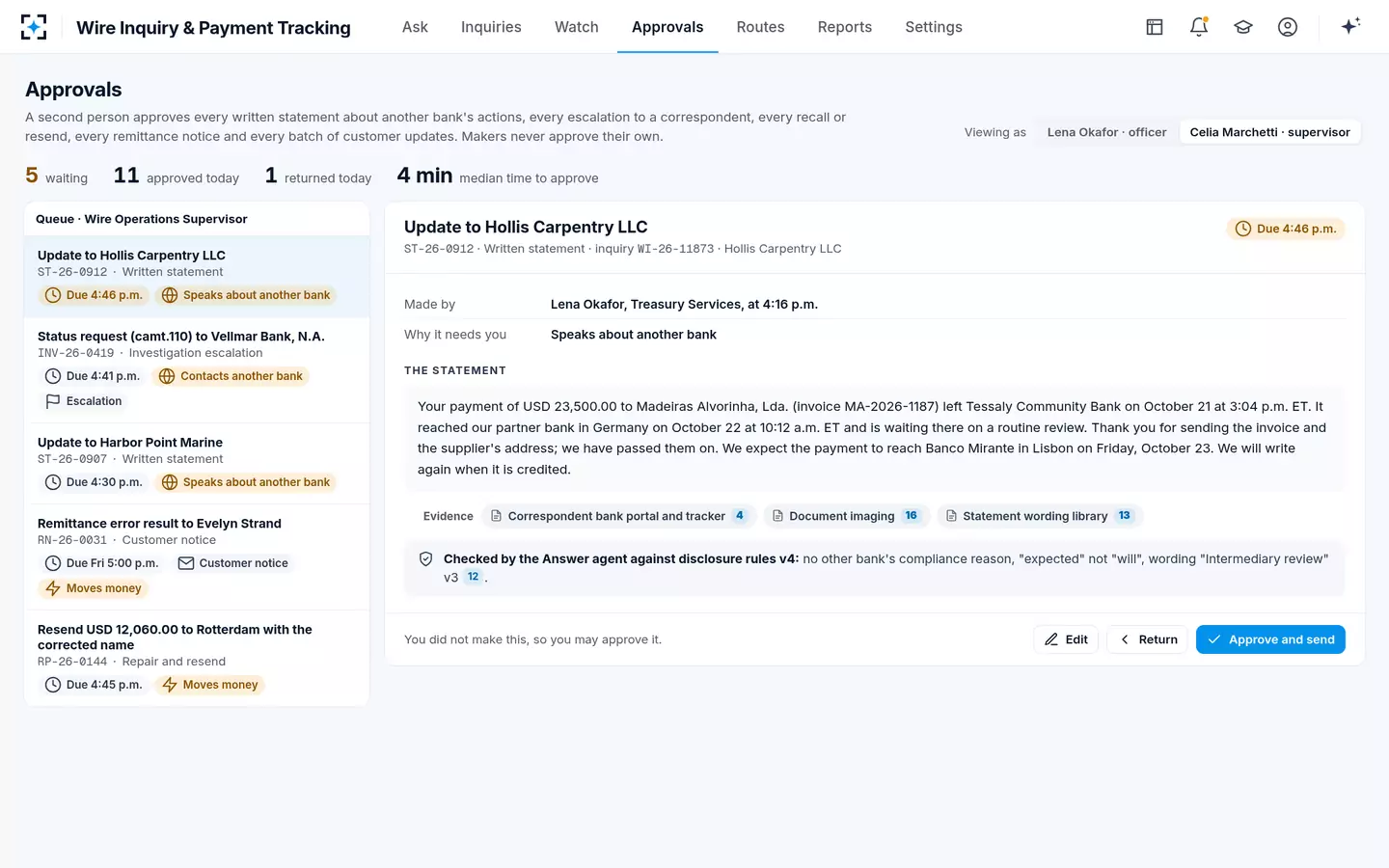
A remittance error notice waits for a second person in Wire Inquiry & Payment Tracking
The other clock on the first call: thirty minutes to cancel
Some tracking calls come minutes after the sender paid, and those carry a different right. A provider must honour any oral or written request to cancel that it receives "no later than 30 minutes after the sender makes payment in connection with the remittance transfer", provided the request identifies the sender and the transfer and the funds "have not been picked up by the designated recipient or deposited into an account of the designated recipient" (12 CFR 1005.34(a)).
The refund is total: the amount, the fees and, where the law allows, the taxes, "within three business days of receiving a sender's request to cancel". A caller who says "where is it, and can I stop it?" twenty minutes after paying is asking for a cancellation as well as a status, and a desk that answers only the status has taken the wrong call a second way. Business wires have no such window; their cancellation runs under Article 4A-211.
What a remittance error file must keep
A provider needs written procedures for error resolution, and those procedures must keep the evidence. At a minimum, the rule says, they must ensure "the retention of any notices of error submitted by a sender, documentation provided by the sender to the provider with respect to the alleged error, and the findings of the remittance transfer provider regarding the investigation of the alleged error" (12 CFR 1005.33(g)(2)).
What a tracking desk should capture on every call about a consumer's international transfer
- The transfer and the disclosed Date Available
So anyone can see whether the call came before or after it.
- What the sender said, in their words
A notice can be oral; the words decide whether it was one.
- The status at the time of the call, with its source
The release, the Fedwire leg and the next bank's report.
- Which exception, if any, the bank relies on
With the evidence: the investigation, the event, or the sender's wrong number and the warning given.
- The dates the clock turns on
Notice received, investigation completed, report sent, remedy chosen, remedy made.
- Who approved the written notice
A second person, never the one who drafted it.
Banks send few remittances, but large ones
Banks are a small part of the remittance market, which is why the rule is easy to treat as a side issue, and their transfers are large, which is why it is not. When the CFPB raised the safe harbor to 500 transfers in 2020, it reported that "in 2017, banks and credit unions conducted 4.2 and 0.2 percent of all remittance transfers, respectively", and that "the average transfer size of a bank-sent remittance transfer was more than $6,500" (CFPB, 85 FR 34870, June 5, 2020).
Remittance transfers at banks: a small share, a large average, a real error rate
4.2%
of consumer remittance transfers sent by banks in 2017; credit unions 0.2%
$6,500+
average bank-sent remittance transfer
1.9%
of transfers on which consumers asserted errors, at the most
At up to 1.9% of transfers, a bank above the safe harbor that sends a few thousand consumer transfers a year could see dozens of error claims, on transfers that average thousands of dollars, and some of them will arrive as status calls. The tracking desk is where they are won or lost. Wire Inquiry & Payment Tracking puts the Date Available next to the trace, so the officer sees which call it is before they answer.
Questions people ask
How do I track an international wire transfer?
Ask the bank or provider that sent it, with your receipt. The provider traces it through the banks on the route by its UETR and the Fedwire records; if the Date Available on your receipt has passed, say so, because under Regulation E your call can then be a notice of error that the provider must investigate.
What if I gave the wrong account number?
The provider may not owe a remedy for the late or lost transfer, but only if it shows you gave the wrong number, warned you before you paid that a wrong number could lose the money, checked any bank identifier you gave, and promptly tried to recover the funds once it went to someone else's account. If it did not meet those conditions, the late-delivery error rules still apply.
Can a provider refuse to investigate?
Not a timely notice: one received within 180 days of the disclosed date that identifies you, the recipient and the transfer and says why you think there is an error must be investigated within 90 days. A provider that has fully complied need not reopen the same error if you assert it again, under 1005.33(e).
Does asking for documents count as an error?
Yes, in a sense: a sender's "request for documentation required by § 1005.31 or for additional information or clarification" is itself listed as an error, so the provider must answer it under the same procedures. A plain question about where the money is, before the Date Available, is not.
What if my bank holds the account but did not send the transfer?
Then the error rules for an incorrect electronic fund transfer from your account, in 12 CFR 1005.11, apply to your bank, and the remittance error rules apply to the provider that sent the transfer, under 1005.33(f)(1). If your bank is also the provider, 1005.33 applies to it.
Is a business's international wire covered?
No. Subpart B protects consumers sending money for personal, family or household purposes. A business wire falls under UCC Article 4A, which owes interest for a delay a bank caused and a refund if the transfer is never completed, but no fee refund for lateness.