If an international wire transfer has not been received, ask the bank that sent it to trace it: whether it left, whether the first interbank leg settled, and where the payment's UETR shows it now, including any request for documents a bank on the route is waiting on. What is owed for the delay depends on who sent it. A consumer's remittance transfer that misses the "Date Available" on its receipt is an error under Regulation E, with a fee refund unless an exception applies; a business wire falls under UCC Article 4A, which owes interest for a delay a bank caused and a full refund if the transfer is never completed. Botminds' Wire Inquiry & Payment Tracking is built for the sending bank's side: it follows every wire in flight and opens an investigation at the bank's stuck mark, so the delay is found before the customer's second call.
This page prices a late day for each party, using the law's own formulas and published rates. The worked example is a fictional sample bank, Tessaly Community Bank, and its sample wires; the enforcement figures are the CFPB's.
What one late day costs each party to an international wire
| Party | What it loses or owes | Set by | How big, on the sample |
|---|---|---|---|
| Consumer sender | The fees paid, refunded if the transfer misses its Date Available and no exception applies | 12 CFR 1005.33(c)(2)(ii)(B) | The whole fee, not a daily amount |
| Business sender | Interest for the delay, if a bank's improper execution caused it; nothing more unless agreed in writing | UCC 4A-305(a) | $2.53 a day on a $23,500 wire |
| Business beneficiary | Its supplier relationship, stock, a closing date: none of it recoverable from the banks by default | UCC 4A-305(a): "additional damages are not recoverable" | Not priced by the law at all |
| Sending bank | Staff time on each call, trace and request; fee refunds and remediation if its process fails | Its own operations; Regulation E orders | About $26.58 per quarter hour of staff time, priced at FinCEN's composite rate |
| Correspondent and beneficiary's bank | Their own investigation time; any interest their own law imposes | The law where each bank is located | Not visible to the sending bank |
International wire transfer not received: the first three questions
Every trace of a missing international wire starts with the same three questions, in order. Did it leave the sending bank? Did the first interbank leg settle? And where does the next bank say it is now? The first two are answered from the sending bank's own systems and the Fedwire messages, whose timing the Reserve Banks' own records settle conclusively (Operating Circular 6, section 8.2.7).
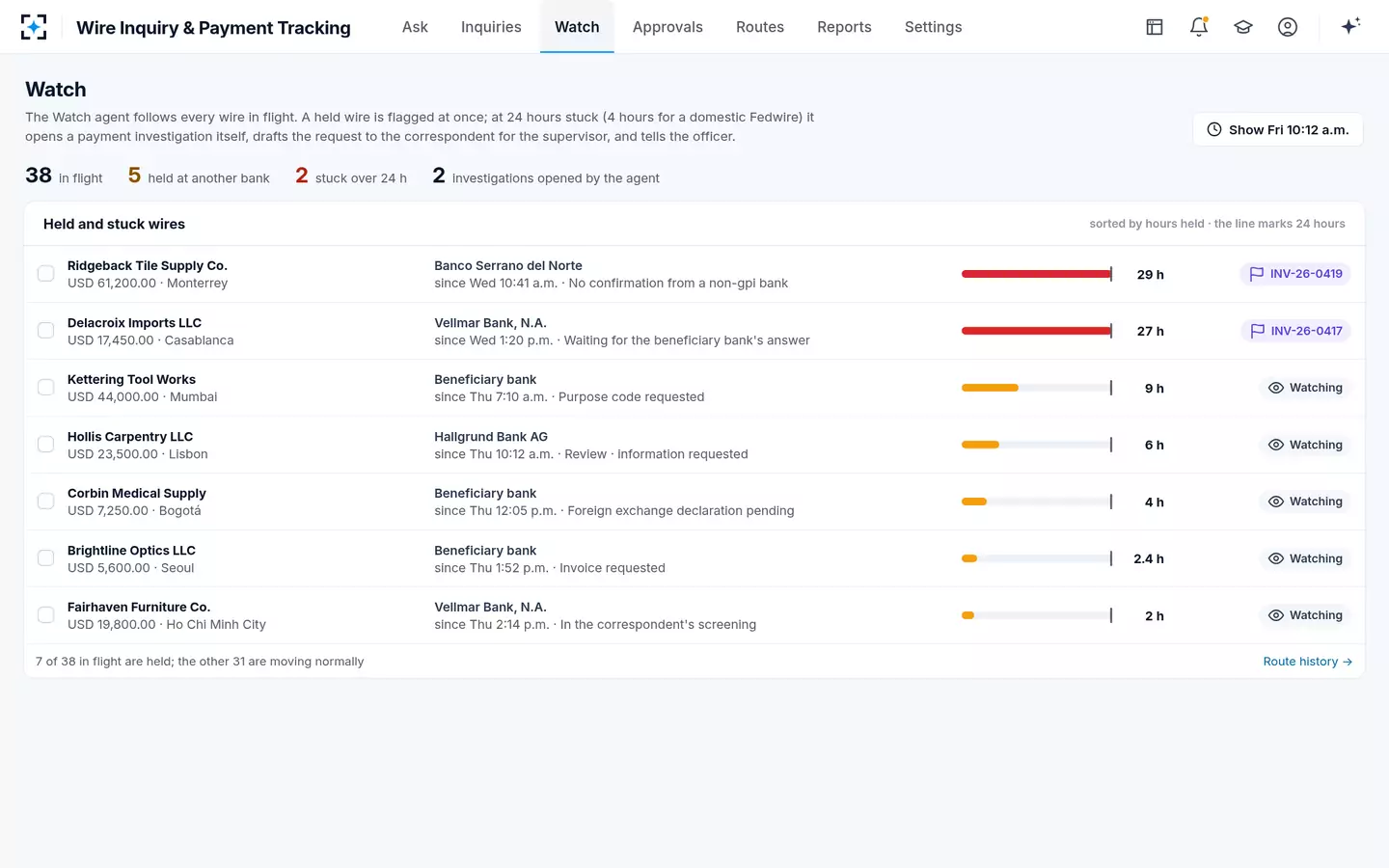
The third depends on what the correspondent, an intermediary or the beneficiary's bank reports by the payment's UETR, and on any request for information it has sent back. In the sample bank's longest-held wire that day, a $61,200 payment to Monterrey, the last tracker event was a transfer to a bank that did not report status, 24 hours earlier. That silence was the answer, and it is the point at which a bank should stop waiting and ask. The full trace, step by step is on its own page.
How long should I wait before asking about a wire?
For a large international wire, ask after one business day; for a smaller business payment, a day passing is not on its own a sign of trouble, and a consumer transfer should be judged against the Date Available on its receipt. In 2025, 93.2% of cross-border payments of $100,000 or more were credited within one business day of initiation, but only 39.6% of the business-to-business payment services in the FSB's retail sample credited recipients within one business day (FSB, 2025 progress report).
The sending bank should not wait for the customer at all. The sample bank sets its stuck mark at 24 hours for an international wire and four hours for a domestic Fedwire with no credit advice; at the mark the Watch agent opens an investigation and tells the officer. Those marks are settings, from 12 to 48 hours and from two to eight, because the right number depends on the bank's routes.
Every held wire in Wire Inquiry & Payment Tracking, measured against the 24-hour mark
Who is liable for a late international wire?
Liability follows the leg where the delay happened and the law that governs that leg. For a consumer's remittance transfer, the provider answers to the sender under Regulation E, whichever bank abroad caused the delay, unless one of the rule's exceptions applies. For a business wire, Article 4A puts it on the bank whose execution was improper: when a completed transfer arrives late because a receiving bank executed it badly, that bank owes interest for the delay to the originator or the beneficiary (UCC 4A-305(a)).
Two limits narrow that. Article 4A adds that "additional damages are not recoverable" except under "an express written agreement", so a missed shipment or a lost discount stays with the customer. And between the beneficiary and its bank, and on when payment is made, "the law of the jurisdiction in which the beneficiary's bank is located" governs (UCC 4A-507(a)); a delay at a bank in Lisbon is a matter for the law where that bank is located, not for a U.S. code.
Two senders, two rulebooks: what each is owed when an international wire is late
Consumer remittance transfer (Regulation E, Subpart B): Funds not available by the Date Available disclosed on the receipt.
Business wire (UCC Article 4A): A delay caused by a bank's improper execution, or a transfer never completed.
Consumer remittance transfer (Regulation E, Subpart B): Extraordinary circumstances; a necessary fraud, BSA or OFAC investigation; sender fraud; the sender's wrong account number, if conditions are met.
Business wire (UCC Article 4A): Article 4A lists none: interest is owed only where a bank's execution breached its duties under 4A-302.
Consumer remittance transfer (Regulation E, Subpart B): The fees, and taxes collected where the law allows, plus the transfer amount or delivery as the sender chooses.
Business wire (UCC Article 4A): Interest for the delay; the full amount with interest if the transfer is never completed.
Consumer remittance transfer (Regulation E, Subpart B): Notice within 180 days of the Date Available; investigation within 90 days; results within 3 business days; remedy within 1 business day of instructions.
Business wire (UCC Article 4A): No investigation clock in Article 4A; the bank's agreement with its customer may set notice periods.
Consumer remittance transfer (Regulation E, Subpart B): Not part of the remedy.
Business wire (UCC Article 4A): Only if the bank agreed to them in writing.
Will I get my fees back on a late wire?
A consumer will, unless an exception applies; a business gets no fee back for lateness, but gets its money back if the wire never arrives. For a remittance transfer that misses its Date Available, the remedy includes a refund of the fees, and of taxes collected where the law allows, and the provider must act "within one business day of, or as soon as reasonably practicable after, receiving the sender's instructions regarding the appropriate remedy" (12 CFR 1005.33(c)(2)). The exceptions matter: a delay caused by a review the provider's fraud screening, the Bank Secrecy Act or OFAC rules required is not an error.
The CFPB has found this duty broken in every remittance order it has issued since 2020, five in all, and three of the orders put it in plain words. In 2020 it found Sigue and its subsidiaries "failed to refund transaction fees when they did not make funds available by the disclosed date of availability" (CFPB, August 2020). In 2022 its order against Servicio UniTeller found fees not refunded "in at least 3,154 instances where a sender properly submitted an error notice alleging a date of availability error" (CFPB, 2022-CFPB-0012). In 2025 it found that Wise had not refunded fees on transfers that arrived late within the time the law allows (CFPB, May 2025); the Wise CFPB consent order and the four before it are set out case by case.
Late money, unrefunded fees: three CFPB orders on one duty
3,154
confirmed late-delivery errors with no fee refund, Servicio UniTeller, 2018–2020
$700K
civil money penalty in the UniTeller order (December 2022)
$300K
civil money penalty for Sigue (August 2020), with about $100,000 of redress
The refund nobody mentions: Article 4A-402 and the wire that never arrives
For a business wire that is never completed, Article 4A has a money-back rule that cannot be signed away. If the beneficiary's bank never accepts the payment, the sender does not owe it; a bank that was paid anyway must refund the money with interest from the day it was paid; and no contract can take that right away (UCC 4A-402(c), (d) and (f); why a wire comes back quotes the section).
That turns a trace into something more than customer service. A wire that is genuinely lost, rejected abroad or stuck at a bank that will not release it is not the customer's loss under 4A; the question is which bank refunds whom, and the sending bank refunds its customer first. Knowing on day one where the payment stopped is what lets the bank pursue the next bank rather than argue with its own customer.
Interest is the smallest cost: the 4A-506 formula, worked
The interest Article 4A owes is real but small, because the default rate is the overnight interbank rate. Unless an agreement or a system rule sets it, interest is the amount times the days times the average of the New York Fed's published federal funds rates for those days, divided by 360 (UCC 4A-506(b); UCC 4A-305 and interest on late wires works one claim day by day).
The price of one late day on the sample wire, as a sum
Interest owed
$23,500 × 3.88% ÷ 360
$2.53 a day; $107.78 a day on a $1 million wire. Owed only if a bank's improper execution caused the delay.
The bank that breached 4A-302
The bank's own time
minutes × $106.30 ÷ 60
A 15-minute call, trace and note is about $26.58 at FinCEN's composite rate; a second call doubles it.
The sending bank, every time the customer calls
Fees refunded
consumer remittance only
The whole fee, once the Date Available is missed without an exception. A business wire's fee is not refunded for lateness.
The remittance transfer provider
The customer's own loss
not recoverable by default
A delayed shipment, a missed discount, a closing that slips. It decides whether the customer stays.
The customer, unless agreed otherwise
The arithmetic makes the argument. The law prices a day of a $23,500 business wire at $2.53, less than the bank spends answering one phone call about it. The interest is not why banks should find stuck wires fast. The cost that matters is the customer's, which the law leaves with the customer, and the bank's own repeated time on a wire nobody has traced. A product or service head who prices answering faster against the interest owed would conclude it is not worth it; priced against calls avoided and customers kept, it can be.
When "not received" means the wrong account, or fraud
Some wires that were "not received" were received, by the wrong account or by a fraudster, and the need then shifts from tracking to getting money back. For a consumer's remittance, a wrong account number supplied by the sender is excused from the late-delivery error only if the provider can show the sender provided it, warned the sender beforehand that the money could be lost, and moved promptly to try to recover it (12 CFR 1005.33(h)). For business wires, the CPMI warns that "The lack of unique identifiers for accounts can potentially result in the misdirection or return of payments" (BIS CPMI, 2026).
Recovery is its own discipline, with indemnities, deadlines and other banks' agreement, and a different set of guides covers it: Wire Recall Management for recalls and wrong-account wires, and Wire Fraud Prevention where the instructions were changed by someone impersonating the beneficiary. The one fact every officer should know first is that the Federal Reserve will not cancel a Fedwire payment for anyone: under Operating Circular 6 a Reserve Bank has no duty to cancel or amend a payment order, only to pass the request on to the receiving bank, and the bank that sends the request takes on a liability under 4A-211 unless it disclaims the indemnity in so many words (OC 6, section 8.1.4; the payment investigation job description quotes the section).
Pricing the case for answering on the first call
The case for faster answers is made from the customer's side, not from the interest line. A customer who calls twice costs the bank twice, and a wire found stuck only on the second call has already lost a day of the time the beneficiary's bank, the correspondent and the customer needed to fix it. The sample bank's design target is 88% of wire status questions answered on first contact with no callback after a trace; on the sample day it answered 84 of 97.
Wire Inquiry & Payment Tracking opens an investigation itself at the 24-hour mark
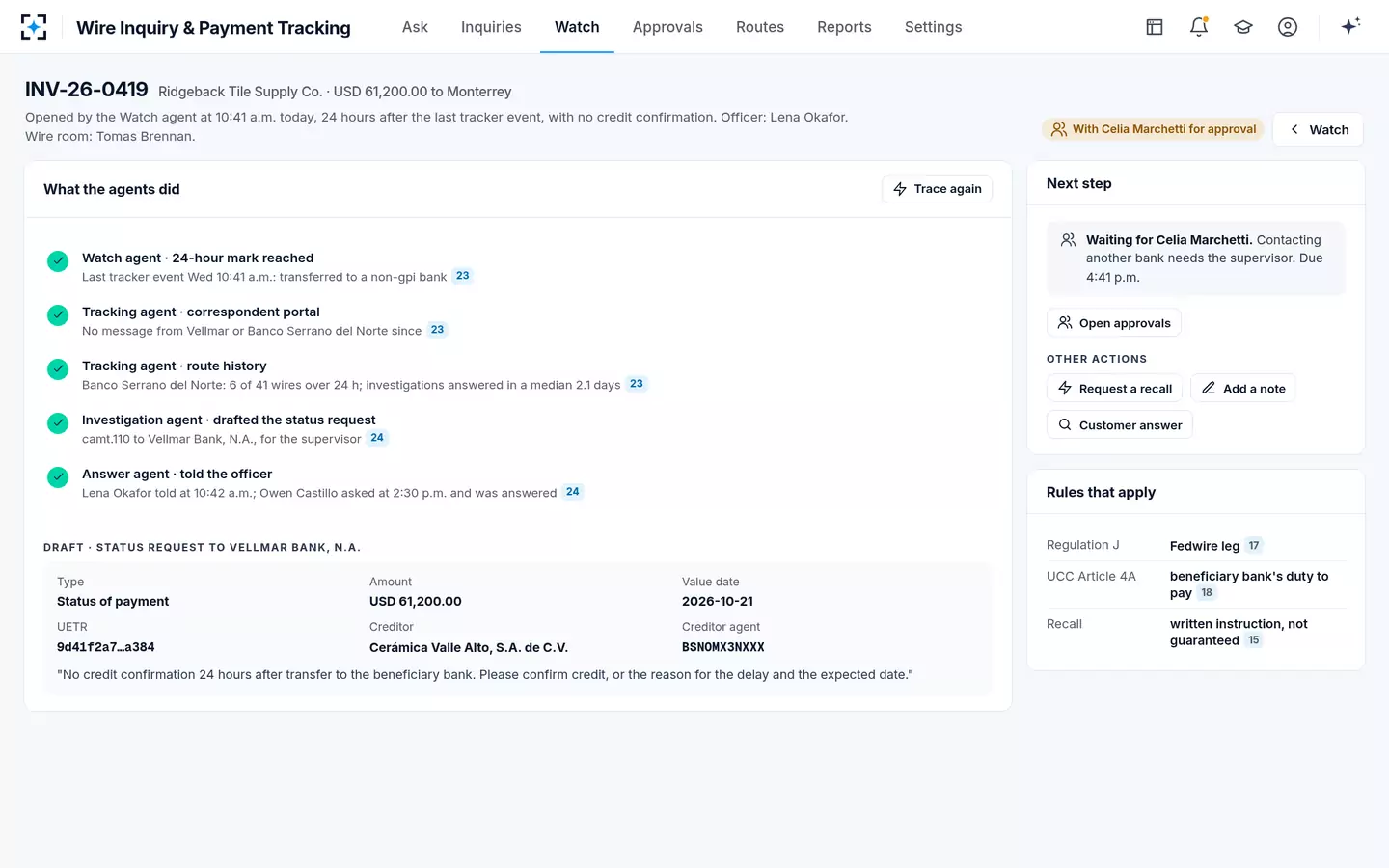
That is the trade Botminds' solution offers a service head: the trace and the investigation start themselves, and the decisions stay with people. Where a consumer's status call becomes a Regulation E error covers the consumer side in detail, and Wire Inquiry & Payment Tracking shows the whole flow.
Questions people ask
Can I claim interest on a late wire?
A business sender or beneficiary can, under UCC 4A-305, if a bank's improper execution caused the delay; the default rate is the New York Fed's federal funds rate divided by 360, which at 3.88% is $2.53 a day on $23,500. A consumer's remittance transfer has its own remedies under Regulation E: fee refunds and redelivery or refund of the amount, not interest.
How do I start a wire trace?
Call or write to the bank that sent the wire with the amount, the date, the beneficiary and its bank, and any reference such as the UETR or IMAD. The bank traces its own leg and asks the next bank for the rest; you cannot ask a correspondent or a foreign bank yourself.
Can an international wire be cancelled after it is sent?
Only if the receiving bank agrees, once it has accepted the order. Under UCC 4A-211, a cancellation is effective only if it arrives in time for the receiving bank to act before acceptance; after acceptance it needs that bank's agreement (UCC 4A-211). For a consumer's remittance transfer, the sender may cancel within 30 minutes of paying if the funds have not been picked up or deposited.
Is an international wire covered by Regulation E?
Only when a consumer sends it for personal, family or household purposes through a provider that sends remittance transfers in the normal course of its business; a bank that sent 500 or fewer in both the previous and current year is outside the rule. Business wires fall under UCC Article 4A, which also applies to remittance transfers that are not electronic fund transfers.
What if the beneficiary's bank says it never received the wire?
Ask the sending bank for the route by the UETR and the name of the last bank that reported the payment; the gap lies between that bank and the beneficiary, or the payment reached a different account. If the transfer was never completed, Article 4A-402 entitles a business sender to a refund with interest, and the sending bank, not the customer, pursues the bank that kept the money.
What information do I need to give the bank?
The amount and currency, the date sent, the beneficiary's name, account and bank, and any confirmation number. For a consumer remittance, a notice of error must let the provider identify the sender, the recipient and the transfer, and say why the sender believes there is an error, within 180 days of the disclosed Date Available.