To track a wire transfer, ask the bank that sent it, with the amount, the date, the beneficiary and any reference you have; if you are expecting a wire, ask your own bank. The bank then traces it in a fixed order: its own release and debit, the Fedwire acknowledgment and status, the next bank's status by the payment's UETR, and any request for information that bank has sent back. The hard part is that these live in four or five systems, and that some of what they show may not be repeated to the customer. Botminds' Wire Inquiry & Payment Tracking runs that trace with agents and drafts the sentence the officer may say; the officer decides what is said, and a supervisor approves anything written about another bank.
The wire on this page belongs to a fictional sample bank: Tessaly Community Bank, where Lena Okafor, a treasury services officer, takes a call at 4:14 p.m. on Thursday, October 22, 2026 about a $23,500 wire Hollis Carpentry LLC sent the day before to a flooring supplier in Lisbon. Everything about the wire is sample data; the rules are the Federal Reserve's and the BIS's, linked where they appear.
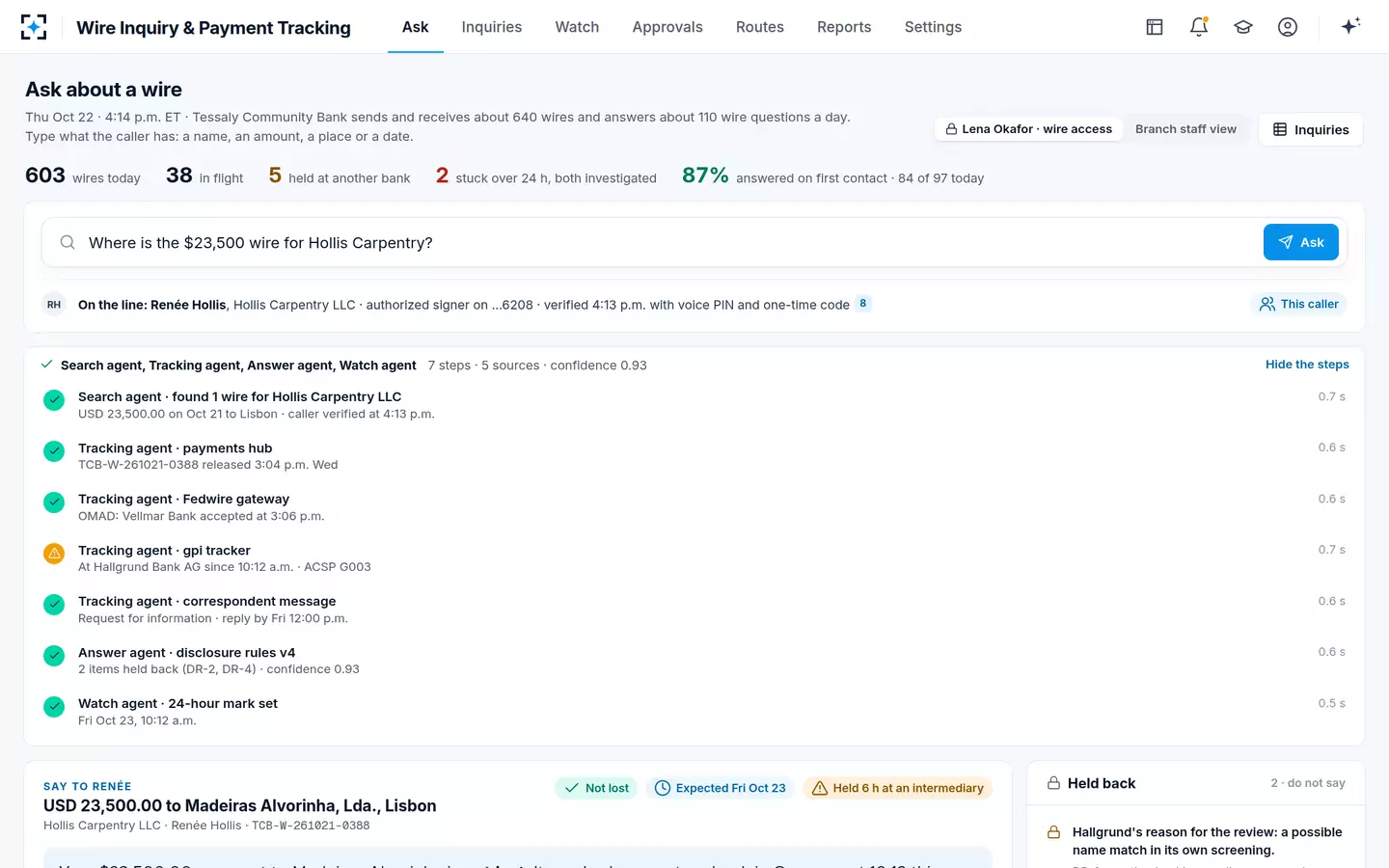
The trace, step by step: seven steps, five sources, four seconds of reading
- Find the wire0.7 s
- Payments hub0.6 s
- Fedwire gateway0.6 s
- Tracker by UETR0.7 s
- Correspondent request0.6 s
- Disclosure rules0.6 s
- 24-hour mark0.5 s
How do I track a wire transfer? Start with the bank that sent it
You track a wire transfer through the bank that sent it, because only that bank can ask the next bank in the route. Give it four things: the amount, the date it was sent, the beneficiary's name and bank, and any reference on your confirmation. A wire is not a parcel with a public tracking page: the messages that move it are exchanged between banks, and each bank answers questions about its own leg.
The order of the trace follows the order of the payment. The OCC describes the flow plainly: "The originating bank verifies the request then initiates the transaction with the operator", the operator "settles the payment between the banks and forwards the message", "Some transactions also include an intermediary bank", and the beneficiary bank "then credits the beneficiary account" (OCC, Payment Systems, 2021). A trace walks the same stops, and stops where the evidence does.
What number do I need to trace a wire?
Any number that identifies one transfer will do, and the best is the one that travels furthest. For a Fedwire leg that is the IMAD, which Fedwire uses to recognise a message it has already processed. For the whole route it is the UETR, the Unique End-to-End Transaction Reference, which the Fed's format rules require on every Fedwire customer, bank and return payment as an end-to-end reference for the transaction (Fedwire Funds Service ISO 20022 Format FAQs).
Customers rarely have either. They have the amount and the beneficiary, and sometimes the End-to-End Identification they typed into business online banking, the customer's own reference that now travels with every Fedwire payment so the beneficiary can match it to an invoice. A good trace starts from whatever the caller has and works out the references itself. IMAD, OMAD, UETR and the Fed reference number explains each one.
Step one: find one wire, and ask back when two fit
The first step is identification, and the commonest error is answering about the wrong wire. A business customer who pays the same supplier every month has several wires to the same name, often for similar amounts. An answer about the wrong one is worse than no answer, because it is confidently wrong.
In the sample trace, Lena typed what Renée Hollis had said: "Where is the $23,500 wire for Hollis Carpentry?" The Search agent found one wire, USD 23,500.00 on October 21 to Lisbon. Had she typed only "Hollis Carpentry wire", it would have asked back: the $23,500.00 to Lisbon on October 21, or the $2,350.00 to Porto on October 8. The rule the agent works to is simple and worth copying into any procedure: never guess between two wires.
Agents trace the wire in Wire Inquiry & Payment Tracking, one system at a time
Steps two and three: the bank's own release and the Fedwire leg
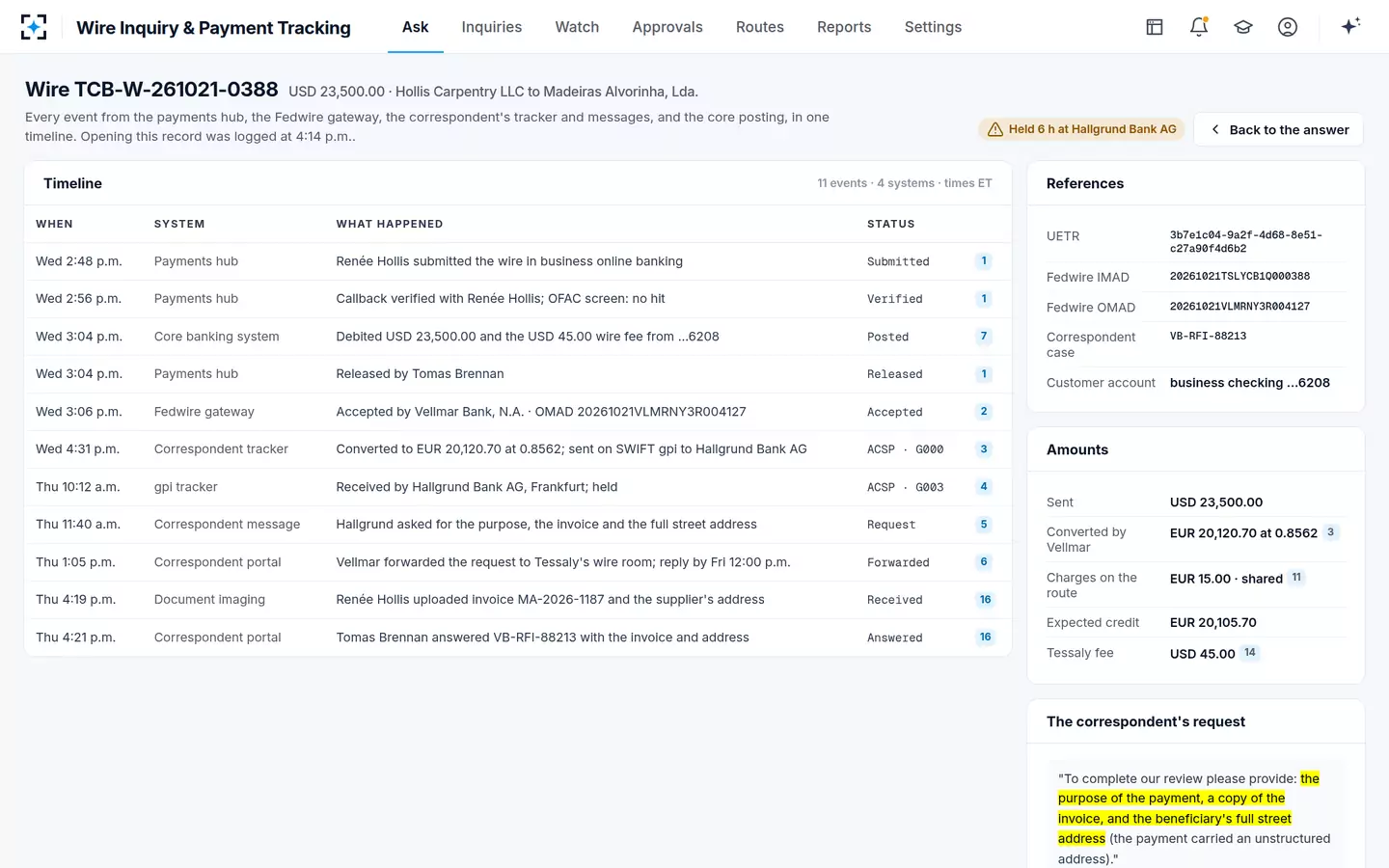
The bank's own systems answer the first question a customer has: did the money leave? The payments hub shows when the wire was submitted, verified and released; the core shows the debit and the fee. In the sample, Renée submitted the wire at 2:48 p.m. on Wednesday, the callback was verified at 2:56 p.m., and the wire was released and the account debited at 3:04 p.m.
The Fedwire messages answer the second: did the Reserve Banks take it? Under Operating Circular 6 an Acknowledgment "indicates that its Administrative Reserve Bank has accepted a Message", and on a payment order the Reserve Banks "settle the payment order", "send an Advice of Credit to the receiver" and "may send an Acknowledgment to the sender" (OC 6, sections 2.3 and 8.2.6). In the ISO 20022 format, status arrives as a pacs.002: the Fed sends "PDNG (Pending) status when a value message (pacs.008, pacs.009, pacs.004) is in process or has been intercepted by the Federal Reserve Banks", then another pacs.002 "by the close of business" with ACSC or RJCT (Format FAQs, question 12).
What each Fedwire message tells a trace, and what it does not
| Message | What it tells the sending bank | What it does not tell |
|---|---|---|
| Acknowledgment | Its Reserve Bank accepted the message | That anyone has paid the beneficiary |
| pacs.002 PDNG | The payment is in process, or intercepted by the Reserve Banks; a final status follows by the close of business | Why it was intercepted |
| pacs.002 ACSC | Accepted, settlement completed: the Reserve Banks settled it with the receiving bank | Whether the receiving bank has sent it on or credited anyone |
| admi.002 reject | A technical or business error, with the original IMAD so the rejected message can be found | How to fix the payment, beyond the error code |
| pacs.028 status request | A copy of the status of a value message already sent (cutoff 7:15 p.m. ET) | Anything from the receiving bank |
| admi.006 retrieval request | A copy of a message previously sent or received | Anything that happened after it |
The settlement time is solid evidence: the circular makes the Reserve Banks' records conclusive on when a payment order was accepted and paid (OC 6, section 8.2.7). What it is not is a confirmation that the beneficiary was paid. In the sample the Fedwire leg ended at Vellmar Bank, N.A., a correspondent in New York, at 3:06 p.m. Vellmar still had to convert the amount and send it on, which it did at 4:31 p.m.
Steps four and five: past the first bank, the UETR and the correspondent's questions
Beyond the first bank the trace depends on what the next bank reports, and that is where most traces stall. The CPMI's harmonised ISO 20022 requirements put the UETR at the centre: "Use of the UETR in cross-border payments will enable easier tracking and thereby improve transparency in cross-border payments", and it makes exceptions and investigations easier to handle too (BIS CPMI, Harmonised ISO 20022 data requirements, updated February 2026; a payments exception management system takes up that half).
The same report is frank that banks and payment platforms still deliver status in different ways, and names the pacs.002 status report and the pacs.028 status request as the standard messages for it. A bank that sends cross-border wires through a correspondent reads that status wherever the correspondent publishes it; in the sample, its portal and tracker are the fifth source.
In the sample the tracker showed the payment received by Hallgrund Bank AG in Frankfurt at 10:12 a.m. on Thursday, with no credit confirmation, and a request for information forwarded by Vellmar at 1:05 p.m.: Hallgrund wanted the purpose of the payment, the invoice and the supplier's full street address, with a reply by Friday noon. That request, not the tracker status, was the real answer to "where is my wire". Where the UETR trail goes dark covers the cases where no status comes back at all.
The whole wire in one timeline, every event with its system
Steps six and seven: the sentence a person may say, and the clock that starts
The last two steps are judgments, and the solution treats them as such. The Answer agent drafts one sentence under the bank's versioned disclosure rules and lists beside it what it held back: in the sample, Hallgrund's own screening reason, because another bank's compliance reason is never told, and the risk that Hallgrund would return the funds if its request went unanswered, because no outcome is threatened without a basis. Lena said: "Your $23,500.00 payment to Madeiras Alvorinha is not lost. It reached our partner bank in Germany at 10:12 this morning and is waiting there on a routine review; they have asked for the invoice and the supplier's full street address."
The Watch agent then set the wire's 24-hour mark for Friday at 10:12 a.m. If the wire is still held then, it opens a payment investigation itself and drafts the status request to the correspondent, which waits for the supervisor. The bank does not wait for the customer's second call to find out a wire is stuck.
Who does what in one trace in Wire Inquiry & Payment Tracking
Agent
Search agentFinds the wire from a name, amount, place, date or reference.
Never: guesses between two wires
Agent
Tracking agentReads the hub, the Fedwire gateway, the tracker, the correspondent's messages and the core; draws the route.
Never: states an arrival without its basis
Agent
Answer agentDrafts the sentence and the list of what is held back, under the disclosure rules.
Never: repeats another bank's compliance reason
A person decides
Treasury services officerDecides what to say on the call, and what happens next.
A person decides
Wire operations supervisorApproves any written statement about another bank, and every request to a correspondent.
Can you track a domestic wire transfer?
Yes. The route is shorter, and the receiving bank has a clear duty to tell its customer. Since the Fedwire Funds Service moved to ISO 20022 in July 2025, domestic Fedwire value messages carry a UETR as well as the IMAD and OMAD, so the same reference can follow a domestic wire into a correspondent's systems. The Fed checks the UETR's format, not its uniqueness (Format FAQs, question 11).
At the other end, Article 4A gives the beneficiary's bank a notice duty: when the order pays into an account, the bank must tell its customer by midnight of the business day after the payment date, or owe interest (UCC 4A-404(b)). The sample bank's stuck mark for a domestic Fedwire is four hours with no credit advice after the OMAD, against 24 hours for an international wire: a domestic beneficiary bank works to a short, clear duty, and hours of silence mean something.
How to track a wire transfer as a receiver
A receiver tracks a wire through its own bank, and the useful question is narrower: has my bank received a payment order for me? If it has, the notice duty above applies. If it has not, only the sender's bank can say where the payment is, so the receiver's best move is to ask the sender for the IMAD or UETR and pass it to its own bank. The End-to-End Identification, the reference the sender's customer supplied, is what lets a beneficiary match a payment to an invoice once it arrives.
What to ask of wire tracking software before you buy it
Wire tracking software earns its keep in the places where traces stall: finding the right wire, reading the correspondent's tracker and messages, and deciding what may be told. It cannot make another bank answer, and it should never move money. The checklist below is what we would ask of any tool, ours included.
Eight questions for any wire tracking tool
- Does it read your own hub, core and Fedwire gateway, or only a network tracker?
Half of the "where is it" questions are answered by the bank's own release and the Fedwire status.
- Does it ask back when two wires fit?
A confident answer about the wrong wire is the worst outcome of a trace.
- Does every statement open its source?
An officer, a supervisor and an examiner should be able to see which message each stop rests on.
- Does it read the correspondent's requests, not just its status?
In the sample, the request for documents was the answer to the customer's question.
- Does it know what may not be said?
Another bank's screening reason and anything that could reveal a SAR stay with staff.
- Who approves what it writes?
Statements about another bank, escalations and recalls need a second person, never the maker.
- Is it read-only?
Tracking needs no permission to release, amend or return a payment.
- What happens when the tracker stops answering?
The tool should hand the wire to a person and say so, not guess an arrival day.
Where the solution fits is specific: banks that already run a payments hub, a Fedwire gateway and a correspondent relationship, and want first-call answers without adding a system of record. It does not replace the hub or the correspondent's tracker, and it cannot see a leg no one reports on. How a tracking layer plugs into the systems a bank already has sets out the integration, and Wire Inquiry & Payment Tracking shows the whole flow.
Questions people ask
Can a bank track a wire transfer?
Yes, but only its own leg directly. The sending bank sees its release, the debit and the Fedwire settlement; for everything after, it depends on what the next bank reports, through a tracker, a portal or a reply to its status request. The Fedwire rules do not oblige a bank to answer another bank's request for information: Operating Circular 6 places no duty on a participant to respond to such messages.
Who can see where my wire is?
The banks on the route, each for its own leg, and the network trackers they report to. A customer sees what its bank chooses to show in online banking or tells on the phone. In the sample bank, branch staff see the sentence and the route only, with account numbers and references kept to wire-access roles.
How long does a wire trace take?
Reading the evidence takes seconds once the systems are connected; in the sample run the agents' seven steps took 4.3 seconds, and the median from question to the sentence the officer may say was 2 minutes 10 seconds on the sample data. When the evidence runs out, a trace becomes an investigation that waits on another bank's answer, and we found no public body that measures how long those take.
Can I track a wire transfer online myself?
Only through your own bank's online banking, if it shows wire status. There is no public lookup for a wire by its reference; the IMAD and UETR are useful to your bank, which uses them to ask the next bank in the route.
Does tracking a wire speed it up?
Not by itself, but it often finds what is slowing it down. The FSB found missing supporting documents among the things that stretch processing times most in the slow corridors it studied (FSB, consolidated progress report 2025); in the sample, the intermediary bank's hold was waiting on exactly that: the invoice and the supplier's full address.