An international wire takes anywhere from under an hour to several business days. In 2025, 54.6% of large cross-border payments, those of $100,000 or more, were credited to the beneficiary within one hour of initiation and 93.2% within one business day, while only 39.6% of the business-to-business payment services in the FSB's retail sample credited recipients within one business day. The wire's size, the route, the cutoff it met, holidays at either end and any request for documents along the way decide which end of that range a given wire lands in. A bank that promises a day therefore needs a basis for it, and Botminds' Wire Inquiry & Payment Tracking gives one: it predicts the arrival from that route's own history and says "expected", never "will".
The figures come from the Financial Stability Board's 2025 progress report on the G20 cross-border payments targets, which reports SWIFT's wholesale data and a commercial survey of retail payment services. The worked example is a fictional sample bank, Tessaly Community Bank, and a $23,500 wire to Lisbon traced in the solution.
How long an international wire takes, measured in 2025
54.6%
of large cross-border payments credited within one hour, worldwide
93.2%
credited within one business day of initiation
73.1%
credited within one hour when the beneficiary is in North America
How long does an international wire take? What the 2025 measurements say
For large payments the honest short answer is "usually the same day, often within the hour". The FSB measures wholesale speed as the share credited within one hour and within one business day of initiation: 54.6% and 93.2% in 2025, up from 50.6% and 92% a year earlier. North America is the fastest receiving region, "73.1% credited within one hour and almost the entirety of payments credited within one day"; Central and Latin America is slower, with 42.7% within the hour (FSB, 2025).
For smaller business payments, like the sample's $23,500 wire, the answer is different. The FSB counts any cross-border payment under $100,000 as retail and splits it by use case. Its 2025 sample shows business-to-business services crediting within one hour in 2.2% of cases and within one business day in 39.6%; for payments sent from North America it says "fewer than 3% of payments credited within one hour" for business-to-business and business-to-person payments.
Smaller cross-border payments: share of payment services that credit within one business day
Why do international wires take longer than domestic ones?
International wires take longer because they cross more banks, more business days and more rules. A domestic Fedwire can have a single interbank leg; a cross-border wire sent through a correspondent has several: the sending bank to its correspondent over Fedwire, the correspondent to an intermediary or the beneficiary's bank abroad, and that bank to the beneficiary's account. Each bank on the route has its own cutoffs and holidays, and each can stop to ask for information.
The FSB's work on slow corridors shows how much those stops can cost. In jurisdictions with capital controls, it found that processing "can delay crediting of funds to the beneficiary by hours or even days", and that "verifying the beneficiary or the transaction's underlying purpose as well as the lack of complete supporting documentation can significantly extend processing times" (FSB, 2025, Box 3). Documentation is not only a capital-controls issue. In the sample, the hold in Frankfurt was a request for the purpose of the payment, the invoice and the supplier's full street address.
Where the hours go: the in-flight leg is quick, the beneficiary leg is not
Most of the waiting happens at the end. The FSB splits wholesale payments into an in-flight leg, between the sending bank and the beneficiary's bank, and a beneficiary leg, "the time for the receiving payment service provider to process a payment after it receives the payment instruction via Swift to crediting the end customer account", which it says "has traditionally been the slowest part of a cross-border payment transaction".
The beneficiary's bank is where a large wire waits
In-flight leg
- Within 1 hour · 88.5%
- 1 hour to 1 day · 11.2%
- Over a day · 0.3%
Beneficiary leg
- Within 1 hour · 61.7%
- 1 hour to 1 day · 32.1%
- Over a day · 6.2%
End to end
- Within 1 hour · 54.6%
- 1 hour to 1 day · 38.6%
- Over a day · 6.8%
The bands matter for a promise. A wire that has reached the beneficiary's bank is not "nearly there" in time: on these figures, one large payment in sixteen still waits there for more than a business day. The improvement the FSB reports for 2025 was "largely driven by faster processing at the beneficiary leg", which is also the leg a sending bank can see least of. Where the UETR trail goes dark looks at that leg from the tracking side.
Do international wires go through on weekends? The Fedwire day still starts the clock
Not on Fedwire. A cross-border wire that a U.S. bank sends through a correspondent starts with a Fedwire leg, and that leg runs on the Fedwire funds-transfer business day, which opens at 9:00 p.m. ET the evening before and closes at 7:00 p.m. ET; Saturdays, Sundays and the Reserve Banks' holidays are not business days (Fedwire operating hours). The cutoff for a customer transfer, a pacs.008, is 6:45 p.m. ET, and any cutoff a bank gives its own customers has to sit before it.
That will change, slowly. The Federal Reserve Board announced in October 2025 that the Fedwire Funds Service will operate "Sunday through Friday, including weekday holidays", and that the Reserve Banks will implement it in 2028 at the earliest (Federal Reserve Board, October 9, 2025). The bank abroad keeps its own calendar, so a wire released on a U.S. Friday afternoon can still meet a Saturday and Sunday at the other end.
Which date on the receipt tells the sender when the money lands?
For a consumer's international wire, the arrival date is not just a courtesy; it is a disclosure. A remittance transfer provider's receipt must state the date the money will be available to the recipient abroad, labelled Date Available or something close, and may add that funds "may be available sooner" (12 CFR 1005.31(b)(2)(ii); remittance transfer disclosure requirements lists every element). Missing that date is, with some exceptions, an error the provider must investigate and remedy.
The duty falls on a remittance transfer provider, meaning a business that sends remittance transfers for consumers as a regular part of its business. A bank that sent 500 or fewer in both the previous and the current calendar year is deemed not to (12 CFR 1005.30(f)), and a business customer's wire is not a remittance transfer at all, because the sender must be a consumer sending money for personal or household reasons. For those wires the date is a matter of service, not disclosure, and nothing stops a bank from holding itself to the same standard.
That makes the date a promise with a price, and it should be set the way any promise is: from evidence about this route. When a status call on a consumer wire becomes an error claim follows the rule through.
Trace the date you promise: from network averages to the route's own history
Every arrival date a bank gives has a history, and it is worth tracing before it is spoken. The network average tells you what usually happens. The region tells you more. The route's own record, how long this intermediary held this bank's wires and how fast this beneficiary bank credits, tells you most. And a request for documents, if there is one, overrides all of them.
Five sources for an arrival date, from weakest to strongest
| Source | What it says | On the sample wire to Lisbon | Good enough to promise? |
|---|---|---|---|
| G20 target for end-2027 | 75% of large cross-border payments within one hour, the rest within one business day | An ambition, not a measurement | No |
| Global measurement | 54.6% within one hour, 93.2% within a business day (large payments, 2025) | The wire is $23,500: retail, not wholesale | No |
| Regional and use-case measurement | Business payments sent from North America: fewer than 3% credited within one hour | Closer, but still not this route | No |
| The route's own history | Hallgrund released 14 of 15 held Tessaly wires, a median 5 h 40 min after the answer; Banco Mirante credits a median 38 minutes after receipt | The basis for "expected Friday" | Expected, with its basis |
| Today's messages on this wire | A request for the invoice and the supplier's full street address, reply by Friday noon | The day depends on the customer's answer | Only once answered |
Why the wire is expected Friday: Wire Inquiry & Payment Tracking answers with its basis
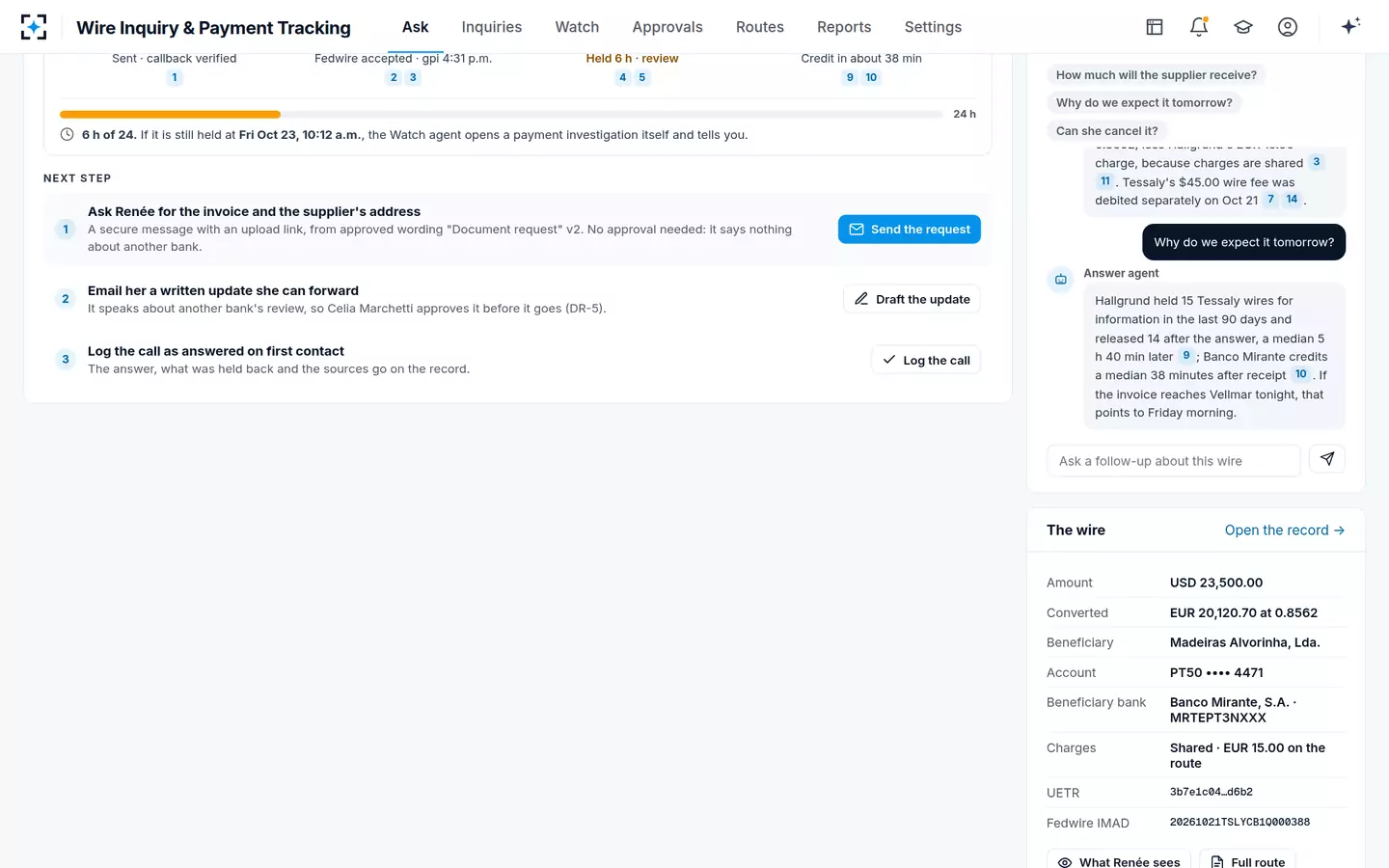
Two practical consequences follow. First, a bank that does not keep route history cannot do better than a network average, which on a $23,500 business wire is a poor guide. Second, the fastest way to shorten the wait is often upstream. The CPMI asks for a structured account identifier wherever one exists, because without one payments get misdirected or returned (BIS CPMI, 2026), and the move away from free-text addresses is under way. The BIS recorded November 2026 as the original milestone for removing unstructured postal addresses from cross-border messages (BIS CPMI Brief 13, May 2026); that removal has since been delayed, and the Bank of England's current expectation, subject to confirmation, is that it moves into its November 2027 release (Bank of England), the month the Fed has also set for Fedwire's hybrid-address release. The structured address deadline, and what moved, is covered in its own guide. In the sample, the intermediary bank asked for the supplier's full street address because the payment carried an unstructured one.
What if an international wire arrives late?
What happens next depends on who sent it. For a consumer's remittance transfer, a missed Date Available is an error under Regulation E unless an exception applies, and the provider must refund its fees. For a business wire, Article 4A sets the remedies: interest for a delay caused by a bank's improper execution, and a refund if the transfer is never completed. The rights between the beneficiary and its bank abroad, though, follow the law of the country where that bank is located (UCC 4A-507(a)(2)). What each late day costs, and who pays it, works through both.
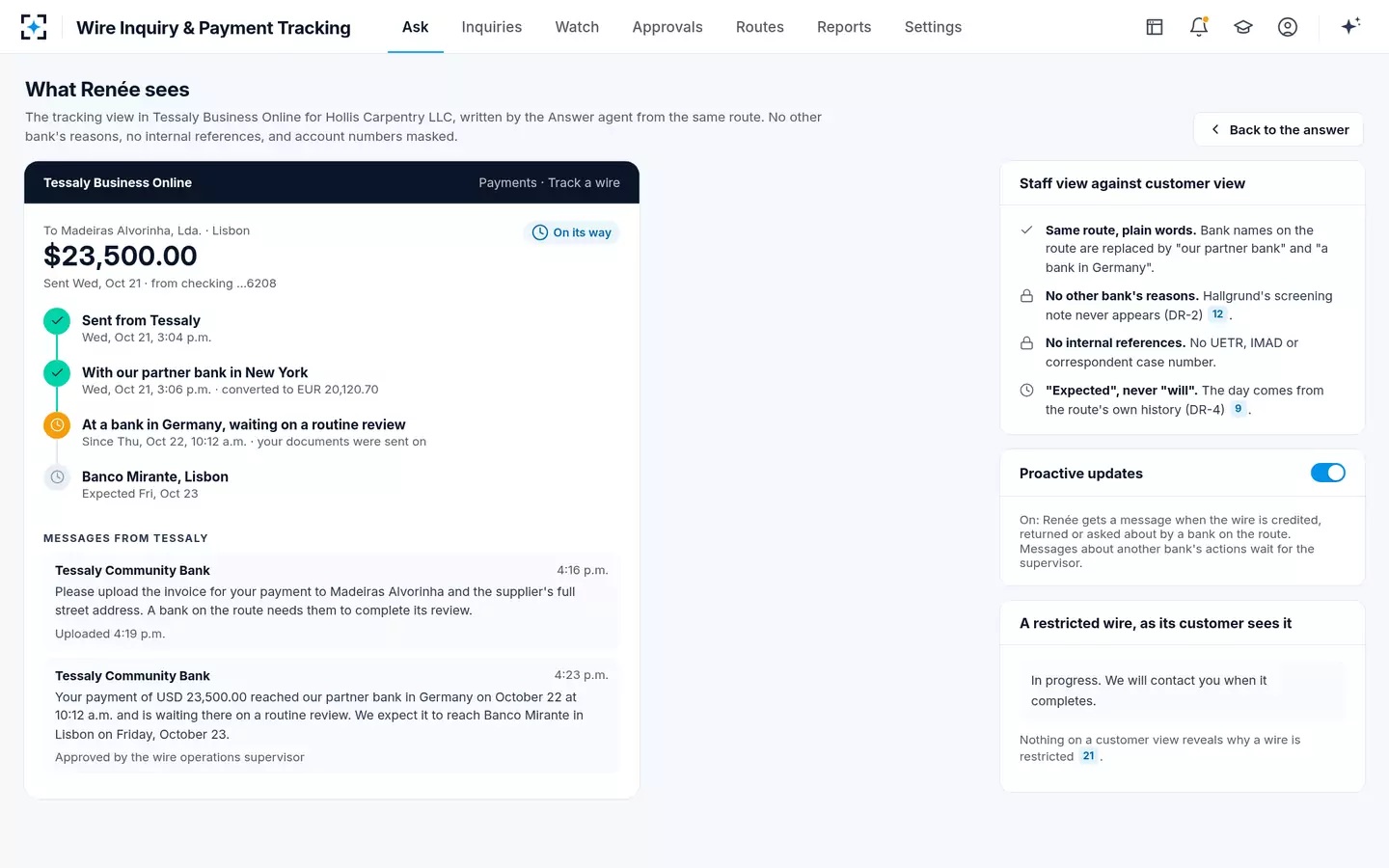
What the customer sees in Wire Inquiry & Payment Tracking: the same route, in plain words
The 2027 targets will not answer a customer's question
The G20 targets are the right yardstick for policy and the wrong one for a phone call. They ask for 75% of large cross-border payments "to be credited within one hour of payment initiation" and "the remainder of the market to be within one business day" by end-2027, and they ask every provider to give payers and payees "the expected time to deliver funds" and "tracking of payment status" (FSB, G20 targets).
The FSB's own verdict is that "It is unlikely that satisfactory improvements at the global level will be achieved in line with the 2027 Roadmap timetable" (FSB, October 2025), and for large payments it has no data at all on whether providers tell customers the expected time or the payment's status. That is a bank's own job, wire by wire, and Wire Inquiry & Payment Tracking is built to do it from evidence.
Questions people ask
How long do wires take to Mexico?
There is no public figure for a single corridor in the FSB's report. For large payments to Central and Latin America it reports 42.7% credited within one hour in 2025; smaller business payments are slower everywhere. In the sample bank, the longest-held wire of the day was one to Monterrey through a bank that did not report status, which the solution flagged at its 24-hour mark.
What is the fastest way to send an international wire?
Release it well before the Fedwire customer cutoff of 6:45 p.m. ET and the receiving country's own cutoff, avoid holidays at either end, and send complete data: a structured address, the beneficiary's account identifier and the purpose. Fixing incomplete messages before they leave is payment repair. A request for documents is one of the delays the FSB names, and complete data is the way to avoid it.
Can a bank guarantee when a wire will arrive?
No bank controls the other banks on the route, so a guarantee is a promise it cannot keep. A provider of consumer remittance transfers must still disclose a Date Available and answers for missing it; for other wires, the sample bank's rule is to say "expected", with its basis, and never "will".
How long does it take to receive an international wire?
Once the beneficiary's bank has the payment, crediting is usually quick; the FSB found 61.7% of large payments credited within an hour of reaching the beneficiary's bank in 2025, and 93.8% within a business day. If your bank has not received it at all, only the sender's bank can trace it, using the UETR.
Why did less money arrive than I sent?
Banks on the route can deduct their charges, and who pays them is set by the charge code on the payment. The Fed describes SHAR, under which each side pays its own bank, and CRED, under which every bank on the route may take its fee from the payment (Fedwire Format FAQs; why a wire comes back quotes the CRED rule). Under Article 4A a bank may not deduct its charges from the amount it sends on unless the sender instructed it to (UCC 4A-302(d)); in the sample, the supplier is expected to receive EUR 20,105.70 of the EUR 20,120.70 converted, after a EUR 15.00 charge on the route.
Why was my international wire delayed?
The reasons the Fed's calendar and the FSB's findings point to are a missed cutoff, a holiday at either end, a review at an intermediary or the beneficiary's bank, and a request for documents such as the invoice or the full address. A bank may tell you that a bank on the route has asked for information; it should not repeat another bank's compliance reason.