Your wire was most likely returned because the bank at the other end could not apply it to the account it named. The usual reasons are an account number that does not exist or is closed, a beneficiary name that does not belong to the account, a beneficiary bank that could not be identified from the details given, or information the receiving country requires that was missing or unreadable. Less often a payment comes back for a regulatory reason the bank may not be able to explain. In each case the fix is in the details you send next time, and the law gives you a right to the money back if the transfer never completed. On the banks' side, Botminds' Payment Repair is an agentic solution that checks each failed outgoing payment against the client's own history before release, so more of these errors are caught and fixed, or raised with the client, before the wire leaves.
The legal points below come from Article 4A of the Uniform Commercial Code, which governs business wire transfers in the United States, and from the Federal Reserve's Fedwire guidance. Consumer international transfers have extra protections under Regulation E, noted where they apply. The screens are the solution's sample data on a fictional bank.
What the law says when a wire cannot be completed
Nobody
has rights as beneficiary if the account or person named does not exist or cannot be identified, so acceptance cannot occur
Refund
with interest from the day you paid, if the transfer is not completed to the beneficiary you named
5days
funds-transfer business days after which an unaccepted payment order is cancelled by law
Fixed
your right to the refund cannot be signed away in an agreement
Why would a wire transfer be returned?
A wire transfer is returned when it reached a bank that could not or would not credit it as instructed, and sent the money back. That is different from a rejected wire, which never settled at all; the difference, and the error codes behind a reject, are in Fed wire reject reason codes. Most returns trace to the beneficiary details. The table translates the common reasons into what they usually mean and what to send next time.
Why a wire comes back, and what to send next time
| What the bank tells you | What it usually means | What to send next time |
|---|---|---|
| The account does not exist, or the number is invalid | The number has a typing error, is incomplete, or belongs to a different bank | The full account number or IBAN copied from the beneficiary's own document, never retyped from memory |
| The account is closed | The beneficiary moved banks or closed that account; the receiving bank cannot credit it | New details from the beneficiary, confirmed by a call to a number you already have |
| The name does not match the account | The receiving bank checked the name and found the account belongs to someone else | The beneficiary's legal name exactly as the bank holds it, and the account that belongs to that name |
| The beneficiary bank could not be identified | A BIC or routing number is wrong, retired after a merger, or missing a branch | The bank's current identifier, from the beneficiary's invoice or the bank's own published details |
| Information required by the receiving country is missing | A purpose code, a structured address or another field the destination needs | Town and country as separate fields, a full address, and the purpose of the payment |
| Characters the system could not process | Accents, symbols or line breaks that do not fit the message's character set | Plain Latin letters and digits in names, addresses and references |
| Returned for a regulatory reason | The receiving bank's compliance review; it may not be able to say more | Ask your bank what you can provide; do not resend until it says so |
The character row surprises clients most. Banks along a cross-border chain agree a restricted character set so every system can read the message; the CPMI's requirement for it says that otherwise "payments risk being delayed or even returned" (CPMI, Harmonised ISO 20022 data requirements, February 2026). A supplier name with an accented letter, or a reference with a line break, is not wrong, but it can still bring the money back.
What does "account closed" mean on a wire return?
It means the account your wire was sent to no longer accepts credits at the beneficiary's bank, so that bank sent the money back instead of holding it. The beneficiary may have moved to another bank, consolidated accounts, or had the account closed by the bank. Your payment reached the right bank and the right number; the number simply no longer leads anywhere.
The fix is new account details, and the risk is in how you get them. A request to pay to a new account is exactly what fraudsters send, so confirm any change by calling the beneficiary on a number you already have, not one in the message that announced the change. On the sample bank in Payment Repair, a payment whose receiving bank reports the account closed becomes a message to the client within the hour, telling it what happened and what to send.
Will I get my money back, and how long does a returned wire take?
If the transfer was never completed to the beneficiary you named, Article 4A says you are entitled to your money back with interest, and no agreement can take that right away. Your obligation to pay for a payment order "is excused if the funds transfer is not completed by acceptance by the beneficiary's bank of a payment order instructing payment to the beneficiary of that sender's payment order", the bank must refund what you were not obliged to pay, and "interest is payable on the refundable amount from the date of payment" (UCC 4A-402(c) and (d)). Subsection (f) puts that right beyond the reach of any agreement with the bank.
A nonexistent or unidentifiable beneficiary is the clearest case. If the name, account number or other identification in the payment order points to a person or account that does not exist or cannot be identified, nobody has rights as the beneficiary and the order cannot be accepted (UCC 4A-207(a)); the section is quoted and worked through in UCC 4A-207: when the name and the account number don't match. The transfer cannot complete, so the refund rule applies.
How long it takes depends on how quickly each bank in the chain acts, and no single deadline covers the return itself: on Fedwire, the Federal Reserve imposes no time limit on when a return may be sent (Fedwire ISO 20022 format FAQs). Each bank that handled the payment on the way out handles the return on the way back, so a cross-border return passes back through every correspondent in the chain. If your bank has not credited a return you were told about, ask it for the return's reference and the date it was received.
Consumers sending money abroad have an extra layer. Under Regulation E's remittance rules, a provider that can show the sender gave an incorrect account number or recipient institution identifier, and that meets the rule's other conditions, is not treated as having made an error, but it must have "promptly used reasonable efforts to recover the amount that was to be received by the designated recipient" (12 CFR 1005.33(h)).
Will I get fees back on a returned wire?
The principal is protected; the fees often are not. A returned wire can come back short because banks along the way deducted their charges, and your own bank's fee for sending the wire is a matter of your agreement with it.
Whether banks in the chain could deduct fees depends on the charge instruction in the payment. Fedwire's guidance explains that with the code CRED, "all financial institutions in the payment chain may deduct fees, thereby reducing the payment amount to the beneficiary/creditor", while with DEBT the originator covers all fees and with SHAR each side pays its own bank (Fedwire ISO 20022 format FAQs). Article 4A sets the default: unless the sender instructs it, a receiving bank may not collect its charges by passing on a smaller payment order (UCC 4A-302(d)). Ask your bank which instruction your payment carried, and whether any deduction on the way back was allowed under it.
Could the bank have fixed the details instead of returning the money?
Sometimes your own bank can, before the wire leaves; the receiving bank, after it arrives, generally will not. Before release, a sending bank's repair desk can correct an obvious error from evidence it already holds, such as a swapped pair of digits in an account you have paid many times, with a second person checking the change. What it should not do is guess: if the name and the account point to two different payees you have paid, only you can say which you meant, and the right answer is to ask.
Once the wire reaches the beneficiary's bank, the details are that bank's to apply, not to rewrite. Article 4A lets it rely on the account number when it does not know the name and number refer to different persons (UCC 4A-207(b)), and a bank that cannot credit the account sends the money back rather than guessing where it should go. That is why a return usually lands back with you as a question.
What happens to a rejected wire transfer, as opposed to a returned one?
A rejected wire never left the network, so nothing needs to come back: your bank either fixes the details and sends it again, or tells you it cannot and asks for corrected instructions. A returned wire did arrive at another bank and came back, so your bank has to receive the return, match it to your original payment and credit your account. The second takes longer and can go wrong in its own way, when the return cannot be matched to the payment it belongs to; the return nobody can post explains why that happens and how banks fix it.
What your bank does when a wire comes back
Agent
Receive the returnA pacs.004 payment return arrives carrying the references of your original wire and a reason code.
Agent
Match it to your paymentThe return is matched to the original by those references, not by amount and date alone.
Agent
Credit your accountThe returned amount is credited back, less any fees the chain was allowed to deduct.
Agent
Translate the reasonThe reason code becomes a plain message: what went wrong and what to send.
Never: Mentions a screening review or investigation
A person decides
Tell you, and wait for your instructionA person approves the message to you; the wire is sent again only with details you confirm.
How do I stop a wire being returned again?
Send details copied from the beneficiary's own documents, in the form the destination needs, and keep your saved templates correct. Most repeat returns come from one saved template with one wrong digit.
What to check before you send a wire
- The beneficiary's legal name, exactly as the bank holds it
Not a trading name or an abbreviation, unless the beneficiary confirms the bank uses it.
- The full account number or IBAN, copied, not retyped
One swapped pair of digits is enough to send a wire to the repair queue or back to you.
- The beneficiary bank's current identifier
A BIC has 8 or 11 characters; an 11-character BIC names a branch. Banks merge and identifiers change.
- A full address, with town and country
Cross-border messages are moving to addresses in structured fields, with town and country at a minimum. The cut-off for free-text addresses, once November 2026, has been pushed back to an expected November 2027.
- The purpose of the payment, where the destination asks for it
Some countries require a purpose code; your bank can tell you which.
- Plain characters
Avoid accents, symbols and line breaks in names and references.
- Your saved template
If a wire from a template was returned, fix the template, not only the payment.
- Any change of bank details, by phone
Call a number you already have before paying to a new account.
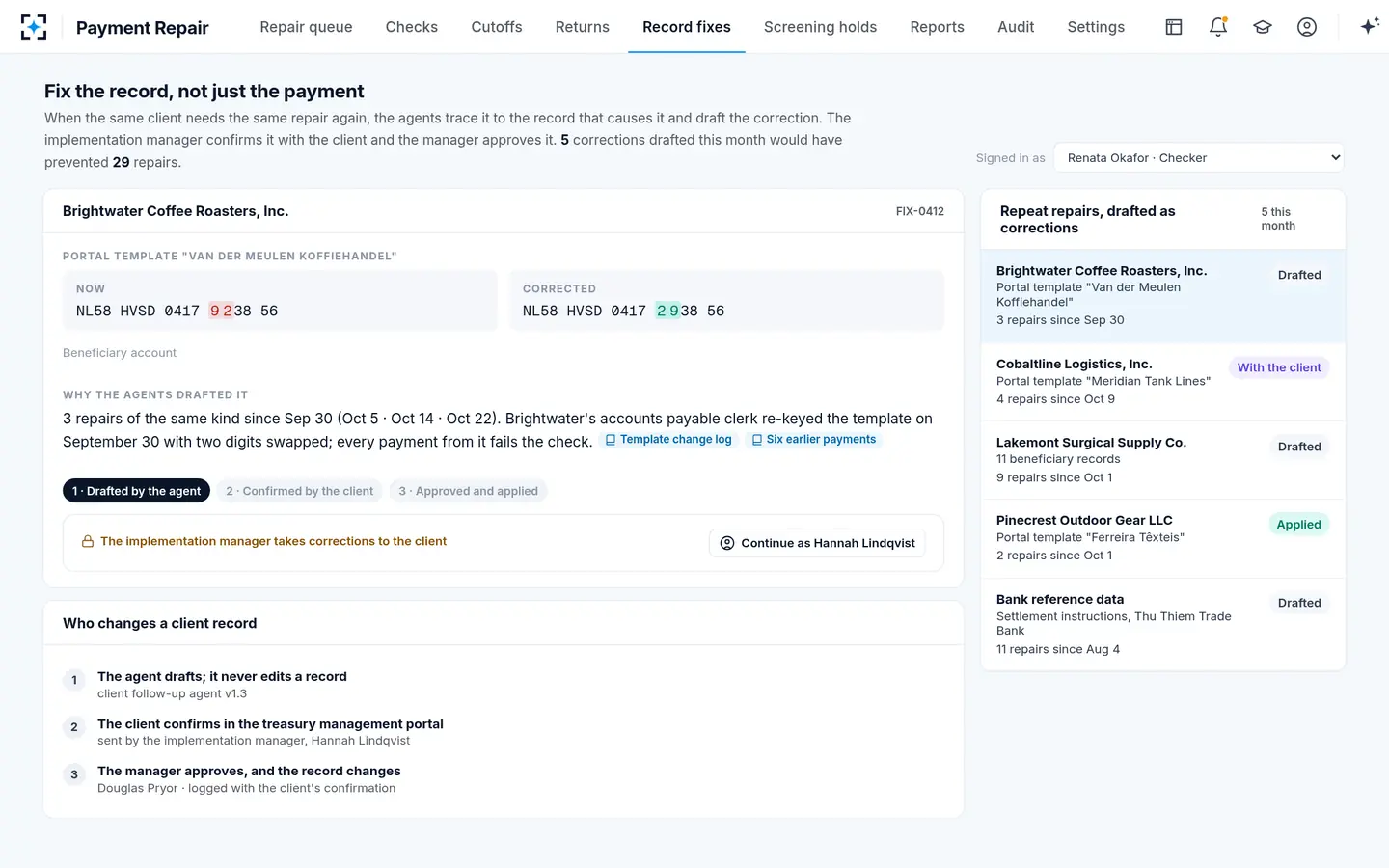
The template point is the one banks see most from their side. On the sample bank in Payment Repair, one client's template for a Dutch supplier was re-keyed with two digits swapped, and payments from it failed three times in October. The bank caught the error before release each time, and the third failure prompted a drafted correction to the template itself, for the client to confirm.
Fix the template, not just the payment
How banks using Payment Repair catch more of these before the wire leaves
Many returns start as data a bank could have questioned before release. A bank using Payment Repair runs each failed outgoing payment past agents that read the client's earlier payments to the same beneficiary, the bank directory and the network rules. When the evidence proves the fix, such as a pair of swapped digits in an account the client has paid six times before, a repairer approves it and a second person re-keys it before release. When it does not, the payment goes back to the client before it is sent, with a plain message, rather than coming back days later from abroad.
Payment Repair's return to client: a plain message, approved by a second person
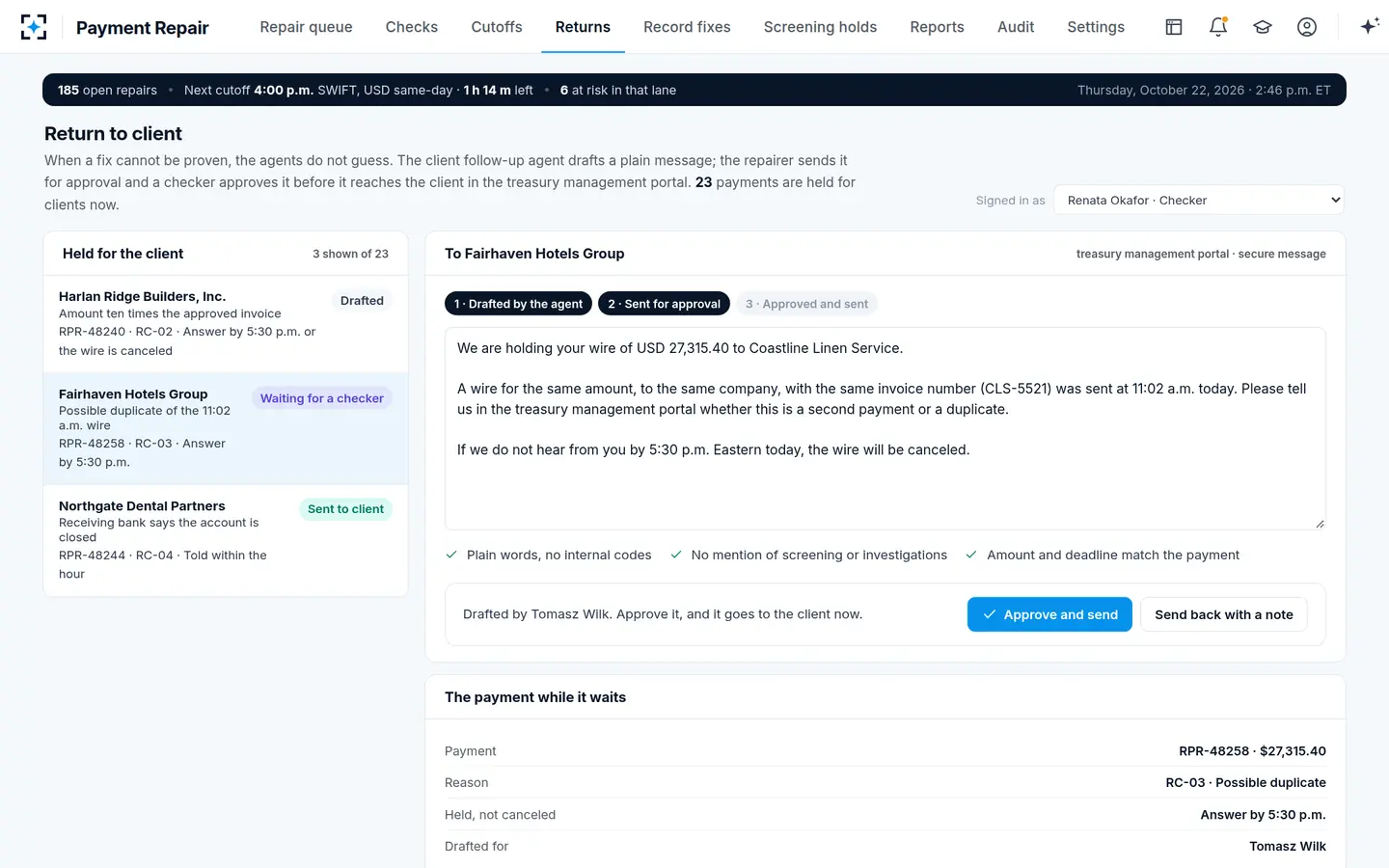
None of this removes returns that start on the other side, such as an account closed after you sent the wire, or a receiving bank's own compliance decision. It does mean that more of the returns a client sees are ones nobody could have prevented. For how the bank's desk decides what it may fix and what it must ask about, see what payment repair is.
Questions people ask
Can a returned wire be sent again automatically?
It should not be. A return means something about the beneficiary details was wrong or has changed, so sending the same details again will usually produce another return. Your bank should credit the return, tell you the reason, and send again only with details you have confirmed.
Why did the bank return my wire without saying why?
Sometimes the reason code is generic, and sometimes the receiving bank's reason is a compliance matter it cannot share. Ask your bank for the reason it received and what you can provide; if it cannot say more, that is usually a legal limit rather than a choice.
What does a wire return code like AC04 mean?
It is a four-character reason code from the ISO 20022 external code lists that banks use in returns and status reports. Your bank's return advice should give the code's published meaning; if it does not, ask for it, because the code tells you which detail to correct.
Is a returned wire the same as a recalled wire?
No. A return is initiated by the receiving side, usually because the payment could not be applied. A recall starts with you asking your bank to get a payment back, which needs the receiving bank's agreement once the payment has been accepted.
Who pays if my bank sent the wire to the wrong account?
If your bank executed your order to a beneficiary different from the one in your order and the transfer completed on that error, Article 4A says you are not obliged to pay for it, and the bank recovers the money from whoever received it. If the wrong account was in your own instruction, the position is different, which is why copying details from the beneficiary's documents matters.
For banks: to see how failed payments are caught and explained before release, start from Payment Repair.