The STP rate, or straight through processing rate, is the share of a bank's payments that go from instruction to network without anyone touching them: payments processed minus payments that needed a person, divided by payments processed, for a period and a lane. Every payment outside that share went to the repair queue, and each has a cost the rate itself does not show. No regulator, central bank or academic source we could find publishes a bank-level STP benchmark for wires, and the figures that circulate come from vendor surveys, so the useful question is not how you compare but what each non-STP payment costs you. Botminds' Payment Repair, an agentic solution for the repair queue, is built to lower that cost: agents diagnose and prove each fix so people spend their minutes deciding.
The worked figures below use two kinds of input, kept apart. The minutes and volumes come from the solution's sample data on a fictional Corvane National Bank, and from Botminds' own estimate of a manual repair; the wage, the interest rate and the rules come from FinCEN, the BLS, the New York Fed and Article 4A, linked where they appear.
The prices a repair business case can rest on
$106.30
an hour: FinCEN's fully loaded composite wage for bank compliance work, used in its 2024 burden estimates
$27.72
an hour: BLS mean wage for financial clerks in credit intermediation, May 2025, before benefits and overhead
3.88%
effective federal funds rate on 23 October 2026, the default rate for Article 4A interest
/360
Article 4A's day count: interest is the average rate, divided by 360, per day of delay
How is the STP rate calculated?
STP rate = 1 − (payments a person had to touch ÷ payments processed), measured over the same period and the same population. The formula is simple; the definitions are where banks differ, and where comparisons between banks fall apart.
- What counts as a touch. A repair certainly does. A manual release of a payment that was never wrong, such as a limit approval, usually does too. A screening hold that is cleared without changing the payment is often reported separately, because its fix lies in screening, not in data.
- What counts as processed. All outgoing payments, or only those that reached validation? Payments rejected at the client channel before they reach the bank's hub are invisible to a hub-based rate.
- Which population. A single bank-wide figure hides the lanes. A domestic Fedwire lane and a cross-border lane to markets with strict purpose-code rules fail at very different rates.
Take the sample bank's October as a worked example. From 1 to 22 October it processed 486,120 payments on every rail, and 28,904 needed a repair. One minus 28,904 ÷ 486,120 is 94.1%. That is a fictional bank's number, given to show the arithmetic, not a target: what matters is that the bank can split the 28,904 by lane, by cause and by client, which is where the cost and the cures are.
What is a good STP rate?
The defensible answer is a rate that is rising on your own lanes, measured the same way each month. A published benchmark would need a common definition of a touch, a common population and data from many banks, and we found none in regulator, central-bank or academic sources. The industry figures that do circulate come from surveys run by vendors and networks, and they are not comparable with a bank's own measurement.
Where public bodies do measure payment performance, they measure something else. The Financial Stability Board tracks how fast cross-border payments are credited, not how many a bank repairs; in its 2025 report, North America was the fastest region for receiving wholesale cross-border payments (FSB, consolidated progress report, October 2025). Speed and STP are related, because a repair delays a payment, but one is not a proxy for the other.
What is straight through processing in payments, and why ISO 20022 did not finish the job?
Straight through processing in payments means the instruction is captured once, validated automatically and sent without manual intervention. ISO 20022 was meant to raise it by giving every party, address and account its own structured field. The BIS's assessment is that the format is necessary and not sufficient: "Achieving meaningful progress in STP often requires more than the adoption of ISO 20022 messages. It demands a comprehensive overhaul of operational workflows and the digitalisation of payment channels" (CPMI Brief No 11, April 2026).
The Federal Reserve gives a concrete example of a field that works against it. Fedwire's ISO 20022 messages omit the Instruction For Next Agent element because its "Use ... may cause non-straight through processing of payment instructions", and the old free-text sender-to-receiver tag is replaced by structured elements for the parties it used to describe (Fedwire ISO 20022 format FAQs). Free text that a person has to read is the opposite of STP, whichever format carries it.
What does a failed payment cost a bank? A formula, not an average
A failed payment costs the minutes of the people who repair and check it, the value of any cutoff it misses, and the cost of what goes wrong later if the repair was wrong. Each can be priced from a bank's own data, and the sum per repair type is more useful than any industry average.
The cost of one repair, term by term
Repair labor
repair minutes × loaded cost per minute
Reading the failure, finding the evidence, checking the directory and the rule, typing and re-checking.
Minutes: the desk's own timing. Rate: finance, or FinCEN's $106.30 an hour as an anchor.
Second-person labor
checker minutes × loaded cost per minute
Only for changes to who is paid or how much, if the bank tiers its checks.
Minutes: the checker's timing, by repair type.
Missed cutoff
P(miss) × amount × rate ÷ 360 × days late
Article 4A interest for a delay the bank caused, plus fees waived and the client's goodwill.
Rate: the EFFR average for the days, unless an agreement says otherwise.
Wrong repair
P(wrong) × (recovery cost + loss if not recovered)
A payment to the wrong beneficiary is the bank's to recover; a re-failure costs another repair or a return.
P(wrong): a seeded-error test and the live re-failure rate.
The terms behave very differently. Labor is certain and small per repair, large in total. The missed-cutoff and wrong-repair terms are rare and can be large on a single payment. A business case built only on labor misses the reason a desk is staffed the way it is; one built only on the rare events cannot be checked. Price both, separately.
Where the minutes go in one account repair
Botminds estimates that one account repair, worked by hand, takes about ten minutes, and that most of them go on finding things out rather than on the change itself. The estimate, used on the solution's own page, splits the time like this.
Most of a manual repair is the hunt; most of an assisted one is the check
By hand · about 10 minutes
- Reading the failure, finding history, directory and rule · 65%
- Typing the fix and re-checking · 15%
- Second person checking the account · 20%
With agents · about 2.7 minutes
- Reading the failure, finding history, directory and rule · 26%
- Typing the fix and re-checking · 18%
- Second person checking the account · 56%
The second row is the shape a bank should expect if it keeps a real second check: the hunt shrinks, and the check becomes most of the remaining time. That is deliberate. A design that also squeezed the check would be saving money on the one step that protects the bank from UCC 4A-303(c).
Pricing it: one repair, one late wire
Put the inputs into the formula and the orders of magnitude become clear. The table prices labor at FinCEN's loaded rate and interest at the effective federal funds rate on 23 October 2026, for one day of delay.
Labor and one day's interest, priced
| Item | Calculation | Result |
|---|---|---|
| Loaded cost per minute | $106.30 ÷ 60 | $1.77 |
| Account repair by hand | 10.0 min × $1.77 | $17.72 |
| Account repair with agents | 2.7 min × $1.77 | $4.78 |
| One day's interest on the sample hero wire | $72,900 × 3.88% ÷ 360 | $7.86 |
| One day's interest on the six repairs at risk at 4:00 p.m. | $412,300 × 3.88% ÷ 360 | $44.44 |
| One day's interest on an average 2025 Fedwire transfer | $5.28 million × 3.88% ÷ 360 | $569.07 |
Two things stand out. Interest is small on most payments, which is why a bank that prices cutoff misses only by Article 4A interest will under-invest in them; the larger cost of a late supplier or payroll wire is the client's, and it comes back as a complaint, a waived fee or a lost mandate. And the labor saving per repair is a few dollars, which only becomes a business case at volume: the sample bank's desk sent 1,604 payments to repair in a single day before 2:41 p.m.
What labor cost should a bank use for a repair?
Use the bank's own fully loaded cost for the people on the desk if finance can supply it; if not, use a public figure whose basis you can state. FinCEN's is the more defensible public anchor for a business case because it is already loaded: its 2024 notice renewing the BSA recordkeeping burden estimates prices compliance time at a fully loaded composite $106.30 an hour (FinCEN, 89 FR 65971, 13 August 2024), a figure the guide to BSA recordkeeping requirements applies by bank size. It is a composite for compliance work, and compliance staff cost more than repair clerks: in May 2025 the BLS's mean annual wage for compliance officers in credit intermediation was $94,090, against $57,660 for the clerks' occupation.
The BLS figure is the opposite kind of anchor. Its mean wage of $27.72 an hour for financial clerks not elsewhere classified in credit intermediation is a wage, not a cost, so it excludes benefits, space, systems and supervision (BLS OEWS, May 2025). Presenting a case with both, as a range, is more honest than choosing the one that makes the numbers look best.
How do you raise the STP rate?
Find the repairs that repeat and fix their source, one client template or reference table at a time. A repair desk's queue is a list of causes, and many of them come from a small number of places: a client's portal template with a typing error, a correspondent whose settlement instructions changed, a client channel that still produces free-text addresses.
The sample bank shows the pattern. One client's template for a Dutch supplier was re-keyed on 30 September with two digits swapped, and every payment from it failed: on 5, 14 and 22 October. In Payment Repair the agents trace the third failure to the template and draft the correction; the treasury management implementation manager confirms it with the client and the manager approves it. Across the month, five drafted corrections would have prevented 29 repairs. Each correction lifts the STP rate a little and permanently, which a faster repair desk never does.
Payment Repair drafts the fix to the template, not just to the payment
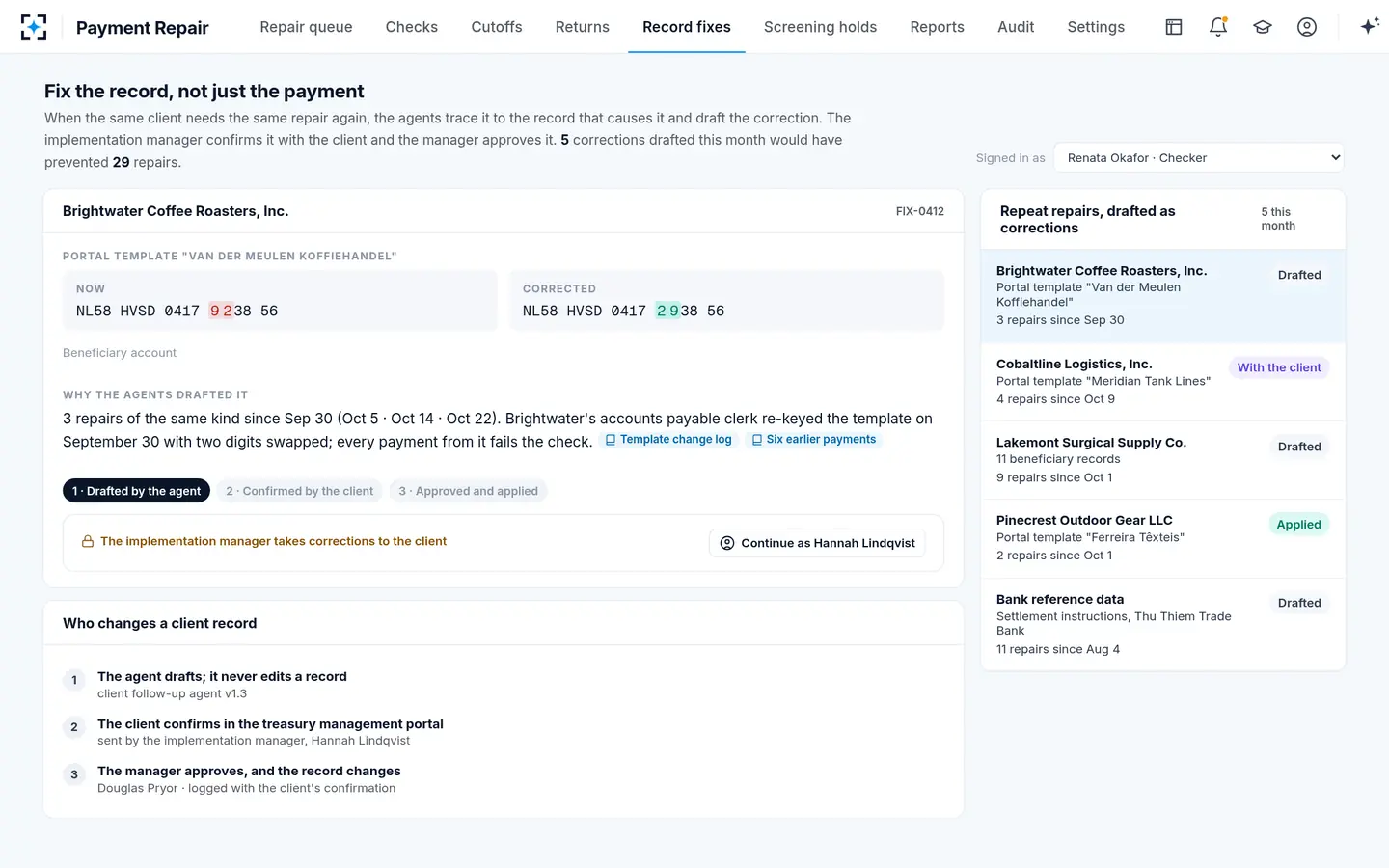
The other levers are upstream. Structured account identifiers and structured addresses in client channels prevent the two largest families of repair, and the CPMI's harmonised requirements set out the data a channel should capture. A bank that measures repairs by client and by channel knows which of its clients to help first, and a pilot on last month's failed payments is a quick way to get that split.
What Payment Repair changes, and what it does not
Payment Repair does not raise the STP rate by itself, because it works on payments that have already failed. It changes the cost terms. The agents remove most of the hunting from each repair, so the labor term falls; the cutoff agent forecasts each lane against its cutoff and proposes reassignments early, which targets the missed-cutoff term; and the agents' refusal to propose a fix without evidence, plus the checker's blind re-key, target the wrong-repair term. The client follow-up agent's drafted corrections are the one part that lifts STP, by removing repeat failures at their source.
Released at 2:46 p.m., 1 hour 14 minutes before the bank's cutoff
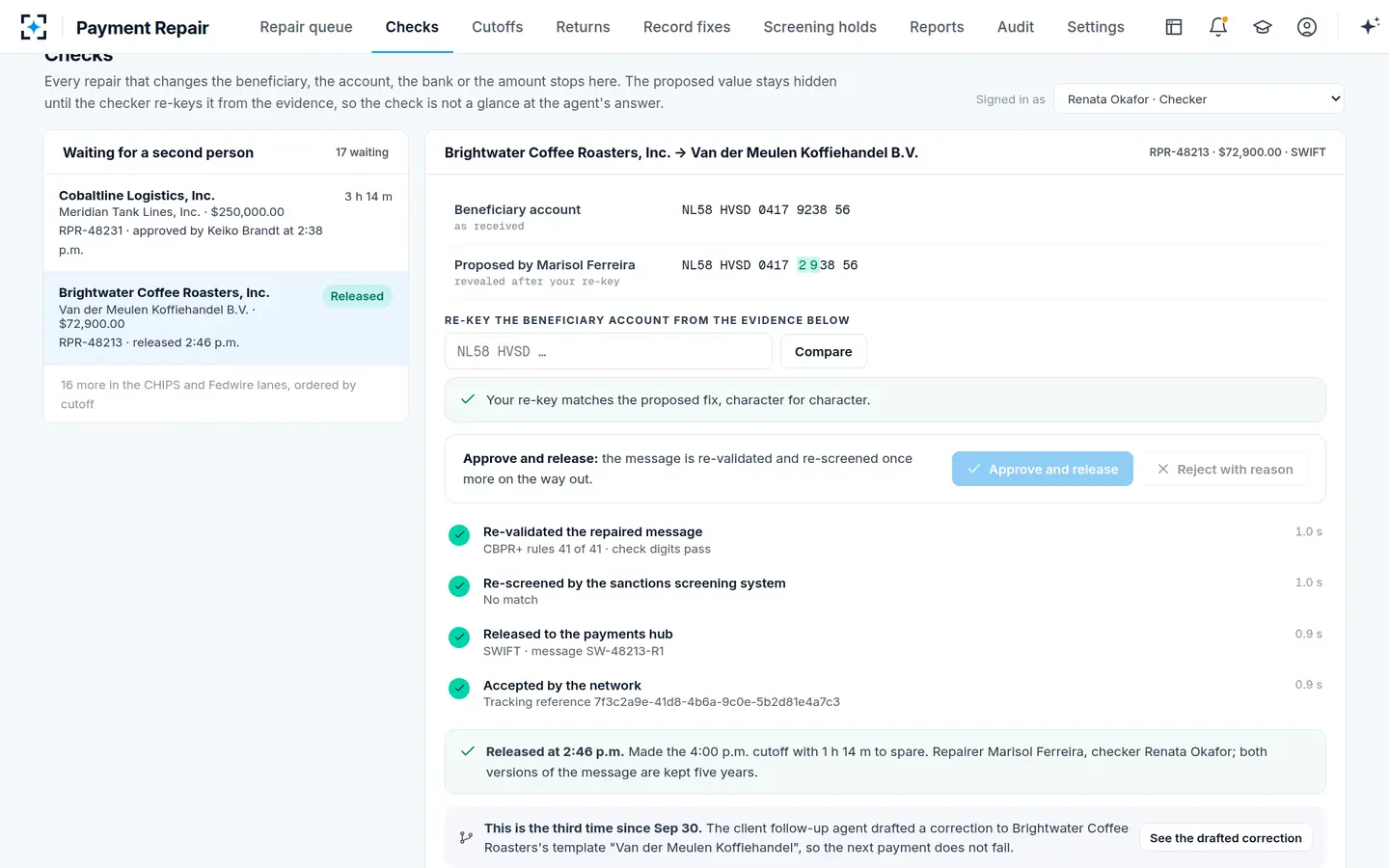
Where it will not help much: a bank whose repairs are mostly screening holds, which belong to the sanctions team, or a bank that cannot give the agents the client's payment history, in which case they will return more payments and propose fewer fixes. A business case should be built on the bank's own mix, measured, and a seeded-error test on the same month supplies the wrong-repair probability the formula needs.
Questions people ask
What does STP rate mean?
It is the percentage of transactions processed from start to finish without manual intervention. In payments it is usually measured as outgoing payments sent without repair or manual release, divided by all outgoing payments, for a lane and a period.
Is a 100% STP rate possible?
Not for outgoing wires in practice, because clients send data that is wrong or incomplete and some of it cannot be fixed without asking them. The aim is a rate that rises as repeat causes are removed, and a repair process that is fast and safe for the rest.
Does a repaired payment count against the STP rate if no data changed?
It depends on the definition the bank chooses, which is why it should be written down. A bank may report manual releases with no data change, such as limit approvals and cleared screening holds, separately from repairs, because their causes and cures are different.
Who pays the interest when a repair misses the cutoff?
Under Article 4A, if a bank's improper execution delays a completed transfer, the bank owes interest for the delay, and additional damages are not recoverable unless a written agreement provides for them (UCC 4A-305). If the delay came from the client's wrong data, the position is different, which is why the repair desk's notes on the cause matter.
How do you measure STP for instant payments?
The same way, with a shorter clock. Instant payments leave little or no time for repair before the network's deadline, so their non-STP payments are mostly rejections or returns rather than repairs, and the cost terms shift from labor to failed and returned payments.
To see the queue, the forecast and the template corrections on the sample bank, start from Payment Repair.