"Unable to apply" as a wire return reason means the bank that received the wire could not credit it to the account it named, usually because the account does not exist, is closed, or does not belong to the named beneficiary, and so it sent the funds back. Since Fedwire moved to ISO 20022, that return arrives at the sending bank as a pacs.004 payment return carrying the original payment's references and a reason code. The return can then fail a second time: if the bank's systems try to match it to the original by amount and date, a return that came back short of fees, days later, or among several similar payments cannot be applied either, and sits in a suspense account until someone works it by hand. Botminds' Payment Repair, an agentic solution for failed outgoing payments, keeps both versions of every repaired message and the reference the network tracked it by, which is what a later return has to be matched against.
The message rules here come from the Federal Reserve's Fedwire ISO 20022 FAQs and the CPMI's harmonised requirements; the controls from the FFIEC's examination handbook. The screens are the solution's sample data on a fictional Corvane National Bank.
What a returned wire carries back
2
mandatory references in a Fedwire pacs.004: the original message identification and the original UETR
3
more optional references: the original instruction, end-to-end and transaction identifications, when provided
NARR
the code a bank uses with free text when no published return reason fits
None
Fedwire's time limit on when a return may be sent: it can arrive weeks after the payment
What does "unable to apply" mean on a wire?
It means the funds reached a bank that could not credit them where the payment said, and the bank returned them rather than hold them. The phrase covers several underlying causes, and the code that comes with the return is more useful than the words: an account that does not exist, an account that is closed or blocked, a name that belongs to a different account, missing information the receiving bank needs. What to tell the client about each, and what to send next time, is in why a wire is returned.
For the sending bank, the more expensive version of "unable to apply" is its own. A return is money owed back to a client, and until it is matched to the payment it belongs to, the bank cannot credit the right account, tell the right client, or decide whether to send the payment again. The FFIEC's examination procedures expect the funds transfer department to perform "end-of-day reconcilements for messages sent to and received from intermediaries (e.g., Federal Reserve Bank, servicers, correspondents, and clearing facilities)" (FFIEC IT Examination Handbook, Wholesale Payment Systems, Tier II procedures). A return that will not match is a break in that reconcilement, every day it stays unmatched.
What is a pacs.004?
A pacs.004 is the ISO 20022 payment return message, used to send back the funds of a payment that has already settled. The Federal Reserve is explicit that it is the right message for the job: "The correct ISO 20022 message to return funds of a previously settled value message (e.g., customer credit transfer (pacs.008) or financial institution credit transfer (pacs.009) message) is the ISO 20022 payment return (pacs.004) message" (Fedwire ISO 20022 format FAQs).
Fedwire uses version 10 of the message rather than the version 9 in the cross-border CBPR+ guidelines, and gives its reason: the return chain in version 9 "does not cater for inclusion of account identifiers that may be needed for return payments sent across the Fedwire Funds Service to be complete and fully transparent" (Fedwire technical documentation FAQs). A return of a customer transfer has the same 6:45 p.m. Eastern cutoff as the customer transfer itself (Fedwire operating hours).
How do you match a returned wire to the original?
By the references the pacs.004 carries, starting with the original UETR, not by amount, date and beneficiary. The Federal Reserve publishes how a returning bank should fill those references, which tells the receiving bank exactly what to match them against.
The references in a Fedwire pacs.004, and what each should match
| Reference in the pacs.004 | Required? | Match it to | Notes |
|---|---|---|---|
| Original UETR | Mandatory | The UETR of the payment you sent | If the original carried none, the returning bank assigns a new one, because the element is mandatory |
| Original Message Identification | Mandatory | Your original message's identification | For a payment first sent in the legacy Fedwire format, the original IMAD |
| Original Instruction Identification | Optional, if provided | Your instruction identification or sender reference | Often the most readable reference on your side |
| Original End To End Identification | Optional, if provided | The client's end-to-end reference | Mandatory in a Fedwire pacs.008; the sender may put "Not Provided" when the client gave none |
| Original Transaction Identification | Optional | Your transaction identification | May be left blank for a payment first sent in the legacy format |
| Return reason | Expected | Your reason-code map | A code from the published ISO 20022 return reason list, or NARR with free text |
The table also shows where matching breaks. A payment first sent before the July 2025 move to ISO 20022 may come back with a UETR the returning bank assigned, which matches nothing on file; the original IMAD is then the key. And a repaired payment comes back with the references of the message the bank actually sent, not the client's original instruction: a bank that stores only the client's version of a repaired payment will not find the return's references anywhere.
Why does a returned wire sit in suspense?
Because the bank's systems try to post it by the wrong key, or receive it in a form they cannot read. Four causes account for most stuck returns, and each has a structural fix.
Matching a returned wire by amount and date, or by its references
By amount, date and name: The amount no longer matches the original, so the match fails
By the pacs.004's references: The UETR and message identification still match
By amount, date and name: The date window has passed; the return looks like a new credit
By the pacs.004's references: References do not expire
By amount, date and name: The match is ambiguous; a person has to guess, or it posts to the wrong one
By the pacs.004's references: Each payment has its own UETR
By amount, date and name: The client's original details may differ from what was sent
By the pacs.004's references: Matches the repaired message, if the bank kept it
By amount, date and name: Looks like an unrelated incoming wire
By the pacs.004's references: No pacs.004 references; needs a person, and the free-text remittance information
The last row deserves its own explanation, because it is a choice some banks still make. The CPMI's first harmonisation requirement uses it as the example of the wrong message for the job: "instead of implementing the ISO 20022 message for return payments (ie pacs.004), certain markets opt to use a regular credit transfer message (eg pacs.008 or pacs.009) with customised, proprietary coding to identify this 'new' payment as a return payment" (CPMI, Harmonised ISO 20022 data requirements, February 2026). The Federal Reserve tells a Fedwire participant that cannot send a pacs.004 to put the return information in the unstructured remittance field of a new pacs.008 or pacs.009, and warns that "A Fedwire receiver may decide to reject a pacs.008 or pacs.009 message that is used to return a previously settled value message due to the Fedwire sender's use of the incorrect message type" (Fedwire format FAQs).
The timing cause is built into the rules. "The Fedwire Funds Service does not impose restrictions on the date that a return request or payment return message may be sent" (Fedwire format FAQs), so a matching rule with a date window will always miss some returns. The client still has its rights in the meantime: if a transfer was not completed, the client's obligation to pay is excused and the bank owes a refund with interest from the date of payment (UCC 4A-402), whether or not the return has been posted.
What are ISO 20022 return reason codes?
They are four-character codes from a published ISO 20022 list that the returning bank puts in the pacs.004 to say why it returned the payment. The CPMI's data model for cross-border returns makes the list mandatory and gives a fallback: "A code from the ISO 20022 externalised ReturnReason1Code list must be used. If no appropriate code is available, then it is recommended to submit a request to ISO 20022 for inclusion of the code and use the code 'NARR' in combination with use of Additional Information in the meantime" (CPMI, October 2023, technical annex, pacs.004).
Published codes matter because private ones need people. The CPMI's second requirement says it plainly: "Use of proprietary codes increases the risk of misunderstanding and the need for human intervention, thereby reducing the potential for automated processing" (CPMI, February 2026). Fedwire itself does not check that a code is on the list, only its form, so a bank cannot rely on the network to filter out codes its own systems will not recognise.
The practical fix is a reason-code map, kept once and used everywhere: each published return reason mapped to how the funds are posted back, which plain-words message the client receives, and whether the payment may be sent again without the client's new instruction. A return whose code is not in the map, or which arrives as NARR with free text, goes to a person, with the text in front of them. The same discipline applies to the repairs and edits on the outgoing side, where every change carries a reason code so that patterns can be found.
A return-handling flow that posts by reference
The flow below is the one we recommend for any bank receiving wire returns, whatever its tools. Its two rules are to match by reference and to treat every return as a question for the client, not as a payment to resend.
A returned wire, from pacs.004 to client decision
Agent
Receive and readTakes the pacs.004, its references and its reason code; a return that arrives as a credit transfer is flagged for a person.
Never: Treats a return as a new incoming payment
Agent
Match by referenceMatches the original UETR and message identification to the message actually sent, including the repaired version of a repaired payment.
Never: Matches on amount and date alone
Agent
Post or routePosts the funds back to the client's account when the match is exact; routes anything ambiguous to a person with the candidates shown.
Agent
Map the reasonTurns the reason code into the plain-words message the bank uses for it, and drafts it for the client.
Never: Mentions a screening review or investigation
A person decides
Decide with the clientA person approves the message; the payment is sent again only on details the client confirms, and repeat failures become a correction to the client's template.
The last step is where returns turn back into repairs. A return for an account that does not exist is the same fault a repair desk sees before release, discovered later and more expensively. When the same client's template produces returns or repairs again and again, the cure is upstream, which is the subject of a pilot on last month's failed payments.
Who decides whether to send a returned wire again?
The client decides, on corrected details, and a person at the bank approves the message that asks. A returned wire came back because something about the beneficiary was wrong or has changed, so resending the same details invites a second return and a second set of fees. Where the return reason points to a fixable detail, such as a closed account, the bank asks the client for new details and confirms them before sending; where it points to the receiving bank's compliance decision, the bank should not resend at all until its own compliance team has looked.
The control the FFIEC asks for applies here too. It expects "The staff responsible for balancing and reconciling daily activity" to be "independent of the receiving, processing, and sending functions" (FFIEC, Tier II procedures). The person who sent a payment is not the right person to decide, alone, what its return means.
What Payment Repair keeps for the return that may come
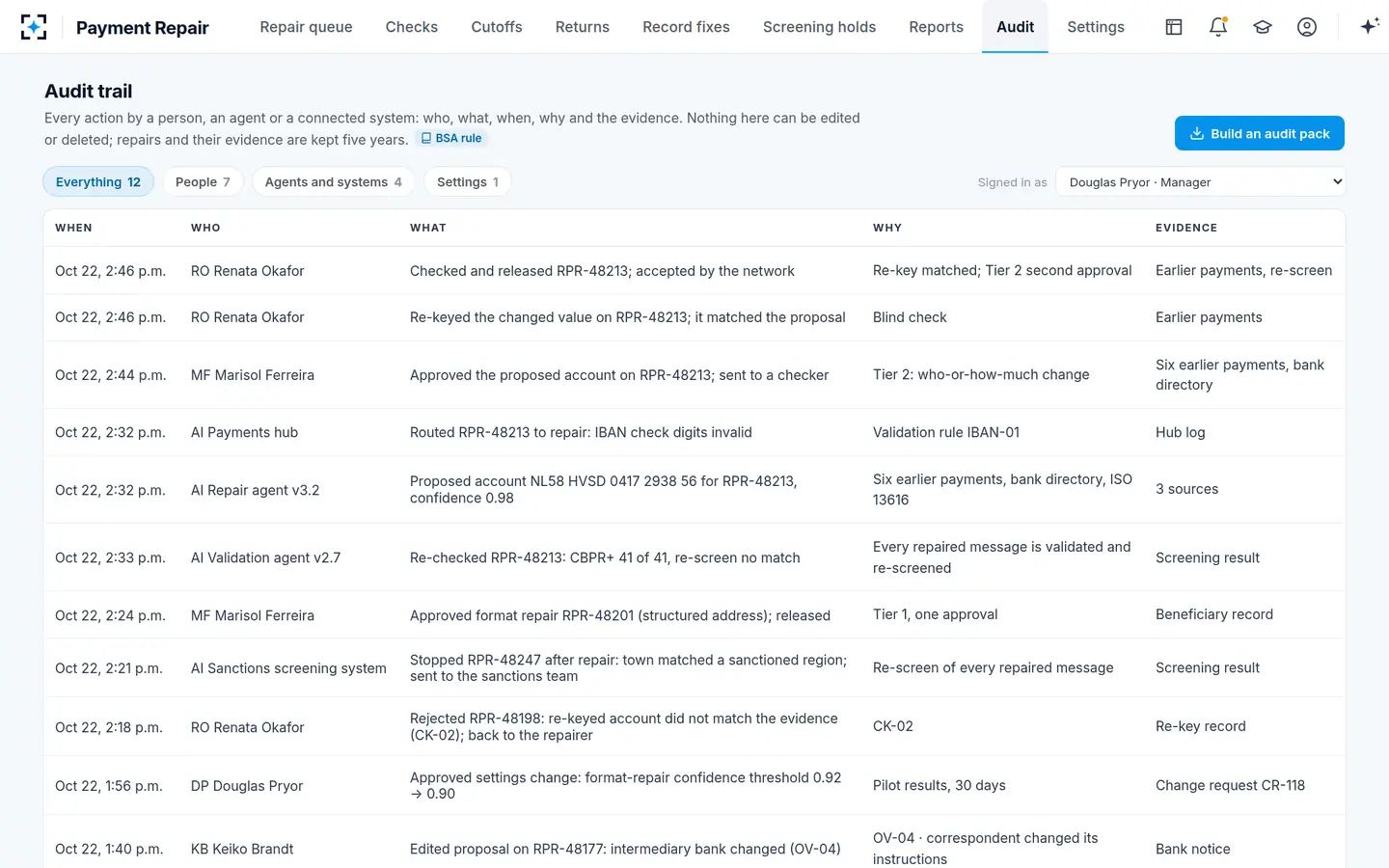
Payment Repair works on outgoing payments that failed before release, and its contribution to returns is in what it keeps and what it prevents. When a repaired payment is released, the network's tracking reference is recorded with it, the repaired message is kept beside the client's original for five years, and the trail names the repairer, the checker and the evidence. A return that comes back weeks later can be matched to the message that was actually sent, and anyone looking at it can see what was changed and why.
A payment repaired in Payment Repair, released with its network tracking reference
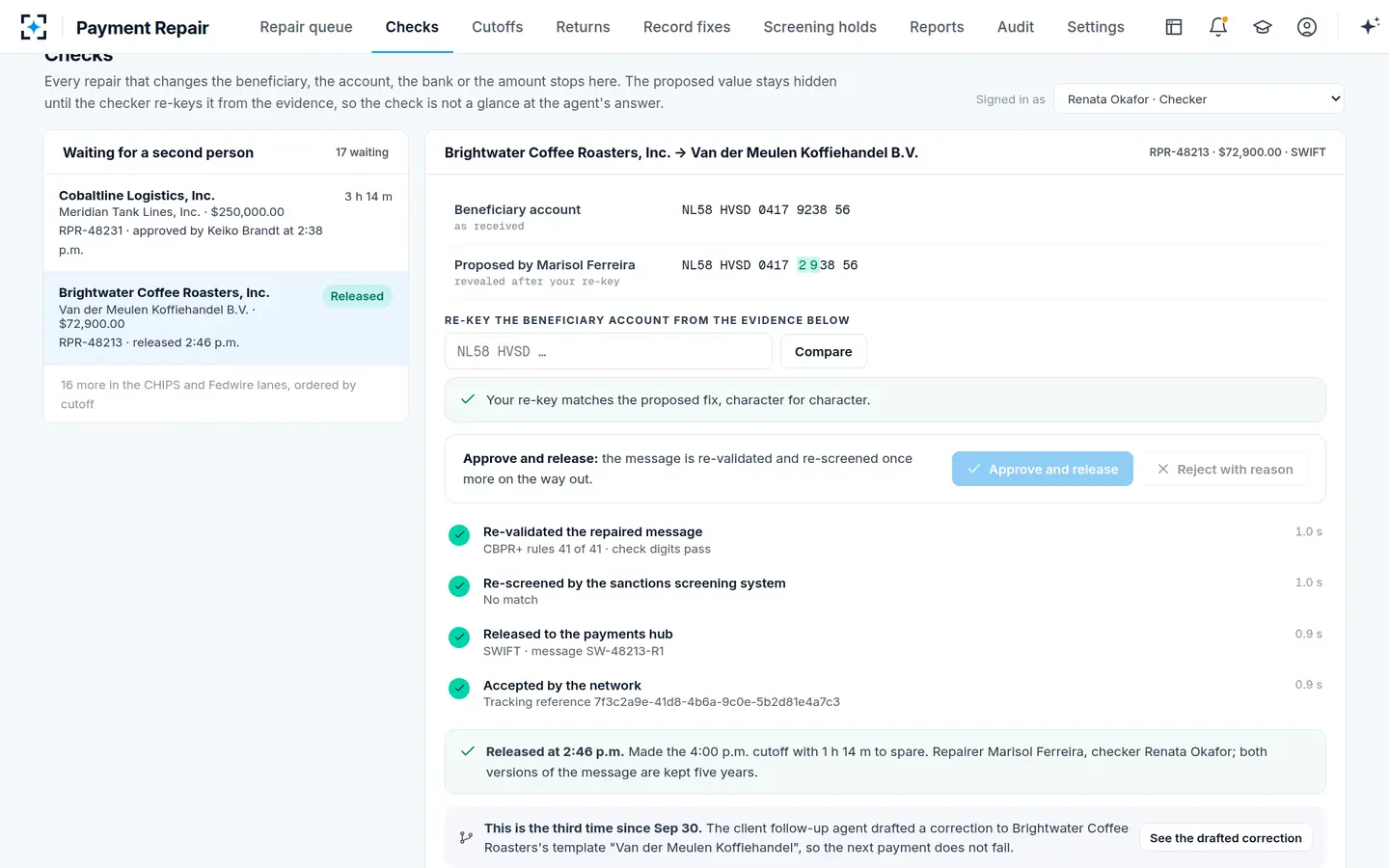
Prevention is the larger effect. Every return for a wrong account, a retired bank code or a name that does not fit the account is a repair that was not made before release. The agents' fixes from the client's own history, the checker's blind re-key on any change to who is paid, and the drafted template corrections all reduce the number of payments that come back at all.
Who changed what, when, why, and on what evidence
Questions people ask
How long can a returned wire take to arrive?
There is no network deadline on Fedwire: the Federal Reserve imposes no restriction on when a return may be sent. Most come back once the receiving bank decides it cannot apply the payment, but a bank's matching should never assume a return will arrive within a fixed window.
What is the difference between a pacs.004 and a pacs.002?
A pacs.004 returns funds from a payment that settled. A pacs.002 is a status report; on Fedwire it reports a value message as pending, settled or rejected, and carries the business error codes when Fedwire rejects one. A rejected payment never settled, so it is never returned with a pacs.004.
Can a bank return a returned wire?
Yes. The Federal Reserve's guidance covers the "return of a payment return", in which the outgoing pacs.004 carries the incoming return's message identification and the original UETR, so the chain of references is kept.
Why did the returned amount come back lower than the amount sent?
Banks in the chain may have deducted fees, on the way out or the way back, if the payment's charge instruction allowed it. That is also why matching a return by amount fails; the references in the pacs.004 do not change when fees are taken.
Who should work the suspense account for unmatched returns?
Someone independent of sending the payments, with the authority to post or escalate, and with the aging of each item in front of them. Examiners look at reconcilements and the attention management gives to open items, so an aged unmatched return is both a client problem and an audit finding.
To see how a repaired payment is released, tracked and kept on the sample bank, start from Payment Repair.