A wire repair on a name is a correction to the originator's or beneficiary's name in a payment message, made from evidence so the payment can pass validation: moving a name that was typed into an address line into the name field, completing a legal name the client's system truncated, or matching a misspelled name to the beneficiary the client has paid before. Such a repair may add or correct party information. It may never remove or obscure who is paying or being paid, and the repaired message must be screened again before it leaves. The line matters because the word has a past: Lloyds TSB called the removal of names from wires "repairing", and forfeited $350 million. Botminds' Payment Repair, an agentic solution for repairing failed payments, proposes name repairs only from evidence, keeps both versions, and sends every repaired message back through sanctions screening.
The case details come from the U.S. Department of Justice and the Treasury's Office of Foreign Assets Control; the rules from Article 4A, the FFIEC and FinCEN's travel rule. The screens are the solution's sample data on a fictional Corvane National Bank, and the worked example uses fictional companies.
The Lloyds case in four numbers
$350M
forfeited by Lloyds TSB in 2009, half to the United States and half to New York County
12years
of the practice, from as early as 1995 until January 2007, according to court documents
4,281
transfers worth nearly $37 million through U.S. banks, June 2003 to August 2006, in OFAC's analysis
$217M
OFAC settlement for the same conduct, deemed satisfied by the $350 million payment
How is repairing a name different from stripping a wire?
Wire stripping is the deliberate removal or alteration of information in a payment message, such as the names of the parties or their banks, so that the payment passes a sanctions filter it would otherwise have stopped. It is the opposite of repair: repair puts information into a message so it can be processed correctly, while stripping takes information out so it can be processed without being seen.
The Justice Department's description of the Lloyds case is the clearest public account of how it worked. According to court documents, "Lloyds deliberately removed material information—such as customer names, bank names and addresses—from payment messages so that the wire transfers would pass undetected through filters at U.S. financial institutions" (U.S. Department of Justice, 9 January 2009).
This process of "repairing" or "stripping," as Lloyds commonly referred to it, allowed more than $350 million in transactions to be processed by U.S. correspondent banks used by Lloyds that might have otherwise been blocked or rejected due to sanctions regulations or for internal bank policy reasons.
U.S. Department of Justice, press release 09-023, 9 January 2009
Nothing in that history says that the repair work done on payments desks today is evasion; it is not. It says something narrower and more useful: the same verb can describe both, so a bank's repair rules should make the difference impossible to blur. A repair desk that can only add or correct, never delete, and whose every repaired message is screened again, cannot be used to do what Lloyds did.
What happened in the Lloyds sanctions case?
Lloyds TSB agreed in January 2009 to forfeit $350 million, $175 million to the United States and $175 million to the New York County District Attorney's Office, under deferred prosecution agreements, after a criminal information charged it with one count of violating the International Emergency Economic Powers Act. According to court documents, from as early as 1995 until January 2007, Lloyds in the United Kingdom and Dubai falsified outgoing U.S. wire transfers involving sanctioned countries or persons, on behalf of customers from Iran, Sudan and other sanctioned countries (DOJ).
OFAC announced its own settlement in December 2009, for $217 million, concerning what it called "intentional manipulation and deletion of information about U.S. sanctioned parties in wire transfer instructions routed through third-party banks located in the United States". Its analysis found at least 4,281 transfers totalling nearly $37 million between June 2003 and August 2006, and it deemed the penalty satisfied by the $350 million already paid. Lloyds also agreed to annual reviews of its policies, procedures and "a statistically significant sampling" of U.S. dollar payments for two years (OFAC, 22 December 2009).
The lesson for a payments desk is in where the damage was done. The U.S. banks that processed the payments were screening; the information their filters needed had been removed before the messages reached them. Sanctions controls depend on the fields being there and being true, and the people who edit those fields are repair staff.
Can a bank change the beneficiary name on a wire?
A bank can correct or complete a beneficiary name when the evidence shows what the client meant, and it must not change it to anything else. The legal starting point is Article 4A: a bank that accepts a payment order "is obliged to issue, on the execution date, a payment order complying with the sender's order" (UCC 4A-302(a)(1)). A repair that puts a name in the right field, or fixes an obvious misspelling of the payee the client has paid before, makes the order say what the sender meant. A repair that swaps one payee for another does not.
The name also matters less to the receiving bank than most clients assume, which makes a wrong name repair harder to detect. Article 4A lets the beneficiary's bank, unless it knows that the name and number refer to different persons, rely on the account number (UCC 4A-207(b)). A name "fixed" to match an account will usually be paid to the account. That is why the sample bank treats any change to the beneficiary's name as a change to who is paid, with a second person checking it from the evidence.
What a name repair may change, and what never goes
The useful rule is simple: a repair may add, move or correct party information to make the message say what the client instructed; it may not remove, hide or replace it. The comparison applies the rule to the repairs a desk actually sees.
Permitted and forbidden repairs to party names in a wire
A permitted name repair: Move a name typed into an address line into the name field, and the address into its own fields
Never, whatever the reason: Leave the name out of every field because it will not fit the structure
A permitted name repair: Complete a truncated legal name from the client's beneficiary details on file
Never, whatever the reason: Shorten a name so a filter will not match it
A permitted name repair: Correct an obvious misspelling to the name of the payee the client has paid before, with the evidence cited
Never, whatever the reason: Change the name to fit an account number that belongs to someone else
A permitted name repair: Put "for further credit to" or "on behalf of" information into the ultimate creditor or ultimate debtor elements
Never, whatever the reason: Drop the ultimate party, an intermediary or the originator's bank to make the message pass
A permitted name repair: Add a BIC or legal entity identifier the client has confirmed
Never, whatever the reason: Replace a name with a code, a pseudonym or an internal reference
A permitted name repair: Answer the sanctions team's questions about the repair
Never, whatever the reason: Re-repair a payment that screening stopped, to get it through
Structured fields are why name repairs are common now. The CPMI's requirements for cross-border payments ask for party names and addresses in their own elements, because legacy messages carried "insufficiently structured and 'bulked' information (eg name and postal address information combined in one text field), which makes screening of the data more complex" and produces false positives that need manual work (CPMI, Harmonised ISO 20022 data requirements, February 2026). Un-bulking a name is a repair that helps the screening filter, which is the opposite of stripping.
Fedwire's own format makes the same demand from the other side. Its guidance says a party can be identified by a BIC alone, but otherwise an originator or beneficiary must be identified with a name and address, not with an account number on its own (Fedwire ISO 20022 format FAQs, postal address questions). A repair that leaves a party with only a number is not a valid Fedwire message, let alone a good one.
One name repair, field by field
Take a fictional client, Harrowfield Tile Works, paying its Portuguese supplier, Kestrel Ceramica, Lda. The client's portal sent the supplier's name and address as one line of free text, and the bank's hub rejected the payment because the network now needs the town and country as separate fields.
A permitted name repair: add and move, never remove
| Field | As received | As repaired | Evidence |
|---|---|---|---|
| Creditor name | KESTREL CERAMICA LDA RUA DAS OLIVEIRAS 14 4050-123 PORTO PT | Kestrel Ceramica, Lda. | The client's beneficiary details on file and three earlier credited payments |
| Street name and building number | (empty) | Rua das Oliveiras, 14 | Taken from the received line, unchanged |
| Post code and town name | (empty) | 4050-123, Porto | Taken from the received line, unchanged |
| Country | (empty) | PT | Taken from the received line, unchanged |
| Creditor account | As sent by the client | Unchanged | Matches the earlier credited payments |
| Original message | Kept | Kept beside the repair | Both versions retained with the repair's reason and approver |
Nothing in that repair changes who is paid, so on the sample bank's policy it is a format repair the repairer approves alone. Change one detail and it becomes a different repair. If the earlier payments had gone to "Kestrel Ceramics Ltd" at a different account, the name and the account would describe two possible payees, and the right answer would be to ask the client, not to choose.
Can abbreviations be used in a wire name?
Yes, within limits. FinCEN's travel rule requires the transmittor's name, among other details, in transmittal orders of $3,000 or more (31 CFR 1010.410(f)), and the FFIEC's examination manual explains that the rule allows abbreviated names, names reflecting different accounts of a corporation, such as a payroll account, and trade or assumed names of a business, but does not allow coded names or pseudonyms (FFIEC BSA/AML Examination Manual, funds transfers recordkeeping).
For a repair desk, that sets the boundary on shortening. A recognisable abbreviation of a legal name, such as "Corp." or "Lda.", is a permitted repair when a field is too short; a name cut down to initials that no one could identify, or replaced with a code the bank alone understands, is not. When the full legal name does not fit, the better repair is usually to add an identifier such as a BIC or LEI the client has confirmed, not to shorten further.
Must a repaired payment be screened again?
Yes, and the reason is specific to repair rather than a general caution. A repair changes what the screening filter reads: a town that was buried in a free-text line now sits in a town field, a misspelled name is now spelled correctly, an intermediary bank has been added from published instructions. Any of those can produce a hit the original message did not.
In Payment Repair every repaired payment is screened again, and a hit goes to the sanctions team
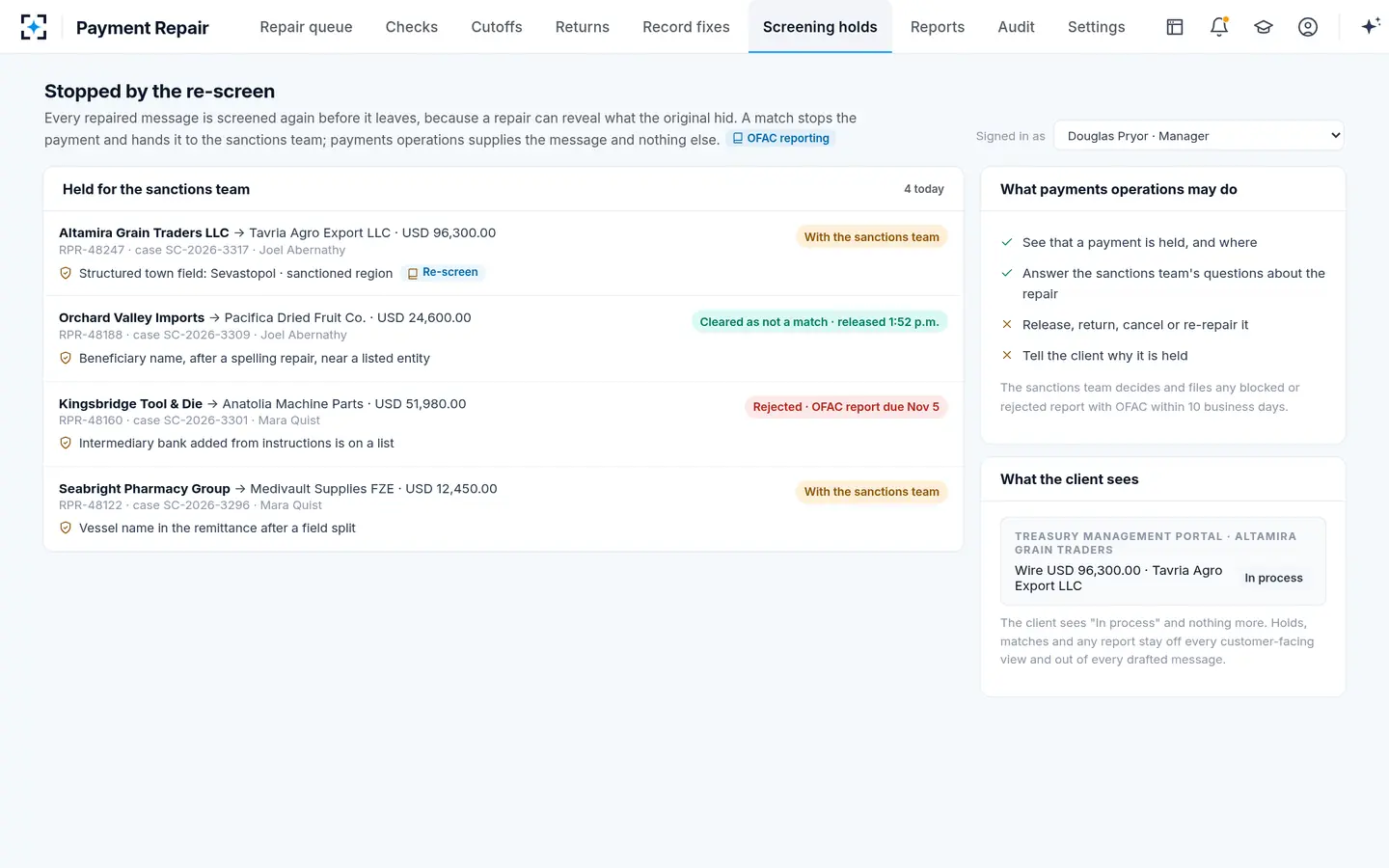
The screen also shows the second half of the rule. Once screening stops a repaired payment, the repair desk's part is over: it cannot release, return, cancel or re-repair the payment, and the client sees only "In process". Screening itself, from what a filter compares to how hits are cleared, is covered in Botminds' Payment Sanctions Screening series, including name screening versus transaction screening.
Keep the original beside the repair
A repair that overwrites the message it repaired destroys the evidence that it was legitimate. The FFIEC lists among the control objectives for a wholesale funds transfer system "Ensuring the original unaltered outgoing instruction is entered into the internal accounting system" (FFIEC IT Examination Handbook, internal and operational controls). For a repair desk, the practical form is to keep the instruction as received and the message as repaired side by side, with who changed what, on what evidence and who checked it.
Bank Secrecy Act records are kept for five years (31 CFR 1010.430(d)), and the sample bank keeps both versions of every repaired message for the same period. An examiner, an auditor or a correspondent bank asking about a payment can then see exactly what the client sent and exactly what the bank changed. That trail of before and after is the strongest answer a bank has to the question the Lloyds case raises.
Who approves a name change on a wire?
On the sample bank, a structural name repair that changes nothing about who is paid is approved by the repairer; any change to the beneficiary's name, account or bank goes to a second person who re-keys the changed value from the evidence; and anything the evidence cannot prove goes back to the client. Screening hits go to the sanctions team and nobody else. The tiers are settings each bank chooses, but the principle behind them is the one in the maker checker process: the person who proposes a change to who is paid is never the person who approves it.
Rules for any repair to a party name, as Payment Repair applies them
- Add, move or correct; never remove
Every name, bank and address in the received message is still in the repaired one.
- Correct only from evidence
The client's beneficiary details, earlier credited payments or a confirmed template, cited with the repair.
- Never change a name to fit an account
If the name and the account describe different payees, ask the client.
- Abbreviate, never encode
A recognisable abbreviation is allowed; a code, pseudonym or bare reference is not.
- Screen the repaired message again
Before a person approves it and again at release.
- Leave hits to the sanctions team
No re-repair, release, return or explanation to the client from the repair desk.
- Keep both versions
Received and repaired, with the reason, the evidence, the repairer and the checker.
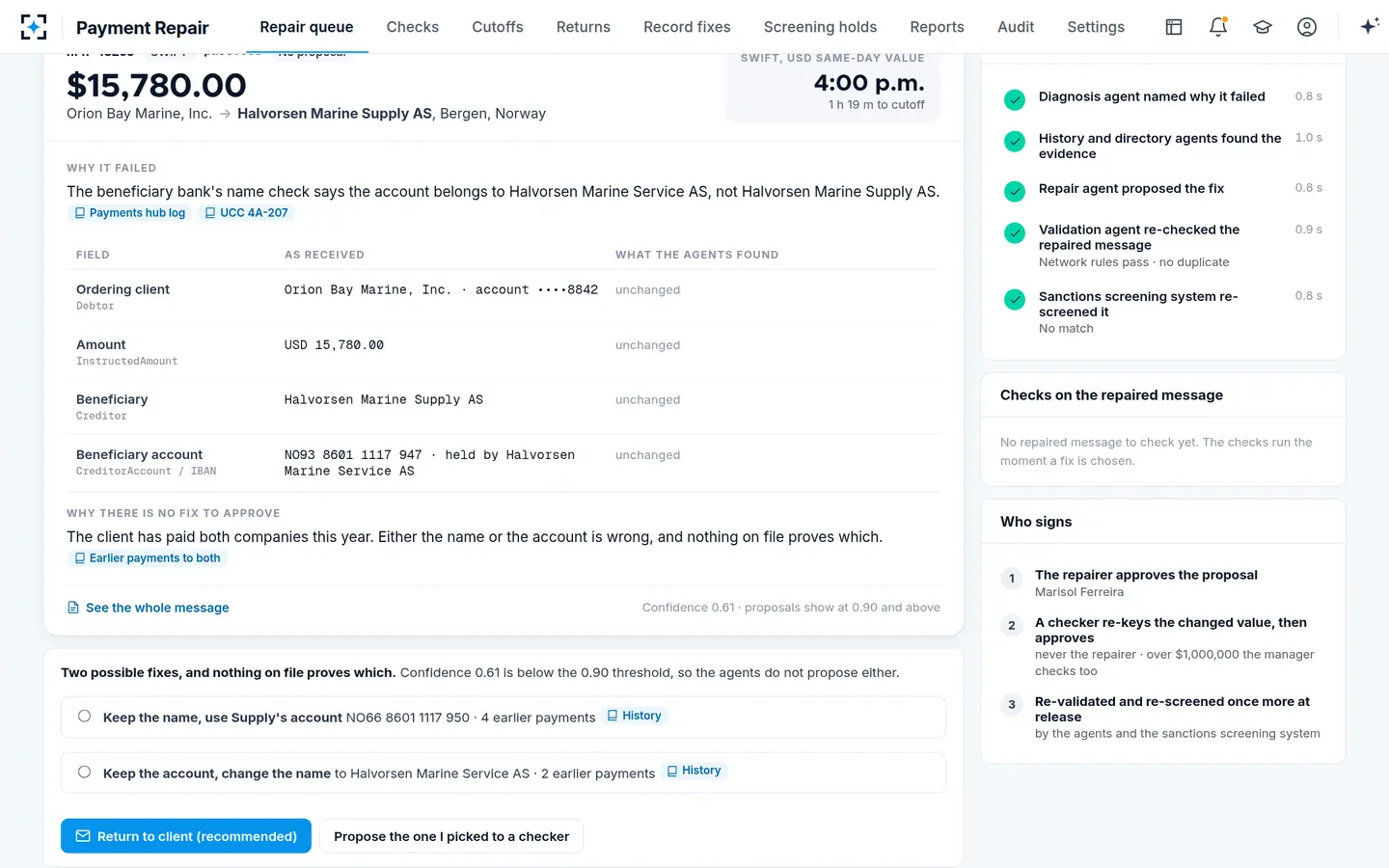
When the evidence runs out, Payment Repair's agents say so. On the sample desk, a payment named one company and carried another's account, and the client had paid both that year; the agents offered the two candidates at a confidence of 0.61, below the bank's 0.90 threshold, and recommended returning it to the client.
A name and an account that point to two payees: candidates, and a return to the client
Questions people ask
Is wire stripping illegal?
Removing or altering payment information to evade U.S. sanctions has been prosecuted under the International Emergency Economic Powers Act, as in the Lloyds case, and is the subject of OFAC enforcement. A bank's legitimate repairs, made from evidence and screened again, are not stripping.
Can the beneficiary's bank reject a wire because the name is wrong?
It can, and some do when their own name check fails. Under Article 4A it is not obliged to compare the name with the account, and may pay on the account number if it does not know the two refer to different people; if it does know, different rules apply.
Should a repair desk shorten long names to fit a field?
Only with a recognisable abbreviation, and preferably not at all: a confirmed identifier such as a BIC or LEI is a better way to make a party unambiguous than a shorter name, and the CPMI encourages complementing an entity's name and address with one.
What is "for further credit to" in a wire, and can it be dropped?
It names the person who ultimately benefits when the account holder is someone else, such as a parent's account credited for a student. In ISO 20022 it belongs in the ultimate creditor element, and the Federal Reserve's guidance is that banks pass it on to the next agent or the creditor; a repair should move it, never drop it.
Who should a repair desk tell about a suspected stripping attempt?
The bank's sanctions and BSA functions, through its internal escalation route, and never the client. Whether to file a report is their decision; the repair desk's part is to stop, keep the message as received, and note what it saw.
To see a name repair proposed with its evidence and screened again on the sample bank, start from Payment Repair.