A payment operations specialist job description usually reads "research and resolve payment exceptions", and the reality is a race against the clock: the specialist works the repair queue of payments that failed validation on their way to Fedwire, CHIPS, SWIFT or an instant network, proves each fix, sends the risky ones to a second person, and keeps every lane clear before its cutoff. The hard part is not typing the fix. It is finding the evidence for it across four systems while the next deadline approaches. Botminds' Payment Repair is an agentic solution built for this desk: its agents diagnose each failed payment and assemble the proof before the specialist opens it, and the specialist decides.
The day below is the solution's sample data: the fictional Corvane National Bank's repair desk on Thursday, 22 October 2026, and its specialist Marisol Ferreira, who works the SWIFT lane. The Federal Reserve's hours, the FFIEC's controls and the BLS's pay data are real and linked where they appear.
The job in four numbers
22hours
in a Fedwire business day: it opens at 9:00 p.m. ET the evening before and closes at 7:00 p.m.
6:45pm ET
the Federal Reserve's cutoff for customer transfers; a bank's own cutoffs come earlier
$27.72
mean hourly wage of financial clerks not elsewhere classified, in credit intermediation, May 2025
18,730
people in that occupation in credit intermediation; BLS has no separate "payment operations" code
What does a payment operations specialist do?
A payment operations specialist keeps a bank's payments moving when the automation stops. In most banks the job covers some mix of four kinds of work, and the job title varies with the mix: payment repair specialist, wire operations specialist, funds transfer specialist or exceptions analyst.
- Repair. Correct outgoing payments that failed the bank's or the network's validation, from evidence, and release them before the cutoff.
- Check. Act as the second person on a colleague's repair when it changes who is paid or how much.
- Return and ask. Send back to the client what cannot be proven, in plain words, and chase the answer before the deadline.
- Prevent. Notice when the same client template or reference table fails again, and get it corrected at the source.
The FFIEC describes the setting in its examination handbook: the funds transfer operation, or wire room, "is responsible for originating, transmitting, and receiving payment orders" (FFIEC IT Examination Handbook, Wholesale Payment Systems). In a small bank that may be one person with other duties; in a large one it is a department split into lanes by network and cutoff.
One afternoon on the repair desk, by the clock
The day turns on the afternoon. Overnight and morning payments mostly go straight through or are repaired with hours to spare; from about 2:30 p.m. the bank's same-day cutoffs start to close one after another, and every repair still open is a payment about to lose its value date. The timeline below follows one repair and one lane on the sample desk.
Fourteen minutes for one repair, most of them waiting for a person
- Agents1 min
- Waiting for a person8 min
- Repairer3 min
- Checker2 min
Read the repair's timeline for where the minutes go. The agents finished their work within about a minute of the rejection; the payment then waited eight minutes for a person, while the desk worked the rest of a busy lane. Marisol's own review took three minutes, and the checker's blind re-key two. Without agents, the same repair would have started with the specialist reading the rejection and opening the client's payment history, the bank directory and the network rules in turn, before any fix could be typed.
A lane that would miss its cutoff by nine minutes, and the move that saves it
- 37 open repairs to the 4:00 p.m. cutoff74 min
- Late+9 min
- Lane clears at 3:41 p.m.55 min
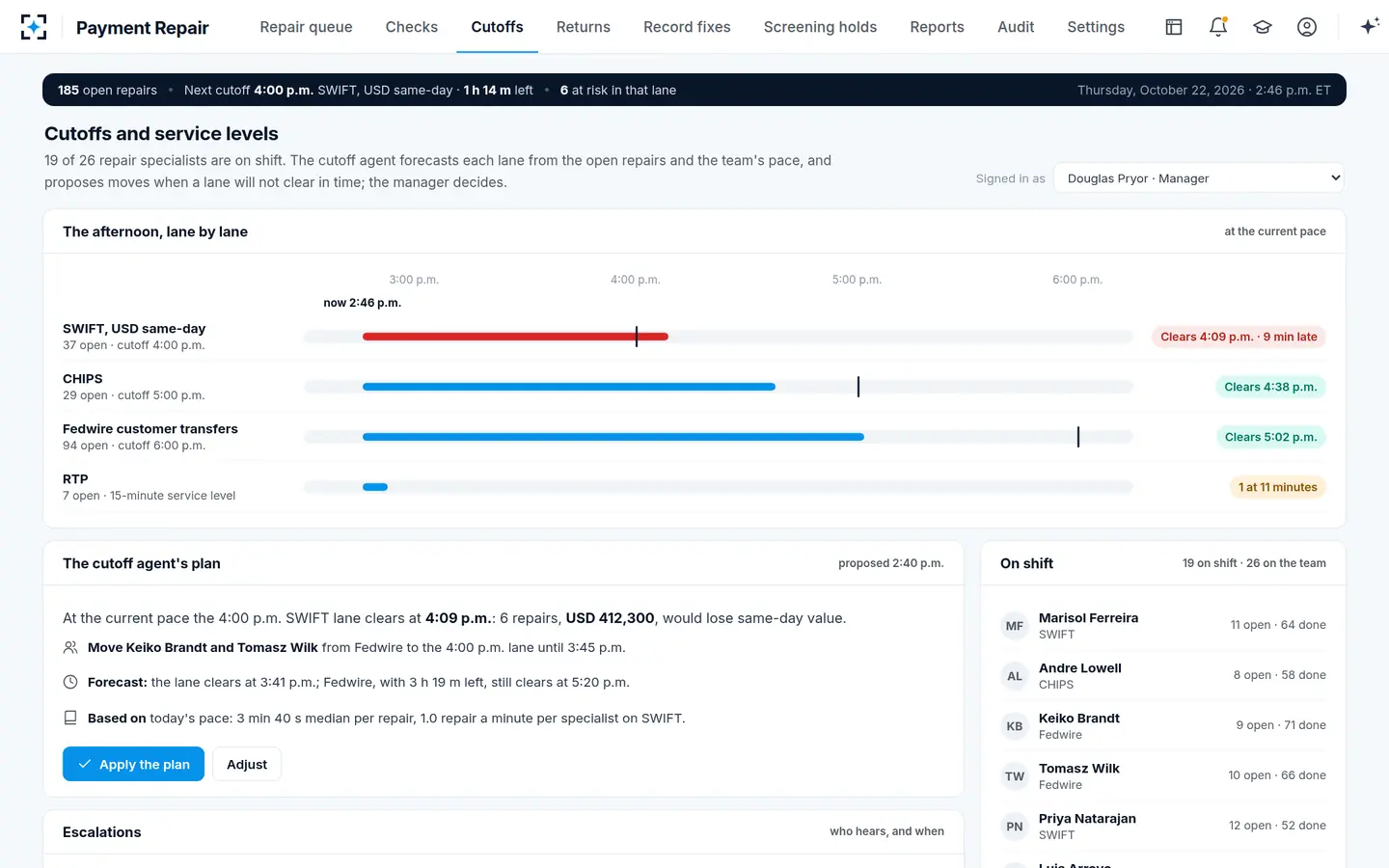
The lane's timeline is the manager's problem, and it arrives on the specialist's desk as an instruction. At 2:46 p.m. the SWIFT lane had 37 open repairs and, at the desk's pace, would clear at 4:09 p.m.: nine minutes late, with six repairs worth USD 412,300 missing same-day value. Moving two specialists from the Fedwire lane, which had more than three hours left, brought the forecast to 3:41 p.m. The decision was the manager's; the arithmetic was done before he was asked.
Payment Repair's cutoff forecast: which lane misses before it happens
When does Fedwire close, and why does the desk's day end earlier?
Fedwire stops taking customer transfers at 6:45 p.m. Eastern and closes at 7:00 p.m., but a repair desk works to earlier deadlines of its own. A bank sets internal cutoffs ahead of the network's so that a repaired payment has time to be checked, screened and sent; the sample bank closes its Fedwire customer lane at 6:00 p.m., its CHIPS lane at 5:00 p.m. and its SWIFT same-day lane at 4:00 p.m.
The Fedwire Funds Service day, cutoff by cutoff
| Time (ET) | What happens | What it means on the desk |
|---|---|---|
| 8:35 p.m., the evening before | Online nonvalue messages (return requests, report requests) begin processing | Requests can be queued for the next day overnight |
| 9:00 p.m., the evening before | The funds-transfer business day begins; value messages start processing | Overnight payments can settle before the desk arrives |
| 5:00 p.m. | Cutoff for tax payments to the Treasury's routing number and for special account messages | Tax payments in repair become urgent first |
| 6:45 p.m. | Cutoff for customer transfers (pacs.008) and returns of customer transfers | The last moment a repaired client wire can settle today |
| 7:00 p.m. | Cutoff for bank transfers, cover payments and other messages; the Fedwire Funds Service closes | Bank-to-bank and cover payments only |
The calendar will change. In October 2025 the Federal Reserve Board announced that Fedwire and the National Settlement Service will operate Sunday through Friday, including weekday holidays, "no earlier than 2028" (Federal Reserve Board, 9 October 2025). A desk that staffs to a Monday-to-Friday week will need a Sunday shift, or a rule for what waits until Monday.
What is a repair queue in banking, from the specialist's chair?
A repair queue in banking is the specialist's worklist of payments that failed validation, and the useful ones are sorted by cutoff and split by what the payment needs next. On the sample desk at 2:41 p.m. the 186 open repairs were divided into ready to approve (71), needs a checker (54), return to client (23), no proposal (31), stopped for screening (4) and waiting on the bank directory (3). Each of those piles calls for a different person and a different action, so a queue that shows them as one list wastes the first minutes of every repair.
The repair queue the specialist opens: one line per failed payment, ordered by cutoff
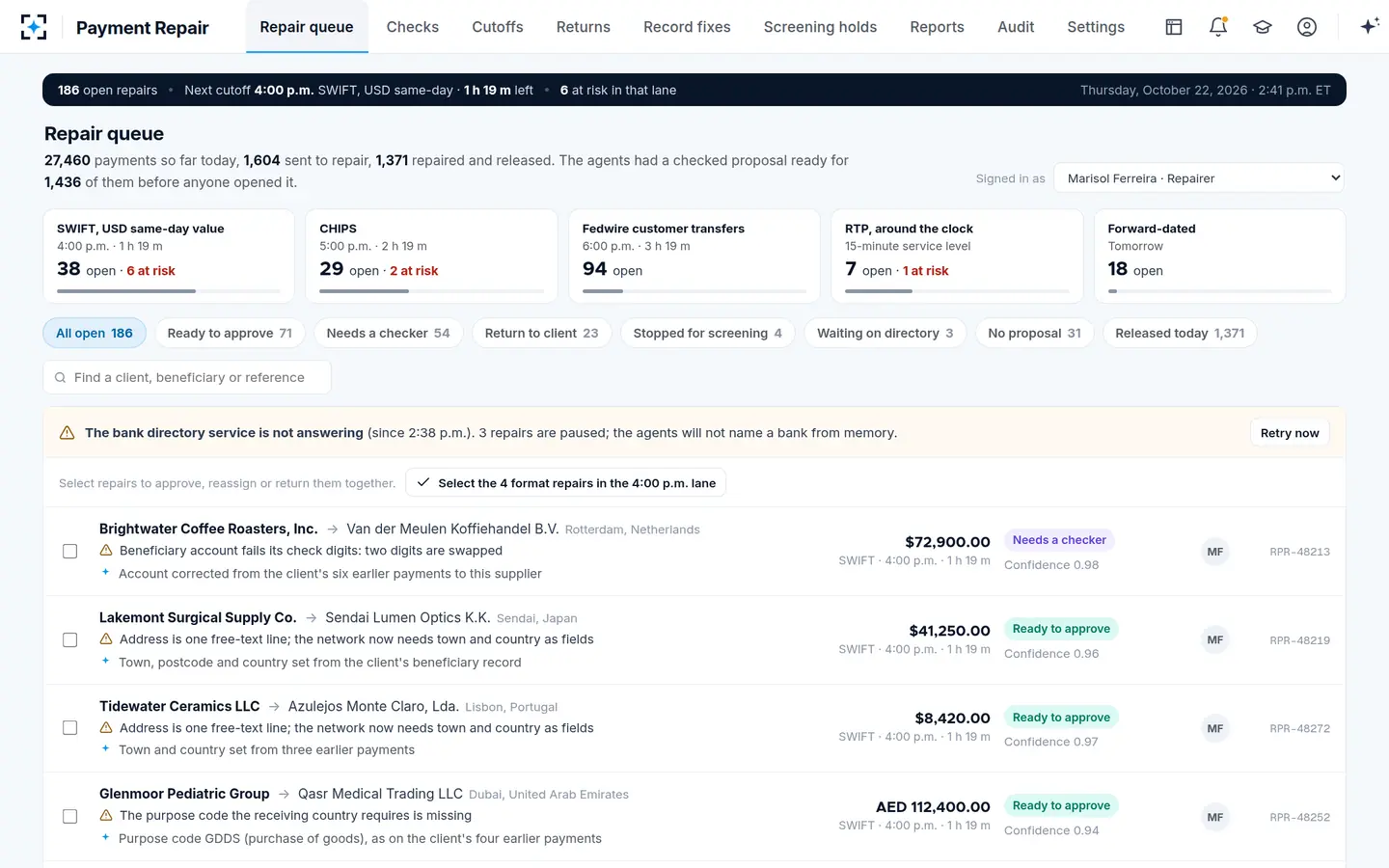
What the specialist does with a line depends on the pile. Ready to approve means the agents have a proof and the change is a format repair the specialist may approve alone. Needs a checker means the specialist has approved a change to who or how much and it waits for a second person. No proposal is the hard pile: the agents found nothing on file that proves a fix above the bank's confidence threshold, and the specialist has to decide between candidates or send it back. For what goes into each kind of fix, see what payment repair is.
How many repairs does one payment operations specialist handle?
There is no public benchmark, and the honest answer depends on the mix of repairs and the bank's tools. No regulator, central bank or academic study we found publishes repairs per specialist, so any figure quoted as an industry norm should be treated with suspicion. What a desk can do is measure its own, by lane and by kind of repair.
The sample desk gives a sense of scale. By 2:41 p.m. it had sent 1,604 payments to repair out of 27,460 processed that day; by 2:46 p.m. Marisol had completed 64, and the colleagues listed beside her between 52 and 71 each; the persona's job description says 60 to 80 a day. Those are fictional numbers, but the method behind them is the right one. The BIS lists "Queue depth and clearance time" among the measures it suggests payment systems track after an ISO 20022 migration, and defines it as tracking "the number of queued transactions and the time required to clear them, ensuring efficient processing" (CPMI Brief No 11, April 2026). A repair desk that tracks the same two numbers by lane can staff to its cutoffs instead of to its average.
What happens to repairs after the cutoff?
A repair that misses its cutoff does not disappear; it is sent on the next business day, returned to the client or, if nobody acts, left to lapse. Each outcome has a cost and a rule behind it.
If the bank had the client's funds in a non-interest-bearing account and did not execute on the execution date, Article 4A makes it pay interest to the client for the delay unless the client was told on that date that the order was rejected (UCC 4A-210(b)). That is the legal reason a repair desk tells the client the same day when a payment will not go. And an unaccepted payment order does not wait for ever: Article 4A cancels it by operation of law at the close of the fifth funds-transfer business day after its execution or payment date (UCC 4A-211). A repair parked in the wrong pile for a week can become a payment nobody can send.
The commercial cost is plainer. A client whose supplier payment lands a day late hears about it from the supplier, and a client whose payroll misses its date calls the relationship manager. The cheapest protection is the one in the timeline above: know at 2:46 p.m. which lane will miss at 4:00 p.m., while there is still time to move people.
Who checks the specialist, and what changes in a small bank?
In a bank of any size, someone other than the specialist checks the risky repairs and reviews the exceptions. The control is the same everywhere; the form changes with headcount. The FFIEC acknowledges that in a smaller institution "the sending and receiving of payment orders may be a part-time responsibility for one or more people", and that "a complete separation of duties may be difficult to achieve, and compensating controls, including rotation of duties and internal review procedures covering those payment orders requiring officer review, should be considered" (FFIEC, Funds Transfer Operations (Wire Room)).
The five people who carry one repair on the sample desk
Today
Opens the payments hub, the client's history, the bank directory and the rulebook in four windows for every failed payment, with the cutoff behind her.
With agents
Opens a repair with the fix already proposed on the same line as the original, re-checked and cited, and approves, edits with a reason code or returns it.
Still theirs: Every decision on the fix
Today
Re-reads the same screens as the repairer or, under time pressure, glances at the first person's value.
With agents
Re-keys the changed value from the evidence before the proposal is revealed.
Still theirs: Release of every who-or-how-much change
Today
Finds out a lane will miss its cutoff when the clock is already against him.
With agents
Sees each lane's forecast clearing time and a proposed reassignment he applies or adjusts.
Still theirs: Staffing, settings and escalations
Today
Hears about a broken client template only after it has failed again and again.
With agents
Receives a drafted correction with its cause and the repairs it prevents, and confirms it with the client.
Still theirs: The conversation with the client
Today
Samples repairs each quarter and reassembles who changed the account, on what evidence and who checked it.
With agents
Builds a masked, sealed pack from the trail with every repair, re-key and reason code.
Still theirs: Independent review; changes nothing
What skills does a payment operations specialist need?
The job rewards a particular combination: message literacy, enough law to know which fixes are dangerous, and the judgement to stop when the evidence runs out. Speed matters, but a fast specialist who guesses costs more than a slow one who returns the payment.
What a strong payment operations specialist can do
- Read an ISO 20022 payment message
Debtor, creditor, their agents and accounts, the intermediary, the remittance and purpose fields, and which of them the network checks.
- Tell a format repair from a who-or-how-much repair
And know that the second needs proof of what the client meant and a second person.
- Use reference data without trusting memory
Bank directories, successor BICs, routing numbers and correspondents' settlement instructions, each with its date.
- Know the few Article 4A rules that bite
The executing bank must follow its sender's order; a payment to the wrong beneficiary is the bank's loss; the beneficiary's bank may pay on the number alone.
- Say nothing that tips off
A payment held by the sanctions team is "in process" to the client; the specialist never explains a screening hold.
- Work by cutoff, not by arrival
Sort the queue by the time left, and raise the alarm before a lane is lost.
- Write a return message a client can act on
What is wrong, what to send, and by when, without internal codes.
- Notice the repeat
The third failure from the same template is a correction to request, not a third repair.
The fourth item is where training most often stops short. A specialist who has never read UCC 4A-303 treats an account change like an address change; one who has knows why the checker re-keys rather than re-reads.
How Payment Repair changes the specialist's day
Payment Repair does not remove the job; it removes the hunting. Its agents read the rejection, the client's earlier payments and templates and the bank directory, propose a fix with its sources, re-validate and re-screen the repaired message, and forecast each lane against its cutoff. The specialist opens a payment that already says why it failed, what the fix is and what proves it, and spends the minutes on the decision.
Three limits keep the decision with people. The agents never release a payment, never change an amount and never clear a sanctions hit; below the bank's confidence threshold, 0.90 on the sample desk, they offer candidates rather than a proposal. And when the bank directory stops answering, they stop too: three repairs on the sample afternoon waited for it rather than name a bank from memory. For the cost side of the same minutes, what each payment that is not straight-through costs turns them into dollars.
Questions people ask
What is a payment operations specialist salary?
The BLS does not publish a separate occupation for payment operations. Its nearest proxy, Financial Clerks, All Other, had a mean annual wage of $57,660 in credit intermediation in May 2025, or $27.72 an hour, across 18,730 jobs. Senior specialists and team leads are often classified in other occupations and paid more.
Is payment operations a good career?
It is a training ground in how money actually moves: messages, networks, law and controls. Specialists who learn ISO 20022 messages and the Article 4A rules behind repairs, returns and investigations can move into investigations, payments product, operational risk or compliance roles.
What is the difference between a payment operations specialist and a payment investigator?
The specialist on a repair desk fixes payments before they leave the bank; an investigator handles questions about payments that have already left, such as a beneficiary who says the money never arrived. Many banks run both from one exceptions team, but the messages differ: repairs change the outgoing payment, while investigations use inquiry, cancellation and return messages.
Do payment operations specialists work weekends?
Today Fedwire is not open on Saturdays, Sundays or Reserve Bank holidays, so most wire repair desks work a weekday day with an evening tail. The Federal Reserve has announced Fedwire operations from Sunday to Friday no earlier than 2028, which will change staffing.
What does a payment operations specialist need to know about ISO 20022?
Enough to read a pacs.008 customer transfer and a pacs.009 bank transfer field by field, to recognise a pacs.004 return and its references, and to know which party and address fields the network validates. Fedwire moved to ISO 20022 on 14 July 2025, so every Fedwire repair is now an ISO 20022 repair.
To see the queue, the checker's re-key and the cutoff forecast on the sample desk, start from Payment Repair.