UETR tracking means following a payment across banks by its Unique End-to-End Transaction Reference, the identifier each bank on the route is meant to carry unchanged and report status against. It works only as far as the banks report: the trail is bright where a bank updates a tracker or answers a status request, and goes dark where one does not, often at the last bank before the beneficiary, where the FSB finds payments wait longest. Since the Fedwire Funds Service moved to ISO 20022 in July 2025, every Fedwire value message carries a UETR, so a domestic leg and a cross-border leg can share one reference. Botminds' Wire Inquiry & Payment Tracking reads the UETR trail from the bank's own Fedwire messages and its correspondent's tracker, and when the trail stops it counts the hours and opens an investigation at the bank's stuck mark.
The two wires on this page are fictional sample wires traced in the solution: one with a bright trail and a hold, one that went dark. The rules and measurements are the Federal Reserve's, the BIS's and the FSB's.
Two sample wires: where the hours went, and where the trail went dark
What is UETR tracking?
UETR tracking is the practice of asking where a payment is by its end-to-end reference rather than by each bank's own number. The CPMI, which sets the harmonised ISO 20022 requirements for cross-border payments, requires the UETR for that reason: "In order for entities to easily track and reconcile a cross-border payment, the message must carry a unique and unambiguous reference end to end", and "The transaction identification commonly used for this purpose is not sufficient to ensure uniqueness across all cross-border payments and involved entities" (BIS CPMI, Harmonised ISO 20022 data requirements, updated February 2026).
The reference is only half of tracking. The other half is a place where banks report status against it, and the CPMI is careful about that too: status reaches banks through the pacs.002 status report, the pacs.028 status request and, in practice, through networks' and correspondents' own tools. A UETR with no one reporting against it is a well-formed number and nothing more.
Does a domestic wire have a UETR?
Yes, if it went over Fedwire after July 14, 2025. The Fed's format rules require it on every customer, bank and return payment message, while the legacy format could carry it only in an optional field, tag {3620}, which is why a return of an old payment may need a new one (Fedwire ISO 20022 Format FAQs). For a community bank that sends cross-border wires through a correspondent, that means the reference exists from the first leg, and the correspondent can carry the same UETR onto the cross-border leg.
One limit matters for anyone joining records on it. Fedwire checks the UETR's format, not its uniqueness, so a tracking system should match on the UETR together with the amount, the date and the Fedwire IMAD. How the UETR differs from the IMAD and OMAD is set out separately.
Can I track a wire with a UETR?
A bank can; a customer usually cannot, at least not directly. The UETR is a key into other banks' systems and into network trackers that banks, not customers, have access to. A customer who has the UETR should give it to the sending bank, which can look up its own correspondent's view or send a status request; a beneficiary who has it should give it to its own bank, which can tell whether a payment with that reference has arrived.
UETR tracking in Wire Inquiry & Payment Tracking: the tracker record behind 'held at the intermediary'
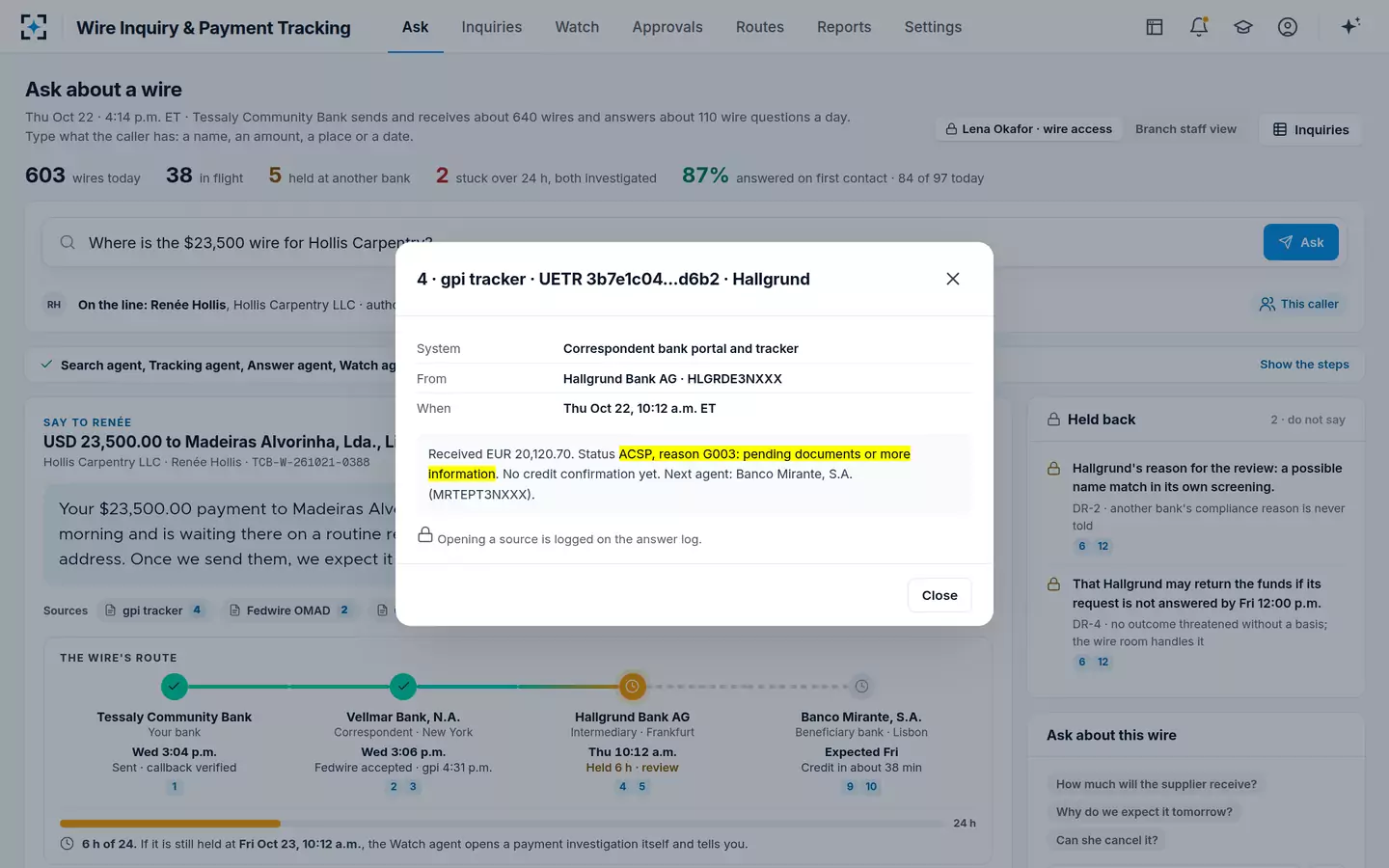
Where the trail goes dark: four places
The trail goes dark in four predictable places, and each calls for a different response. Waiting is the right response to none of them past the bank's own stuck mark.
Four places a UETR trail goes dark, and what the sending bank can do at each
| Where | Why it goes dark | What the sending bank can do |
|---|---|---|
| A bank that does not report status | It is not on the tracker the correspondent uses, or reports only by message when asked | Ask through the correspondent with a status request quoting the UETR; set an earlier mark for that bank if its history is slow |
| A relay or second correspondent | The CPMI notes relay cases, where banks other than the customer's own are involved in starting the payment | Ask the correspondent which bank holds the payment now |
| The beneficiary's bank | The slowest leg; a hold for documents or screening may not be reported | Read any request for information first; it is often the reason |
| A payment that lost or changed its UETR | A leg that did not carry the reference, or a return that needed a new one | Trace by IMAD, amount and date, and ask for the reference the next bank used |
Why does my UETR show no update?
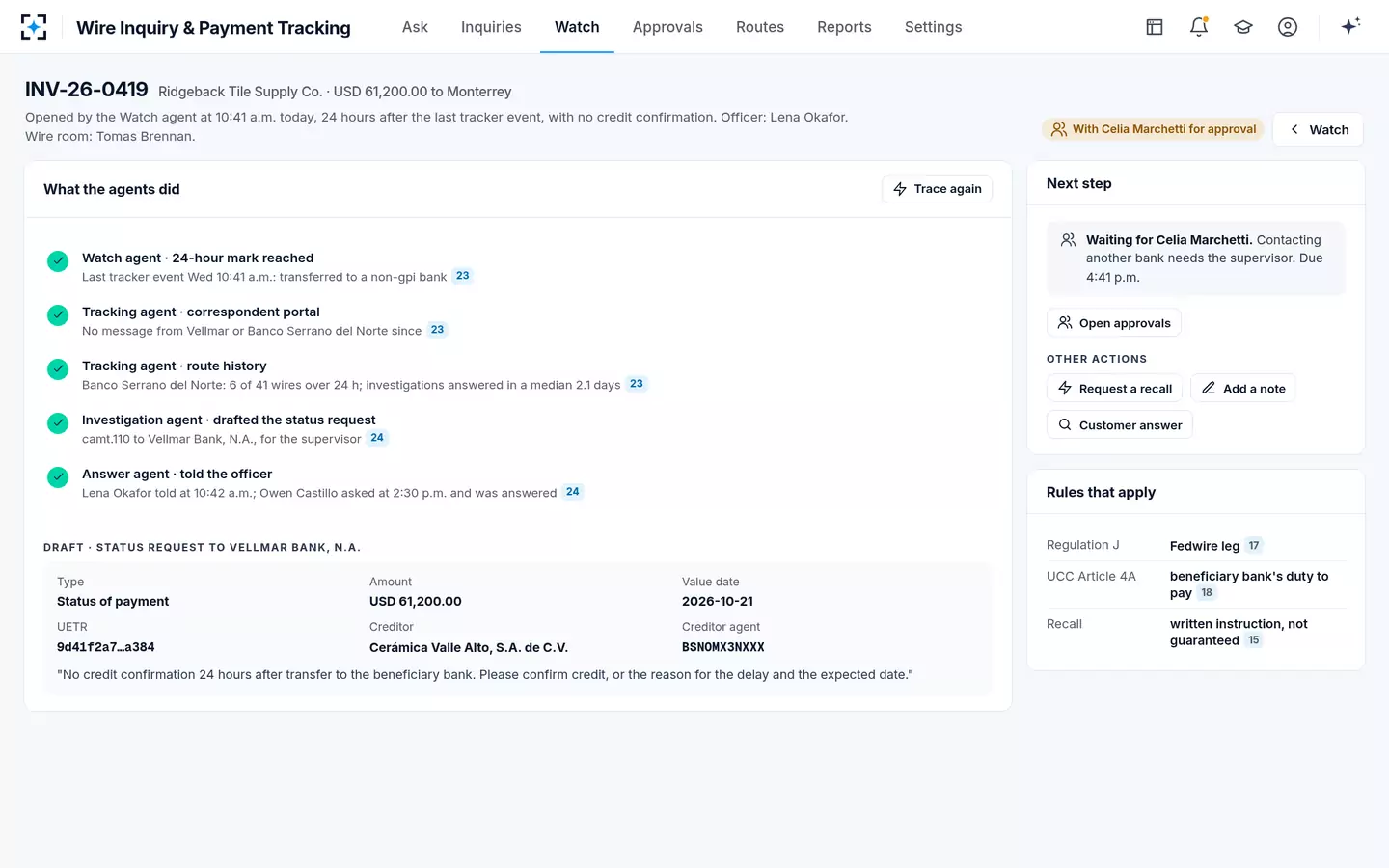
No update means a bank on the route has not reported; it does not mean the payment is lost, and it does not mean it is safe. In the sample bank's longest-held wire that day, the last tracker event was a transfer to a Monterrey bank outside the tracker, and nothing came back for 29 hours. The route's own history explained the silence without excusing it: that bank had held 6 of 41 earlier wires for more than 24 hours, and investigations with it had been answered in a median 2.1 days.
The fix is to stop treating silence as a status. The solution's Watch agent follows every wire in flight, and at the bank's stuck mark, 24 hours for an international wire, it opens a payment investigation itself, drafts the status request to the correspondent and tells the officer. Nothing goes to the other bank until the supervisor approves.
When the trail stops, Wire Inquiry & Payment Tracking opens an investigation at 24 hours
The beneficiary leg: the slowest, and the least visible
The last bank is where most of the time goes and where a sending bank sees least. The FSB splits large cross-border payments into an in-flight leg and a beneficiary leg, the time from the beneficiary's bank receiving the instruction to crediting the customer's account, which it says has always been the slowest part of the journey. In 2025, 88.5% of large payments cleared the in-flight leg within an hour; only 61.7% cleared the beneficiary leg that fast (FSB, consolidated progress report 2025, Annex C).
The beneficiary leg is slow, and nobody measures its transparency
88.5%
of large cross-border payments through the in-flight leg within an hour, 2025
61.7%
through the beneficiary leg within an hour
None
data source for the FSB's wholesale transparency measure, which includes tracking status
What the FSB cannot measure: whether anyone is told
The G20 targets ask every provider to give payers and payees, among other things, "tracking of payment status" by end-2027. The FSB's own report admits it "currently lacks a data source for calculating the wholesale transparency KPIs" and "is exploring potential ways to monitor transparency on payment status". Its transparency table for wholesale payments reads, under source, "No source currently available".
That gap is a bank's to fill for its own customers. No network figure will tell a business customer where its payment is; only the sending bank's reading of the trail, and its decision to act when the trail stops, will. How long a wire takes, leg by leg, uses the same FSB data for arrival dates.
What to do when the trail stops: ask, with the right message
When the trail stops, ask the next bank you can reach, quoting the UETR, and record when you asked. The messages for it exist. On Fedwire, the investigation request (camt.110) and response (camt.111) handle exceptions and investigations, alongside the pacs.028 status request (Format FAQs, question 1; camt.110 and camt.111 explains both); Fedwire takes investigation requests until 7:00 p.m. ET (Fedwire operating hours). The Fed says Fedwire was the first system anywhere to put them into use (Fed360, June 2026), and the structured data models for them were tied to a release it has since rescheduled to November 2027 (FRFS).
Asking is not the same as being answered. Operating Circular 6 treats requests for information as nonvalue messages and places no duty on the receiving participant to reply (OC 6, section 8.1.3); the answer comes because the correspondent relationship and the customer depend on it. That is why the sample bank's investigation records the route's history with that bank and escalates on its own clock; managing the case from there, across banks and messages, is the payment investigation process.
What the trail tells you besides where: amounts, charges and conversion
A good trail answers the customer's second question too: how much will arrive? The CPMI's requirements ask that a cross-border payment carry "the amount and currency of the payment as instructed by the payer, any currency conversion applied to that amount, any charges that have been deducted by any FI involved in the processing of the payment along the end-to-end payment chain, and the interbank settlement amount", and that "Except for the interbank settlement amount, all other information must be carried unchanged along the end-to-end payment chain" (BIS CPMI, Requirement 6).
Where banks follow it, the trail explains a short payment without a phone call. In the sample, the correspondent converted USD 23,500.00 to EUR 20,120.70 at 0.8562, the intermediary's record showed EUR 20,120.70 received, and the expected credit was EUR 20,105.70 after a EUR 15.00 charge, with the bank's own USD 45.00 fee debited separately. Each figure in the answer opened to the record it came from. The CPMI itself warns that full transparency on charges "could have major implications for business models": a frank admission that the requirement asks banks to change more than a message format.
Is a UETR update proof that the beneficiary was paid?
No. A tracker status says what a bank reported; in law, payment to the beneficiary turns on the beneficiary's bank accepting the order and paying it. Under Article 4A a beneficiary's bank accepts at the earliest of paying the beneficiary, notifying it of the credit, receiving payment from the sender, or the opening of its next business day with funds in hand (UCC 4A-209(b)), and must notify an account beneficiary by midnight of the business day after the payment date (UCC 4A-404(b)). Abroad, the local law of the beneficiary's bank governs. A "received" status at that bank is the start of its duty, not the end of the customer's question.
The sample answer keeps the distinction in its words: it places the payment at the partner bank in Germany, waiting on a review. It does not say the supplier has been paid, because no bank has said so. Wire Inquiry & Payment Tracking draws the whole route that way, stop by stop, with each status cited.
Questions people ask
What is a gpi tracker?
The tracker SWIFT runs for payments sent under its gpi service, which follows a payment by its UETR as participating banks update its status. A bank that sends through a correspondent may see it only through that correspondent. For an independent view of its speed, the FSB reports SWIFT's data for the whole wholesale market.
What if a bank in the chain is not on gpi?
Then its leg will not appear on that tracker, and the trail goes dark until the bank answers a request. In the sample, a Monterrey bank outside the tracker gave no update for 29 hours; the solution opened an investigation at 24 hours and drafted a status request quoting the UETR for the supervisor to approve.
What is a UETR in banking?
The Unique End-to-End Transaction Reference: a universally unique identifier, defined in RFC 4122 version 4, that the CPMI requires on cross-border payments and Fedwire requires on value messages. It is generated by an algorithm rather than issued by a registry, and every bank on the route is meant to carry it unchanged.
Is a UETR proof of payment?
No. It identifies the payment; proof of each leg comes from that leg's records, such as the Reserve Banks' settlement for the Fedwire leg and the beneficiary's bank's credit for the last. A tracker status is evidence of what a bank reported, which is useful but is not the bank's acceptance or the beneficiary's credit.
How long before a UETR shows an update?
There is no public measure of it; the FSB says it has no data source even for whether providers report tracking status. In the sample, the correspondent's record showed the payment sent on 85 minutes after the Fedwire leg settled, and the intermediary's receipt the next morning. Each bank's own history is the only reliable guide, which is why the sample bank keeps route history by bank.
Can a UETR change along the route?
It should not; the CPMI's requirement is one reference end to end. In practice a leg that did not carry it, or a return of a legacy payment, may produce a new one, so a trace that loses the UETR should fall back on the IMAD, the amount and the date.