A wire transfer at closing takes minutes on Fedwire once the sending bank releases it: the Reserve Banks settle the payment with the title company's bank as soon as they accept the message, and that bank must pay its customer on the same day. What takes hours is everything around those minutes, the buyer's bank verifying and releasing the wire, the Fedwire cutoff of 6:45 p.m. ET for customer transfers, and the receiving bank matching the money to the title company's escrow account. When a title company says "the wire hasn't arrived", the sending bank can prove its own leg to the minute, but it cannot see inside the other bank. Botminds' Wire Inquiry & Payment Tracking gives a treasury services officer that proof on the call, with the sentence she may say, so the closing does not wait for a callback.
The call below is illustrative: the bank, the people and the amounts are invented for this page and are not drawn from the solution's sample data. The rules and times are the Federal Reserve's and the UCC's, linked where they appear.
Twenty-five minutes on a closing-day call, and nineteen of them waiting on others
- Find and read3 min
- Say it3 min
- References passed on6 min
- Her bank finds and credits it13 min
How long does a wire transfer take at closing?
Once released, a domestic closing wire is usually settled within minutes, and the title company's bank owes its customer the money that day. Operating Circular 6 says that for a payment order the Reserve Banks accept, they "settle the payment order by debiting the amount of the payment order from the Master Account of the sender of the payment order and crediting the amount of the payment order to the Master Account of the Funds Participant identified by the sender as the receiver" (OC 6, section 8.2.6). There is no overnight float on Fedwire.
The time a buyer feels is elsewhere. Before release, the bank verifies the request, often with a callback, checks that the funds are there and screens the payment. After settlement, the title company's bank has to credit the escrow account and tell the title company. Article 4A sets the payment date as "the day on which the amount of the order is payable to the beneficiary by the beneficiary's bank", by default "the day the order is received by the beneficiary's bank" (UCC 4A-401), and requires that bank to pay on it, unless the order was accepted "after the close of the funds-transfer business day of the bank", in which case "payment is due on the next funds-transfer business day" (UCC 4A-404(a)).
3:40 p.m.: the call, minute by minute
At 3:40 p.m. on a Thursday, Odalys Esterhuizen, a treasury services officer at Marlpit Savings Bank, takes a call from a customer buying a house. Cobbstone Title says his $186,400 wire for the down payment and closing costs has not arrived, and the closing is at 4:30. He sent it from his account that morning; the bank released it at 1:52 p.m.
3:41. She verifies the caller and finds the wire: one wire for $186,400 that day, to Pemberley National Bank for credit to Cobbstone Title's escrow account, released at 1:52 p.m. after a callback to the customer. 3:42. The Fedwire record shows the message acknowledged and settled at 1:53 p.m., with the IMAD of Marlpit's message. 3:43. She has the answer she can prove: the money left Marlpit at 1:52 p.m. and Fedwire delivered it to Pemberley National Bank at 1:53 p.m.
3:44. She does not say "Cobbstone has the money", because she cannot see Pemberley's books, and she does not say "it will be there by 4:30", because nothing she holds supports it. She says: "Your wire left us at 1:52 and the Federal Reserve delivered it to Cobbstone's bank, Pemberley National, at 1:53. I'm sending you the reference numbers now; Cobbstone's bank can find it with them." 3:46. She sends the IMAD, the settlement time and the amount by secure message, for the customer to pass to the escrow officer.
3:52. The escrow officer calls Pemberley with the IMAD. 4:05. Pemberley credits the escrow account, and Cobbstone confirms receipt. The closing goes ahead at 4:30. Nothing about the payment changed between 3:40 and 4:05; what changed is that the receiving bank was given a number it could find the money by.
Who is on a closing-day wire call, and what each can know
Today
Hears "the wire hasn't arrived", opens a ticket and promises to call back after checking with the wire room.
With agents
Reads the release, the Fedwire settlement and the references on one screen, and says what she can prove while the buyer is on the line.
Still theirs: what may be said, and what may not be promised
Today
Relays messages between the title company and two banks, with no number either bank can use.
With agents
Passes the escrow officer the IMAD and the settlement time within minutes of calling.
Still theirs: the decision to close or wait
Today
Checks the escrow account and waits.
With agents
Calls her own bank with the IMAD, which lets it find the incoming message.
Still theirs: releasing the documents
Today
Learns of the call afterwards, if at all.
With agents
Sees the inquiry; approves anything written about the other bank before it goes.
Still theirs: the second signature
What time do wires stop for the day?
On Fedwire, customer transfers stop at 6:45 p.m. ET and the funds-transfer business day ends at 7:00 p.m. ET; it "begins at 9:00 p.m. ET on the preceding calendar day" (Fedwire operating hours). Saturdays, Sundays and the Reserve Banks' holidays are not business days. A bank's own deadline for customers' wire requests has to sit earlier than the Fedwire cutoff, because the bank needs time to verify and release.
The Fedwire clock a closing runs against
6:45 p.m.
ET cutoff for customer transfers (pacs.008)
7:00 p.m.
ET end of the funds-transfer business day
9:00 p.m.
ET opening, on the evening before the business day
Can a wire arrive the same day?
Yes, and on a domestic Fedwire released before the cutoff it should. The beneficiary's bank accepts a payment order at the earliest of paying or notifying the beneficiary, receiving payment from the sender, or the opening of its next business day with the funds in hand (UCC 4A-209(b)), and on Fedwire the receiving bank's Master Account is credited when the Reserve Banks settle. The exception is timing at the receiving end: an order the bank accepts after the close of its own funds-transfer business day is payable the next business day.
Weekends are the hard limit. A Friday-afternoon closing that misses the cutoff waits until Monday on Fedwire. The Federal Reserve Board has announced that Fedwire will open on Sundays and on weekday holidays, from 2028 at the earliest (Federal Reserve Board, October 2025); Saturdays stay closed.
What proof of a wire can the title company accept?
The strongest proof a sending bank can give is the Fedwire record: the time it settled and the references that let the receiving bank find the message. The Reserve Banks' records are conclusive as to when a payment order was accepted and paid, under section 8.2.7 of Operating Circular 6, and a final pacs.002 status of ACSC means Fedwire settled it (Fedwire ISO 20022 Format FAQs).
Proof a sending bank can give a title company, and what each piece shows
- The amount and the time Fedwire settled the payment
Shows the money left the buyer's bank and reached the title company's bank, to the minute.
- The IMAD
Identifies the message the sending bank put into Fedwire.
- The UETR
The end-to-end reference the receiving bank's own systems also carry for the payment.
- The beneficiary account and bank as sent
Lets the title company check the payment went to the account it gave, verified independently.
- Not a screenshot of online banking
It proves only that the customer asked; "sent" there may mean released, not settled.
- Not "the title company has it"
Only the receiving bank can confirm the credit to the escrow account.
The receiving bank's credit is the proof that ends the question, and it is not the sending bank's to give. What each Fedwire number is, and which side quotes it, explains why the IMAD was the number that moved Pemberley in the call above.
What the officer must not promise before 7 p.m.
Three promises are tempting on a closing-day call and none can be kept from the sending bank's side. "It will be there by 4:30" depends on the receiving bank. "Cobbstone has it" is a statement about another bank's books. And "we'll resend it to be safe" risks paying twice: a second wire is a second payment, and Fedwire's protection against duplicates applies to a resend of the same message under the same IMAD, not to a new one.
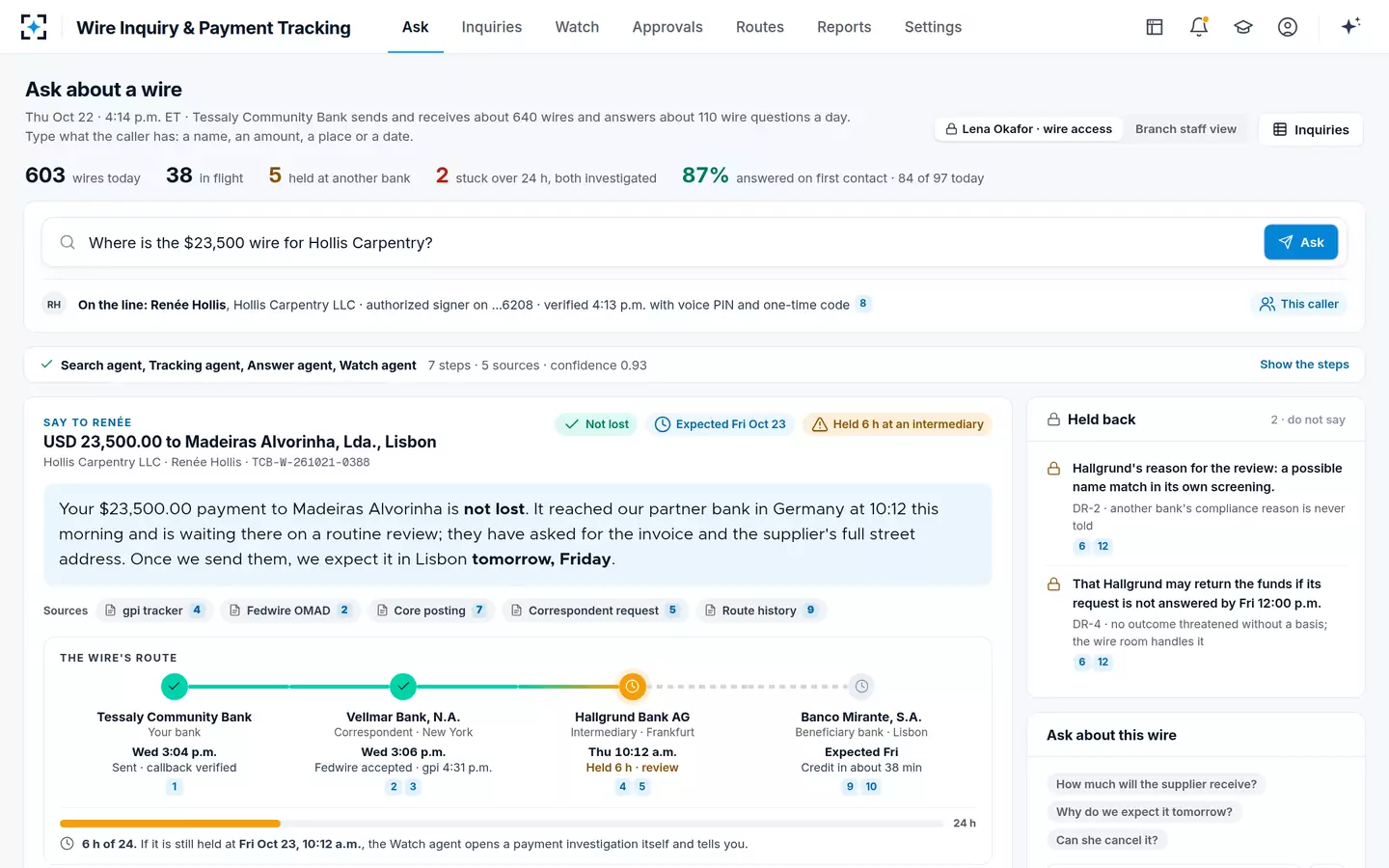
What the officer can promise is what the bank controls: that it will stay on the inquiry, that the references are on their way, and that if the receiving bank cannot find the payment the bank will ask it through its own channel. In Wire Inquiry & Payment Tracking those statements come from approved wording, and anything written about the other bank goes to the supervisor first.
The tracking answer in Wire Inquiry & Payment Tracking: what the officer may say, and what is held back
Who confirms receipt of a closing wire?
The title company's bank, and through it the title company. Article 4A puts the duty there: when the order pays into the beneficiary's account, the bank must tell the beneficiary it arrived by midnight of the next funds-transfer business day after the payment date (UCC 4A-404(b); a wire transfer completed but not received quotes it). That is a legal outer limit, not a closing-day service standard; a title company that needs confirmation by 4:30 depends on its own bank's practice.
What if the wire is late for closing, and when is it something worse?
Unless something worse has happened, a wire that is late for closing is waiting at one of three places: the sending bank before release, the Fedwire cutoff, or the receiving bank before credit. The trace above settles which in minutes. But a wire the title company "never received" can also be a wire that went exactly where it was sent, to an account that was not the title company's, because the instructions came from someone impersonating it.
The individuals were closing on a home when they received an email impersonating their legitimate attorneys. A wire was submitted at their bank for over $449,000 and was sent to the recipient bank.
FBI Internet Crime Complaint Center, 2025 IC3 Annual Report, on a Recovery Asset Team case
In that case the FBI's team asked the recipient bank to freeze the account, and the report records that the whole amount was still there, frozen (the wire fraud recovery rate quotes the case). Not every case ends that way, and the steps after that point, recall requests, indemnities and law enforcement, are a different job from tracking: what a wire recall is covers recalls, and how banks verify wire transfers covers checking closing instructions before money moves. A tracking desk's part is to notice quickly that the account the money reached is not the one the title company expected, and to hand the case over at once.
One constraint applies throughout. If a closing wire leads to a suspicious activity report, nothing said to the buyer, the title company or anyone else may reveal it, under 31 CFR 1020.320(e) (eCFR). What a bank may say while a wire is held sets out the wording.
Closing-day calls with Wire Inquiry & Payment Tracking
Closing wires are domestic and urgent, and they reward a tracking desk that answers on the first call. The sample bank in Wire Inquiry & Payment Tracking watches every domestic Fedwire and flags one with no credit advice four hours after the OMAD, a setting a bank can tighten to two; for a closing, the officer can open the trace on the spot. To see the route, the references and the sentence on one screen, start from Wire Inquiry & Payment Tracking.
Questions people ask
Can a closing wire be sent on Saturday?
Not over Fedwire, which does not operate on Saturdays, Sundays or Reserve Bank holidays; a wire requested then goes on the next funds-transfer business day. The Fed plans to add Sundays and weekday holidays no earlier than 2028, but not Saturdays.
How do I verify wire instructions for closing?
Call the title company or closing attorney at a phone number you already know, not one in the email that sent the instructions, and confirm the bank, account number and name before you send. The FBI's 2025 report describes exactly this kind of impersonation at a closing; Wire Fraud Prevention covers the controls in detail.
Can a closing wire be cancelled?
Only before the receiving bank accepts it, or afterwards with that bank's agreement, under UCC 4A-211 (UCC 4A-211). The Federal Reserve does not cancel Fedwire payments; it passes a cancellation or return request to the receiving bank, and the requesting bank may be liable under 4A-211 unless the request disclaims an indemnity.
What if the title company says it has not received the wire?
Ask your bank for the time Fedwire settled the payment, the IMAD and the UETR, and give them to the title company for its bank. If the money settled, the receiving bank has it and can find it by those numbers; if the account it was credited to is not the title company's, treat it as possible fraud and tell your bank at once.
How long does a domestic wire take to clear?
Fedwire settles each payment individually as the Reserve Banks process it, so there is no clearing period as there is for a check. The beneficiary's bank must pay its customer on the payment date and notify an account beneficiary by midnight of the next funds-transfer business day.