The remittance transfer disclosure requirements in 12 CFR 1005.31 call for two documents. Before the sender pays, a prepayment disclosure states the transfer amount, transfer fees and taxes, total, exchange rate, any covered third-party fees, the total to recipient and, where they may apply, a warning about fees and taxes others may take. When he pays, a receipt repeats those and adds the date available, the recipient, a statement of his error-resolution and cancellation rights, the provider's contact details and those of its State regulator, if any, and the CFPB (1005.31(b)). Each element must use the rule's term or a substantially similar one, appear in a set format and size, be accurate when the sender pays, and be given in English and, where it applies, the foreign language the provider markets in. Botminds' Remittance Transfer Rule Compliance checks every element of every disclosure, in each language, before the transfer leaves; this guide sets out what it checks for.
A remittance receipt built element by element, with the paragraph each comes from
What is a remittance transfer prepayment disclosure?
It is the price and the promise, given when the sender asks for the transfer and before he pays. It has up to eight elements, each with a prescribed term: the "Transfer Amount" in the funding currency; "Transfer Fees" and "Transfer Taxes" charged by the provider; the "Total"; the "Exchange Rate," rounded consistently for each currency to between two and four decimal places; the transfer amount in the receiving currency, but only if covered third-party fees apply; those fees as "Other Fees"; the "Total to Recipient"; and, where they may apply, a statement that fees charged by the recipient's institution or taxes collected by someone else may reduce what arrives (1005.31(b)(1)).
It must come "when the sender requests the remittance transfer, but prior to payment for the transfer" (1005.31(e)(1)), and it must be accurate when he pays. The interpretation is blunt about quotes that move: a provider "is not required to guarantee the terms" for any period, but if any disclosure is no longer accurate at payment, it "must give new disclosures before accepting payment" (comment 31(f)-1). A provider may instead give one combined disclosure before payment, with proof of payment afterwards.
What must a remittance receipt include?
Everything on the prepayment disclosure, plus five things: the "Date Available" in the foreign country; the "Recipient," with the telephone number or address if the sender gave one; a statement of the sender's rights on errors and cancellation, in the language of Model Form A-37 or substantially similar; the provider's name, telephone number and website; and a statement that the sender can contact the State agency that licenses or charters the provider and the CFPB, with their names, telephone numbers and websites (1005.31(b)(2)). Transfers scheduled at least three business days ahead also need the "Transfer Date."
Two details trip up banks and credit unions. An institution regulated only by a federal agency, such as a federal credit union, need not name a State agency, but every provider must give the CFPB's details, "whether or not the Consumer Financial Protection Bureau is the provider's primary Federal regulator" (comment 31(b)(2)-2). And the rights statement belongs on the receipt itself; a full description on Model Form A-36 is owed only on request.
The words the rule requires, and the words regulators rejected
"Substantially similar" is narrower than it sounds. In two orders, the CFPB found that ordinary product language failed the test. UniTeller's disclosures and receipts, including its agents', used "net amount" for the amount to be transferred, which "is neither the term 'transfer amount' nor a substantially similar term" (UniTeller consent order, paragraph 27). Wise's prepayment disclosures used "You Send" for the total and "Estimated Rate" for the exchange rate, and its receipts used a "Paid Out" date instead of the date available.
Terms that failed on real remittance disclosures, and what the rule asks for
| Term used | Where | Required term | Rule |
|---|---|---|---|
| "Net amount" | UniTeller disclosures and receipts, including agents', until at least June 2021 | "Transfer Amount" | 1005.31(b)(1)(i), (b)(2)(i) |
| "Amount We'll Convert" / "Estimated amount we'll convert" | Wise prepayment disclosures | "Transfer Amount" | 1005.31(b)(1)(i) |
| "You Send" | Wise prepayment disclosures | "Total" | 1005.31(b)(1)(iii) |
| "Estimated Rate", and rates to six decimal places | Wise prepayment disclosures | "Exchange Rate", rounded to two to four places | 1005.31(b)(1)(iv) |
| "Paid Out" date: when the money went to the recipient's bank | Wise receipts | "Date Available": when the recipient can have it | 1005.31(b)(2)(ii) |
| A "Help Centre" hyperlink | Wise receipts | The provider's website | 1005.31(b)(2)(v) |
| "Refunds … will be made upon written request of the sender" | Some UniTeller disclosures, until at least June 2021 | Oral or written cancellation request | 1005.31(f), 1005.34(a) |
The "Paid Out" finding deserves attention from any bank that sends wires. Wise's receipts identified the date funds were transferred to the recipient's institution, a date that "did not necessarily reflect when the funds were available to the designated recipient" (Wise amended order, paragraph 67). A bank's wire system knows when the wire left; the rule wants the date the recipient can use the money, which the bank must know from its payout partner or disclose conservatively. The same order's findings on late money are read alongside the other cases in CFPB remittance transfer rule enforcement.
What is the date available on a remittance receipt?
It is "the date in the foreign country on which funds will be available to the designated recipient" (1005.31(b)(2)(ii)), and it must be a single date. A range or an estimate does not comply. If the provider does not know the exact date, it "may disclose the latest date on which the funds will be available," and may add that funds "may be available sooner" (comment 31(b)(2)-1); the interpretation's example is "January 10 (may be available sooner)."
The latest-date approach is the safe one, because the date available is also the trigger for the most common error. If the money is not available by that date, the sender has a timing error, and the provider owes back its fees. A receipt that promises the earliest plausible day manufactures errors; one that promises the latest realistic day, and says it may be sooner, does not.
Receipts at scale: one template error repeats on every transfer
40M
non-compliant disclosures Trans-Fast gave consumers from 2013, the CFPB found
1,000+
UniTeller template versions with required terms below eight-point type, 2018–2021
8 pt
minimum type for written and electronic disclosures, on the front of the page
Can a remittance disclosure use estimates?
Only where 1005.32 allows, and the estimate must be labelled "Estimated" or similar in close proximity (1005.31(d)). For an insured bank or credit union the main exception is narrow: it may estimate the exchange rate, and the amounts that depend on it, only if it cannot determine the exact rate when it must disclose, the recipient receives local currency, the transfer is sent from the sender's account with the institution, and the institution sent 1,000 or fewer transfers to that country in the prior calendar year (1005.32(b)(4)). A parallel exception for covered third-party fees applies at 500 or fewer transfers to the recipient's institution.
Other estimates are permitted where the recipient country's laws or payment methods prevent exact figures, using the CFPB's published list of countries, and for transfers scheduled five or more business days ahead. An estimate must rest on an approach the rule lists, such as the most recent wholesale rate plus the provider's usual spread. The temporary exception that once let any insured institution estimate expired on 21 July 2020. In practice, a credit union sending thousands of transfers a year to Mexico must disclose an exact rate there, while it may still estimate for a country it sends a few hundred to.
Must remittance disclosures be in a foreign language?
Sometimes, and the test is marketing, not the customer's preference. Disclosures go in English and, if applicable, either in each foreign language the provider principally uses to advertise, solicit or market remittance transfers at the office where the sender transacts or asserts an error, or in the one of those languages the sender primarily uses with the provider (1005.31(g)(1)). Whether a language is "principally used" depends on the frequency and prominence of the advertising and the terms used; a prominent English advertisement with a greeting in another language does not count, while several prominent foreign-language advertisements with rates and fees do (comment 31(g)(1)-1).
An "office" includes a telephone number and a website or mobile application where the sender can transfer money or assert an error. Disclosures given orally or by mobile application or text follow the language the sender used for the transaction (1005.31(g)(2)). Wise, the CFPB found, provided the cancellations and disputes section of its mobile receipts in English rather than the language the sender used, until 9 March 2022.
What font size must remittance disclosures use?
At least eight-point type for written and electronic disclosures, on the front of the page, with every required disclosure in equal prominence (1005.31(c)(3)). The amounts must be grouped so a sender can calculate the total and what the recipient will receive; the exchange rate must sit close to them, and the rights statement close to the rest of the receipt. Required disclosures must be segregated from everything else and contain only directly related information; a company logo, a confirmation code and a "may be available sooner" note are allowed (comment 31(c)(4)-2). Disclosures by mobile application or text message are exempt from most format rules.
What are the remittance cancellation rights on the receipt?
The receipt must state the sender's right to cancel and his error-resolution rights, in Model Form A-37 language or substantially similar. For an ordinary transfer that is 30 minutes after payment, if the money has not been picked up or deposited, with a full refund; for a transfer scheduled at least three business days ahead, it is any time up to three business days before the transfer date. A provider that offers both may print both periods and mark which applies, with a checkbox, highlighting or a statement (comment 31(b)(2)-7). The statement must say the sender can cancel orally or in writing; UniTeller's said refunds would be made "upon written request."
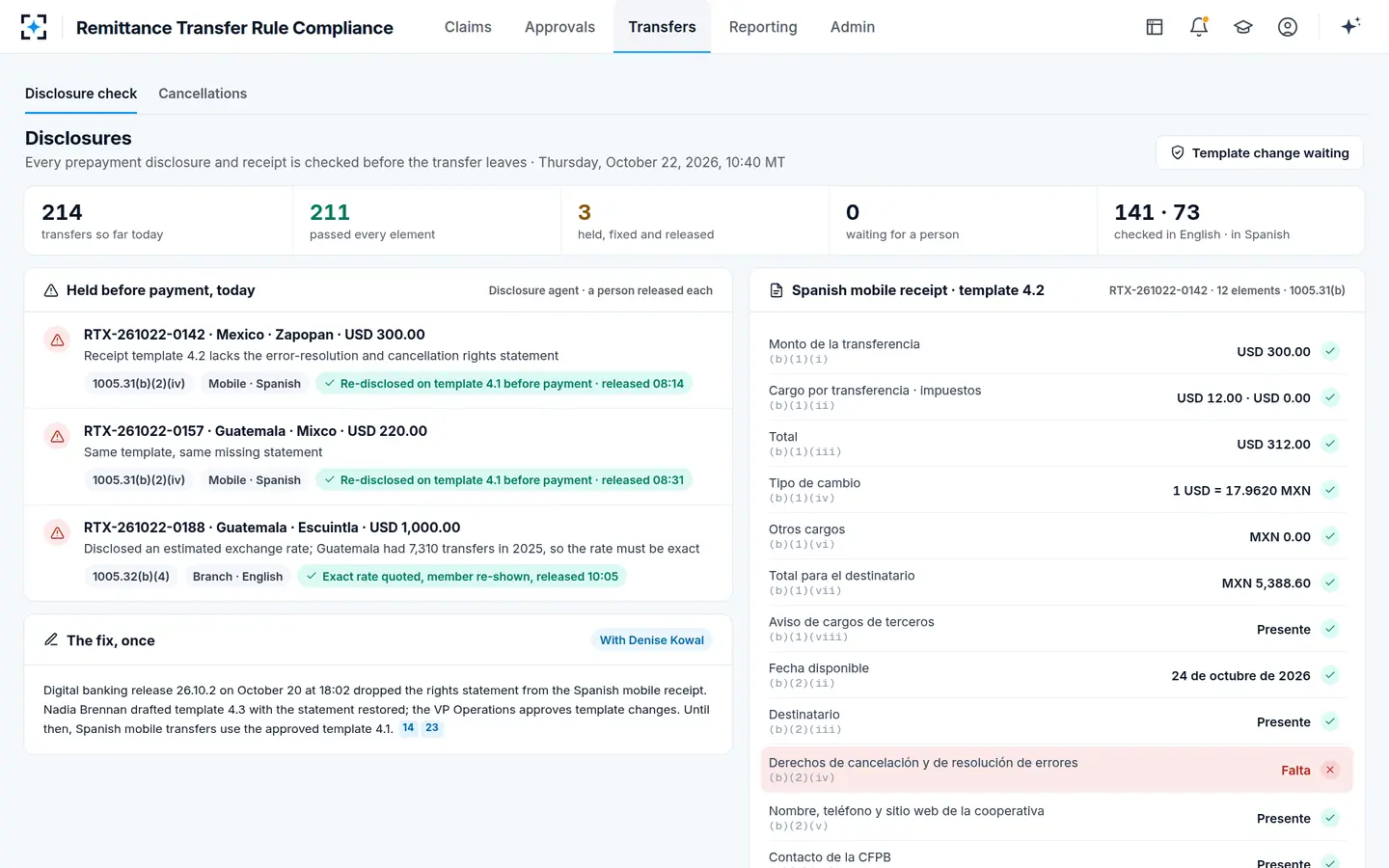
Every disclosure element checked before the transfer leaves, in English and Spanish
Testing receipts before release, not a month later
A monthly sample finds a broken template after it has run for weeks. Each of the large disclosure findings above, the 40 million at Trans-Fast, the 1,000-plus template versions at UniTeller, came from templates that were wrong on every transfer they touched. The checks that would have caught them are mechanical: is each element present, is it the right term, is the rate rounded correctly, is the date a single date, is the rights statement there in each language the office markets in.
In the solution, the disclosure agent runs those checks on every prepayment disclosure and receipt before the transfer leaves and holds any that fails; it never changes a template or releases a transfer itself. A held transfer goes to a person, who re-discloses on an approved template and releases it. The receipt then becomes the left-hand column of any later claim, which is where remittance transfer error resolution begins.
Eight checks to run on every remittance disclosure template
- Every element present
Eight on the prepayment disclosure where applicable; five more on the receipt.
- The rule's terms, or truly similar ones
"Transfer Amount", "Total", "Exchange Rate", "Total to Recipient", "Date Available". Not "net amount", "You Send" or "Paid Out".
- Rate rounded consistently, two to four decimals
Per currency, the same every time.
- A single date available
The latest realistic date, optionally "may be available sooner". Never a range.
- Estimates only where allowed, and labelled
Country counts and the sender's-account test for 1005.32(b)(4); "Estimated" beside the figure.
- Rights statement on the receipt
Errors and cancellation, oral or written, with the right period for scheduled transfers.
- Contacts
Provider name, telephone and website; the State agency if one licenses or charters you; the CFPB always.
- Each marketing language
A matching template per office, website and app; checked after every software release.
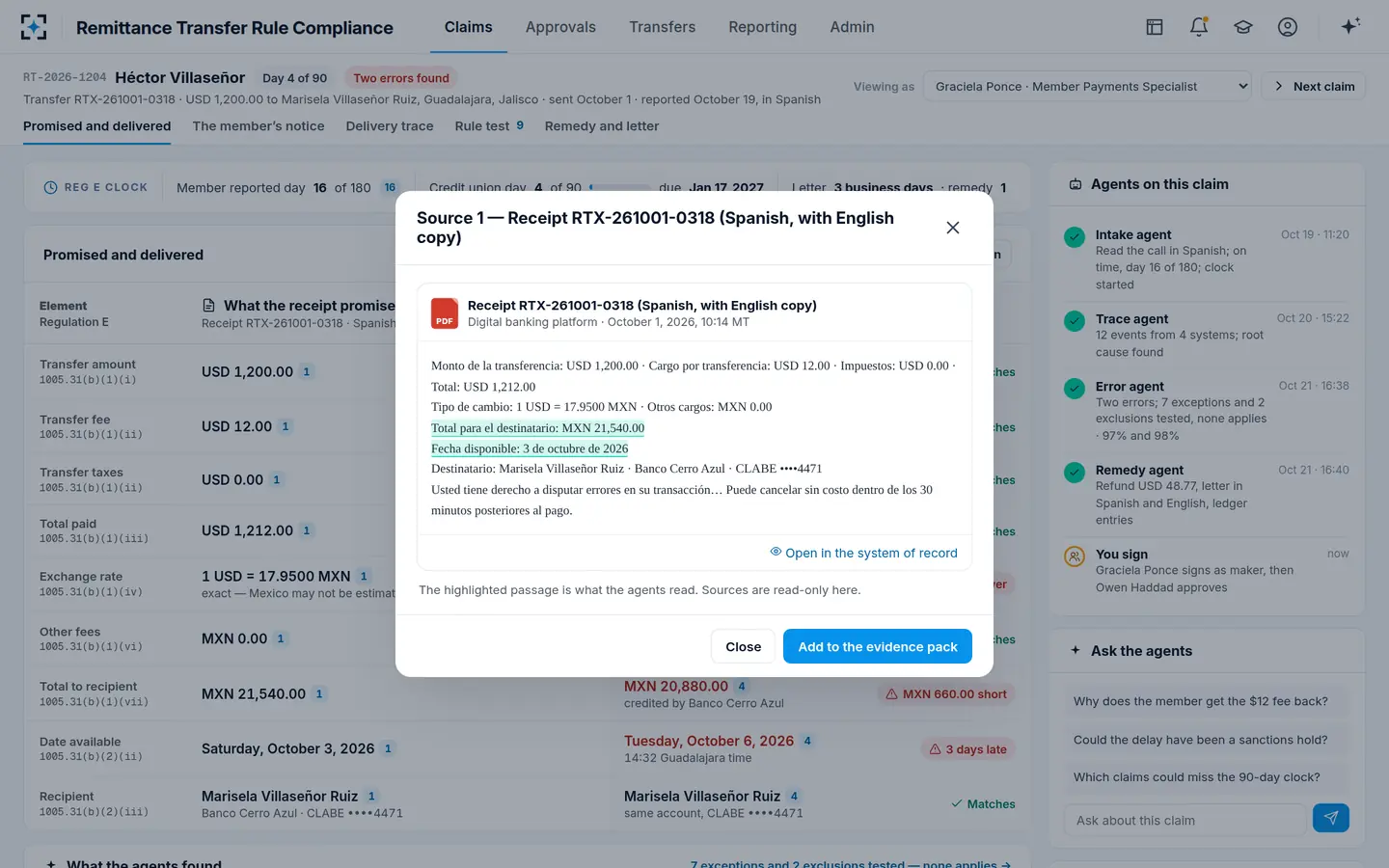
Every value on a claim opens the receipt passage it came from
Questions people ask
What are wire transfer disclosure requirements for consumers?
A consumer's wire to a recipient abroad is a remittance transfer, so it needs the prepayment disclosure and receipt in 1005.31 if the bank sends remittances in the normal course of business. A domestic consumer wire is outside Regulation E, and its terms come from the account agreement and Article 4A.
Can the prepayment disclosure and receipt be combined?
Yes. A provider may give one combined disclosure with all receipt information before payment, then proof of payment when the sender pays, clear and conspicuous and in a retainable form (1005.31(b)(3)).
When can a remittance receipt be mailed later?
When the transaction is conducted entirely by telephone, the receipt may be mailed or delivered no later than one business day after payment. If the telephone transfer comes from the sender's account with the provider, it may go on the next periodic statement or within 30 days (1005.31(e)(2)). Wise, the CFPB found, sent receipts only when its payout partner initiated payment, sometimes days later.
Do remittance disclosures have to show taxes?
Taxes the provider collects must appear as "Transfer Taxes" with its fees. The federal 1% excise tax on cash-funded transfers, in force since 1 January 2026, is collected by the provider from the sender (26 U.S.C. 4475(b)), so where it applies it fits that element on the rule's own wording; neither the CFPB nor the IRS has addressed the disclosure in the texts we reviewed. Taxes collected by someone else, such as a foreign government, belong in the optional statement under (b)(1)(viii), not in the total to recipient.
Can a provider rely on the sender for the receiving currency?
Yes, if it has no specific knowledge. A provider may rely on the sender's statement about the currency in which funds will be received, and if the sender does not know, assume it is the funding currency (comment 31(b)(1)(vi)-1). A change that results from relying on the sender in this way is not an error.