The remittance transfer safe harbor in 12 CFR 1005.30(f)(2) deems a person not to be providing remittance transfers in the normal course of its business, and so not a remittance transfer provider, if it provided 500 or fewer remittance transfers in the previous calendar year and provides 500 or fewer in the current one (12 CFR 1005.30(f)(2)(i)). Both years count. A credit union that sent 480 transfers last year is outside the rule only until it sends its 501st this year; from that transfer on, the facts decide whether it is a provider, and if it is, it has a reasonable period, not more than six months, to comply. The threshold rose from 100 to 500 on 21 July 2020. For a small institution near the line, the count is the compliance program's first control, and Botminds' Remittance Transfer Rule Compliance keeps it by year and by country, because a second count, 1,000 transfers to a country, decides whether exchange rates may be estimated.
Who the 2020 safe harbor took out of the remittance rule
414
banks removed from coverage when the threshold rose to 500: 54.6% of covered banks
247
credit unions removed: 62.4% of covered credit unions
0.054%
of all remittance transfers: about 141,970 a year left the rule with them
What is the remittance transfer safe harbor?
It is a numerical answer to a facts-and-circumstances question. The rule covers anyone who sends remittance transfers "in the normal course of its business," and the interpretation describes that by frequency: an institution that makes transfers generally available and sends them more than occasionally is in the normal course, while one that sends a couple a year as a favour to a customer is not (comment 30(f)-2.i). The safe harbor takes the guesswork out at the low end. At 500 or fewer in both years, the institution "is not a 'remittance transfer provider' and is not subject to the requirements of subpart B" (comment 30(f)-2.ii).
Above 500, the safe harbor does not make an institution a provider; it simply stops answering the question. A bank that sends 600 transfers a year as accommodations might, on the facts, still be outside the normal course of business. Few compliance officers would rely on that. The CFPB's examination procedures direct examiners to examine only entities above 500 transfers in the relevant period (CFPB remittance examination procedures), which is as close to a bright line as the regulator draws.
How many remittance transfers before the rule applies?
More than 500 in either the previous calendar year or the current one takes an institution out of the safe harbor. The count is of remittance transfers, so it excludes transfers that are not remittance transfers for another reason: those of $15 or less and securities or commodities transfers do not count. It includes transfers that would be remittance transfers but for the safe harbor itself, which is to say every consumer transfer abroad that otherwise meets the definition (comment 30(f)-2.ii).
What counts toward the 500-transfer remittance safe harbor
| Transfer | Counts? | Why |
|---|---|---|
| Consumer wire abroad from a personal account | Yes | A remittance transfer except for the safe harbor |
| Consumer international ACH or electronic bill payment abroad | Yes | Same; the rail does not matter |
| Member sends $12 to a relative abroad | No | Excluded as small-value, $15 or less, for a reason other than the safe harbor |
| Wire from a business account | No | Not a remittance transfer: the requester is not a consumer sender |
| Wire to an account in a State, or on a U.S. base abroad | No | Not received at a location in a foreign country |
| Transfers the institution sends as agent for another provider | No | An agent is not the provider; the transfers are the principal's |
The counting year: why both years matter
Because the test looks at two years, the risky year is the one after a busy one. An institution that sent 520 transfers last year cannot use the safe harbor this year at all, even if it expects only 300; an institution that sent 300 last year is protected only until its 500th this year. The interpretation spells out the mechanics: if a person within the safe harbor last year sends more than 500 this year, "the safe harbor applies to the first 500 remittance transfers that the person provides in the current calendar year" (comment 30(f)-2.iii).
One year's running count: the safe harbor covers the first 500 transfers, then ends
What happens when a bank exceeds 500 remittance transfers?
Two things, in this order. First, the facts decide whether the institution is now a provider for the 501st and later transfers. Second, if it is, it gets "a reasonable period of time, not to exceed six months, to begin complying with this subpart," and "compliance with this subpart will not be required for any remittance transfers for which payment is made during that reasonable period of time" (1005.30(f)(2)(ii)). The six months is a ceiling, not an entitlement: the interpretation's example assumes six months is reasonable, and an examiner may ask why a shorter period was not.
The interpretation's own example sets the dates. A person sent 490 transfers in 2020 and 490 in 2021, so the safe harbor covered 2021 and the first 500 of 2022. "If the person provides a 501st transfer on September 5, 2022," and is then in the normal course of business, and six months is reasonable, "compliance with subpart B is not required for remittance transfers made on or before March 5, 2023 (i.e., six months after September 5, 2022)" (comment 30(f)-2.iv.C). The person cannot use the safe harbor in 2023 at all, because it sent more than 500 in 2022.
The 501st transfer starts a clock of at most six months
- Safe harbor: first 500 transfersJan 1 – Sep 5
- TransitionSep 5 – Dec 31
- Transition endsto Mar 5
- Full compliance with Subpart BMar 6 – Dec 31
Six months is not much time to build what the rest of this series describes: compliant prepayment disclosures and receipts in every channel and marketing language, a 30-minute cancellation process, error resolution on its four clocks, written procedures and two years of evidence. An institution whose count is rising should start before the 501st transfer, not after it; the full list is in the remittance transfer rules cheat sheet.
Leaving the rule: what still applies
Falling back under 500 lets an institution stop complying, but only going forward. A provider that determines that, from a particular date, it qualifies for the safe harbor "may cease complying with the requirements of this subpart with respect to any remittance transfers for which payment is made after that date," while the error and cancellation rules and record retention "continue to apply to transfers for which payment is made prior to that date" (1005.30(f)(2)(iii)). A sender with a transfer from last year keeps his 180 days.
The safe harbor also leaves the rest of Regulation E in place. If a remittance transfer is also an electronic fund transfer, Subpart A's requirements, "initial disclosures, change-in-terms notices, liability of consumers for unauthorized transfers, and procedures for resolving errors," continue to apply regardless (comment 30(f)-2.v). For most bank wires that point is moot, because wires are outside Subpart A; for international ACH and bill payments from consumer accounts, it is not.
What is the 1,000-transfer estimate threshold?
It is the second count every insured bank and credit union above the safe harbor has to keep. Under 1005.32(b)(4), an insured institution may estimate the exchange rate, and the amounts that depend on it, for a transfer to a particular country only if it cannot determine the exact rate, the recipient receives local currency, the transfer is from the sender's account with it, and it "made 1,000 or fewer remittance transfers in the prior calendar year to the particular country" in which recipients received local currency (1005.32(b)(4)(i)(C)). A parallel line of 500 or fewer transfers to a recipient's institution governs estimates of covered third-party fees.
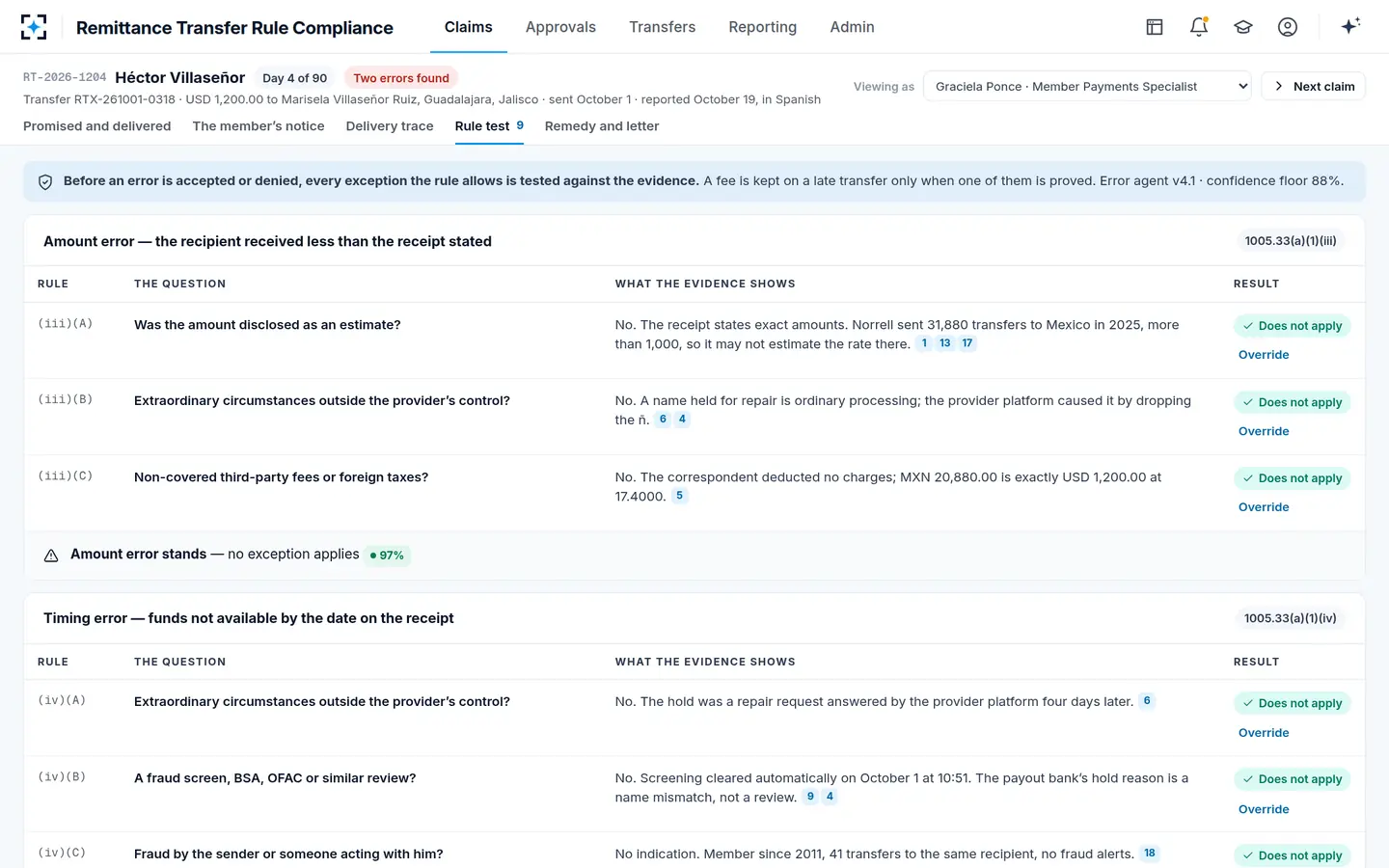
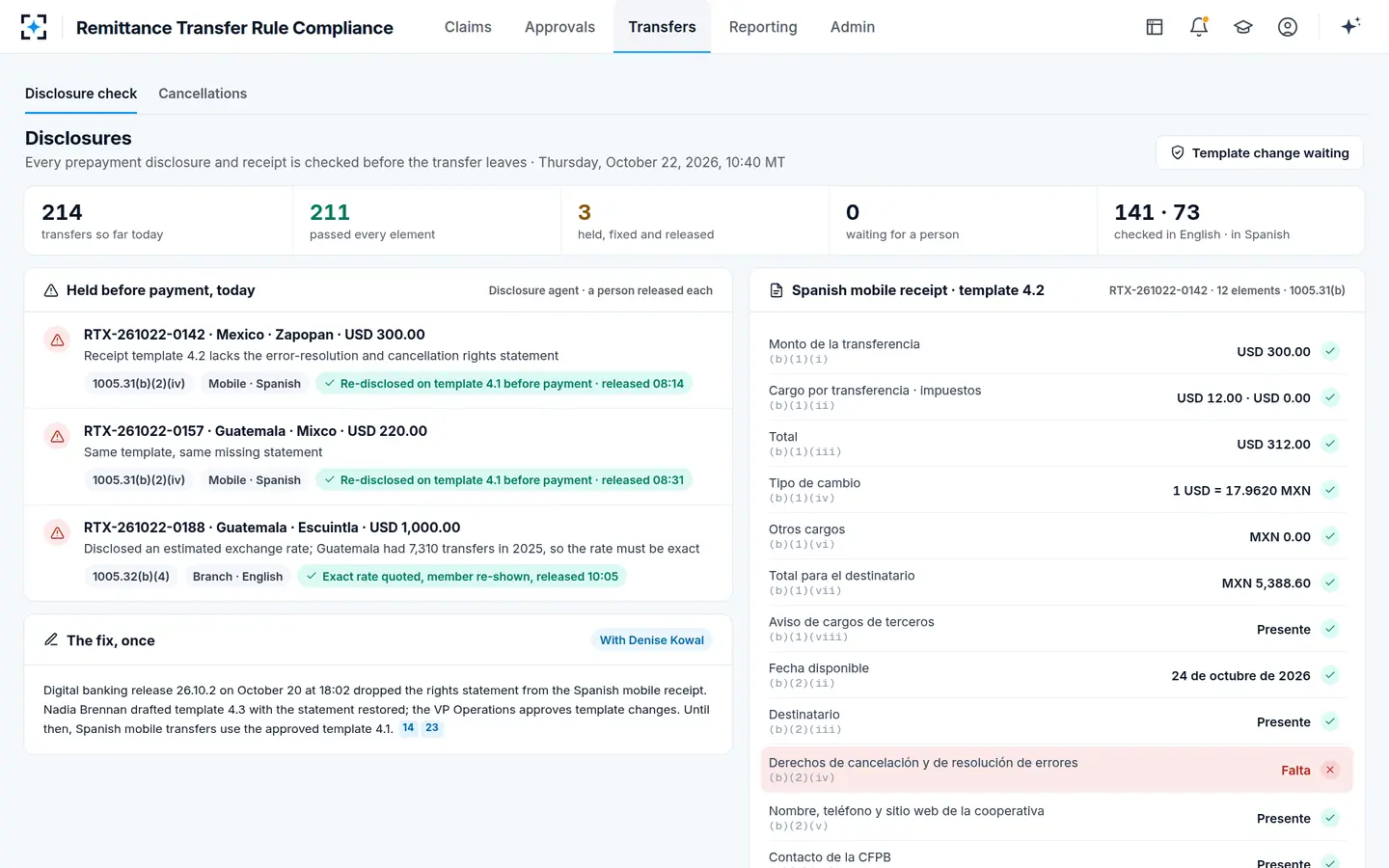
So a credit union can be above the 500 safe harbor and still estimate rates to most countries, while needing exact rates in its one or two big corridors. The counts reset each calendar year, and a corridor that crosses 1,000 this year loses the estimate from next January. The fictional sample credit union in the solution shows the effect: it sent 31,880 transfers to Mexico and 7,310 to Guatemala in 2025, so it must disclose exact rates to both, but 940 to the Philippines, where an estimate remains allowed if the other conditions are met.
The country count, applied on every claim: no estimate where more than 1,000 transfers went last year
The same count before payment: an estimated rate held where the rate must be exact
Does the safe harbor apply to the remittance tax?
No. The 1% federal excise tax on cash-funded remittances, in force since 1 January 2026, borrows Regulation E's definition of a remittance transfer provider but, under the proposed regulations, not its safe harbor. Treasury and the IRS explain the choice: "The safe harbor was not adopted in the proposed regulations because it is inconsistent with the operation of an efficient and effective excise tax" (REG-114499-25, 13 April 2026).
They also explain why they think it matters little. "In 2020, the CFPB was not aware of any MSB remittance transmitter providers with less than 500 annual transfers," and while banks and credit unions "are more likely to qualify for the safe harbor," their transfers "are unlikely to be funded with cash and hence would not be taxable with or without the safe harbor." A small credit union that takes cash at the counter for an occasional transfer abroad should not assume the safe harbor covers it for the tax; how the tax works, and how it meets Regulation E's refunds, is set out in the remittance transfer excise tax.
The same 400-transfer credit union under the remittance rule and under the remittance tax
Regulation E, Subpart B: 500 or fewer transfers in the previous and current year: not a provider
Excise tax, 26 U.S.C. 4475 (proposed rules): None: the proposed rules exclude the Reg E safe harbor
Regulation E, Subpart B: Every consumer remittance over $15, however funded
Excise tax, 26 U.S.C. 4475 (proposed rules): Only those funded with cash, money orders, cashier's or traveler's checks
Regulation E, Subpart B: Disclosures, cancellation, error resolution, agents
Excise tax, 26 U.S.C. 4475 (proposed rules): Collect 1% from the sender, deposit semimonthly, file Form 720 quarterly
Regulation E, Subpart B: At the 501st transfer; up to six months to comply
Excise tax, 26 U.S.C. 4475 (proposed rules): No line to cross
The other "remittance transfer tax safe harbor": deposits
Searchers who find "remittance transfer tax safe harbor" are often looking for something else: the excise tax deposit safe harbor. Under the excise tax procedural rules, a collector that filed Form 720 for the look-back quarter, the second quarter before the current one, meets its semimonthly deposit duty if each deposit is at least one-sixth of the look-back quarter's net liability, every deposit is on time, any underpayment is paid by the return's due date, and the liability includes no tax that was not imposed in the look-back quarter (IRS Notice 2025-55).
Because the remittance tax began on 1 January 2026, no provider had a look-back quarter for it until the third quarter of 2026, for which the first quarter is the look-back. Notice 2025-55 therefore relieved providers from failure-to-deposit penalties for the first three quarters of 2026 if they deposited on time, even if the amounts were computed incorrectly, and paid any shortfall with the quarter's return, and it preserved their later use of the deposit safe harbor. It has nothing to do with the 500-transfer line.
Questions people ask
What is the remittance transfer tax safe harbor?
Usually the excise tax deposit safe harbor in 26 CFR 40.6302(c)-1(b)(2), which lets a Form 720 filer base semimonthly deposits on one-sixth of its liability in the look-back quarter. For the remittance tax it could first be used in the third quarter of 2026, and Notice 2025-55 gave penalty relief and protected its use for the first three quarters of 2026.
Does a credit union under 500 transfers have any Reg E duties for them?
Not under Subpart B, the remittance rule. If a transfer is also an electronic fund transfer, such as an international ACH payment from a member's account, Subpart A's disclosures, unauthorized-transfer liability and error-resolution rules still apply (comment 30(f)-2.v).
Does a wire to the sender's own account abroad count toward 500?
Yes. A sender can be his own designated recipient, so a personal transfer from his account in a State to his account in a foreign country is a remittance transfer and counts (comment 30(c)-3).
Is the six-month transition automatic?
No. It is "a reasonable period of time, not to exceed six months," and only for a person that is then providing transfers in the normal course of business (1005.30(f)(2)(ii)). The official example assumes six months is reasonable; an institution should be able to show why its period was.
When did the threshold change from 100 to 500?
On 21 July 2020, under a final rule published on 5 June 2020. The CFPB estimated that the change took about 414 banks and 247 credit unions out of the rule, with about 141,970 transfers a year.