A remittance transfer error is one of five things Regulation E defines in 12 CFR 1005.33(a)(1): the sender paid an incorrect amount; the provider made a computational or bookkeeping error; the recipient received less than the receipt stated; the money was not available by the date on the receipt; or the sender asked for documentation or clarification about the transfer. Each brings a fixed remedy, and when the money was late the provider must refund its fees as well. The refund itself is rarely large. The cost comes when it is not paid: in the CFPB's orders against Sigue and UniTeller, fee refunds that averaged roughly ten dollars each were missed thousands of times and settled with penalties many times larger than the money owed. Botminds' Remittance Transfer Rule Compliance is built to make that refund impossible to skip; this guide prices what it protects against, and what it cannot change.
Small refunds, missed at scale, priced by the CFPB
9,280+
times Sigue kept the fee on a late transfer when the sender chose a resend, 2015–2019
$9.41
average redress per missed UniTeller refund: $29,664.37 across 3,154 instances
24×
UniTeller's $700,000 penalty against the redress it had to set aside
What is a remittance transfer error?
It is a failure of the transfer against its own disclosures, asserted by the sender within 180 days of the disclosed date of availability. The five types work differently. An incorrect amount paid or a provider's computational error is fixed by refunding or delivering the difference. A recipient who received less than the "Total to Recipient" on the receipt is an error unless the receipt lawfully used an estimate, the shortfall came from extraordinary circumstances, or it came from a fee the receipt warned of that the recipient's own bank charged. A late delivery is an error unless one of four exceptions applies. A request for documentation is an error whose remedy is the documentation.
The interpretation gives concrete cases. If a relative in Mexico picks up 1,150 pesos where the receipt promised 1,180 because the pay-out agent applied a lower rate, "an error has occurred" (comment 33(a)-3.i). Late or non-delivery, delivery to the wrong account, a fraudulent pick-up by someone other than the recipient, and a payout agent keeping the money instead of releasing it are all timing errors unless an exception applies (comment 33(a)-5).
What is not a remittance transfer error?
Four things are excluded by name: an inquiry about the status of a transfer, unless the money has already missed its date; a request for information for tax or recordkeeping purposes; a change the recipient asked for; and a change in currency or amount that follows from information the sender gave and the provider was allowed to rely on (1005.33(a)(2)). Beyond those, each error type has exceptions, and the late-delivery exceptions matter most: extraordinary circumstances outside the provider's control, a necessary fraud, Bank Secrecy Act or sanctions review it could not have foreseen, fraud by the sender, and a wrong account number or bank identifier from the sender where the provider meets five conditions.
An exception is a reason to keep money, so it needs proof. A name held by the payout bank over a missing accent is ordinary processing, not an extraordinary circumstance; a sanctions review that was always going to happen should have been reflected in the date on the receipt. The cheapest error to defend is one the provider can show it tested and ruled out on evidence, the approach set out in a remittance error file that proves every clock.
What happens if a remittance transfer is late?
Unless an exception applies, the provider owes two things within one business day of the sender's instruction: the amount fixed, by refunding it or by making it available to the recipient at no extra cost, and a refund of the fees imposed and, where the law allows, the taxes collected on the transfer (1005.33(c)(2)(ii)). The fees include ones an intermediary or the payout institution charged. Where the money did arrive in full before the provider must choose a remedy, no more is owed beyond the fees and taxes (comment 33(c)-5).
Take the fictional sample in the solution: a member's USD 1,200.00 transfer to Guadalajara arrived three days late and MXN 660.00 short. He chose a refund: USD 36.77 for the shortfall at the receipt's rate, plus the USD 12.00 fee because the money was late, USD 48.77. The fee is the part that depends on a date nobody at the credit union controlled, which is why it is the part that goes missing.
The refund to the cent: the shortfall at the receipt's rate, plus the fee on a late transfer
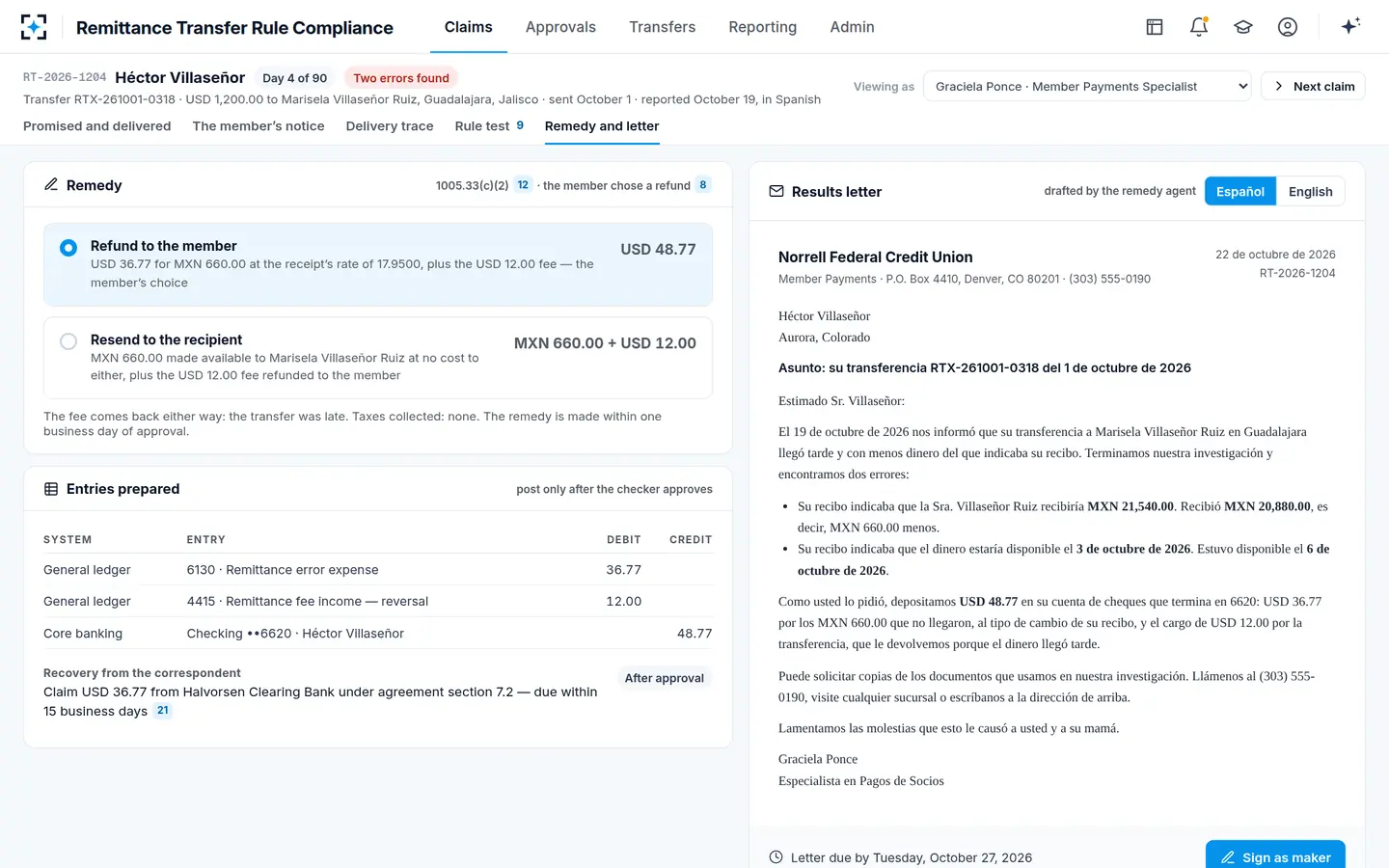
What a missed fee refund costs, per transfer and in total
Per transfer, very little. Sigue's order counts "more than 9,280 instances" between 2015 and 2019, "resulting in a total cost to consumers of approximately $99,944.95," about $10.77 each. UniTeller had to set aside not less than $29,664.37 for 3,154 instances, about $9.41 each. Those are the fees on ordinary consumer transfers, and a provider might reasonably think them too small to build a control around.
In total, they were the case. Both orders made the missed refunds a named violation, both added civil money penalties, and both imposed compliance plans and board oversight. The way Sigue missed them is the design lesson. "When Respondents committed errors under § 1005.33(a)(1)(iv), they refunded fees only to senders who, as a remedy, requested that Respondents cancel the transaction. Respondents did not refund fees to senders who, as a remedy, requested that Respondents resend the transaction" (Sigue consent order, paragraph 20). The fee refund was wired to the wrong branch of the process.
How much are CFPB remittance penalties?
From $44,955 to $1.6 million in the orders since 2020, set by the scale and duration of the violations and, in the latest one, by a change of policy at the Bureau. Penalties are paid to the CFPB; redress goes to consumers; and every order also requires a compliance plan, which is the cost that lasts longest.
Civil money penalties in CFPB remittance transfer rule orders, 2020–2025
Each order, the late-delivery fee duty, and what it cost
| Order | Late-delivery fee refunds | Redress | Penalty |
|---|---|---|---|
| Sigue, 31 Aug 2020 | Not refunded when the sender chose a resend: more than 9,280 instances, 2015–2019 | About $100,000 (not less than $99,944.95) | $300,000 |
| Trans-Fast, 31 Aug 2020 | Its practice was not to refund fees once the money had arrived, even if it arrived after the disclosed date; also cancellations, and about 40 million non-compliant disclosures | No redress amount in the order | $1,600,000 |
| La Nacional, 21 Dec 2020 | Failed to refund certain fees and taxes when funds were not available on time; also cancellations | Not stated in the CFPB summary | $750,000 |
| UniTeller, 22 Dec 2022 | No fees or taxes refunded in at least 3,154 confirmed late-delivery errors, 2018–2020 | Not less than $29,664.37 | $700,000 |
| Wise, 30 Jan 2025, amended 15 May 2025 | 351 fee refunds not made; over 1,000 cases where fees were not refunded after funds missed the date | $449,550.99 for all violations in the order, prepaid card fees included | $44,955 |
Why the penalty dwarfs the refund
A penalty prices the failure of a control, not the size of the harm. At UniTeller the CFPB found missed fee refunds, but it also found that the provider could not prove its clocks, used the wrong disclosure terms, printed required terms below eight-point type in more than 1,000 template versions, and omitted the sender's right to cancel orally. The refunds were the measurable harm; the penalty answered the pattern. At Sigue the ratio of penalty to redress was about three to one; at UniTeller, about 24 to one.
Wise shows that the price can also move with policy. The January 2025 order imposed a $2.025 million fine; the amended order of 15 May 2025 replaced it with $44,955, and the CFPB's notice tied the change to "relevant precedents for the conduct and cooperation at issue" and to its rescission of guidance. A provider should not plan on either figure. It should plan on the redress, which was not reduced, and on the compliance plan, which every order imposed. The record of all five cases is in CFPB remittance transfer rule enforcement.
How often do consumers report remittance errors?
Rarely, but not never. The CFPB's 2018 assessment found that "consumers asserted errors for as many as 1.9 percent of transfers and cancelled between 0.29 and 4.5 percent of transfers depending on the provider" (85 FR 34870, 2020). The upper figure is a ceiling across providers, not an average, and banks send far larger transfers than money transmitters, more than $6,500 on average against about $381.
Applied as a rough bound, a credit union sending 20,000 consumer remittances a year could see up to about 380 error notices; our arithmetic, not a prediction. The fictional sample credit union in the solution logs 63 notices in a heavy month. Each is a 90-day clock, a trace through other institutions and, if late, a fee to refund.
What does a remittance error cost a bank to handle?
The staff time is the cost an institution controls, and it has no published benchmark for remittance claims. A defensible way to price it is to measure your own hours per claim and apply a loaded wage. FinCEN, in its own burden estimates for funds-transfer recordkeeping, prices an hour of compliance work at $106.30, fully loaded (FinCEN, 89 FR 65971, 2024; BSA recordkeeping requirements by bank size shows how it was built); it is a regulator's composite for compliance work, not a remittance figure, and we use it only as a stand-in for your own rate.
The cost of one remittance error, and of one missed refund
Remedy owed
shortfall + fees and taxes if late
Set by 1005.33(c)(2). Owed whether or not the provider recovers it from a correspondent.
The rule
Handling
hours per claim × loaded wage
Notice, trace, comparison, exceptions, remedy, letter, approval. Measure your own hours; $106.30 is FinCEN's composite.
Your operations
Recovery
amount the correspondent or payout bank reimburses
By contract, after the sender is paid. Not a defence to the sender.
Your agreements
Exposure if missed
redress + penalty + compliance plan
In the orders: redress about $9–11 per missed fee refund; penalties up to 24 times the redress.
The CFPB or your regulator
Where the solution changes the cost, and where it cannot
It cannot change what the rule makes you owe. The shortfall and the fees on a late transfer are the sender's money, and a tool that reduced them would be breaking the rule. What it changes is the handling line and the exposure line. Handling: the agents gather the receipt, the payout confirmation and the correspondent's messages on the day of the notice and test every exception, so the specialist's time goes to the decision. Exposure: the fee refund is computed from the error type, not from the remedy the sender chose, so the Sigue failure cannot recur; every refund and letter has a maker and a checker; and a monthly re-test checks each late-delivery claim for its fee refund. In the fictional sample September test, all 12 late-delivery claims passed that check.
Paying a late-transfer refund by hand, and with agents preparing it
By hand: Depends on the procedure the specialist remembers; Sigue tied it to the cancel remedy only
With Remittance Transfer Rule Compliance: Computed from the error type: a late transfer refunds the fee on a refund and on a resend
By hand: Often missed because they never touched the provider's books
With Remittance Transfer Rule Compliance: Read from the correspondent and payout messages and included
By hand: Waits for whoever is free to key it
With Remittance Transfer Rule Compliance: Prepared on the day of the decision; in a checker's queue with its evidence
By hand: Raised later, if at all
With Remittance Transfer Rule Compliance: Drafted with the refund under the agreement, posted after approval
By hand: A note in case management
With Remittance Transfer Rule Compliance: Maker, checker, amount, entries and letter on one append-only trail
Every refund and resend in a checker's queue, with the fee rule applied by error type
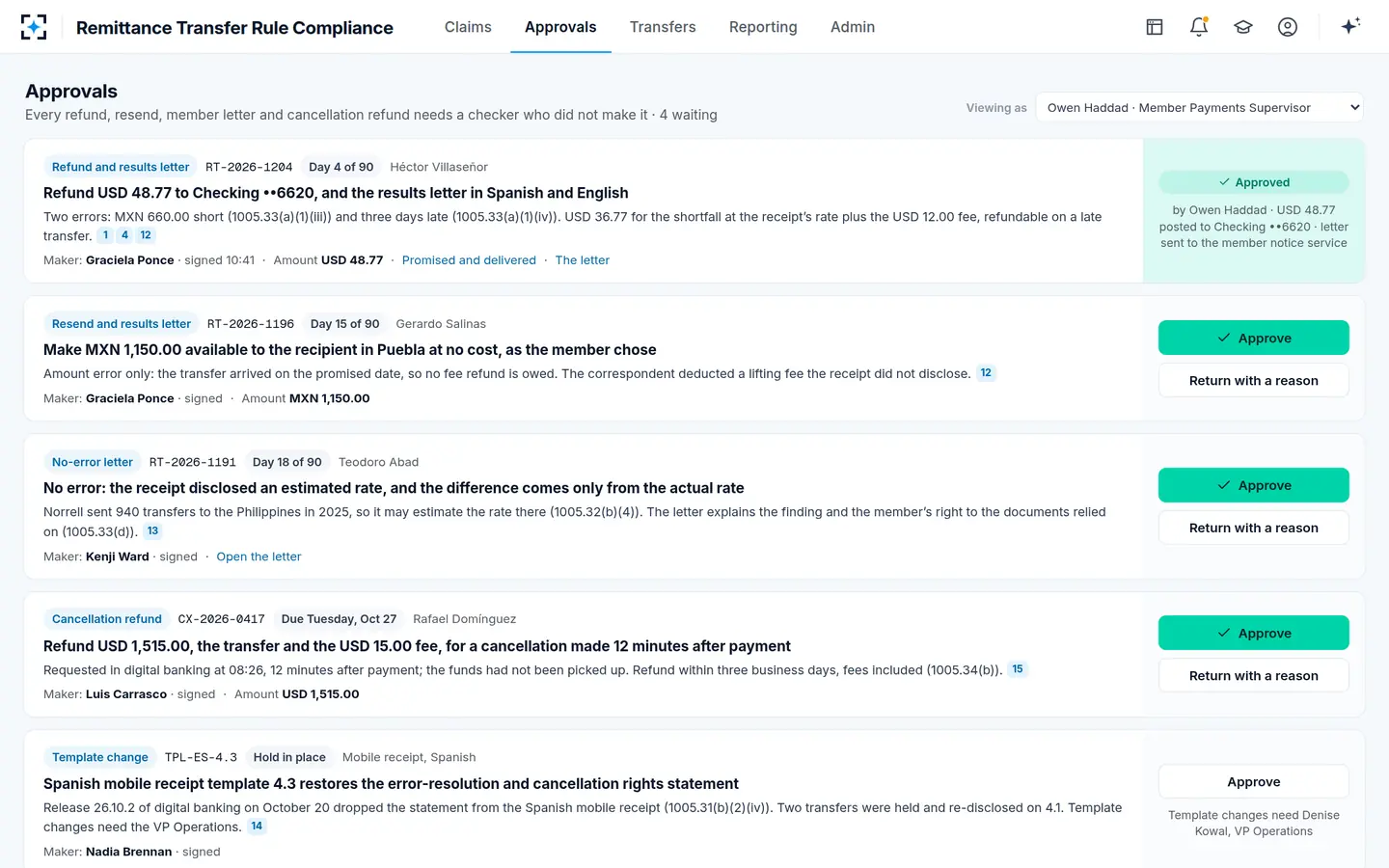
A buyer should test that claim on their own files: take last year's late-delivery claims, check which refunded the fee, and compare. To see the agents work a full claim, start from Remittance Transfer Rule Compliance.
Questions people ask
What is consumer redress in a CFPB remittance order?
Money the provider must pay back to affected consumers, separate from the penalty paid to the Bureau. UniTeller's order required it to deposit not less than $29,664.37 for redress and submit a plan for finding and paying each affected consumer; if it paid out less, it had to pay the difference to the Bureau.
Can a provider charge for investigating a remittance error?
Not if an error occurred, whether as alleged or in a different amount or manner. The interpretation bars any charge related to the error-resolution process, including for documentation or investigation (comment 33(c)-9).
Is a remittance that arrived in full but late still an error?
Yes, unless an exception applies, and the remedy is the refund of fees and, where the law allows, taxes. If the full amount reached the recipient before the provider had to choose a remedy, nothing more is owed beyond those fees and taxes (comment 33(c)-5).
Who pays when a correspondent caused the error?
The provider pays the sender; it may then recover from the correspondent or payout bank under its agreement. The remedies apply regardless of whether the provider has an agreement with the third party that makes funds available (comment 35-1).
How are remittance refunds paid?
Generally in cash or the same form of payment the sender used; a sender who paid in cash may be refunded by check (comment 33(c)-6). Most banks and credit unions credit the account the transfer came from.