A remittance transfer provider is any person that provides remittance transfers for a consumer in the normal course of its business, whether or not the consumer holds an account with it (12 CFR 1005.30(f)). For a bank or credit union, that means one that offers consumers international transfers more than occasionally; one that sent 500 or fewer in both the previous and the current calendar year is deemed outside the definition. Being the provider is what makes the work hard: the institution answers for the receipt it handed the sender, the exact amount, rate, fees and date, although a correspondent and a payout bank abroad actually move the money. Botminds' Remittance Transfer Rule Compliance exists for the specialist who works those clocks; its agents read the sender's notice, trace the transfer, put the receipt beside what was delivered and draft the remedy for a person to sign.
The week below follows a fictional credit union through sample data in the solution. The rule and the enforcement history come from the regulation, its official interpretations and the Consumer Financial Protection Bureau's own orders, linked where they appear.
Banks send few remittances, but large ones
4.2%
of consumer remittance transfers sent by banks in 2017; credit unions sent 0.2%
$6,500+
average bank-sent remittance transfer, against about $381 at money transmitters
95.5%
of consumer remittance transfers sent by money services businesses in 2017
What is a remittance transfer provider?
A remittance transfer provider is the intermediary that deals directly with a consumer in a State and sends money electronically, at the consumer's request, to someone at a location in a foreign country. The definition does not care whether the money moves by wire, by international ACH or through a money transmitter's network, or whether the sender is a customer at all. It turns on two things: the transfer is a remittance transfer, and the institution provides such transfers "in the normal course of its business."
The official interpretation draws the line by frequency. "If a financial institution generally does not make remittance transfers available to customers, but sends a couple of such transfers in a given year as an accommodation for a customer, the institution does not provide remittance transfers in the normal course of business" (comment 30(f)-2.i). An institution that makes transfers generally available, in its account agreement or in practice, and sends them more than occasionally, does. The regulation also sets a numerical safe harbor, raised from 100 to 500 transfers on 21 July 2020: 500 or fewer in the previous calendar year and 500 or fewer in the current one.
Two clarifications settle most arguments about who the provider is. An agent is not one: a grocery store or a check casher that takes cash for a money transmitter acts for the provider, and the provider answers for it. And where two providers are involved in one transfer, "only one set of disclosures must be given," but they must agree which of them does the work, and "all remittance transfer providers involved in the remittance transfer remain responsible" (comment 30(f)-3). Whether a particular consumer wire falls inside the rule at all is a separate question, walked through in are international wires covered under Reg E.
Is a credit union a remittance transfer provider?
A credit union is a remittance transfer provider if it sends consumer international transfers in the normal course of business and is above the safe harbor; the definition makes no distinction between a credit union, a bank and a money transmitter. The CFPB's own counts show how many sit near the line: when it raised the threshold from 100 to 500 transfers, the change removed approximately 247 credit unions and 414 banks, which were 62.4% and 54.6% of the credit unions and banks then covered (85 FR 34870).
Those institutions left the rule with very little of the volume: about 141,970 transfers a year, or less than one-tenth of one percent of all remittance transfers. For a credit union between 400 and 600 transfers a year, the question is not academic, and the counting rules decide it; what happens when 500 transfers a year runs out works through the year an institution crosses the line.
What a remittance transfer provider answers for when other banks move the money
The provider answers for the whole transfer, including what happens after it leaves the building. Section 1005.35 makes it "liable for any violation of this subpart by an agent when such agent acts for the provider" (12 CFR 1005.35), and the interpretation goes further: the provider must give the disclosures and the remedies "even if an agent or other person performs functions for the remittance transfer provider, and regardless of whether the provider has an agreement with a third party that transfers or otherwise makes funds available to a designated recipient."
In practice that reaches three parties the credit union does not control. A remittance platform or correspondent that converts the dollars; an intermediary that may deduct a lifting fee; a payout bank that may hold the money over a name that does not match. When the money is late, the fee refund includes fees "imposed by the provider or a third party involved in sending the transfer, such as an intermediary bank" (comment 33(c)-8). When a sender tells an agent about a problem, the notice "is deemed to be received by the provider" when the agent receives it. The provider may recover from its partners by contract; it may not make the sender wait for that.
The clocks a remittance transfer provider runs, and who usually starts each one
| Clock | Length | Starts when | Rule |
|---|---|---|---|
| Cancellation | 30 minutes | The sender pays (cash handed over or payment authorized) | 1005.34(a) |
| Cancellation refund | 3 business days | A timely request to cancel is received | 1005.34(b) |
| Sender reports an error | 180 days | The disclosed date of availability | 1005.33(b)(1)(i) |
| Provider determines whether an error occurred | 90 days | The notice of error is received | 1005.33(c)(1) |
| Report of the results to the sender | 3 business days | The investigation is complete | 1005.33(c)(1) |
| Remedy | 1 business day, or as soon as reasonably practicable | The sender designates the remedy | 1005.33(c)(2) |
| Keeping evidence of compliance | At least 2 years | The date the disclosure or action was required | 1005.13(b)(1) |
Monday: a phone call that has to become a notice of error
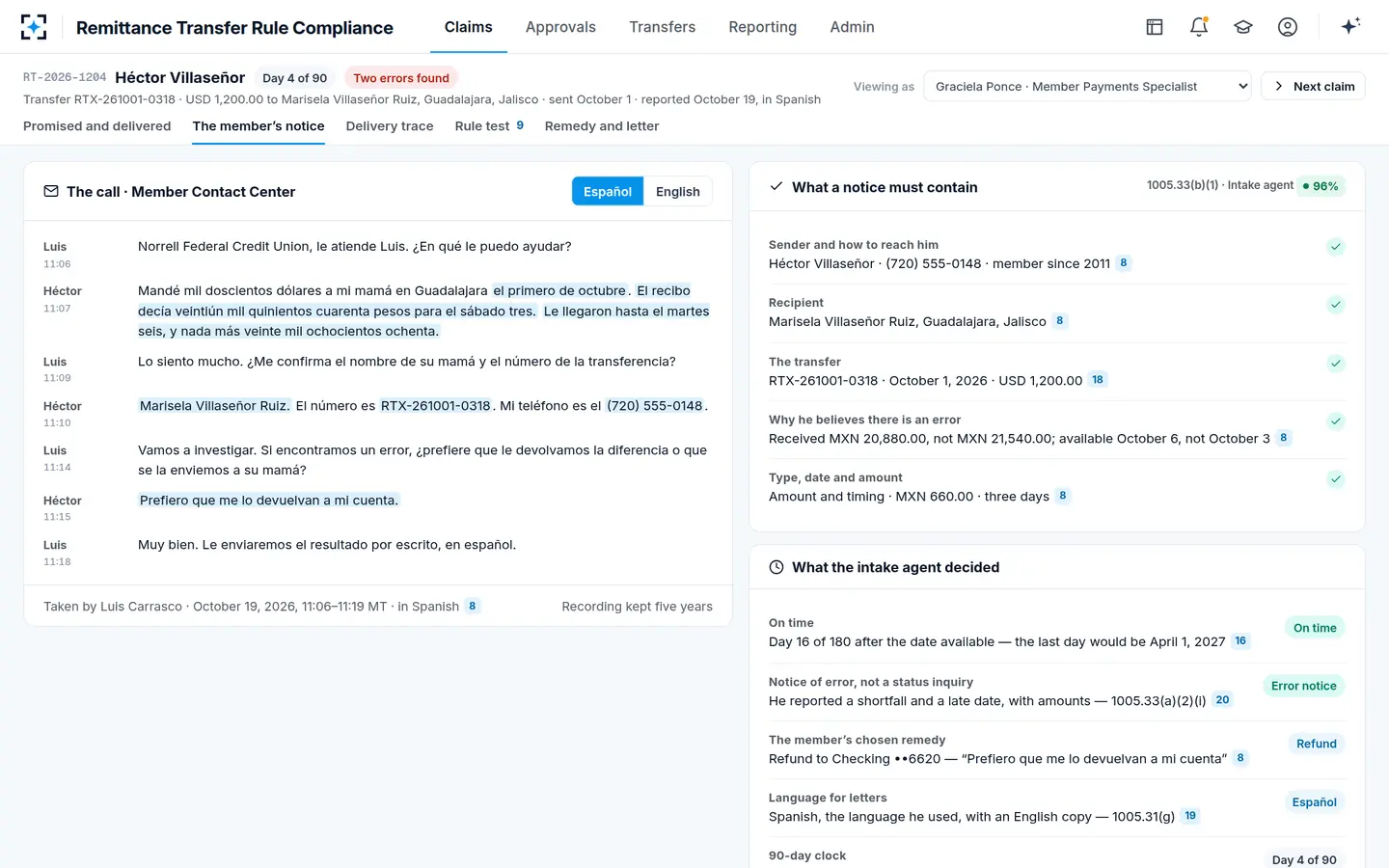
Most error claims start as a phone call, and the specialist's first job is to decide what kind of call it was. Take the sample: on a Monday in October, Héctor Villaseñor, a member of the fictional Norrell Federal Credit Union, calls the contact center in Spanish. The USD 1,200.00 he sent to his mother in Guadalajara on 1 October arrived as MXN 20,880.00, not the MXN 21,540.00 on his receipt, and on 6 October, not on Saturday 3 October.
That is a notice of error if it arrives within 180 days of the disclosed date of availability, lets the provider identify the sender and how to reach him, the recipient and the transfer, and says why he believes there is an error, with the type, date and amount where he can (1005.33(b)(1)). A confirmation number is enough to identify the transfer. A call that only asks where the money is would be a status inquiry, which is not an error, unless the money already missed its date; then it is one, and the 90-day clock starts on the call.
The language matters too. Error-resolution disclosures go out in English and, where the credit union principally uses Spanish to market remittance transfers at the office where the member asserts the error, in the Spanish he used to assert it (1005.31(g)(1)). In the sample, the call is day 16 of 180, the notice is complete, and the credit union's determination is due by 17 January 2027.
The member's call, read in the language he used and checked against what a notice must contain
Tuesday and Wednesday: tracing money the credit union never touched
A trace is the slowest part of the week because the evidence sits with other institutions. The specialist needs the remittance platform's status log, the rate contract, the correspondent's messages and the payout bank's confirmation, and by hand each is an email or a portal search. In the product's own estimate for the sample credit union, waiting for the correspondent takes about 9 of the 19 days a claim needs by hand.
The sample trace finds the cause in twelve events. The remittance platform sent the recipient's name without the ñ; the payout bank held the money over VILLASENOR against VILLASEÑOR; the repair came back on 5 October, after the 72-hour rate contract had expired, so the correspondent re-quoted at 17.4000 instead of 17.9500. Two of those parties caused the shortfall and the delay. Neither of them owes the member anything under Regulation E; the credit union does.
What the trace must not do is wait for the member to prove the money's absence. The CFPB found that one provider required senders to supply a copy of the recipient's bank statement before it would start a trace, a condition the rule does not impose, and that some claims "that should have been resolved in the consumers' favor were instead resolved unfavorably" as a result (Wise US amended consent order, 2025).
Thursday: what the receipt promised against what was delivered
The determination compares two columns and then tries to break the result. On the left, what the receipt promised: transfer amount, fees, taxes, total, exchange rate, other fees, total to recipient, date available, recipient. On the right, what the payout bank delivered. In the sample, seven of nine elements match; the rate, the pesos and the date do not.
Each difference is an error unless an exception the rule allows applies, and the specialist has to rule each one out on evidence. Extraordinary circumstances means things like "war or civil unrest, natural disaster, garnishment or attachment of funds after the transfer is sent," or unforeseeable currency controls; a name held for repair is ordinary processing. A sanctions or fraud review excuses lateness only if the provider "did not and could not have reasonably foreseen the delay" when it gave the receipt (comment 33(a)-7); here screening cleared automatically at 10:51 on the day of the transfer. An estimated rate excuses a shortfall only where an estimate was allowed, and Norrell sent more than 1,000 transfers to Mexico in 2025, so it was not. Both errors stand.
Friday: the refund, the letter and a second signature
Once the member says which remedy he wants, the provider has one business day, or as soon as reasonably practicable, to apply it. Because the money was late, the remedy has two parts: fix the amount, by refund or by delivering the shortfall at no cost, and refund the fees and, to the extent not prohibited by law, the taxes on the transfer (1005.33(c)(2)(ii)). Héctor chose a refund: USD 36.77 for the MXN 660.00, at the receipt's rate, plus the USD 12.00 fee, USD 48.77 in all.
The results go to the member within three business days of the determination. Where the provider finds the error as the sender described it, it may tell him orally or in writing; where it finds no error or a different one, it owes a written explanation that notes his right to the documents it relied on. Sigue's practice, from the rule's effective date through at least 2019, "was to inform consumers about complaint-investigation results only by telephone, even if Respondents found no error or a different error from the one alleged" (Sigue consent order, 2020).
In the sample, the specialist signs the refund and the Spanish letter as maker, and her supervisor approves as checker before anything posts. The regulation does not require two signatures. It does require the right amount within a business day, and a second person who did not prepare the refund is the cheapest way to prove it was.
Every day: thirty-minute windows and receipts checked before payment
Two duties run underneath the claims. The first is cancellation: a request received within 30 minutes of payment must be honoured if the money has not been picked up or deposited, with a full refund, fees and, where the law allows, taxes, within three business days (1005.34). The window runs regardless of the provider's hours; the interpretation's answer for an institution that closes at five is that it "could stop accepting payment for remittance transfers after 4:30 p.m." (comment 34(a)-3).
The second is the receipt itself. A changed template that drops one required element is wrong on every transfer it touches until someone notices. In the sample morning, 214 transfers were checked against every element before release; three were held, including two Spanish mobile receipts that a software release had left without the error-resolution and cancellation rights statement. Each was re-disclosed before payment, and a person released it.
Who works a remittance claim, and what changes in their week
Today
Types a free-text note; whether the call is on time, an inquiry or names a remedy is rarely written down.
With agents
Every element the rule needs is ticked from the call itself, and the 90-day clock starts on the call.
Still theirs: The conversation with the member
Today
Waits on correspondents by email and compares the payout confirmation with the receipt in a spreadsheet.
With agents
Opens each claim with promise and delivery side by side and every exception already tested on evidence.
Still theirs: The determination, signed as maker
Today
Refunds keyed into the core by hand, often without a second person.
With agents
Approves or returns each refund, resend and letter with the evidence attached, never one he made.
Still theirs: The checker signature
Today
Re-performs the monthly sample on paper; a broken template is found a month late.
With agents
Receives proposed findings from a re-performed sample, receipts already checked before release.
Still theirs: Accepting each finding and signing the test
Today
Learns which claims are near day 90 when someone escalates.
With agents
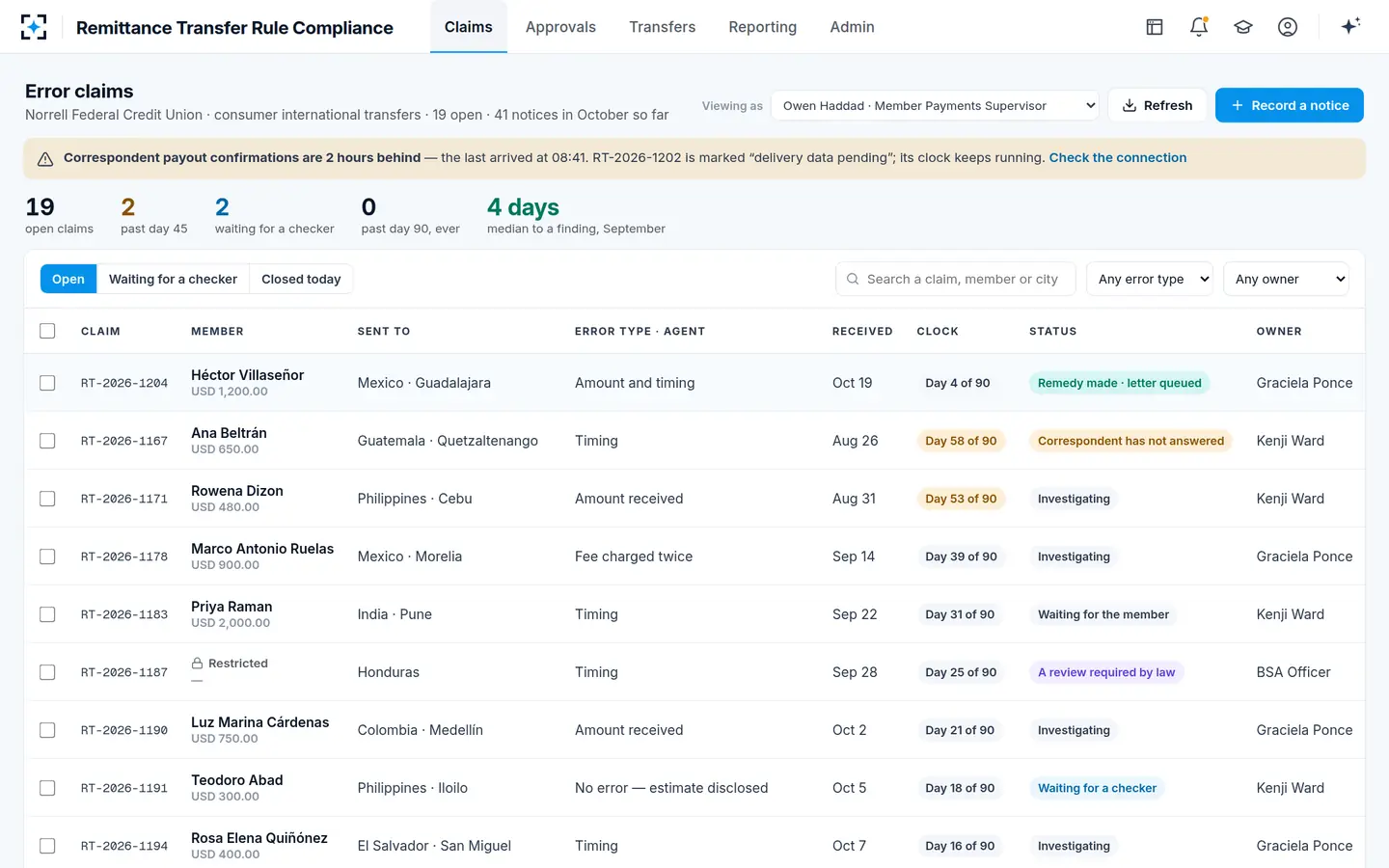
Sees every open claim on its clock and is told at day 60.
Still theirs: Second approval above USD 2,500 and on template changes
Where the specialist's days go, and which ones can be won back
Most of a hand-worked claim is waiting and looking, not deciding. The split below is the product's own estimate for the sample credit union, built from its case log: a 19-day median from notice to determination by hand. It is an estimate on fictional data, offered to show the shape of the work, not a measured result at any customer.
Nine of a hand-worked claim's nineteen days are spent waiting on the correspondent
One claim by hand, 19 days (estimated)
- Notice and comparison · 13%
- Trace and wait · 47%
- Exceptions, decide · 16%
- Remedy, letter · 11%
- Post, approve · 13%
Only the decide band belongs to judgement. The trace can be asked for on the day of the notice; the comparison is arithmetic once both documents are in hand; the remedy is a formula the regulation writes. On the sample claim, with the agents doing the gathering, the determination came on day 4 of 90.
Every open claim on its 90-day clock, with the escalations a supervisor needs
What goes wrong when the week is run from memory
The enforcement record is mostly about procedure, not about fraud or bad faith. Providers lost track of which complaints were notices of error, told senders results by phone when the rule wanted writing, or refunded fees on some remedies and not others. Wise had a written policy to resolve errors within 90 days, but the CFPB found it "failed to follow its policies and procedures and failed to provide customer service staff with adequate training on required timelines" (Wise US amended consent order).
Each of those failures is a clock someone was meant to remember. That is why the fee refund on late money recurs across the CFPB's orders, a pattern traced in the CFPB's remittance transfer rule enforcement: it is the one remedy that depends on a date nobody in the room set.
Where Botminds' Remittance Transfer Rule Compliance fits in the week
The solution sits across the systems a transfer already runs through: the remittance platform, the correspondent's messages, digital banking receipts, the contact center, the core and the general ledger. Seven agents read the notice, trace the money, test the exceptions, compute the remedy, check receipts before release, watch cancellation windows and re-perform the monthly sample. None of them decides an error, posts money, sends a letter, changes a template or releases a held transfer; the specialist decides and signs, and a supervisor approves.
It does not replace the remittance platform or the correspondent relationship, and it cannot make a payout bank answer faster. What it changes is when the specialist starts and what she starts with: every document gathered, every exception tested with its evidence, and the clock visible on every claim.
Questions people ask
Is an agent a remittance transfer provider?
No. A person is not acting as a remittance transfer provider when it performs activities as an agent on behalf of one (comment 30(f)-1). The provider remains liable for the agent's violations under 1005.35, and a notice of error or a cancellation request given to the agent counts as received by the provider when the agent receives it.
Who handles remittance errors at a bank?
The regulation does not name a role; it requires written policies and procedures designed to ensure compliance with the error-resolution rules (1005.33(g)(1)). In practice a payments or deposit operations specialist investigates, a supervisor approves money and letters, and compliance tests the work. UniTeller's policies, the CFPB found, did not identify which employees were responsible for investigations, notices to consumers and keeping documents until at least September 2019.
How many transfers make a bank a remittance transfer provider?
More than 500 in either the previous or the current calendar year takes a bank out of the safe harbor, and then the facts decide whether it sends transfers in the normal course of business. An institution that crosses 500 mid-year gets a reasonable period, not more than six months, to begin complying (1005.30(f)(2)(ii)).
Does the provider have to refund fees a correspondent or payout bank charged?
On a late-delivery error, yes. The interpretation says the provider must refund any fees imposed for the transfer "whether the fee was imposed by the provider or a third party," such as an intermediary bank or the institution where the money is picked up, unless the sender's own incorrect or insufficient information caused the error (comment 33(c)-8).
Can a provider charge for investigating a remittance error?
Not when an error occurred. If there was an error, as alleged or in a different amount or manner, the provider "may not impose a charge related to any aspect of the error resolution process," including charges for documentation or investigation (comment 33(c)-9).
Does Saturday count as a business day for the clocks?
Only if the provider's offices are open for substantially all business functions, back office included. A branch open on Saturday for customers to send transfers but not for investigating errors does not make Saturday a business day for resolving errors or processing refunds (comment 30(b)-2).