The remittance transfer excise tax is a federal tax of 1% of the amount of a remittance transfer, created by section 4475 of the Internal Revenue Code and applying to transfers made after 31 December 2025. It applies only when the sender gives the remittance transfer provider cash, a money order, a cashier's check or a similar physical instrument; it does not apply to transfers withdrawn from an account at a U.S. financial institution or funded with a U.S.-issued debit or credit card (26 U.S.C. 4475). The sender pays it; the provider collects it, deposits it semimonthly and reports it quarterly on Form 720. For most banks and credit unions, whose transfers come from accounts, it will rarely apply. Where it does, it meets Regulation E at three points, the receipt, the cancellation refund and the late-delivery refund, and the two agencies' texts do not yet line up. Botminds' Remittance Transfer Rule Compliance treats the tax as an element to check on every disclosure and an amount to account for in every refund; this guide sets out what each agency's text says.
A small tax on a narrow slice of transfers, felt most by cash senders
1%
of the amount transferred, on cash-funded transfers made after 31 December 2025
1.1–1.3M
households a year likely to use cash or cash-like instruments to send remittances
18–26%
rise in what a $200 to $500 cash transfer costs the sender, money sent excluded, on Treasury's estimate
What is the remittance transfer excise tax?
It is a 1% tax on cash-funded consumer remittances, added to the Code by section 70604 of Public Law 119-21, enacted on 4 July 2025, in chapter 36, "Certain Other Excise Taxes." The tax uses Regulation E's own definitions: "remittance transfer," "remittance transfer provider" and "sender" have the meanings in section 919(g) of the Electronic Fund Transfer Act (4475(e)(1)). So the tax reaches the same consumer-to-abroad transfers the remittance rule governs, but only those paid for with physical instruments.
The proposed regulations fill in the edges. They would add traveler's checks to the taxable instruments; treat a transfer funded by a check the provider or its agent cashes for the sender as funded with cash, "regardless of whether the sender ever has actual possession of any resulting cash"; and tax "the amount that will ultimately be transferred to the designated recipient," so service fees are not part of the base (REG-114499-25). Personal checks made out to the provider, debit and credit cards from any country and general-use prepaid cards would not trigger the tax, subject to an anti-avoidance rule.
Who collects the remittance tax, and who pays it?
The sender pays; the provider collects and remits. Section 4475(b) says the tax "shall be paid by the sender," that the provider "shall collect the amount of the tax … from the sender and remit such tax quarterly," and that where the tax is not collected at the time of the transfer, "such tax shall be paid by the remittance transfer provider." An agent, such as a grocery store taking cash for a money transmitter, is not itself a provider; the provider collects through it.
The mechanics are the excise tax system's. The tax is reported on Form 720, Quarterly Federal Excise Tax Return, under IRS No. 155, and collectors must make semimonthly deposits; "the first semimonthly deposit is due January 29, 2026" (Instructions for Form 720, June 2026). The proposed rules say the tax attaches at the earlier of the provider initiating the transfer or the sender paying, so a cash transfer paid on 31 December 2026 and paid out on 2 January 2027 belongs to the fourth quarter of 2026.
Does the 1% remittance tax apply to bank transfers?
Rarely. Transfers withdrawn from an account at a U.S. financial institution subject to the Bank Secrecy Act are excluded by statute (4475(d)(1)), and the proposed rules confirm that card-funded transfers are not taxed whatever the card's country. A bank or credit union would collect the tax only when a sender pays at the counter with cash, a money order, a cashier's check or a traveler's check, or when it cashes a check and uses the cash for the transfer. Treasury's own assessment is direct.
"Since remittance transfers facilitated by financial institutions are primarily funded by non-cash instruments, the Treasury Department and the IRS expect that banks and credit unions will not be materially affected by the remittance tax and proposed regulations."
Treasury Department and IRS, proposed regulations on the excise tax on remittance transfers, 91 FR 18797 (13 April 2026)
The burden falls on money transmitters with retail networks. Treasury counts approximately 600 money services businesses licensed as money transmitters, of which "more than 200 MSBs, through approximately 500,000 authorized agents, provide remittance transfers at retail locations and likely accept cash and cash-like payment instruments." It estimates that 30% to 36% of money transmitters' remittances are funded with cash, about $156 billion to $187 billion a year on 2019–2024 volumes.
The same $500 remittance, funded two ways
Paid in cash or by money order at the counter: 1%: $5.00 on a $500 transfer amount
Sent from the sender's checking account: None: excluded by 4475(d)(1)
Paid in cash or by money order at the counter: Sender pays; provider collects, deposits semimonthly, files Form 720 quarterly
Sent from the sender's checking account: Not applicable
Paid in cash or by money order at the counter: Collected by the provider, so it fits "Transfer Taxes" on the rule's wording
Sent from the sender's checking account: "Transfer Taxes" USD 0.00, or omitted where none apply
Paid in cash or by money order at the counter: Reg E refund includes taxes "to the extent not prohibited by law"; the tax rule sends the sender to the IRS
Sent from the sender's checking account: Transfer amount and fees refunded
Paid in cash or by money order at the counter: Money transmitter retail agent; occasionally a bank branch
Sent from the sender's checking account: Bank or credit union
When did the remittance tax start, and what is still only proposed?
The statute applies to transfers made after 31 December 2025, so it has been in force since 1 January 2026. The regulations are not final. Treasury and the IRS published proposed rules on 13 April 2026, took comments until 12 June 2026, and propose that the final rules apply to transfers in calendar quarters beginning on or after their publication; until then, collectors "may rely on these proposed regulations" if they follow them "in their entirety and in a consistent manner." As of late October 2026, the Federal Register showed no final rule.
The remittance transfer excise tax, date by date
| Date | What happened | Source |
|---|---|---|
| 4 July 2025 | Public Law 119-21 adds section 4475 to the Internal Revenue Code | 26 U.S.C. 4475; Notice 2025-55 |
| 20 October 2025 | Notice 2025-55: relief from failure-to-deposit penalties for the first three quarters of 2026 | IRS |
| 1 January 2026 | Tax applies to transfers made after 31 December 2025 | 4475 effective-date note |
| 29 January 2026 | First semimonthly deposit due, for 1–15 January | Notice 2025-55; Form 720 instructions |
| 13 April 2026 | Proposed regulations published (REG-114499-25) | 91 FR 18797 |
| 12 June 2026 | Comments on the proposed regulations due | 91 FR 18797 |
| 30 September 2026 | End of the third quarter: the last covered by penalty relief | Notice 2025-55 |
| Not yet | Final regulations | Federal Register search, October 2026 |
The penalty relief was conditional. For semimonthly periods in the first three quarters of 2026, a provider is treated as having reasonable cause if it makes timely deposits, "even if the deposit amounts are computed incorrectly," and pays any underpayment in full by the Form 720 due date for the quarter (Notice 2025-55). From the fourth quarter, ordinary deposit penalties apply.
Does the remittance tax apply to credit unions?
Yes, on the same terms as banks: a credit union that is a remittance transfer provider must collect the tax on any transfer a member funds with cash or a cash-like instrument. And the tax does not adopt Regulation E's 500-transfer safe harbor. The proposed rules say the safe harbor "does not apply" for the tax, because otherwise the rule "would have the potential to create inconsistent tax results for senders in otherwise identical remittance transfer transactions." A small credit union outside the remittance rule may therefore still be a provider for the tax; how that counting works is set out in the remittance transfer safe harbor.
Where the tax meets Regulation E: the receipt
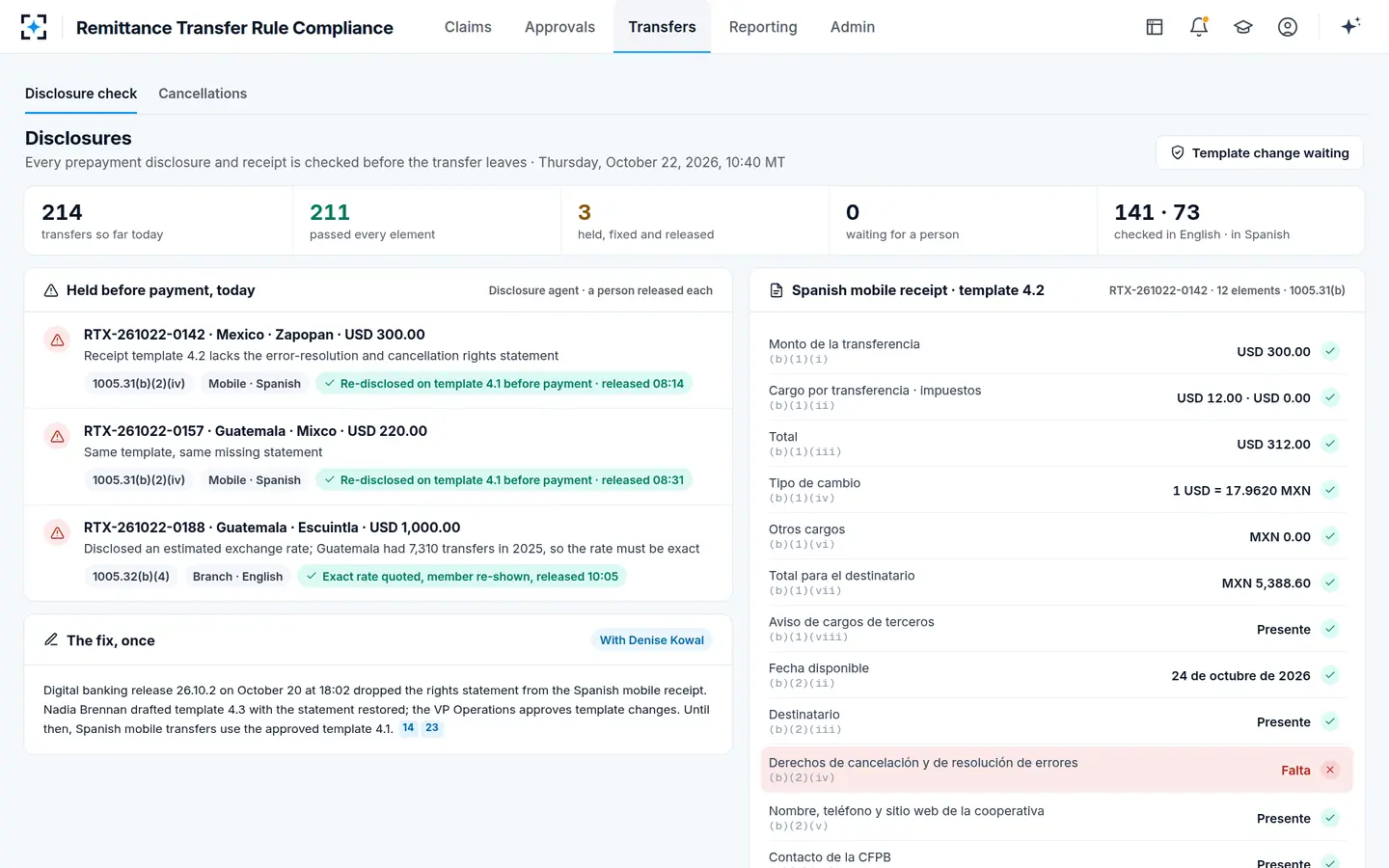
Regulation E requires the prepayment disclosure and receipt to show "any fees imposed and any taxes collected on the remittance transfer by the provider," as "Transfer Fees" and "Transfer Taxes" (1005.31(b)(1)(ii)). The excise tax is collected by the provider from the sender, so on the rule's wording it belongs on that line where it applies; neither the CFPB nor the IRS addressed the disclosure in the texts we reviewed. Because the tax base excludes fees and the disclosure total adds fees and taxes, the receipt arithmetic is: transfer amount, plus fees, plus 1% of the transfer amount.
Is the remittance tax refunded if the transfer is cancelled?
Here the two texts pull apart. Regulation E says a provider honouring a timely cancellation must refund "the total amount of funds provided by the sender in connection with a remittance transfer, including any fees and, to the extent not prohibited by law, taxes imposed in connection with the remittance transfer, within three business days" (1005.34(b)), and the interpretation extends that to taxes assessed by "a State or other governmental body" (comment 34(b)-2).
The tax rule takes a different route. It says the tax attaches when the transfer is made "regardless of whether the remittance transfer is ever paid out," and that where a transfer is cancelled or expires and its amount is returned, "the sender may be eligible to file a claim for refund of the remittance transfer tax with the Internal Revenue Service." It adds: "Neither section 4475 nor any other section of the Code entitles the collector (unlike the sender) to refunds of the remittance transfer tax" (REG-114499-25). The IRS instructions agree: do not use Form 720-X for cancelled or expired transfers; the sender files Form 8849, Schedule 6 (Instructions for Form 720-X).
Put together, a provider that refunds the 1% on a cancelled transfer, as Regulation E appears to ask, cannot recover it from the IRS under the proposed rules; one that withholds it and sends the sender to the IRS is relying on "to the extent not prohibited by law," and nothing in the tax texts prohibits a provider from refunding. The CFPB has not, in any text we found, addressed the point. Each provider that collects the tax needs a written position, taken with counsel, and needs to apply it the same way on every cancellation.
Late money: the Reg E remedy refunds "taxes collected" too
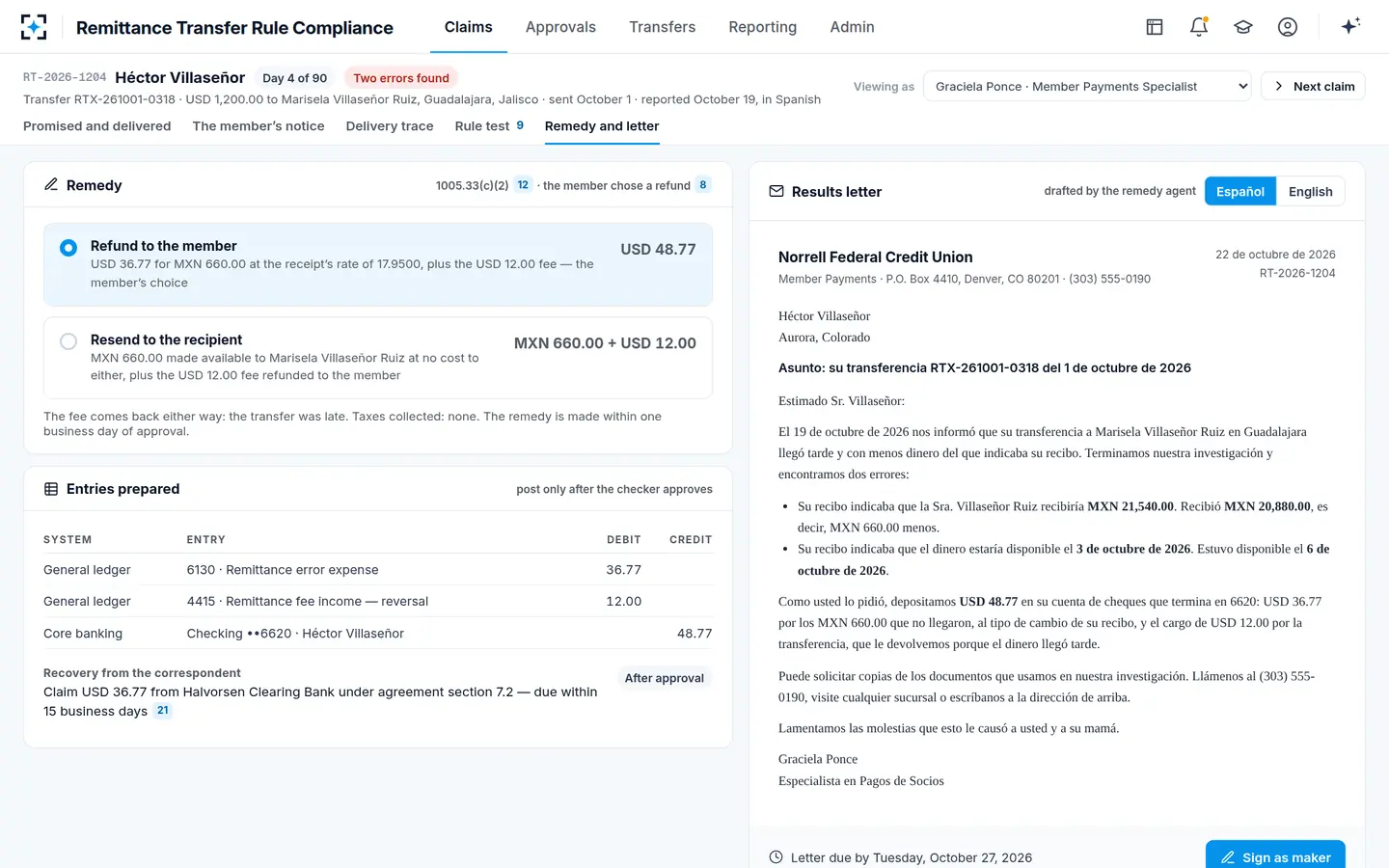
The same tension sits in error resolution. When a transfer misses its disclosed date and no exception applies, the remedy includes refunding the sender's fees and, again unless the law prohibits it, the taxes collected (1005.33(c)(2)(ii)(B); remittance transfer error resolution quotes the remedy). This is the duty the CFPB has enforced most; UniTeller's order counts at least 3,154 confirmed late-delivery errors in which it "did not refund fees or taxes." A provider collecting the excise tax should expect an examiner to ask how its late-delivery refunds treat it.
Where the lateness was the sender's own doing, through incorrect or insufficient information, the rule lets the provider deduct taxes "actually collected" on the failed attempt. The interpretation's example is a $15 State tax, which the provider may deduct "unless the relevant tax law will result in the $15 tax being refunded to the provider" (comment 33(c)-12.iii). Whether that reasoning carries over to the federal tax is, again, a question for counsel; the example at least shows the CFPB contemplated taxes a provider cannot get back.
Transfer taxes checked as an element of every receipt, in each language
What a bank or credit union should do now
Find out whether you take cash for remittances at all, and where. Branch counters, money orders and cashier's checks bought for the purpose, and check-cashing that funds a transfer are the paths that bring the tax in. If none exist, document that, because an examiner or auditor may ask. If any do, the provider needs Form 720 filing and semimonthly deposits, receipts that show the tax, and a written position on refunding it on cancellations and late-delivery errors, applied the same way every time.
The solution helps with the Regulation E side: it checks that every receipt shows transfer taxes correctly, computes refunds and remedies with the taxes the institution's policy says to include, and puts each refund before a checker with its evidence. It does not file Form 720 or make tax deposits, which belong to the institution's tax function. For the other refund the remittance rule makes providers pay, the fee on a late transfer, see what a remittance transfer error costs.
A remedy that states the fees and taxes it refunds
Questions people ask
What is section 4475?
Section 4475 of the Internal Revenue Code imposes a tax equal to 1% of the amount of a remittance transfer funded with cash, a money order, a cashier's check or a similar physical instrument, for transfers made after 31 December 2025. It was added by section 70604 of Public Law 119-21 on 4 July 2025.
What is the IRS remittance transfer tax penalty relief?
Notice 2025-55 waives the failure-to-deposit penalty for the first three calendar quarters of 2026 if the provider made its semimonthly deposits on time, even if miscalculated, and paid any shortfall by the Form 720 due date for the quarter. It also protects the provider's later use of the deposit safe harbor.
Is the remittance tax charged on the fee?
Not under the proposed rules. The tax base would be the amount ultimately transferred to the designated recipient, including promotional bonuses added to it, and excluding service fees, State taxes and other charges not sent to the recipient.
Who pays the tax if the provider does not collect it?
The provider. Section 4475(b)(3) says that where the tax is not paid at the time of the transfer, to the extent it is not collected, it "shall be paid by the remittance transfer provider."
Does the tax apply to transfers within the United States?
No. It applies to remittance transfers, which by definition go to a designated recipient at a location in a foreign country; the proposed rules adopt Regulation E's definition, under which a location is foreign if it is physically outside any State.