International wires are covered under Reg E when a consumer sends them. A consumer's wire to a recipient abroad is a "remittance transfer" under Subpart B of Regulation E if the sender is a consumer in a State sending primarily for personal, family or household purposes, the money will be received at a location in a foreign country, the amount is more than $15, and the bank or credit union sends such transfers in the normal course of its business. That holds even though wires through Fedwire and similar systems are excluded from the rest of Regulation E: the definition applies "regardless of whether the transaction is also an electronic fund transfer" (12 CFR 1005.30(e)(1)). Once a wire is covered, it carries the remittance rule's disclosures, its 30-minute cancellation right and its 90-day error process, which is the work Botminds' Remittance Transfer Rule Compliance supports: checking every receipt before payment and working every claim against its clock.
Five questions decide whether an international wire is covered under Reg E
Is the sender a consumer, sending primarily for personal, family or household purposes?
If noNot a remittance transfer. Business and commercial accounts are out, whoever signs the request.
1005.30(g); comment 30(g)-3
Will the money be received at a location in a foreign country?
If noNot covered by Subpart B. A U.S. military installation abroad counts as a State; an account located in a State is not abroad.
1005.30(c); comment 30(c)-2
Is the transfer amount more than $15, and not a securities or commodities transfer?
If noExcluded from the definition of remittance transfer.
1005.30(e)(2)
Is it an electronic transfer that you send for the sender, as the intermediary dealing with him?
If noNot a remittance transfer: a check mailed abroad, or a card payment the consumer makes directly to a foreign merchant.
comments 30(e)-1, 30(e)-2
Do you send remittance transfers in the normal course of business, above the 500-a-year safe harbor?
If noYou are not a remittance transfer provider for it; Subpart A may still apply to other parts of the transaction.
1005.30(f)
Yes to all five: the wire is a remittance transfer.
Prepayment disclosure and receipt; 30-minute cancellation; error resolution on the 180, 90, 3 and 1-day clocks; liability for agents.
Does Reg E apply to wire transfers?
Two answers, because Regulation E has two parts. Subpart A, the general electronic fund transfer rules, excludes "any transfer of funds through Fedwire or through a similar wire transfer system that is used primarily for transfers between financial institutions or between businesses" (12 CFR 1005.3(c)(3)). The interpretation lists the similar systems as the Clearing House Interbank Payments System, SWIFT, Telex "and transfers made on the books of correspondent banks" (comment 3(c)(3)-3). So a wire is not an electronic fund transfer for Subpart A's purposes.
Subpart B, the remittance transfer rule, was written to reach consumer wires anyway. Among its examples of remittance transfers, the official interpretation lists "Consumer wire transfers, where a financial institution executes a payment order upon a sender's request to wire money from the sender's account to a designated recipient" (comment 30(e)-3.i.B). The wire's legal plumbing, Article 4A and, for Fedwire, Regulation J, still governs the funds transfer between banks; the remittance rule governs what the bank owes the consumer who asked for it.
Banks send a small share of remittances, in large amounts
11.1M
remittance transfers sent by banks in 2017; credit unions sent 790,000
$6,500+
average size of a bank-sent remittance transfer
325M
remittance transfers sent by money transmitters the same year
Question 1: is the sender a consumer sending for personal purposes?
A sender is "a consumer in a State who primarily for personal, family, or household purposes requests a remittance transfer provider to send a remittance transfer" (1005.30(g)). A transfer from an account established primarily for personal purposes may generally be treated as personal; if the consumer says it is for business, it is not covered, even from a personal account (comment 30(g)-2). A transfer from an account established as a business or commercial account, or held by a corporation, partnership, limited liability company or sole proprietorship, is never covered (comment 30(g)-3).
"In a State" is decided by the account, not the person's location, for most accounts: if the account is located in a State, the consumer is treated as being in a State. An account on a U.S. military installation abroad counts as being in a State. The test matters most at branches, where a business owner may ask to wire personal money from a business account, or family money from a business one; the account's purpose decides.
Question 2: will the money be received at a location in a foreign country?
The recipient must be at "a location in a foreign country," meaning physically outside any State; a specific pick-up point need not be named (comment 30(c)-2). For an account, what matters is where the account is located: a wire to a U.S. account is not a remittance transfer even if its holder lives abroad, and a wire to an account on a U.S. military base overseas is treated as received in a State.
The sender can be his own recipient. A consumer who wires money "from the sender's checking account in a State to the sender's checking account located in a foreign country" is both sender and designated recipient, and the transfer is covered (comment 30(c)-3). Branch staff who treat a transfer to the customer's own account abroad as outside the rule are the most common source of missing disclosures on otherwise ordinary wires.
Question 3: is it more than $15?
Transfers of "$15 or less" are excluded as small-value transactions, measured on the transfer amount the provider discloses, not the total with fees (1005.30(e)(2)(i)). So are transfers excluded from the definition of electronic fund transfer as securities and commodities transfers. For bank wires the dollar floor rarely matters; for small international ACH credits and bill payments it sometimes does.
Question 4: is it an electronic transfer that you send for the sender?
The definition needs "an intermediary that is directly engaged with the sender to send an electronic transfer of funds on behalf of the sender" (comment 30(e)-2.i). A wire qualifies; so does an international ACH payment sent at the sender's request, an online bill payment to a payee abroad, and a top-up of a prepaid card that was sent to someone abroad. A check or draft mailed abroad generally does not, and neither does a consumer paying a foreign merchant directly with a card or account number, because then the bank is processing the merchant's payment, not sending one for the consumer.
Covered or not: international transfers a bank or credit union sees
| Transaction | Remittance transfer? | Why |
|---|---|---|
| Consumer wires $2,000 from checking to a relative's account in Mexico | Yes | Consumer wire to a designated recipient abroad (comment 30(e)-3.i.B) |
| Consumer wires $50,000 to her own account in Portugal | Yes | A sender may be the designated recipient (comment 30(c)-3) |
| Sole proprietor wires from the business account to a supplier in China | No | Business account; not a sender (comment 30(g)-3) |
| Member sends an international ACH payment from checking at her request | Yes | International ACH sent at the sender's request (comment 30(e)-3.i.D) |
| Customer's online bill payment to a landlord abroad, paid electronically | Yes | Bill payment by electronic transfer (comment 30(e)-3.i.E) |
| Customer buys from a foreign online store with a debit card | No | Card given directly to a foreign merchant (comment 30(e)-3.ii.A) |
| Bank mails a draft to a payee abroad | Generally no | Paper instrument, not an electronic transfer (comment 30(e)-1) |
| Wire to a soldier's account at a bank on a U.S. base in Germany | No | Treated as received in a State (comment 30(c)-2) |
| $12 sent abroad from a personal account | No | Small-value exclusion, $15 or less (1005.30(e)(2)(i)) |
Question 5: do you send remittance transfers in the normal course of business?
A bank that wires abroad for consumers once or twice a year as an accommodation is not a provider; one that offers international wires generally and sends them more than occasionally is (comment 30(f)-2.i). The safe harbor makes it numerical: an institution that sent 500 or fewer remittance transfers in the previous calendar year and sends 500 or fewer in the current one is deemed outside the normal course of business, and is not subject to Subpart B (1005.30(f)(2)). The count, the year it is crossed and the six months that follow are worked through in the remittance transfer safe harbor.
Are domestic wires covered under Reg E?
No, in most cases. A domestic consumer wire is not a remittance transfer, because the recipient is not abroad, and a wire through Fedwire or a similar system is excluded from Subpart A's definition of an electronic fund transfer. Its rights between banks and customer come from UCC Article 4A, the account agreement and, for Fedwire, Regulation J; the interpretation notes that telephone-initiated Fedwire payments "are not subject to Regulation E" (comment 3(c)(3)-2).
There is one nuance worth knowing at the back office. If a bank receives funds by Fedwire and then sends them on to a consumer's account by ACH, "the transfer by ACH is covered by the regulation even though the Fedwire or network transfer is exempt" (comment 3(c)(3)-1). Coverage follows each leg, not the whole payment.
A consumer's domestic wire and a consumer's international wire under Regulation E
Domestic consumer wire: No: excluded from the definition of an electronic fund transfer
International consumer wire (remittance transfer): Yes: Subpart B, regardless of whether it is also an electronic fund transfer
Domestic consumer wire: None under Regulation E; the account agreement
International consumer wire (remittance transfer): Prepayment disclosure and receipt with set terms, including the date available
Domestic consumer wire: Article 4A and the agreement
International consumer wire (remittance transfer): 30 minutes after payment, full refund with fees in 3 business days
Domestic consumer wire: Article 4A, Regulation J and the agreement
International consumer wire (remittance transfer): 180 days to report; 90 to determine; 3 business days to report; 1 to fix
Domestic consumer wire: No Regulation E remedy
International consumer wire (remittance transfer): An error: fees refunded, and taxes where the law allows
Is a remittance transfer a wire transfer?
Sometimes. "Remittance transfer" is a legal category defined by who sends and where the money goes; "wire" is a payment rail. A consumer wire abroad is a remittance transfer; so is a cash transfer at a money transmitter's counter, an international ACH credit or an electronic bill payment abroad. A business wire abroad is a wire but not a remittance transfer.
The rail still matters for compliance. Wires pass through correspondents that may deduct fees on the way, which the rule calls covered third-party fees and requires on the disclosure as "Other Fees" (comment 30(h)-2 gives intermediary "lifting fees" as the example). An insured institution that cannot determine the exact rate may estimate it only for a country to which it sent 1,000 or fewer transfers the year before, and only from the sender's account (1005.32(b)(4)); for covered third-party fees, the line is 500 or fewer transfers to that recipient's institution. And a wire sent with a wrong bank identifier is an error unless the provider meets five conditions, including having verified the identifier by "reasonably available means," such as a directory of Business Identifier Codes (comment 33(h)-1).
What changes when the answer is yes
Every covered wire needs a compliant prepayment disclosure and receipt, a cancellation window watched for 30 minutes, and an error process ready for a notice up to 180 days after the date available. For a bank that sends wires from a back-office system built for business payments, the receipt is the hard part: the date available is a promise about another bank's behaviour, and the third-party fees are another bank's decision. The elements are set out one by one in remittance transfer disclosure requirements.
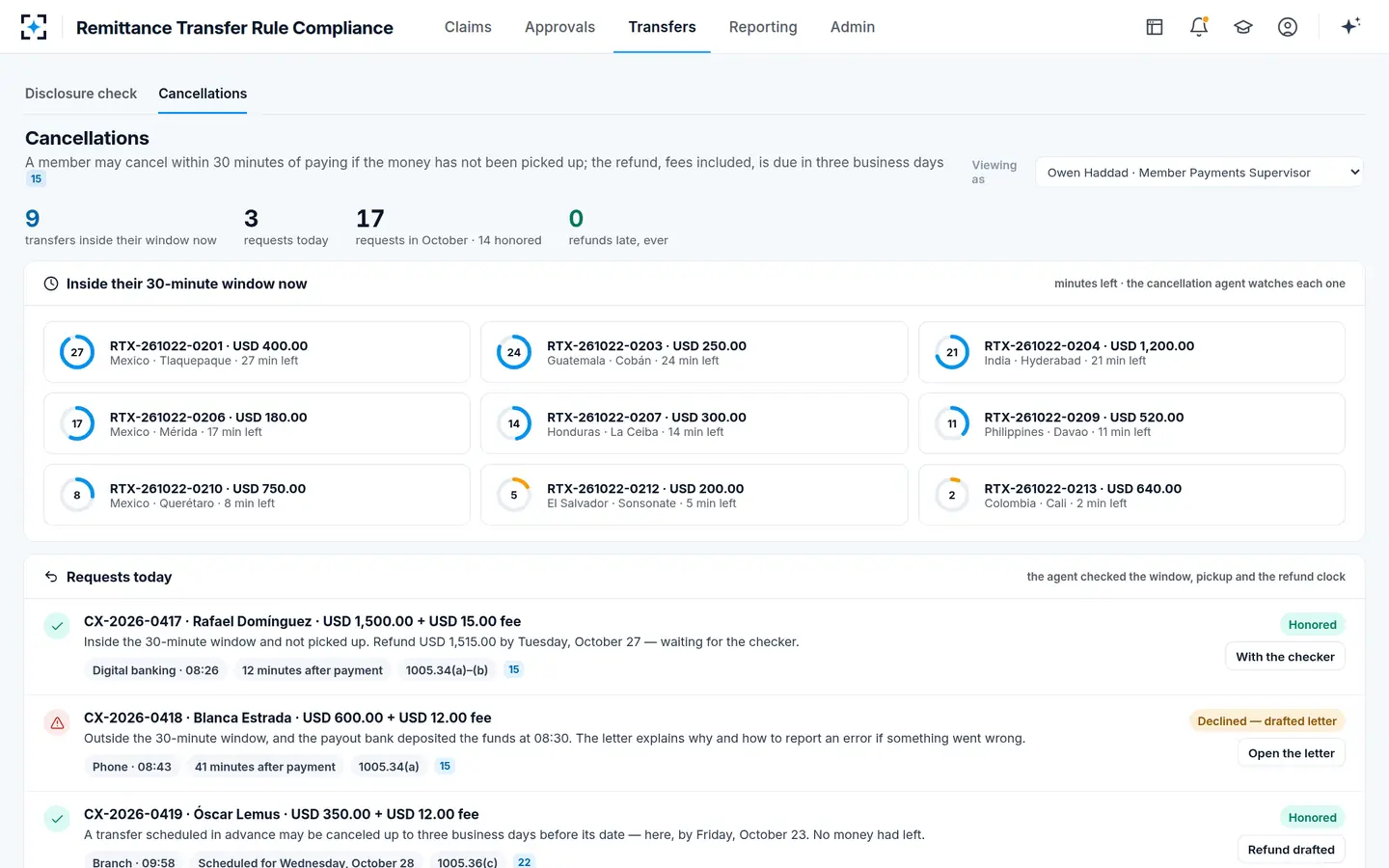
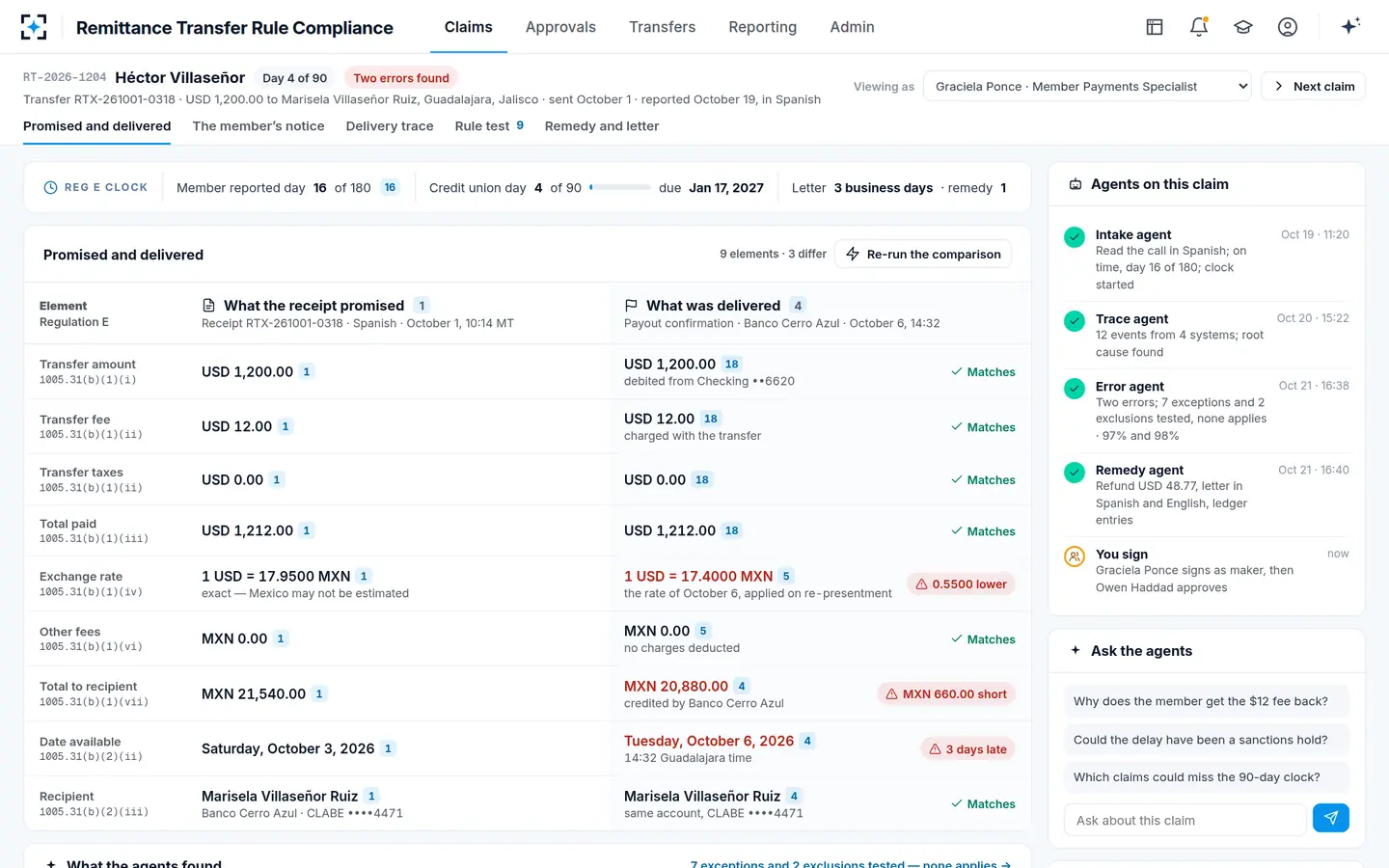
That is where the solution's checks sit. Before a covered transfer leaves, the disclosure agent checks every element of the disclosure and receipt, and whether an estimate is allowed for that country; after payment, the cancellation agent watches the window; when a claim arrives, the agents lay the receipt beside what the payout bank delivered. A person decides each error and approves each refund.
Every covered transfer's 30-minute cancellation window, watched from payment
Promised and delivered: the receipt of a covered transfer beside the payout bank's confirmation
Questions people ask
Are business wires covered by Reg E?
No. A transfer requested from an account established for business or commercial purposes, or held by a business entity including a sole proprietorship, is not requested primarily for personal, family or household purposes, so the person requesting it is not a sender under the remittance rule (comment 30(g)-3).
Is a wire to my own account abroad covered?
Yes, if it is sent for personal purposes from a consumer account. The interpretation's own example is a transfer from the sender's checking account in a State to the sender's checking account in a foreign country; the sender is also the designated recipient (comment 30(c)-3).
Does Reg E cover international ACH transfers?
Yes, as remittance transfers, when the sender's financial institution sends them at the consumer's request to a recipient abroad (comment 30(e)-3.i.D). An estimate based on the rate set by the recipient country's central bank is allowed in limited cases for international ACH transfers to countries whose laws prevent exact disclosures (1005.32(c)(1)(i)).
Are wires covered under Reg CC?
Regulation CC is 12 CFR part 229, "Availability of Funds and Collection of Checks"; it deals with deposits and checks, not with sending wires. A consumer's wire abroad falls under Subpart B of Regulation E, and the funds transfer itself under Article 4A and, for Fedwire, Regulation J.
When did international wires become covered?
When the CFPB's remittance rule took effect on 28 October 2013, implementing the 2010 amendment that added section 919 to the Electronic Fund Transfer Act. The rule was last amended by a final rule published on 5 June 2020, which raised the safe harbor to 500 transfers.