Remittance transfer error resolution is the procedure in 12 CFR 1005.33. A sender has 180 days after the disclosed date of availability to give notice of an error; the provider must investigate promptly and determine within 90 days whether an error occurred, report the results within three business days, and correct the error within one business day of the sender's choice of remedy, refunding the fees, and taxes where the law allows, when the money was late (12 CFR 1005.33). Doing that is half the job. The other half is proving it: Regulation E requires evidence of compliance for at least two years, and the CFPB has penalised a provider whose records could not show the clocks were met even where the work may have been done. Botminds' Remittance Transfer Rule Compliance builds the error file as the claim is worked, so that every date, value and decision opens the document it came from.
The error file is where remittance cases are won or lost
2 yrs
minimum retention of evidence of compliance, from the date action was required
6
kinds of evidence UniTeller could not produce for its error investigations
3,154
confirmed late-delivery errors on which UniTeller refunded no fees or taxes, 2018–2020
How long does a provider have to resolve a remittance error?
Ninety days to decide, three business days to tell the sender, one business day to fix it. The 90 days run from receipt of the notice of error, not from the transfer; the report follows completion of the investigation; the remedy follows the sender's instruction, or, if he gives none, a default remedy after a reasonable time, which the interpretation deems met by allowing 10 days after the report (comment 33(c)-4). The rule contains no pause for a correspondent that is slow to answer.
The sender's window has one extension. Where he first asked for documentation or clarification, which is itself an error under 1005.33(a)(1)(v), a notice based on what he received is timely if it arrives by the later of 180 days after the date of availability or 60 days after the provider sent what he asked for (1005.33(b)(2)). A file that does not record when documents went out cannot prove a late notice was late.
What the rule allows the provider, and what the sample claim used
What counts as a notice of error for a remittance transfer?
An oral or written statement from the sender that arrives within 180 days, lets the provider identify the sender and how to reach him, the recipient and the transfer, and says why he believes there is an error, with the type, date and amount where he can (1005.33(b)(1)). It does not have to be on a form or use the word "error." A confirmation number that identifies the transfer is enough, and a notice given to an agent counts when the agent receives it.
Three things look like notices and are not. The procedures "apply only when a notice of error is received from the sender, and not when a notice of error is received from the designated recipient or when the remittance transfer provider itself discovers and corrects an error" (comment 33(b)-1). A status inquiry is not an error, unless the money has missed its date. And a request for tax or recordkeeping information is excluded. The reverse trap is a request for documentation or clarification: that is an error under (a)(1)(v), and UniTeller's written definition of "error" left it out until at least June 2021.
What records must a remittance provider keep?
At a minimum, every notice of error, any documentation the sender provided, and the provider's findings, under written policies that also govern retention (1005.33(g)(2)), kept for not less than two years from the date the notice was submitted or the action was required (1005.13(b)(1)). The provider "need not maintain records of individual disclosures that it has provided to each sender; it need only retain evidence demonstrating that its procedures reasonably ensure the sender's receipt of required disclosures and documentation" (comment 33(g)-1).
The minimum is not what an examiner or an enforcement attorney asks to see. UniTeller's order is the clearest list of what a file has to prove, because it describes six things the provider could not. Its starting point was more basic still: "Until at least September 2020, Respondent's records did not distinguish 'notices of error' from other customer complaints, and therefore did not identify whether a sender's inquiry was a 'notice of error' under the Remittance Rule" (UniTeller consent order, paragraph 22).
Six things UniTeller's records could not prove, and what a defensible file shows instead
| UniTeller failed to retain evidence that it… | Rule | A defensible file shows |
|---|---|---|
| reported results within three business days of completing the investigation | 1005.33(c)(1) | The date the investigation closed and the date and channel of the report, side by side |
| told the sender which remedies were available | 1005.33(c)(1) | The report itself, with the remedies stated |
| knew whether and how the sender chose a refund or a resend | 1005.33(c)(2) | The sender's instruction, in his words, with the date it arrived |
| reported findings orally or in writing, as the case required | comment 33(c)-1 | Which finding was made, and the written explanation where the finding was no error or a different error |
| gave a written explanation addressing the specific complaint and the right to documents | 1005.33(d)(1) | The letter, and the documents it relied on, ready to copy on request |
| kept the notice, the sender's documentation and its findings | 1005.33(g)(2) | All three, linked to the claim, for at least two years |
When must fees be refunded on a remittance transfer?
Whenever the error is a failure to make funds available by the disclosed date, unless the sender's own incorrect or insufficient information caused it. The remedy then has two parts: fix the amount, by refund or by delivery at no cost, and refund "any fees imposed and, to the extent not prohibited by law, taxes collected on the remittance transfer" (1005.33(c)(2)(ii)(B)). The fees include those a third party imposed, such as an intermediary bank's (comment 33(c)-8). The refund does not depend on which remedy the sender picks.
The other error types work differently, which is why the file must name the error type before the remedy is computed. An amount error alone, such as an intermediary's undisclosed lifting fee on a transfer that arrived on time, is corrected by refunding or delivering the shortfall, and no fee refund is owed. Where the money was late because the sender gave wrong or insufficient information, the provider refunds the transfer amount and its own fee within three business days of the report, and may deduct only third-party fees and taxes actually taken from the failed attempt; it "shall not deduct its own fee" (1005.33(c)(2)(iii)). Where the sender gave a wrong account number and five conditions are met, there is no error at all (1005.33(h)).
Which remittance errors bring the fee back
| What went wrong | Error? | Fee refunded? |
|---|---|---|
| Money arrived after the date on the receipt; no exception applies | Yes, (a)(1)(iv) | Yes, with taxes where the law allows, including third-party fees |
| Recipient received less than the receipt stated, on time | Yes, (a)(1)(iii) | No; the shortfall is refunded or delivered |
| Late because the sender gave a wrong address or insufficient details | Yes, remedy under (c)(2)(iii) | Yes for the provider's own fee; third-party fees and taxes actually taken may be deducted |
| Wrong account number or bank identifier from the sender, all five conditions in (h) met | No | No |
| Late because of a necessary fraud, BSA or sanctions review the provider could not have foreseen | No | No |
| Sender asks where the money is before its date | No; a status inquiry | No |
What must a no-error letter say?
A written explanation of the findings that addresses the sender's specific complaint and notes his right to request the documents the provider relied on; on request, the provider must promptly send copies (1005.33(d)). The same applies when the provider finds an error different from the one alleged, in which case it owes both the correction and the explanation. Only when it finds the error exactly as described may it report orally.
These are the letters that go missing. In the Wise order, the CFPB found that in reporting the results of error investigations the provider "failed to note the sender's right to request documents on which Respondent relied in making its determination" (Wise US amended consent order, paragraph 101), and that it "did not begin tracking document retention compliance until December 2020." The letter is the one part of the file the sender holds too, so its wording is the easiest part to check.
What a remittance error file should contain before it is closed
- The notice, as received
Call recording or transcript, message or form; the date it arrived and the day of the 180 it fell on.
- Inquiry or error, and why
Especially for "where is my money" calls: was the disclosed date already past?
- The receipt the sender was given
Every element, in the language he received it, with the date available.
- What was delivered, from the payout side
Payout confirmation, correspondent messages, rate contract; dates and amounts with their sources.
- Each difference named as an error type
Amount paid, computational, amount received, timing, or documentation request.
- Each exception tested
With the evidence that rules it in or out; a no-error finding without it is not a finding.
- The determination, its date and who made it
Inside 90 days of the notice.
- The report and the remedies offered
Within three business days; written if no error or a different error, with the right to documents.
- The sender's choice of remedy and the date applied
Within one business day; fees and taxes refunded on a late transfer.
- Who approved the money and the letter
And the general ledger entries, and any recovery claim on the correspondent.
Was the investigation prompt? What the file must show about the trace
The rule requires the provider to investigate promptly, and 90 days is the outer limit, not the target. A file shows promptness with dates: when the trace was requested from the remittance platform or correspondent, when each party answered, and when the determination followed the last answer. A gap of weeks between the notice and the first trace request is the first thing a reviewer will ask about, because the rule's clock was running throughout.
Promptness also rules out conditions the rule does not impose. The CFPB found that Wise required senders to produce the recipient's bank statement before it would start a trace, a demand beyond the identification and explanation that 1005.33(b)(1) asks of a notice, and held that this failed the duty to investigate promptly (Wise amended order, paragraphs 84 to 88). A provider may, on the other hand, correct an error without investigating at all, in the amount or manner the sender alleged, provided it meets the rest of the section (comment 33(c)-10). In the fictional sample claim in the solution, the trace was assembled the day after the notice from twelve timed events, each with its source, and the determination followed two days later.
What do examiners test in remittance error files?
They test whether the procedures catch every notice, whether the clocks were met, and whether the remedy was right. Module 3 of the CFPB's examination procedures asks examiners to consider "the procedures for receiving complaints of error from branches, agents or other locations where a consumer may lodge a complaint" and "the procedures for identifying complaints alleging 'errors'," then to determine compliance "with the regulatory requirements regarding the investigation of alleged errors, and notification of consumers within the allotted time frames" (CFPB remittance examination procedures).
On a late-delivery error, the procedures check the remedy line by line: whether the provider gave the sender a remedy he selected or a default only after a reasonable time, whether a redelivery used the same exchange rate, fees and taxes as the receipt, and whether the provider "refunds to the sender any fees and, to the extent not prohibited by law, taxes collected on the remittance transfer." The last step is record retention, two years. Each of those is a field in a well-built file, which is why an examiner who can open one claim and see all of them tends not to need the next twenty.
Remittance transfer error resolution on one page: the clock in one line, promise beside delivery
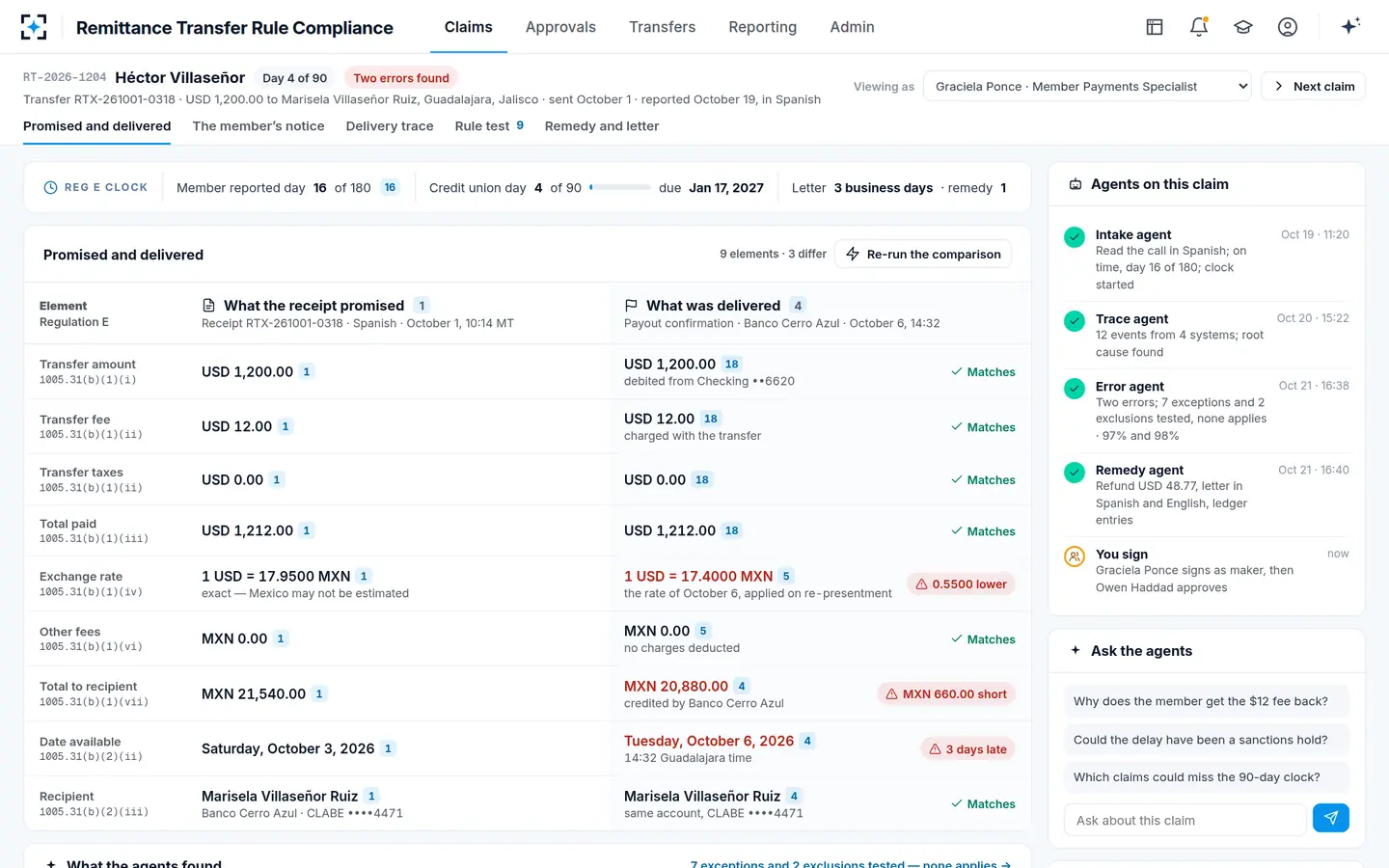
Building the file as the work happens, not after
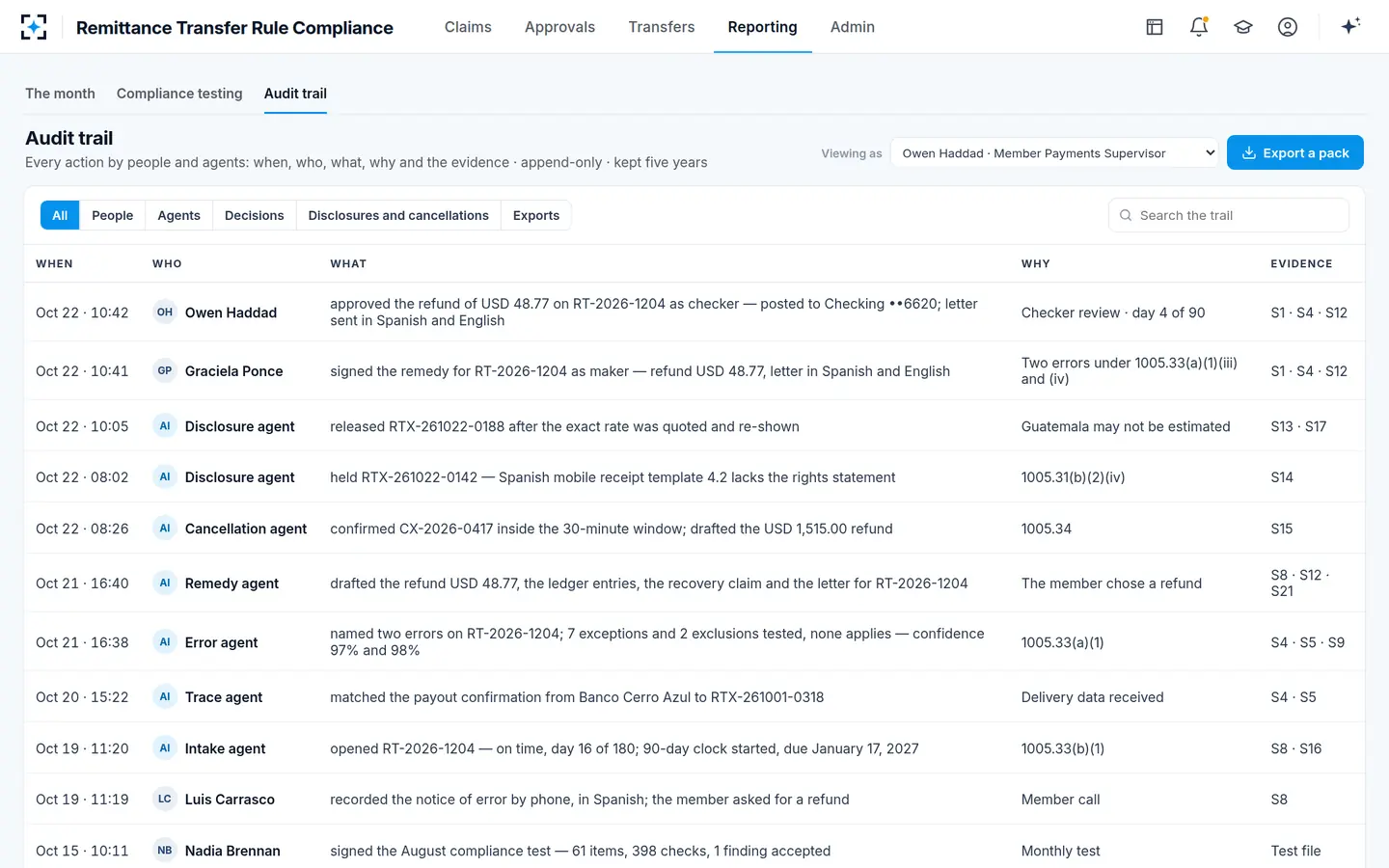
A file assembled at the end of a claim is a reconstruction; one built as the claim moves is evidence. In the solution, the intake agent writes the notice's elements with the line of the call each came from; the trace agent orders every event with its source; the error agent's exception tests sit beside the determination; the remedy agent's arithmetic is shown; the maker's and checker's signatures carry timestamps. Every action by a person or an agent goes on one append-only trail with who, what, when, why and the evidence.
The same trail is what a monthly compliance test re-performs. In the fictional sample credit union's September test, the testing agent re-performed 412 checks on 65 items and proposed two findings, one of them a results letter sent four business days after the determination because no backup checker had been named over Labor Day. The Compliance Officer accepts or rejects each finding with an owner and a date; the agent never accepts its own. A clock missed by a day is found in the month it happened, not at the next examination.
Who decided, when, on what evidence: the trail an examiner pack is cut from
The fee refund on late money is the duty the CFPB has found broken most often, and what a remittance transfer error costs prices it order by order. For the agents that build this file and the limits on each, see where AI agents stop under the Reg E remittance transfer rule.
Questions people ask
What is the default remedy for a remittance error?
One the provider sets in advance and applies if the sender does not choose a remedy within a reasonable time after the report. Allowing 10 days after the report before applying it is deemed reasonable, and the correction is then due within one business day (comment 33(c)-4). A default remedy is not available where the sender's incorrect or insufficient information caused the error.
Does a complaint from the recipient start the 90-day clock?
No. The error-resolution procedures apply only to a notice from the sender, not one from the designated recipient, and not to an error the provider finds and corrects itself (comment 33(b)-1). The provider may still choose to fix the problem, but the rule's clocks start with the sender.
Can a sender reassert an error after it is resolved?
A provider that has fully complied has no further duty if the sender reasserts the same error, unless it follows information the provider gave on a documentation request (1005.33(e)). A sender who withdrew a notice may reassert it within the original 180 days if the provider had not already completed the process.
Does the 90-day clock stop while the correspondent investigates?
No. Section 1005.33(c)(1) requires the determination within 90 days of the notice and provides no extension for third parties. The provider is liable for its agents' acts, and the interpretation says the remedies apply regardless of any agreement with the institution that makes the funds available.
How long must a remittance provider keep error files?
At least two years from the date the notice was submitted or action was required (1005.13(b)(1); comment 33(g)-1), and until the matter is finally disposed of if the provider knows it is under investigation or an enforcement proceeding (1005.13(b)(2)). Many institutions keep them longer under their own policies.