The Wise CFPB consent order, signed on 30 January 2025 and amended on 15 May 2025, found among other things that Wise US treated a transfer's arrival at the recipient's bank as delivery and did not refund its fees when the money reached people after the date on the receipt; the amendment cut the penalty from $2.025 million to $44,955 and kept about $450,000 of redress (CFPB, May 2025). Wise is the latest provider the CFPB has found in breach of the remittance transfer rule, Subpart B of Regulation E, and the Bureau's public record since 2020 has one thread running through it: in every order, against Trans-Fast and Sigue in August 2020, La Nacional in December 2020, Servicio UniTeller in December 2022 and Wise in 2025, the Bureau found that the provider failed to refund its fees when a transfer did not arrive by the date on the receipt, a duty in 12 CFR 1005.33(c)(2)(ii)(B). The orders differ in everything else: size, disclosures, cancellations, records. The shared failure says where a provider's procedures break: at the one remedy that depends on a date nobody at the provider set. Botminds' Remittance Transfer Rule Compliance computes that refund from the error type on every claim; this casebook shows why that is the place to start.
Five orders, one duty
5 of 5
CFPB remittance orders since 2020 that found late-delivery fee refunds not paid
$3.4M
in civil money penalties across the five orders, as finally set ($3,394,955)
2013
year the rule took effect; most orders reach back to it
What is the CFPB remittance transfer rule?
It is the set of consumer protections for international money transfers that Congress added to the Electronic Fund Transfer Act as section 919 in 2010 and the CFPB implemented in 12 CFR 1005.30 to 1005.36, effective 28 October 2013. It requires disclosures before and at payment, a 30-minute cancellation right, an error-resolution process with fixed clocks and remedies, and liability for agents. The CFPB writes the rule and enforces it against money transmitters directly; for banks and credit unions with $10 billion or less in assets, examination for compliance with federal consumer financial law sits with the prudential regulator, and the Bureau "may, at its discretion, include examiners on a sampling basis" (12 U.S.C. 5516(c)). The rule's requirements, number by number, are in the remittance transfer rules cheat sheet.
What remittance cases has the CFPB brought?
Five consent orders between 2020 and 2025 that found violations of the remittance rule, and one lawsuit it later left. All five orders were against companies whose business is sending money abroad; no bank or credit union appears among them. That says more about who the CFPB examines directly than about where the risk sits: the duties are identical for a credit union sending wires.
The CFPB's remittance transfer rule cases, 2020–2025
| Provider and date | What the CFPB found | Penalty | Redress |
|---|---|---|---|
| Trans-Fast Remittance, 31 Aug 2020 | Error-resolution, cancellation and refund failures, including fees kept on late transfers that had arrived; no required policies; about 40 million non-compliant disclosures; deceptive speed claims | $1,600,000 | No amount in the order |
| Sigue and subsidiaries, 31 Aug 2020 | Fees refunded on late transfers only when the sender chose to cancel, not to resend: more than 9,280 instances, 2015–2019; results given only by phone | $300,000 | About $100,000 |
| La Nacional, 21 Dec 2020 | In the CFPB's words, "thousands of violations" since 2013: cancellations not honoured, fees and taxes not refunded on late transfers, bill pay not treated as remittances | $750,000 | Not stated in the CFPB summary |
| Servicio UniTeller, 22 Dec 2022 | No fees or taxes refunded in at least 3,154 late-delivery errors; records could not prove the clocks; "net amount" for "Transfer Amount"; type below eight-point | $700,000 | Not less than $29,664.37 |
| Wise US, 30 Jan 2025, amended 15 May 2025 | Arrival at the recipient's bank treated as delivery; fees not refunded; remedies late; "Paid Out" for "Date Available"; also prepaid card violations | $44,955 (was $2.025 million) | $449,550.99, all violations |
| MoneyGram, sued 21 Apr 2022 | Lawsuit with the New York Attorney General; the CFPB withdrew as plaintiff in April 2025 | None | None |
What is the most common remittance transfer rule violation?
Keeping the fee on a late transfer. Each of the five orders found it, each in a different form, and in each the duty is the same sentence of the regulation: when a provider fails to make funds available by the disclosed date and no exception applies, it must refund the fees it imposed and, where the law allows, the taxes collected, in addition to fixing the amount (1005.33(c)(2)(ii)(B)).
The forms are worth reading closely because each is a plausible procedure. Trans-Fast refunded fees only if the money had not arrived at all. Sigue refunded them only if the sender chose a refund instead of a resend. UniTeller found the errors and then refunded nothing extra. Wise decided some late transfers were not late. A bank or credit union could write any of those into a procedure in good faith.
Late-delivery fee refunds the CFPB found missing, by order
Trans-Fast and Sigue: the refund wired to the wrong condition
The August 2020 orders were the CFPB's first remittance sweep, and both turned partly on the same misreading. Trans-Fast's "practice was to not refund fees to consumers if the transfer was already received, even if the transfer was received after the date disclosed on the receipt," the order states; the rule "required Respondent to refund fees imposed on the transfer if the transfer occurred after the date disclosed, regardless of whether the transfer was ultimately received" (Trans-Fast consent order, paragraph 25). Trans-Fast's order also counted about 40 million non-compliant disclosures since 2013 and found deceptive advertising about the speed of its transfers.
Sigue's error was narrower and more instructive. It refunded the fee when a sender, as the remedy, asked to cancel the transfer, and not when he asked for it to be resent: more than 9,280 times between 2015 and 2019, about $99,945 in fees. Its procedures for telling senders the results were also wrong: from the rule's effective date through at least 2019 it reported results only by telephone, even where the rule required a written explanation. The penalty was $300,000; the redress, about $100,000.
La Nacional and UniTeller: cancellations, bill pay and records that proved nothing
La Nacional sent "$2.2 billion in remittance transfers between November 2016 and April 2018" to Central America, South America, the Caribbean and Africa, and the CFPB found "thousands of violations." It violated the rule "by failing to honor cancellation requests and failing to refund certain fees and taxes when funds were not available on time," and it "has failed to treat international bill pay services as remittance transfers" (CFPB Supervisory Highlights, Issue 24). The penalty was $750,000. Its bill-pay finding is a reminder that the rule follows the transfer, not the product name.
UniTeller, a subsidiary of Grupo Financiero Banorte sending to more than 70 countries, refunded no fees or taxes in at least 3,154 confirmed late-delivery errors from 2018 to at least 2020. The larger part of its order is about evidence: records that did not separate notices of error from complaints, and six kinds of proof it could not produce. The penalty was $700,000 against redress of not less than $29,664.37, the clearest case in the record of a penalty priced on the control, not the harm; the arithmetic is in what a remittance transfer error costs.
Wise: "arrived at the bank" is not "available to the recipient"
Wise's case is the one most relevant to banks, because it concerns how a provider decides whether money was late. When senders said their money had not arrived by the disclosed date, the CFPB found, Wise "failed to investigate the error as alleged, and determined no error occurred because it concluded the remittance arrived at the recipient's bank, even though in some instances the funds were not available to that recipient by the disclosed date of availability" (Wise amended order, paragraph 78). The result was over 1,000 cases in which senders paid fees that were not refunded. A further 351 confirmed late-delivery errors went without the fee refund.
"When people sent money that did not arrive on time, Wise failed to refund the remittance fees in the timeframe required by law."
CFPB, 'CFPB Amends Wise Order for Remittance Practices' (May 2025)
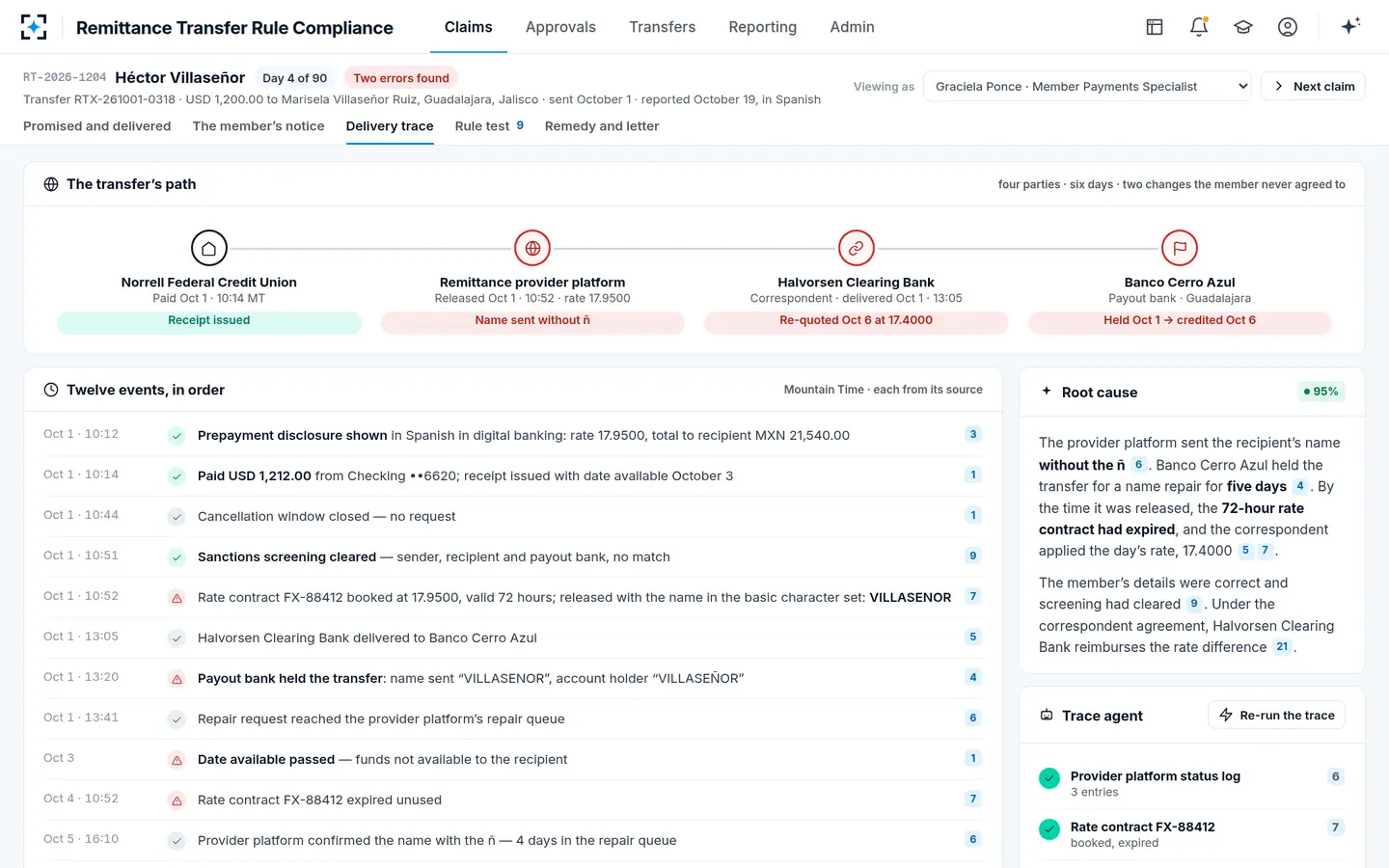
The same order found receipts showing a "Paid Out" date instead of the date available, a requirement that senders produce the recipient's bank statement before a trace, results not reported within three business days or at all, and remedies not applied within one business day in 351 instances. For a bank, whose wire system records when a payment left and when the receiving bank acknowledged it, the lesson is that neither of those dates answers the rule's question. The trace has to reach the recipient.
A delivery trace that follows the money to the recipient, not just to the receiving bank
What happened in the CFPB MoneyGram case?
The CFPB and the New York Attorney General sued MoneyGram International and MoneyGram Payment Systems on 21 April 2022, alleging violations of the Electronic Fund Transfer Act, the remittance rule and the Consumer Financial Protection Act; the complaint was amended in July 2022 and January 2025. Then, in the Bureau's words, "On April 7, 2025, the Bureau filed a consent motion to withdraw as a plaintiff, which the court granted on April 8, 2025" (CFPB, MoneyGram enforcement page).
MoneyGram is therefore not a penalty case for the CFPB, and should not be cited as one. The Bureau's page does not say what became of the New York Attorney General's claims, and we have not checked the court record; anyone relying on the case should.
Is the CFPB still enforcing the remittance transfer rule?
The rule is unchanged and the Wise order of May 2025 still found violations and kept its redress, but the Bureau's posture shifted in 2025. On 12 May 2025 it withdrew a long list of guidance, including its 2012 bulletin on implementing the remittance rule, its April 2020 statement on remittance enforcement during the pandemic, and Circular 2024-02 on "deceptive marketing practices about the speed or cost of sending a remittance transfer," saying the withdrawn guidance "should not be enforced or otherwise relied upon by the Bureau while this review is ongoing" (90 FR 20084). Three days later it cut Wise's penalty from $2.025 million to $44,955. In August 2025 it asked for comment on raising the threshold for supervising non-bank international money transfer providers, now "at least one million aggregate annual international money transfers" (90 FR 38412).
None of that changes a bank's or credit union's obligations. The regulation's text, the official interpretations and the error clocks are as they were; prudential regulators examine smaller institutions against them; and a sender can still complain. The safer reading of 2025 is that the Bureau narrowed its own guidance and penalties, not that the rule's duties went away.
What changed at the CFPB in 2025, and what did not
| Date | Change | What it does not change |
|---|---|---|
| 7–8 April 2025 | CFPB withdraws as plaintiff in the MoneyGram suit | The New York Attorney General's status is not stated by the CFPB |
| 12 May 2025 | Withdrawal of guidance including Bulletin 2012-08, the April 2020 remittance statement and Circular 2024-02 | Regulation E, Subpart B and its official interpretations |
| 15 May 2025 | Wise penalty amended from $2.025 million to $44,955 | The findings, the redress and the compliance requirements |
| 8 August 2025 | Advance notice on raising the larger-participant threshold for international money transfers | Coverage of the remittance rule itself; banks are not larger participants |
Lessons for a bank or credit union
Write the fee refund against the error type, not the remedy. Decide "late" by when the recipient could use the money, not when a bank received it. Keep evidence of every clock on every claim, and make the results letter carry the right to documents. Check every receipt's terms against the rule's, in each language. And test the late-delivery refunds every month, because every order above found them missing for years before anyone outside the provider noticed.
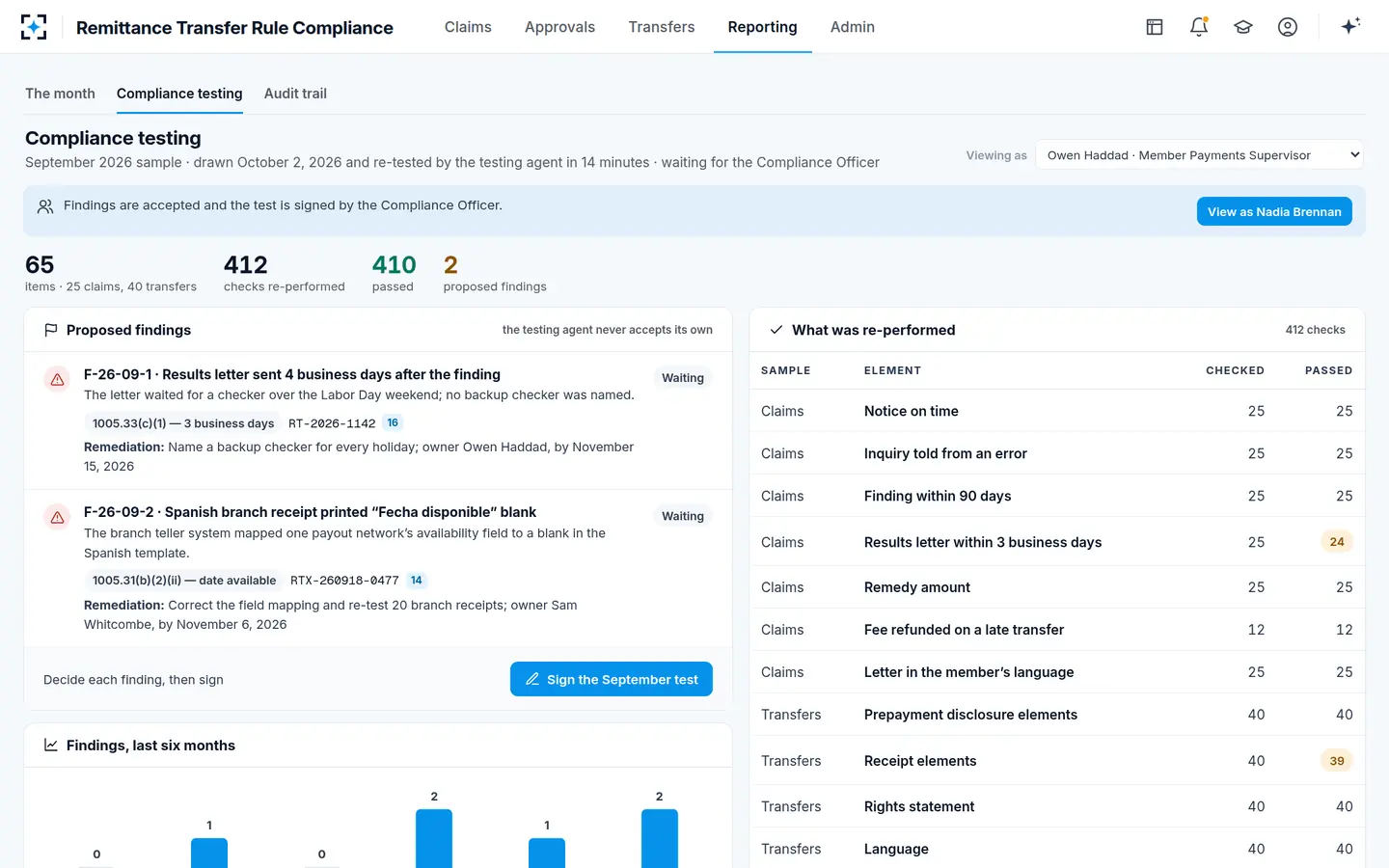
The solution is built around those lessons: the error agent tests "late" against the payout evidence, the remedy agent computes the fee refund from the error type, a checker approves every refund, and the testing agent re-performs each late-delivery claim in the monthly sample. In the fictional sample credit union's September test, it re-performed 412 checks and proposed two findings, each with an owner and a date for the fix.
The monthly test re-performed element by element, including the fee refund on every late transfer
Questions people ask
How large are CFPB remittance penalties?
From $44,955 (Wise, as amended in 2025) to $1.6 million (Trans-Fast, 2020) in the orders since 2020, with La Nacional at $750,000, UniTeller at $700,000 and Sigue at $300,000. Redress to consumers is separate and was ordered in three of the five.
What did the CFPB find against Wise?
Among other things, that Wise treated arrival at the recipient's bank as delivery, leaving over 1,000 cases in which fees were not refunded; that it did not refund fees in 351 confirmed late-delivery errors; that its receipts showed a "Paid Out" date instead of the date available; and that it required the recipient's bank statement before starting a trace. The amended order of 15 May 2025 requires about $450,000 in redress for all violations and a $44,955 penalty.
Has the CFPB brought a remittance case against a bank?
Not among the remittance orders reviewed here, all of which were against non-bank providers whose business is international money transfer. Banks and credit unions with $10 billion or less in assets are examined for compliance with federal consumer financial law by their prudential regulators, with the CFPB able to join on a sampling basis.
Does the CFPB's 2025 guidance withdrawal affect the remittance rule?
It withdrew guidance documents about the rule, including the 2012 implementation bulletin and Circular 2024-02, not the regulation or its official interpretations in Supplement I. The Bureau said the withdrawal "is not necessarily final" while it continues its review.
How far back do remittance enforcement findings reach?
To the rule's effective date in October 2013 in several orders: Trans-Fast's disclosures and La Nacional's violations were counted from 2013, and Sigue's results-by-phone practice ran from the effective date through at least 2019.