A remittance transfer rules cheat sheet comes down to a dozen numbers in Subpart B of Regulation E, 12 CFR 1005.30 to 1005.36: transfers of $15 or less are excluded; 500 transfers a year is the safe harbor; 1,000 transfers to a country ends an insured institution's right to estimate the exchange rate there; 30 minutes to cancel and three business days to refund; 180 days for the sender to report an error, 90 for the provider to determine it, three business days to report and one to fix it; two years to keep the evidence; eight-point type on written disclosures. Each number is a duty, each duty needs a check that proves it was met, and each check needs an owner. Going live means wiring all three together before the first transfer, which is the job Botminds' Remittance Transfer Rule Compliance is built to support: agents run the checks on every transfer and every claim, and named people own the decisions.
The remittance transfer rules in seven numbers
$15
or less: excluded from the definition of a remittance transfer
500
transfers a year or fewer, in both years: outside the rule
30 min
after payment: the sender may cancel
180 / 90
days for the sender to report an error; days for the provider to determine it
What is the remittance rule?
It is the set of consumer protections Congress added to the Electronic Fund Transfer Act in 2010 for money sent abroad, which the CFPB implemented in Subpart B of Regulation E, effective 28 October 2013 and last amended by a rule published on 5 June 2020. It applies to a remittance transfer provider: any person, bank, credit union or money transmitter, that sends electronic transfers abroad for consumers in the normal course of business. It gives the sender a price and a date in advance, a right to cancel, and a right to have errors investigated and fixed, and it makes the provider answer for its agents. Whether a particular transfer is covered is a five-question test, set out in are international wires covered under Reg E.
The remittance transfer rules on one page
Read the table by row: what the rule requires, the number in it, the check that proves you met it, and who usually owns the check at a bank or credit union. The owners are a common pattern, not a regulatory assignment; the regulation requires only that the provider maintain written error-resolution policies and procedures and keep evidence of compliance.
The remittance transfer rules cheat sheet: duty, number, check and owner
| Duty | Number | Rule | The check that proves it | Usual owner |
|---|---|---|---|---|
| Prepayment disclosure before the sender pays | 8 elements, set terms | 1005.31(b)(1), (e)(1) | Every disclosure checked for each element and term, in each language, before payment | Operations; compliance approves templates |
| Receipt at payment | Adds date available, recipient, rights, contacts | 1005.31(b)(2), (e)(2) | Every receipt checked before release; "Date Available" a single date, not a range | Operations |
| Format | 8-point minimum, front of page, grouped, segregated | 1005.31(c) | Template review at each change; a rendered sample per channel | Compliance, with digital banking |
| Foreign language | Each language principally used to market at the office | 1005.31(g) | A list of offices and channels with their marketing languages; disclosures and letters to match | Compliance and marketing |
| Estimates | Only where 1005.32 allows; insured institutions: 1,000 or fewer transfers to the country last year | 1005.32(b)(4) | Country counts kept by year; estimates blocked above the line | Compliance |
| Cancellation | 30 minutes; refund in 3 business days | 1005.34 | Each window watched; each request logged with its time; refunds include fees and taxes | Operations; a checker approves |
| Scheduled transfers | Cancel 3 business days before; disclosures for each future transfer | 1005.36 | Scheduled dates and cut-offs tracked per transfer | Operations |
| Notice of error | 180 days after the date available | 1005.33(b) | Every complaint screened: inquiry, notice of error or neither; the day of 180 recorded | Contact center and operations |
| Determination and report | 90 days; 3 business days | 1005.33(c)(1), (d) | Clock on every claim; written explanation where no or different error | Operations specialist |
| Remedy | 1 business day; fees and taxes refunded if late | 1005.33(c)(2) | Remedy computed from the error type; approval by a second person | Specialist and supervisor |
| Policies and evidence | Written procedures; at least 2 years | 1005.33(g), 1005.13(b) | Notices, sender documents and findings retained and retrievable by claim | Compliance |
| Agents | Provider liable for agents | 1005.35 | Agent agreements, training and monitoring | Compliance and vendor management |
What are the remittance transfer rule requirements for disclosures?
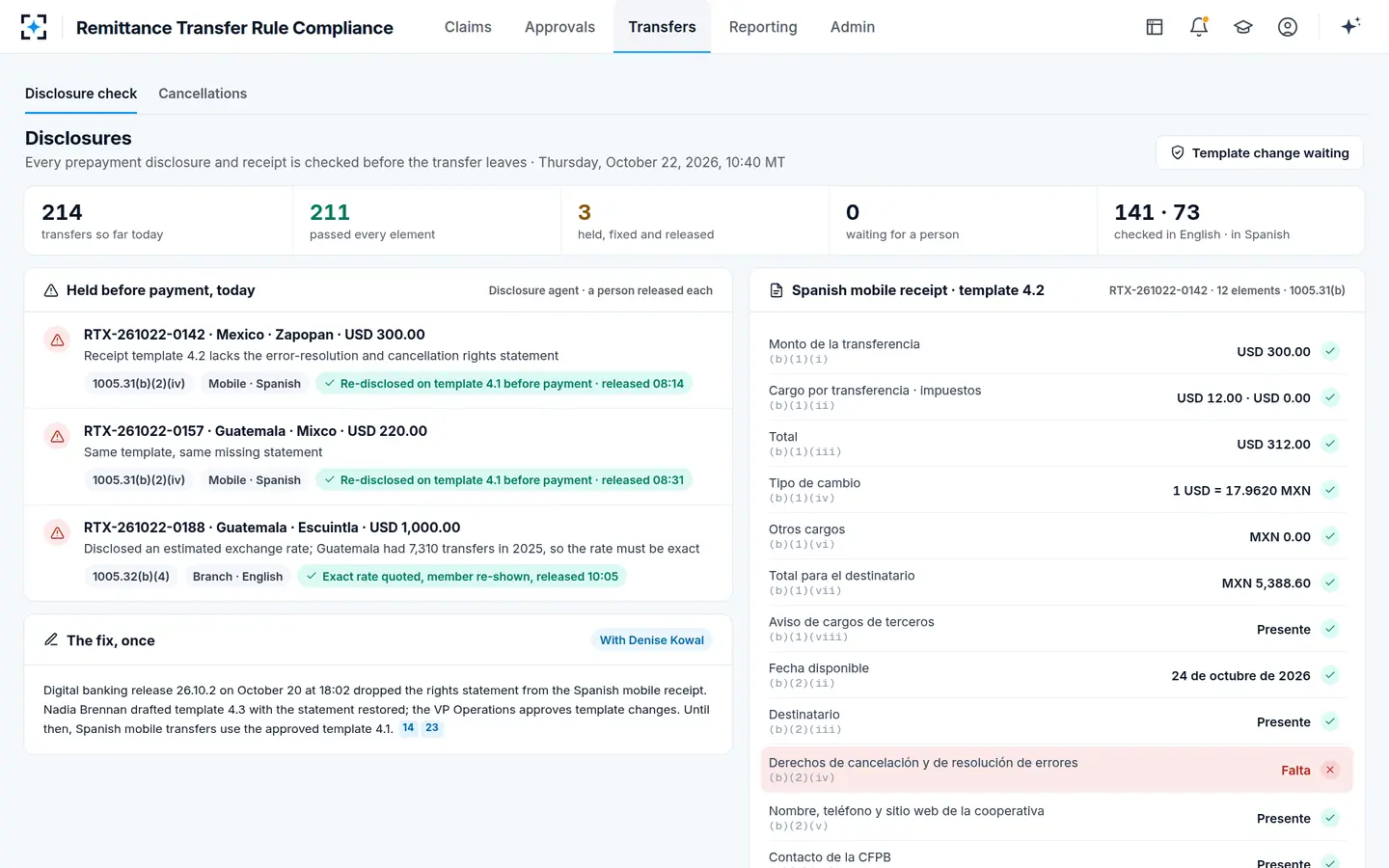
Two documents, one before payment and one at payment, with exact terms. The prepayment disclosure gives the transfer amount, transfer fees and transfer taxes, the total, the exchange rate rounded consistently to two to four decimal places, any covered third-party fees as "Other Fees," the "Total to Recipient," and a warning where the recipient's bank or a foreign government may take more. The receipt repeats them and adds the "Date Available," the recipient, a statement of the sender's error and cancellation rights, the provider's name, telephone and website, and the contacts for its State regulator and the CFPB (1005.31(b)). Disclosures must be accurate when the sender pays; if anything changed, new disclosures come before payment. The element-by-element version is remittance transfer disclosure requirements.
What are the remittance transfer rule requirements for errors and cancellations?
For cancellation, a request received within 30 minutes of payment, oral or written, must be honoured if the money has not been picked up or deposited, with a full refund including fees and, where the law allows, taxes within three business days (1005.34). A provider may allow longer (comment 34(a)-3). For a transfer scheduled at least three business days ahead, the request must arrive at least three business days before the transfer date instead (1005.36(c)).
For errors, the sender has 180 days from the disclosed date available; the provider has 90 days from the notice to determine whether an error occurred, three business days to report and one business day from the sender's instruction to correct it (1005.33). On a late transfer the fees, and taxes where the law allows, come back whichever remedy the sender chooses. That last point is the one most often missed. Sigue, the CFPB found, had "no written policies and procedures on the appropriate remedies for correcting 'errors'" from the rule's effective date to at least 2019 (Sigue consent order, paragraph 28).
What do examiners ask for in a remittance exam?
A document list that doubles as a go-live inventory. The CFPB's remittance examination procedures start by asking for, among other things, a "List of divisions or departments involved in offering or providing remittance transfers," "Disclosure forms in all languages (as applicable)," a "List of foreign countries to which the provider sends remittance transfers," a list of "all third-party service providers or business partners involved in remittance transfers, including correspondent banks, payment networks, payment processors, software providers, foreign currency providers, agents," "Error resolution files," "Form letters used in case of errors or questions concerning a remittance transfer (including any provided in foreign languages)," any agreements that divide compliance duties with third parties, and "Consumer Complaint Files" (CFPB remittance examination procedures).
The same procedures set the threshold for bothering: "Only entities that provide more than 500 remittance transfers in the relevant time frame should be examined for compliance with the remittance transfer rules." And they test training, which must cover "the sections of Regulation E that apply to the individual entity's product offerings and operations including, to the extent appropriate, those functions carried out by third-party service providers or other business partners, such as agents and correspondent banks." If an institution cannot produce the list above in a day, it is not ready to go live, and it is not ready for an exam.
How do you implement the remittance transfer rule?
Start from the inventory, not the software. Every channel that can send a consumer transfer abroad, branch, digital banking, mobile, telephone and online bill pay, produces its own disclosures, and each must carry every element. Every office and channel has its own marketing languages. Every correspondent and payout partner holds evidence the error process needs. Then map each row of the cheat sheet to a check and an owner, configure the checks, and test them on cases built to fail before any live transfer depends on them.
Going live on the remittance transfer rules: eight steps in order
- Count your transfers
By year, to confirm you are above the 500 safe harbor, and by country, to know where estimates are allowed.
- List every channel and template
Branch, digital, mobile, phone, bill pay; each disclosure and receipt template, with its version and language.
- List languages by office and channel
Each foreign language principally used to advertise remittances where the sender transacts or asserts an error.
- List partners and what each holds
Platform status logs, rate contracts, correspondent messages, payout confirmations; who answers a trace and how fast.
- Write the procedures the rule requires
Error resolution, including how complaints from branches and agents are identified as notices of error; retention.
- Name the owners and the second approvers
Who determines errors, who approves money and letters, who approves template changes.
- Configure the checks and the clocks
Disclosure elements per template, cancellation windows, the 180/90/3/1 clocks, escalation days.
- Test on cases built to fail, then run in parallel
The test set below, then a period where the checks run beside the current process and every difference is explained.
What should be tested before go-live?
The failures regulators have found, and the boundaries the rule draws in minutes and days. A test set that passes only clean transfers proves nothing; each case below should be built so that a wrong configuration produces a wrong answer that someone sees.
Ten test cases to run before the first live remittance transfer
| Test case | Expected result | Why it matters |
|---|---|---|
| Spanish mobile receipt with the rights statement removed | Held before payment; re-disclosed on an approved template | A template release can drop an element from every receipt |
| Estimated rate on a transfer to a country with more than 1,000 transfers last year | Held; exact rate required | 1005.32(b)(4) allows estimates only at or under 1,000 |
| Cancellation request at 29 minutes; another at 31 | First honoured with fees; second declined with a letter | The 30-minute boundary, measured from payment |
| Cancellation after the payout bank deposited the funds | Declined, citing the deposit time | 1005.34(a)(2) |
| Late transfer; sender chooses a resend | Resend at the receipt's rate plus refund of all fees | The Sigue failure |
| Late transfer; an intermediary deducted a lifting fee | Third-party fee refunded too | Comment 33(c)-8 |
| "Where is my money?" call two days after the date available | Treated as a notice of error; 90-day clock starts | 1005.33(a)(2)(i) |
| No error found on an estimate the law allows | Written explanation with the right to documents | 1005.33(d)(1) |
| Transfer scheduled four business days ahead; cancel two days before | Declined under the scheduled-transfer cut-off | 1005.36(c) |
| Results letter due over a holiday weekend | Backup checker named; letter inside 3 business days | Business days are the provider's own |
Remittance transfer disclosure requirements checked before release, in English and Spanish
Who owns remittance compliance?
The board and senior management own the program; a compliance officer owns the policies, the testing and the templates; operations owns each claim and each window. The examination procedures assess whether the compliance audit reaches every key process, including the ones third parties and partners run (the Reg E audit checklist quotes the same test), whether management has "taken corrective actions to follow up on previously identified deficiencies," and whether "significant deficiencies and their causes are included in reports to management and/or to the board of directors."
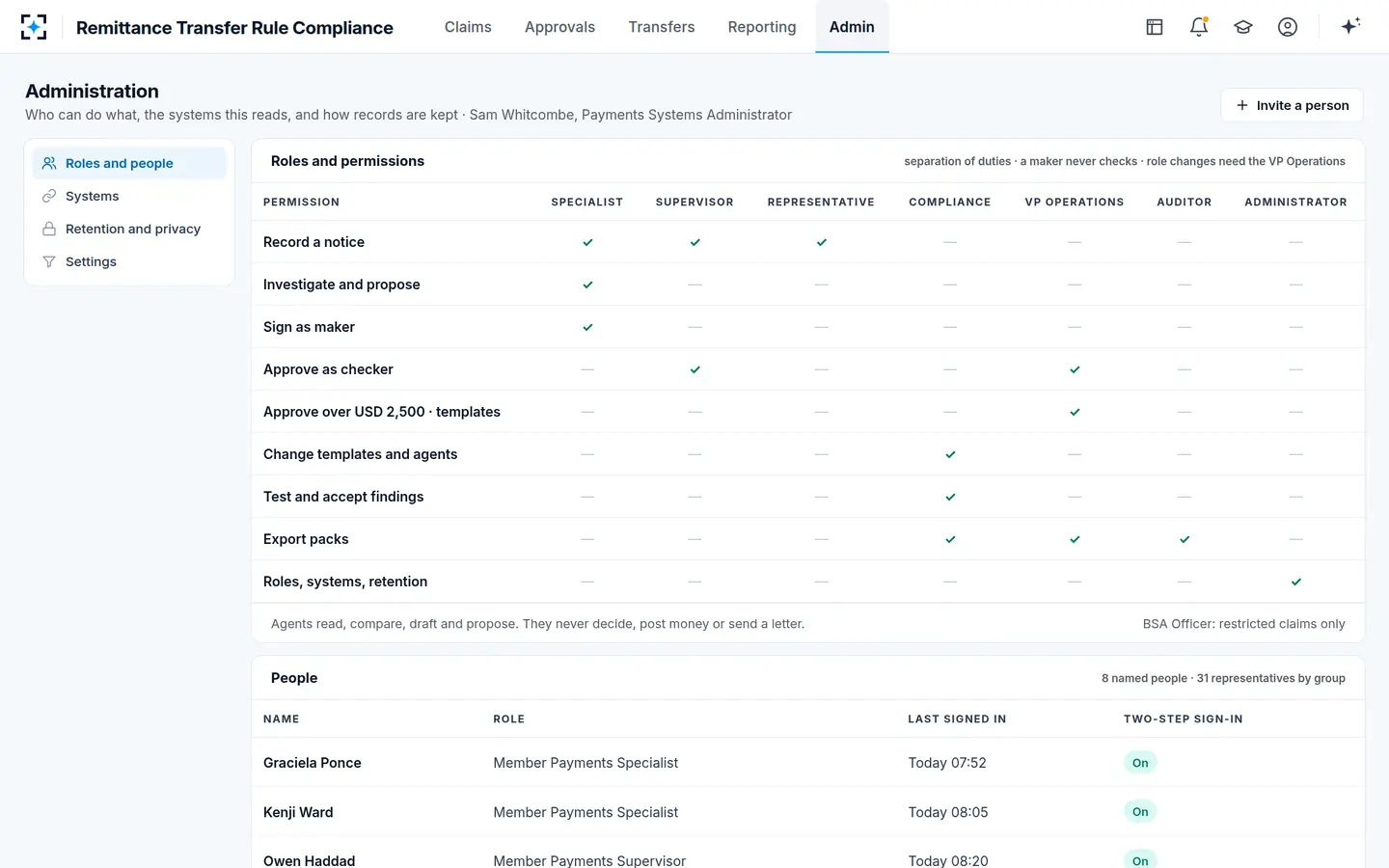
Inside operations, the division that holds up best separates the person who decides from the person who approves money and letters. In the fictional sample credit union, a specialist determines each error and signs as maker, a supervisor approves as checker and never his own work, the VP Operations approves refunds above USD 2,500 and every template change, and the compliance officer accepts or rejects each finding of the monthly test before signing it.
Who can make, check and change what: separation of duties written into roles
Where Remittance Transfer Rule Compliance fits in a go-live
It turns most rows of the cheat sheet into checks that run on every transfer and every claim: disclosure elements before payment, cancellation windows, the 180/90/3/1 clocks, the remedy arithmetic, the monthly re-test. It reads the institution's own templates, procedures, correspondent agreements and past claims to configure them, and its settings, such as escalation days, approval limits and the error agent's confidence floor, are proposed and approved before they take effect. What it leaves to the institution are the rows that need authority: approving templates and languages, deciding errors, approving money, overseeing agents and correspondents, and reporting to the board.
A sensible pilot runs it on last year's claims and a recent month of receipts first, and compares what it finds with what the institution's own testing found. To see that on a sample, start from Remittance Transfer Rule Compliance; the line between what the agents do and what people decide is drawn section by section in where AI agents stop under the Reg E remittance transfer rule.
Questions people ask
What are the CFPB remittance transfer rule requirements in brief?
Disclose the price, the rate and the date before and at payment; let the sender cancel within 30 minutes; investigate errors reported within 180 days, determine them within 90, report within three business days and fix them within one; refund fees on late transfers; keep evidence for two years; answer for agents. Each is in 12 CFR 1005.31 to 1005.36.
Does the remittance rule apply to business transfers?
No. A sender is a consumer requesting a transfer primarily for personal, family or household purposes, and a transfer from an account established as a business or commercial account is not covered (comment 30(g)-3).
How long must remittance records be kept?
Evidence of compliance, including error investigation documents, for not less than two years from the date the disclosure was required or action was required to be taken (1005.13(b)(1)). A provider need not keep each individual disclosure, only evidence that its procedures reasonably ensure senders receive them (comment 33(g)-1).
Can a provider give the sender longer than 30 minutes to cancel?
Yes. The interpretation says the provider "may, at its option, provide a longer time period for cancellation," and must honour the 30 minutes regardless of its business hours (comment 34(a)-3). An institution that closes at five may stop accepting payment for transfers at 4:30.
What changed in the remittance rule in 2020?
The safe harbor rose from 100 to 500 transfers a year, effective 21 July 2020, and two permanent exceptions let insured institutions estimate the exchange rate and certain third-party fees in limited cases, replacing a temporary exception that expired that day. Subpart B has not been amended since.