The Reg E remittance transfer rule is Subpart B of Regulation E, 12 CFR 1005.30 to 1005.36. It requires a bank, credit union or money transmitter that sends consumers' international transfers in the normal course of business to give a prepayment disclosure and a receipt with set elements, to honour a cancellation made within 30 minutes of payment, to investigate a notice of error and determine within 90 days whether an error occurred, to apply fixed remedies, and to answer for its agents. A large part of that is mechanical, and AI agents can do it on every transfer rather than on a sample: checking each receipt for each element, counting the clocks, tracing the money, computing a refund. The determination that an error occurred, the money that posts and the letter that goes out should stay with people who sign for them. Botminds' Remittance Transfer Rule Compliance is built on that division, and the rest of this guide shows where it falls in each section.
The Reg E remittance transfer rule in six sections, and how much of each is mechanical
| Section | What it requires | Mechanical: agents can do it | Judgement: a person decides |
|---|---|---|---|
| 1005.30 Definitions | Who is a provider and which transfers count: consumer sender, foreign recipient, over $15, more than 500 a year | Counting transfers by year and by country; flagging business accounts and small-value transfers | Whether a borderline transfer is personal or commercial; when the institution is in the normal course of business |
| 1005.31 Disclosures | Prepayment disclosure and receipt, set terms, format, timing, languages | Checking every element on every receipt in every language before payment | Approving a template and its translation; releasing a held transfer |
| 1005.32 Estimates | When a rate, fee or amount may be estimated, and on what basis | Applying the country counts and the account test to each transfer | Whether the provider truly cannot determine the exact rate |
| 1005.33 Errors | Notice within 180 days; determination within 90; results in 3 business days; remedy in 1 | Reading the notice, starting the clock, tracing, comparing promised with delivered, testing exceptions, computing the remedy, drafting letters | Whether an error occurred; signing the remedy and the letter |
| 1005.34 Cancellation | 30-minute right; full refund in 3 business days | Watching the window; checking pickup or deposit; drafting the refund | Approving the refund; declining a late request |
| 1005.35 and 1005.36 | Liability for agents; transfers scheduled in advance | Tracking scheduled dates and the three-business-day cancellation cut-off | Overseeing agents and correspondents |
What does the Reg E remittance transfer rule require?
The rule requires two disclosures, two rights and a liability. Before the sender pays, a prepayment disclosure states the transfer amount, fees and taxes, total, exchange rate, any covered third-party fees and the total to recipient; at payment, a receipt repeats them and adds the date available, the recipient, a statement of the sender's error and cancellation rights, the provider's contact details and those of its State regulator and the CFPB (1005.31(b)). The sender may cancel within 30 minutes of payment if the money has not been picked up or deposited, and gets everything back within three business days (1005.34).
The error right is the heavy one. Five things count as errors, from an incorrect amount paid to money that did not arrive by the date on the receipt; a sender has 180 days from that date to give notice; the provider must "investigate promptly and determine whether an error occurred within 90 days," report within three business days and correct the error within one business day of the sender's choice of remedy (1005.33). Section 1005.35 makes the provider liable for its agents. The full set of numbers sits on one page in the remittance transfer rules cheat sheet.
Can remittance compliance be automated?
The checks can, and on volumes where sampling misses things, they should be. A receipt either carries "Date Available" and the rights statement or it does not; a notice arrived on day 16 or day 190; MXN 660.00 at 17.9500 is USD 36.77. None of that needs judgement, and all of it has gone wrong in the CFPB's orders: more than 1,000 versions of one provider's disclosure templates printed required terms below eight-point type, and another disclosed exchange rates to six decimal places where the rule allows two to four.
No regulator has written a rule about AI in remittance compliance, and none has endorsed it. What exists is general. Treasury recommends that firms check each AI use against existing law before they deploy it (Treasury, AI in Financial Services, December 2024; how to use AI for regulatory compliance on wires quotes Treasury and the agencies). The 2026 interagency model risk guidance excludes deterministic, rule-based software from what it calls a model, and places generative and agentic AI outside its scope pending further work (SR 26-2). The regulators' own practice is the clearest signal.
"They said they were not using AI to make decisions autonomously or relying on it as a sole source of input."
U.S. Government Accountability Office, GAO-25-107197 (May 2025), on how financial regulators use AI
That is a sensible standard for a provider as well: agents gather, compare and propose; a person who can be named decides. The remaining sections apply it to each duty.
Section by section: what each agent does, and the line it does not cross
A useful way to evaluate any remittance compliance tool is to ask, for each duty, what the software does on its own and what it is never allowed to do. The table sets out how Botminds' solution answers, agent by agent. The limits are not settings a user can relax; they are how the agents are built.
Seven agents in Remittance Transfer Rule Compliance, the section each serves, and what each never does
| Agent | Rule | What it does | What it never does |
|---|---|---|---|
| Intake | 1005.33(a)–(b) | Reads a call, message or branch form in English or Spanish; extracts the notice elements; checks timeliness; tells an inquiry from a notice of error; records the chosen remedy; starts the 90-day clock | Decides that an error occurred, or tells a member a result |
| Disclosure | 1005.31, 1005.32 | Checks every prepayment disclosure and receipt for every element, and whether an estimate is allowed for the country, before the transfer leaves | Changes a template or releases a held transfer |
| Trace | 1005.33(c)(1) | Follows the transfer through platform, correspondent and payout bank; orders every event with its source; names the root cause | Guesses a missing event, or contacts the recipient |
| Error | 1005.33(a)(1) | Lays the receipt beside the delivery, names each difference as an error type, tests every exception and exclusion on evidence | Finds "no error" on an exception without evidence; proposes below its confidence floor |
| Remedy | 1005.33(c)(2), (d) | Computes the refund or resend, fees included on a late transfer; drafts the letter; prepares core and general ledger entries and the correspondent recovery claim | Posts money or sends a letter |
| Cancellation | 1005.34, 1005.36(c) | Watches each 30-minute window, checks pickup or deposit, drafts the refund or a decline letter | Declines a request made inside the window; refunds without a checker |
| Testing | 1005.33(g), 1005.13 | Draws the monthly sample, re-performs every element, writes failures as proposed findings | Accepts its own finding |
Who decides a remittance error?
The provider decides, and a provider acts through people. The regulation puts the determination on the provider, "determine whether an error occurred," and the consequences of a wrong one are the provider's: a "no error" finding needs a written explanation that addresses "the specific complaint of the sender" and notes his right to the documents relied on (1005.33(d)(1)). An agent can assemble that evidence; it should not be the one that concludes there is nothing to refund.
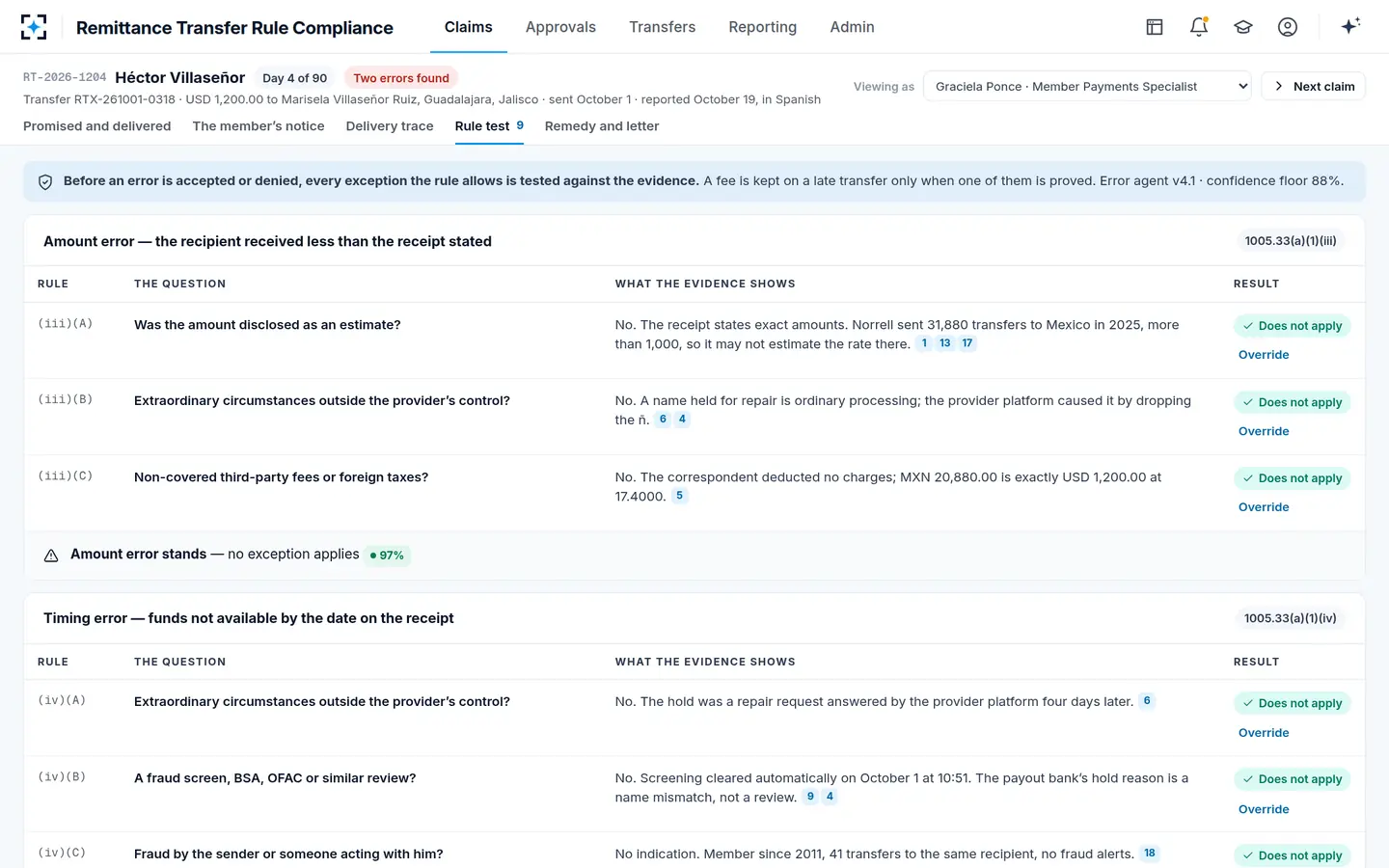
The exceptions are where an automated "no error" would do the most harm, because each one takes money away from the sender. Extraordinary circumstances, a fraud or sanctions review, sender fraud, a wrong account number: every one has conditions. The sanctions exception, for instance, applies only to a delay the provider could not have foreseen when it issued the receipt and set the date (comment 33(a)-7). In the solution, each exception is tested and shown with its evidence, and an override needs a reason code; the specialist signs the determination.
Every exception tested on evidence before an error stands or falls
Can a remittance refund be automated?
The calculation can; the payment should not post without a second person. The remedy is a formula the rule writes: for a late transfer, fix the amount by refund or redelivery and refund the fees and, where the law allows, the taxes (1005.33(c)(2)(ii)). A redelivery must use "the same exchange rate, fees, and taxes stated in the disclosure" (comment 33(c)-3). Getting the arithmetic right on every claim is exactly what software is for.
The risk in automating the posting is speed without control. The rule gives one business day after the sender's instruction, and the CFPB counted 351 instances in which Wise missed that requirement after properly designating complaints as errors (Wise US amended consent order, 2025). A one-day deadline argues for a queue that a checker clears daily, with the evidence attached, rather than for a payment that releases itself.
One remittance error claim: agents prepare, people decide and sign
Agent
Intake agentReads the notice, checks the 180 days, tells inquiry from error, starts the 90-day clock
Never: Decides an error
Agent
Trace agentOrders every event from platform, correspondent and payout bank, with its source
Never: Guesses a missing event
Agent
Error agentCompares promised with delivered; tests every exception on evidence
Never: Concludes without evidence
A person decides
Member Payments SpecialistDetermines whether an error occurred; chooses the finding; signs as maker
Agent
Remedy agentComputes the refund or resend; drafts the letter; prepares the entries
Never: Posts money or sends a letter
A person decides
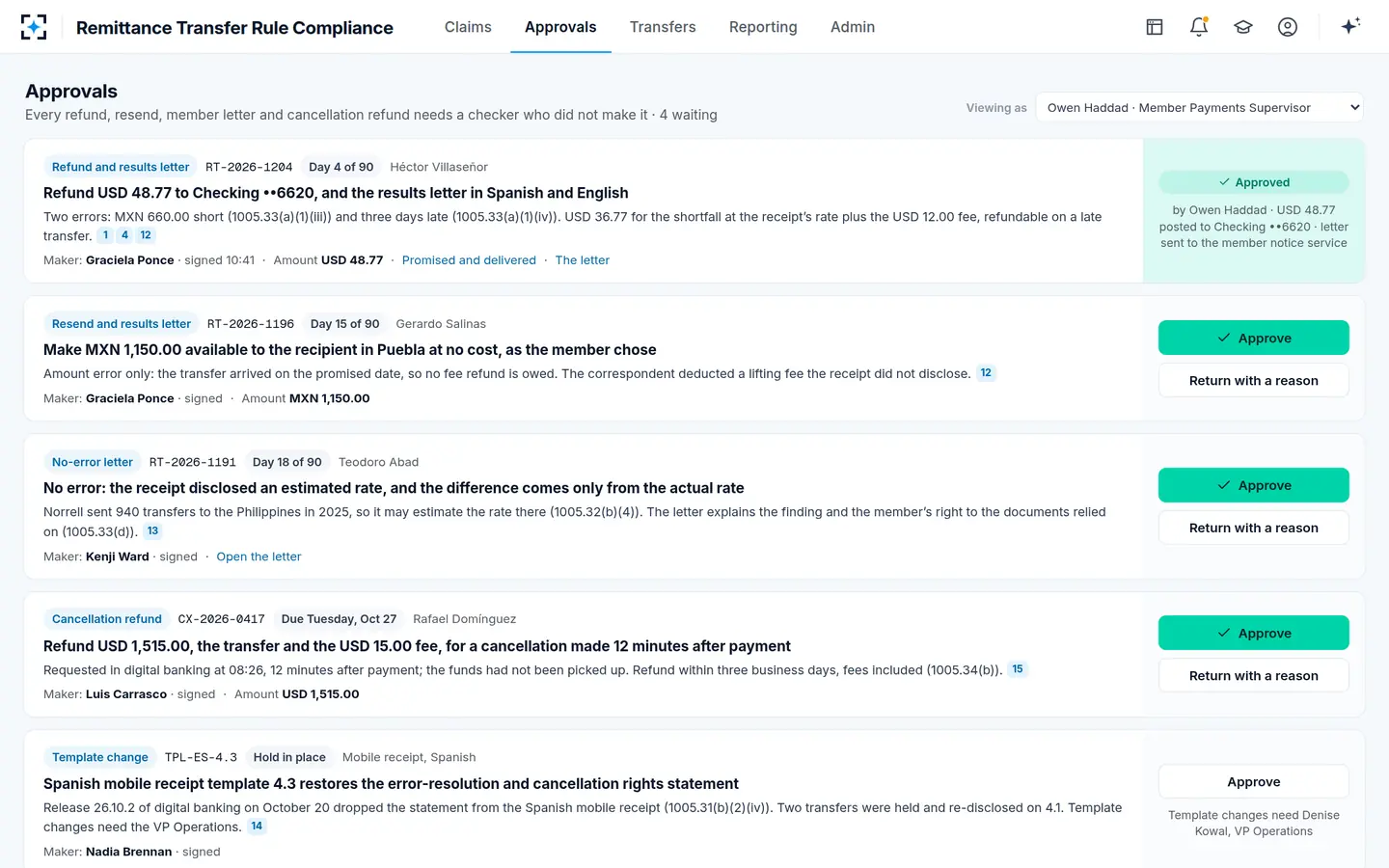
Member Payments SupervisorApproves or returns with a reason; never a refund he made
How do you handle a 30-minute cancellation?
You watch every transfer's window from the moment of payment and decide each request on two questions: was it received within 30 minutes, and had the money been picked up or deposited? A request is valid if it lets the provider identify the sender and the transfer, orally or in writing; a confirmation number will do (comment 34(a)-1). The window runs regardless of business hours, and a request given to an agent counts when the agent receives it.
The failure to design against is the late decline of a timely request. In the solution, the cancellation agent may draft a decline only for a request outside the window or after pickup, citing the time and the payout bank's deposit; it may never decline one made inside the window, and every refund, the transfer amount plus fees and, where the law allows, taxes, waits for a checker. Transfers scheduled at least three business days ahead follow a different cut-off: the request must arrive at least three business days before the transfer date (1005.36(c)).
What must stay with a person
Four decisions, in our view, should never be made by software alone under this rule. Whether an error occurred, because it takes or gives money and a no-error finding owes the sender a written explanation. Whether money moves, because a wrong refund is as real as a missed one. What a letter says to a sender, because it is the provider's statement of the result and his rights. And what a disclosure template says, because one bad template is wrong on every transfer that uses it.
Everything else, the reading, counting, tracing, comparing and drafting, is work that agents can do faster and more completely than a specialist with a spreadsheet, provided every output shows its source. The CFPB's examination procedures tell examiners to review "relevant error resolution statements/files, consumer complaints, form letters," and to "determine the timeliness and adequacy of remedies the provider uses to address identified errors" (CFPB remittance examination procedures, module 3). A file in which every value opens the document it came from, and every decision names the person who made it, answers those questions directly.
A checker's queue: every refund, resend, letter and template change approved by someone who did not make it
What should remittance compliance software do? Questions to ask before you buy
Buyers should test any tool against the failures the CFPB has actually found, not against a feature list. The questions below come from those orders and from the rule's own clocks.
Nine questions to put to remittance compliance software
- Does it check every receipt before payment, or a sample after?
A template change can drop a required element from every receipt it touches. Ask how many transfers were checked yesterday, and how many were held.
- Does every value open its source?
The receipt, the payout confirmation, the correspondent message, the call. A finding you cannot trace is a finding you cannot defend.
- Does it test each exception on evidence, and show the test?
An automated "no error" without the proof behind it is the most expensive output a tool can give you.
- Does the fee refund on a late transfer depend on the remedy chosen?
It must not. The fee comes back whether the sender takes a refund or a resend.
- Can it post money or send letters on its own?
If it can, ask who approved the last thousand. Maker and checker should be two named people.
- Does it tell a status inquiry from a notice of error?
An inquiry about money past its date is a notice, and its 90-day clock starts on the call.
- Does it handle the languages you market in?
Disclosures and error letters may be owed in the foreign language used to advertise at the office.
- Can you see, change and approve its settings?
Confidence floors, escalation days, approval limits: each should be versioned, approved and on the audit trail.
- What does it keep, and for how long?
Regulation E requires evidence of compliance for at least two years; your own policy may be longer.
Where Remittance Transfer Rule Compliance fits, and where it does not
Botminds' Remittance Transfer Rule Compliance is built for a bank or credit union that is a remittance transfer provider: it reads the systems a transfer already runs through, the remittance platform, correspondent messages, digital banking receipts, contact-center calls, the core and the general ledger, and puts the evidence for each claim and each receipt in one place for the people who decide. The sample configuration covers English and Spanish; other languages are a configuration question for each institution.
It does not send transfers, quote rates or replace the remittance platform, and it does not file the federal remittance excise tax return; where a cash-funded transfer is taxed, the tax shows as an element to check on the receipt and an amount to refund when the rule requires it. A money transmitter running a network of retail agents would need agent oversight that the sample configuration does not include. And no tool can shorten a correspondent's reply: what it can do is ask for the trace on the day of the notice and show the clock on every claim. To see the agents work on a full claim, start from Remittance Transfer Rule Compliance; the defensible file they produce is the subject of remittance transfer error resolution.
Questions people ask
When is the remittance rule applicable?
When a consumer in a State asks a provider to send more than $15 electronically to a recipient at a location in a foreign country, primarily for personal, family or household purposes, and the provider sends such transfers in the normal course of business. Transfers from business accounts are not covered, and a provider with 500 or fewer transfers in both the previous and the current year is outside the rule.
Does AI change who is liable for a remittance error?
No. The provider is liable for violations of Subpart B, including those of its agents (1005.35), whatever tools it uses. Treasury's December 2024 report recommends that firms review AI use cases for compliance with existing laws before deployment and reevaluate periodically.
Can software send the results letter automatically?
The rule allows oral results when the provider finds the error as the sender described it, but a no-error or different-error finding needs a written explanation that addresses the specific complaint and notes the right to documents. Because the letter states the provider's determination, the solution drafts it and a maker and checker sign before it goes.
How fast must a remittance refund be paid?
Within one business day of, or as soon as reasonably practicable after, receiving the sender's instruction on the remedy. If the sender names no remedy, a provider may apply a default one after a reasonable time; allowing 10 days after the report is deemed reasonable (comment 33(c)-4).
Does the remittance rule require a second approver on refunds?
No. It requires written error-resolution policies and procedures and evidence of compliance kept for at least two years. A maker and checker on money and letters is an internal control that makes the timing and the amount provable, which is what examiners test.