Hail damage insurance fraud is a claim for hail damage that did not happen, happened earlier or elsewhere, was made by hand, or is billed for far more than the hail did. After a storm the costliest form is rarely a single homeowner's lie. It is a contractor's: one estimate pasted onto dozens of roofs, squares that were never measured, steep-roof charges on low-pitch homes, and sometimes shingles damaged on purpose. An insurer can seldom prove any of that on one claim before the prompt-pay clock runs, so the decision in front of the SIU is narrower: pay now, or re-inspect first. Botminds' Contractor Fraud Detection finds the clusters and drafts the hold; this guide is about what that hold must contain to survive a regulator, a complaint or a lawsuit.
The standard is set by the claims rules themselves. NAIC's model claims regulation lets an insurer take longer only where there is "a reasonable basis supported by specific information available for review by the insurance regulatory authority" (NAIC Model Regulation 902, §6), and California copies the phrase almost word for word. A hold that holds is one whose file shows that information to a stranger.
What every held hail claim's file needs before the payment run
- The specific information, in writing
Which lines, which quantities, which documents: “34.67 squares billed; aerial report 23.6 squares”, not “estimate looks inflated”.
- Hail at the address, as the estimate it is
The radar-estimated maximum at the home and time, labelled as an estimate built to over-forecast, never as proof of damage or of none.
- Measured against billed
The measurement report for this roof beside the billed tear-off, pitch and storeys.
- The cross-claim evidence
The identical lines across the cluster, and the documents that join any business names, each one openable.
- A booked re-inspection
The hold is a re-inspection with a date, not an open-ended investigation.
- A reason letter, dated inside the clock
To the insured, saying what more is needed and why, sent before the state’s deadline, with the next letter diarised.
- The undisputed part paid
Anything not in question (a tarp invoice, contents) still paid on time.
- Who decided, and who co-signed
A named SIU manager, a second signature for a large hold, and the setting values in force that day.
- The referral date
Where the state requires a fraud report, its due date from the day the suspicion was formed.
What is hail damage insurance fraud? Four kinds, one of them organised
Hail damage insurance fraud comes in four kinds, and they call for different evidence. A homeowner may claim old damage, or damage from another storm, as this one's. A claim may come from a home the hail never reached. Someone may make the damage. And a contractor may bill the insurer for more than the hail did, on one roof or on forty.
The first three are claim-level problems, handled by inspection and, where needed, an examination under oath. The fourth is a pattern problem: each estimate is plausible, and the evidence is in the resemblance between them. It is also the kind most likely to involve many policyholders who did nothing wrong, which is why the response to it needs to protect them as much as the insurer. What an inflated estimate is, and how its cost adds up across a storm, is set out in inflated estimate meaning.
Can you fake hail damage? Yes, and investigators have caught it on camera
Hail damage can be faked, and state investigators have built cases by watching it happen. In late 2025 the North Carolina Department of Insurance and an insurer's special investigations unit ran a sting using a "bait house" to catch roofing company employees "intentionally damaging a roof to create repair work for themselves and to support a fraudulent insurance claim" (NCDOI, December 2025). A project manager at a Charlotte roofing company was charged with conspiring with a co-worker to damage and bend shingles on a Wake County home and claim the damage came from wind and hail; the attempted claim was $30,000.
One staged roof in North Carolina, from sting to sentence
$30,000
claim attempted for shingles bent by hand and blamed on wind and hail
2months
of investigation, with an engineering expert and surveillance
$27,678.50
restitution paid to the insurer by one defendant
24months
supervised probation for the other, barred from roofing work meanwhile
Made damage is not limited to roofs. A federal jury in Arizona convicted a general contractor whose schemes "included staging vehicle accidents, as well as deliberately flooding residences and then submitting fraudulent claims to insurance companies" (U.S. Attorney, D. Ariz., December 2022). Both cases needed people on the ground. A desk cannot see a bent shingle; it can see that the same contractor's estimates repeat across homes the hail barely touched, and send a field adjuster to look.
How do insurers prove hail damage is fake? On the claim, they usually do not have to
Insurers rarely need to prove fraud to resolve a hail claim; they need to establish what damage the covered storm caused, and pay that. Proving fraud is for the prosecutor, who must show intent. The claim decision turns on evidence an adjuster can gather inside the clock: test squares and photographs on the roof, the measurement report, the estimate's own lines, and what the weather data says about the address.
That evidence has limits that a careful file states. The radar product most address hail reports draw on, the maximum estimated size of hail, "was designed to be an overforecast" so that 75% of observed hail falls below it (Wendt and Jirak, NOAA Storm Prediction Center). A radar estimate under an inch does not prove a roof was undamaged, and one over an inch does not prove it was damaged. It is a reason to look, recorded as such. Reading those reports, and their sources, is the subject of hail history report by address.
A hold that fails review, and a hold that holds
Fails: “Suspected contractor fraud” in a note.
Holds: The lines and quantities that do not fit this home, with the documents.
Fails: “No hail at the address” from one map.
Holds: The radar estimate, its time, the buffer used, and the re-inspection result.
Fails: Payment stopped; no letter until the deadline passes.
Holds: Reason letter dated before the deadline; next notice diarised.
Fails: Told nothing, or told the contractor is under investigation.
Holds: Told the roof will be re-inspected and the claim is not denied.
Fails: Whole claim frozen.
Holds: Disputed part held; undisputed part paid.
Fails: No name on it.
Holds: SIU manager’s signature, co-signed above the threshold.
Can an insurer delay a claim for suspected fraud? Yes, inside each state's rule
An insurer can take longer on a claim it reasonably suspects, but only on the terms its state sets, and none of them lets it simply stop. NAIC's model regulation relieves the insurer of the ordinary deadlines where specific, reviewable information supports the suspicion, but still requires a decision "within a reasonable time for full investigation". The states that matter most for hail write the rule differently.
What four rulebooks let an insurer do with a claim it suspects
| Rulebook | The ordinary clock | What suspicion changes | What must still happen |
|---|---|---|---|
| NAIC Model Reg. 902 | Accept or deny within 21 days of proof of loss; if more time is needed, say why, then every 45 days | Relieved of those deadlines with a reasonable basis supported by specific information reviewable by the regulator | A decision within a reasonable time for full investigation |
| California, 10 CCR §2695.7 | 40 days to accept or deny; written notice of the need for more time, then every 30 days | 80 days (or suspended by the Commissioner) on the same specific-information standard | The notices continue; the insurer need not reveal that fraud is suspected |
| Texas, Ins. Code ch. 542 | 15 business days after receiving the items requested; 5 business days to pay | Nothing specific to fraud; the insurer may notify the reasons it needs more time, then decide within 45 days; +15 days in a declared weather catastrophe | Pay within the deadlines or owe 18% a year plus fees |
| Florida, §627.70131 | Pay or deny within 60 days of notice; inspect within 30 days of proof of loss | Fraud or misrepresentation that reasonably prevents compliance counts as a factor beyond the insurer’s control; the clock tolls while requested information is outstanding | Interest from the date of notice on late payments |
Texas deserves a closer look because so much hail falls there. Its statute has no fraud exception at all. What it has is a reason rule: if the insurer cannot accept or reject within 15 business days of receiving what it asked for, it must tell the claimant, within that same period, why it needs more time, and must then decide within 45 days (§542.056(d)). In "a weather-related catastrophe or major natural disaster, as defined by the commissioner", every deadline in the subchapter stretches by 15 days (§542.059(b)). A hold in Texas is therefore a reason letter and a re-inspection on a calendar, which is how the solution's payment guard drafts it. The wider comparison of state deadlines is in prompt payment laws by state.
What happens if an insurer holds a storm claim too long? Interest, fees and the lawsuit
If the hold outlasts the clock and the claim turns out to be owed, the insurer pays the claim plus statutory damages. In Texas that is interest at 18 percent a year as damages, plus reasonable and necessary attorney's fees (§542.060(a)). For weather claims brought under chapter 542A, the rate is the post-judgment rate plus five percentage points, running from the date the claim should have been paid (§542.060(c)). Florida adds interest from the date the insurer received notice of the claim to any payment made after its 60 days (§627.70131(7)).
The lawsuit has its own clock. A Texas claimant suing over a claim for damage "caused, wholly or partly, by forces of nature", hail included, must give written notice at least 61 days before filing, stating the acts complained of and the amount owed (Tex. Ins. Code §542A.003). A file that already contains the re-inspection, the letters and the measured-against-billed comparison answers that notice in a day. A file that contains a note saying "SIU hold" does not.
Coverage questions run alongside. Where the hold also raises a policy question, such as wear and tear or a prior loss, the letter that reserves the insurer's rights is a separate document with its own rules; see the reservation of rights letter guide.
What is a reason letter? The insured's copy of the hold
A reason letter tells the policyholder, in writing and before the deadline, that the insurer needs more time and why. California sets out what it must contain: it "shall specify any additional information the insurer requires in order to make a determination and state any continuing reasons for the insurer's inability to make a determination", and it must be repeated every 30 days (10 CCR §2695.7(c)(1)). The same regulation does not make the insurer say anything that would tip the claimant off to a fraud investigation (§2695.7(c)(2)); what a policyholder can learn about a claim under review is covered in the insurance claim under review guide.
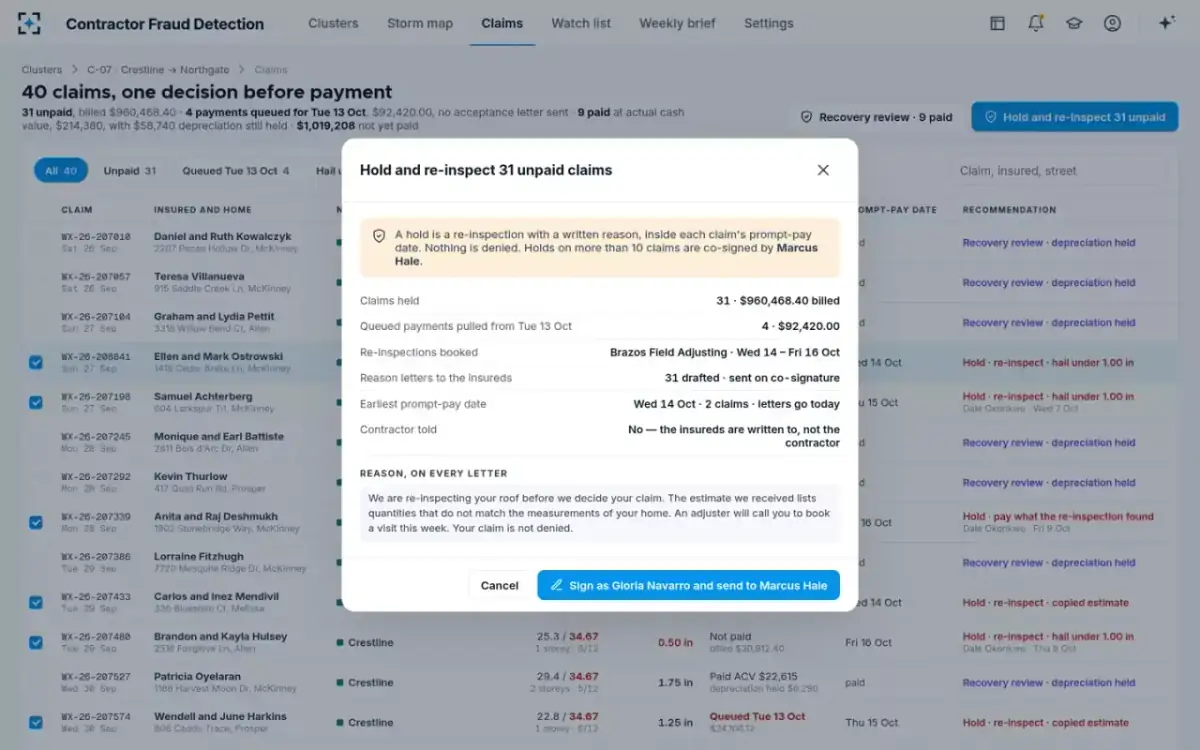
That combination shapes a good letter: specific about what is needed, silent about suspicion, addressed to the insured rather than the contractor, and clear that nothing has been denied. In the sample storm the solution runs on, every one of the 31 letters carries the same reason.
We are re-inspecting your roof before we decide your claim. The estimate we received lists quantities that do not match the measurements of your home. An adjuster will call you to book a visit this week. Your claim is not denied.
The reason on every letter in the fictional sample storm, drafted for the SIU manager to sign
The hold in Contractor Fraud Detection: 31 re-inspections, 31 letters, two signatures
Can a contractor sue an insurer for holding payment?
Usually only through the policyholder, because the claim belongs to the policyholder. A contractor can sue in its own name when the policy benefits were validly assigned to it, and Florida has closed that door for most homes: a post-loss assignment under a residential or commercial property policy issued on or after 1 January 2023 is "void, invalid, and unenforceable" (Fla. Stat. §627.7152(13)). A direction to pay, which only puts the contractor on the check, is a different document; the difference is set out in assignment of benefits vs direction to pay.
Three states go further against the contractor who breaks their deductible rules. In Colorado, Minnesota and Oklahoma, if the contractor advertised or promised to pay the deductible, the insurer is not obliged to consider its estimate at all (C.R.S. 6-22-105; Minn. Stat. 325E.66; Okla. HB 1940). That does not end the claim, which is still the homeowner's and still owed for real damage, but it changes what the re-inspection has to price from.
How Contractor Fraud Detection builds the file before the payment run
The solution assembles the checklist at the top of this page for every claim in a cluster, then stops. For each claim it shows the roof measured and billed, pitch and storeys, the hail at the home, the payment status and the prompt-pay date, with a recommendation: hold and re-inspect, pay, or recovery review for claims already paid.
Forty claims, one decision: every row carries its own evidence and deadline
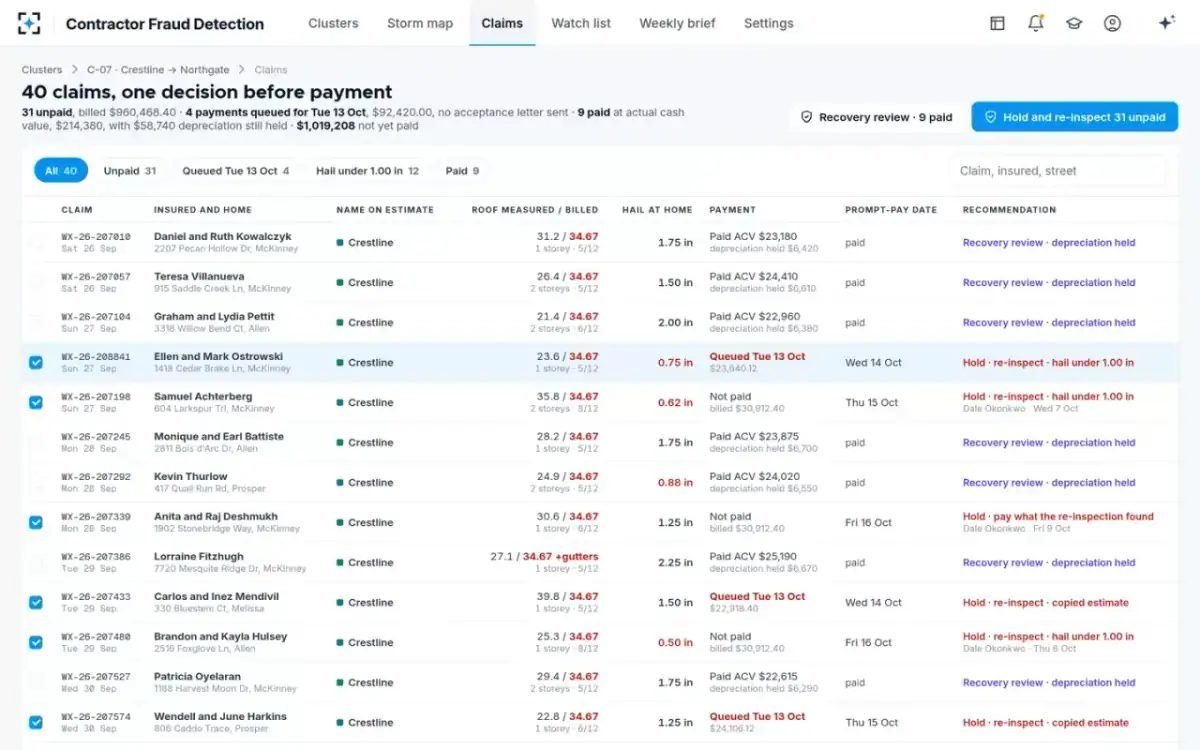
The people do the rest. The SIU manager signs the hold, the catastrophe claims manager co-signs above ten claims, a field adjuster re-inspects, and the fraud analyst completes the referral, which in Texas is due within 30 days of the suspicion (§701.051). The reason letters are drafted three business days before each prompt-pay date by default, a lead time the insurer can set to two or five. Every hold, release and referral is logged with who and when, so the file a regulator asks for is the file the team worked from.
Questions people ask
How do insurers check hail at an address?
They use radar-derived estimates of the largest hail at the location and time, ground reports from NOAA's Storm Events Database and storm spotters, and the roof itself. The radar estimate is designed to over-forecast, so it is evidence to weigh beside a field inspection, not a verdict.
Does a payment hold mean the claim is denied?
No. A hold done properly is a re-inspection with a written reason and a date; the claim is decided afterwards, and any part not in dispute should still be paid. In Texas the insurer that needs more time must tell the claimant why within the 15-business-day period and decide within 45 days.
How long can a hail claim be held in Texas?
After the insurer has everything it asked for, 15 business days, extendable by notice to 45 days, plus 15 days in a weather-related catastrophe the commissioner defines. Payment is due five business days after acceptance; holding longer when the claim is owed costs 18% a year in interest plus attorney's fees.
What if the roofer damaged my roof without my knowledge?
The homeowner is a victim, and the damage the roofer caused is a matter for the state fraud unit and the police. In the North Carolina sting, the people charged were roofing company employees, and the homeowner in such a case should report it to the insurer and the department of insurance.
Can the insurer refuse a contractor's estimate?
It can disagree with any estimate and pay what the covered damage costs. In Colorado, Minnesota and Oklahoma it is not obliged to consider at all an estimate from a contractor who advertised or promised to pay the deductible.