Storm claim fraud prevention software stops a fraudulent or inflated payment on a catastrophe claim before it is made, where detection software usually finds it afterwards. For catastrophe claims that difference has a calendar attached. Contractor fraud arrives in the days after each storm, while the prompt-pay clocks run, and three in four hail reports in the United States fall between April and July. Software that goes live in June has missed April and May, the busiest month included. Botminds' Contractor Fraud Detection is built to raise copied-estimate clusters while claims are still unpaid, and this guide sets out what it needs, how to test it on your own past storms and how to be live by spring. The general buyer's questions for claim-by-claim fraud scoring are in the guide to insurance fraud detection software.
The plan below counts back from the start of the season. It is our recommended sequence for a carrier with its estimates and claims data in hand, not a contractual timetable; the length of each phase depends mostly on how fast the data arrives.
Twelve weeks of preparation, then the four months that matter
- Inventory and connectionswk 1–2
- Load three past stormswk 3–5
- Replay against SIU findingswk 6–8
- Thresholds, roles, letterswk 9–10
- Live on new claimswk 11–12
- April · 17%5,074
- May · 26%7,848
- June · 18%5,490
- July · 13%3,751
What is insurance fraud prevention software? Four kinds, and where storm fraud fits
Insurance fraud prevention software is any system that flags a claim, a party or a document before payment so a person can look. It comes in four broad kinds: rules and red flags, claim scores, network or link analysis across parties, and document checks. Each catches something the others miss. NAIC's surveys found 49% of responding private passenger auto insurers and 42% of responding larger homeowners insurers using machine learning for fraud detection, mostly to refer claims for investigation (NAIC auto survey, 2022; NAIC homeowners survey, 2023).
Storm contractor fraud needs a fifth kind: comparison across estimates. A claim score sees one claim; a network tool sees people, phones and addresses; a document check sees whether a PDF was altered. None of them notices that forty honest-looking roof estimates share 29 identical lines and one pasted square count. Botminds offers the other kinds as separate solutions, Claims Fraud Detection, Fraud Network Analysis and Document Fraud Detection; Contractor Fraud Detection is the storm-and-estimate piece.
When should insurers prepare for storm season fraud? Before April
Insurers should be live before April, because that is when the hail season starts in earnest. Across 2023 to 2025, the months from April to July held three quarters of the hail entries in NOAA's Storm Events Database, and Texas recorded entries on 95 to 113 days a year. A system still being configured in May is configured during the busiest month of the year.
The hail calendar a storm fraud system has to be ready for
74%
of US hail entries fall between April and July
2023–2025 combined
26%
in May alone, the single busiest month
232–240
days a year with at least one hail entry somewhere in the US
#1
Texas, the state with the most hail entries in each of the three years
Within each storm, the window is shorter still. NOAA forecasters found that on days with several severe hail events, 96.7% of them fell within a four-hour period (Wendt and Jirak, NOAA/SPC), and in the fictional sample storm the solution runs on, every copied estimate arrived within 14 days. A system has to process a storm's first fortnight of estimates as they arrive, not in a batch at month end.
What data does storm fraud software need? Six feeds and three past storms
Storm fraud software needs the claims and payments, the contractor documents, an independent measure of each roof, the weather at each address and the business filings behind each contractor. Contractor Fraud Detection reads exactly those six sources, plus the estimates from earlier storms to compare against. Most go-live delays come from the second and third items, which sit in document stores and vendor portals rather than the claim system.
What to have ready before week 3
- New claims in the storm footprint
Loss date, address, peril, adjuster, payment status, queued payments and each claim’s prompt-pay date, from your claims system.
- Contractor estimates and invoices
As received, not re-keyed: every line, quantity and price, in whatever format contractors send.
- Direction-to-pay and assignment forms
With signer, bank details and the date signed.
- Aerial roof measurements
The squares measured, to set against the squares billed.
- Weather event data
Radar-estimated hail at each address and time, from your weather provider.
- Business filings
Assumed names and registrations behind each contractor name.
- Three past storms, with their outcomes
The estimates and claims from storms your SIU already worked, and what it concluded about each contractor.
Can you test fraud software on past storms? Yes, and you should before trusting it
You can test storm fraud software by replaying it on storms your SIU has already investigated, and it is the only test that tells you how it will behave on your contractors and your estimate formats. The questions are simple: did it raise the contractors your team found, how many days earlier, which ones did your team miss, and how many honest contractors did it raise that a person then had to clear.
Contractor Fraud Detection builds that test into how it is run. Every change to a setting is versioned and replayed on the last three storms, so the effect of moving the raising line from 0.85 to 0.80 shows up as a count of clusters, homes and dollars on storms the team already knows. For a model used in claims, the governance reference points are NIST's AI Risk Management Framework, which is voluntary (NIST), and NAIC's model bulletin on insurers' use of AI, which names fraud detection among AI's uses and which many states have adopted (NAIC adoption map). Neither prescribes a storm test, but a replay on past storms is documented evidence of how a model behaves on the insurer's own data.
Four numbers a past-storm replay should produce
| Measure | How to count it | Why it matters |
|---|---|---|
| Found | Contractors your SIU acted on that the replay raised | If it misses what you found by hand, stop |
| Earlier | Days between the replay’s first flag and your team’s first action | The value of a hold is the money still unpaid when the flag comes |
| New | Clusters the replay raised that your team did not work, reviewed now | The cases a claim-by-claim desk could not see |
| Cleared | Raised contractors a person reviewed and cleared | Every flag is an investigation someone must document |
What thresholds should storm fraud rules use? Yours, set from the replay
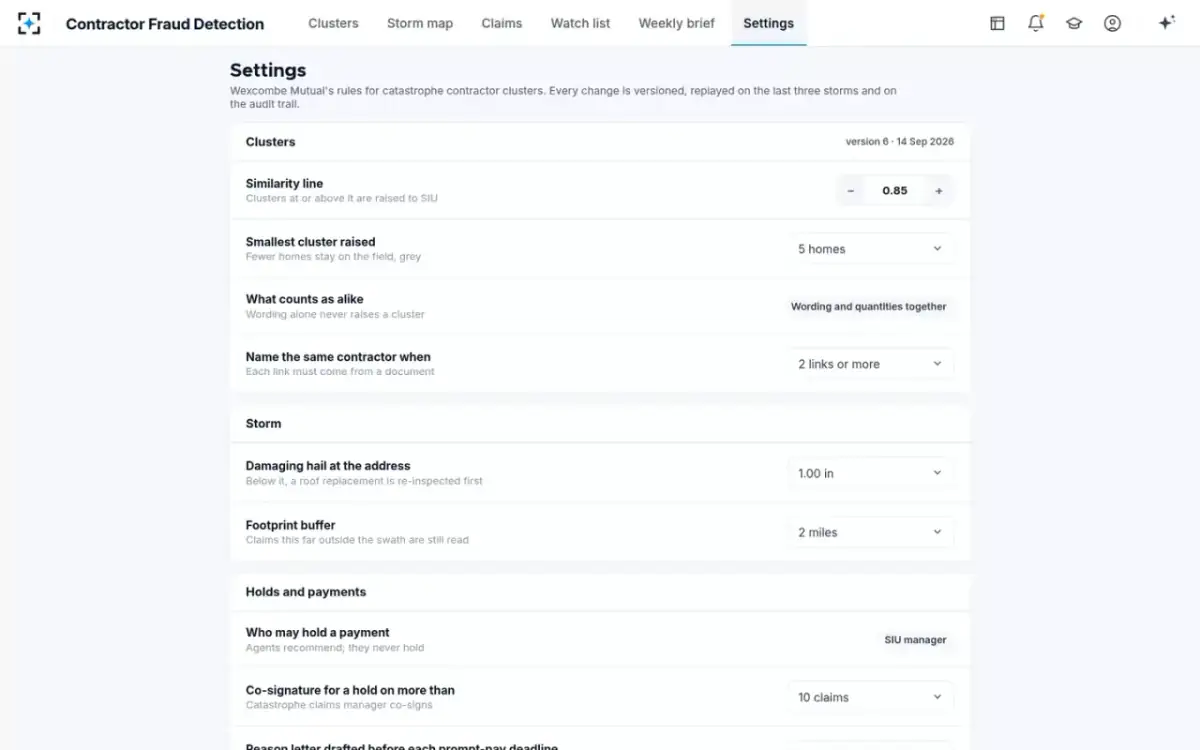
The thresholds should be the carrier's own, chosen from what the replay shows, and every one of them should be a setting a named person can change and see versioned. The defaults in Contractor Fraud Detection are a starting point, not a recommendation for every book.
The settings that decide what reaches the SIU, with their defaults
| Setting | Default | Options | What moving it does |
|---|---|---|---|
| Similarity line | 0.85 | 0.70 – 0.95 | Lower raises more clusters, including more templates a person must clear |
| Smallest cluster raised | 5 homes | 3 · 5 · 8 | Smaller catches new contractors sooner, with more noise |
| Same contractor when | 2 links | 2 · 3 | Three links names fewer firms, each with more evidence |
| Damaging hail at the address | 1.00 in | 0.75 · 1.00 · 1.25 | Below it, a roof replacement is re-inspected first |
| Footprint buffer | 2 miles | 1 · 2 · 5 | Claims this far outside the swath are still read |
| Co-signature for a hold on more than | 10 claims | 5 · 10 · 25 | Who must agree before many policyholders wait |
| Reason letter before each prompt-pay date | 3 business days | 2 · 3 · 5 | Lead time to sign and send inside the clock |
The rules as settings: each versioned, each replayed on the last three storms
Who approves a payment hold? A named SIU manager, co-signed above ten claims
A person approves every hold; the software only recommends. In Contractor Fraud Detection the SIU manager decides each hold, the catastrophe claims manager co-signs holds on more than ten claims, a field adjuster re-inspects, and the fraud analyst completes the referral to the state. Go-live is the moment to write those names into the settings and to agree the reason-letter wording with claims counsel, because the letters go to policyholders and must meet each state's notice rules; in Texas, an insurer that needs more time must tell the claimant why within the decision period (Tex. Ins. Code §542.056(d)).
Who signs what once the system is live
Today
Learns of a contractor pattern from a payments audit or a call, weeks after payment.
With agents
Reviews each morning’s clusters and decides holds before the payment run.
Still theirs: every hold and its reason
Today
Sees volume and deadlines, not which claims belong together.
With agents
Co-signs large holds and sees everything else paid on time.
Still theirs: the co-signature
Today
Reviews letters case by case after a complaint.
With agents
Approves the reason-letter wording once, before the season.
Still theirs: the letter templates
Today
Fields one-off extracts for every investigation.
With agents
Keeps six feeds flowing and the past storms loaded.
Still theirs: the connections
How long does it take to implement fraud prevention software? Twelve weeks, if the data arrives
For storm contractor fraud, about twelve weeks is a realistic plan when the claims feed and three past storms are available early; it is the data, not the configuration, that sets the pace. The first two weeks go to the inventory above and the connections. Weeks three to five load the past storms. Weeks six to ten are the replays: first against what the SIU found, then again after the thresholds are set. The last two weeks run the solution on new claims as they arrive, with holds decided by the people named in the settings.
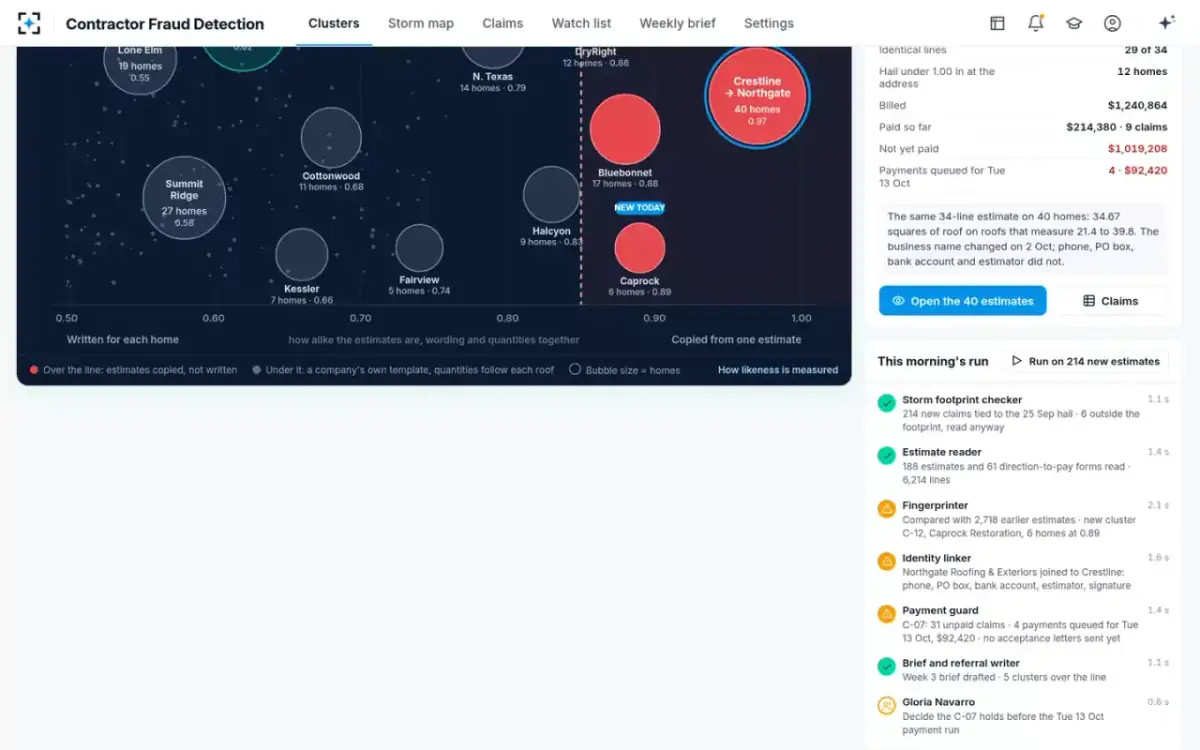
The run itself is quick. In the sample storm, the morning run that tied 214 new claims to the storm, read 188 estimates and 61 direction-to-pay forms, compared them with 2,718 earlier estimates and found a new six-home cluster took twelve minutes, from 06:02 to 06:14, before the SIU manager's working day.
A morning run in Contractor Fraud Detection: six agent steps, one decision left for a person
How much does fraud prevention software cost? Price it against one cluster
We know of no published, reliable price survey for insurance fraud software, and vendor list prices vary with claim volume, connections and support, so the useful comparison is with what one missed cluster costs. In the sample storm, one contractor's forty copied estimates had $1,019,208 still unpaid when the solution raised them on day 17: $960,468.40 of unpaid estimates and $58,740 of depreciation withheld on claims already paid. Raising that cluster by hand would take an SIU, by our estimate, about 46 days, against about three with the agents.
The other costs are internal and worth budgeting honestly: the data owner's time on the six feeds, the SIU's time clearing contractors the system raises, and claims counsel's review of the letters. A buyer should ask any vendor for the replay numbers on its own past storms before discussing price. The economics of a single cluster, line by line, are set out in inflated estimate meaning: what one copied line costs across a storm, and the checks themselves in contractor verification software.
Where Contractor Fraud Detection fits, and what it will not do
It sits beside the claims system and the SIU's case work: it reads, compares, links and recommends, and every action that touches a policyholder belongs to a person. It never holds or stops a payment, denies a claim, calls a contractor fraudulent or sends anything. The referral it drafts carries a due date, which in Texas is 30 days from the suspicion (§701.051), and a fraud analyst completes it. A sensible first step, before any plan, is to run it on the estimates from one of your own past storms.
Questions people ask
What is the difference between fraud prevention and fraud detection software?
Prevention acts before payment, detection usually after. The same model can do either; what makes it prevention is running on claims while they are unpaid and putting the result in front of a person before the payment run, as on day 17 of the sample storm.
Can fraud prevention software deny a claim on its own?
It should not, and in Contractor Fraud Detection no agent can. NAIC's surveys found that fraud models used to refer claims mostly support an adjuster's decision; the decision, and the letter to the policyholder, stay with a person.
Does the system need our past SIU cases?
It needs the estimates and claims from about three past storms and what your SIU concluded about the contractors in them. That is what the replay is scored against; without outcomes there is nothing to say whether a threshold is right.
What happens if a storm hits during go-live?
Run it on the new storm in parallel and let people decide every hold, as they would anyway. Settings changed in a hurry are still versioned and replayed on the last three storms, so the team can see what a change does before relying on it.
Is the hail threshold a damage threshold?
No. The default of 1.00 inch at the address only decides which roof replacements are re-inspected first; NOAA's radar hail estimate is built to over-forecast, and only an inspection says whether a roof was damaged.