Contractor verification software, on a property claim, checks that the business asking to be paid is who it says it is, is allowed to do the work, and wrote an estimate for this house rather than for the last one. Many products sold under the name answer only the first question: they look up a licence, an insurance certificate or a business registration. After a hailstorm that is the smaller risk. The larger one is a contractor that passes every lookup, files the same estimate on forty roofs and changes its name when questioned. Botminds' Contractor Fraud Detection treats verification as a set of checks across every claim in the storm, gives agents the reading and matching, and leaves every decision about money with a named person.
That split is the useful way to buy. Ask of each check whether it is reading and matching, which an agent can do on every claim in minutes, or judgement with consequences for a policyholder, which a person signs. The grid below sets out the checks for a storm contractor, who does each in the solution, and what the agent is never allowed to do.
Twelve checks on a storm contractor, and who does each in Contractor Fraud Detection
| Check | What is compared | Who does it | The limit |
|---|---|---|---|
| Licence or registration | The state’s licence or registration, where the state has one | Your vendor-management team or a licence service | Not one of the sources the solution reads today |
| Business filings | Formation, assumed names and filing dates behind each business name on the claims | Agents | Reports what the filings say, with each filing date |
| Address | Street office, PO box or none, as printed on the forms and as filed | Agent (estimate reader) | Keeps the address exactly as written |
| Phone, PO box, bank account | The values printed on estimates, invoices and direction-to-pay forms, across all claims | Agent (identity linker) | Links only on a value found in a document, never on a similar name |
| Estimator and signature | The “prepared by” name and the rep’s signature image on every form | Agent (identity linker) | Two links or more to name two businesses one contractor |
| Earlier storms | The same values in claims from past storms | Agents, shown on the watch list | Only your own claims; other insurers’ files are for the fraud unit |
| Estimate wording and quantities | Each line against every other estimate in the storm | Agent (fingerprinter) | Wording and quantities together; a template alone never raises a cluster |
| Squares billed against measured | The billed tear-off against the aerial measurement report | Agent (fingerprinter) | Reports the gap; never calls it fraud |
| Hail at the address | Radar-estimated hail at each home at the time of the storm | Agent (storm footprint checker) | Never says whether a roof was damaged |
| Payee and form | Direction to pay or assignment of benefits; signer, date, bank details | Agent reads; claims counsel decides validity | Never rules on whether an assignment is valid |
| Deductible offers, coverage talk | What the homeowner tells the adjuster the contractor offered or said | Desk adjuster | Heard by a person and noted on the claim |
| Hold, re-inspect, refer | All of the above, per claim, before the payment run | SIU manager, catastrophe manager, field adjuster, fraud analyst | Agents recommend; they never hold, stop, send or deny |
What is contractor verification software? Two different jobs under one name
Contractor verification software does one of two jobs, and a buyer should know which before comparing prices. The first is credentialing: confirming a licence, an insurance certificate, a bond or a business registration, usually once, when a contractor joins a preferred-vendor programme or first appears on a claim. The second is claim-level verification: checking, on every estimate and invoice, that the business and the work match what is on the documents, and comparing those documents across claims.
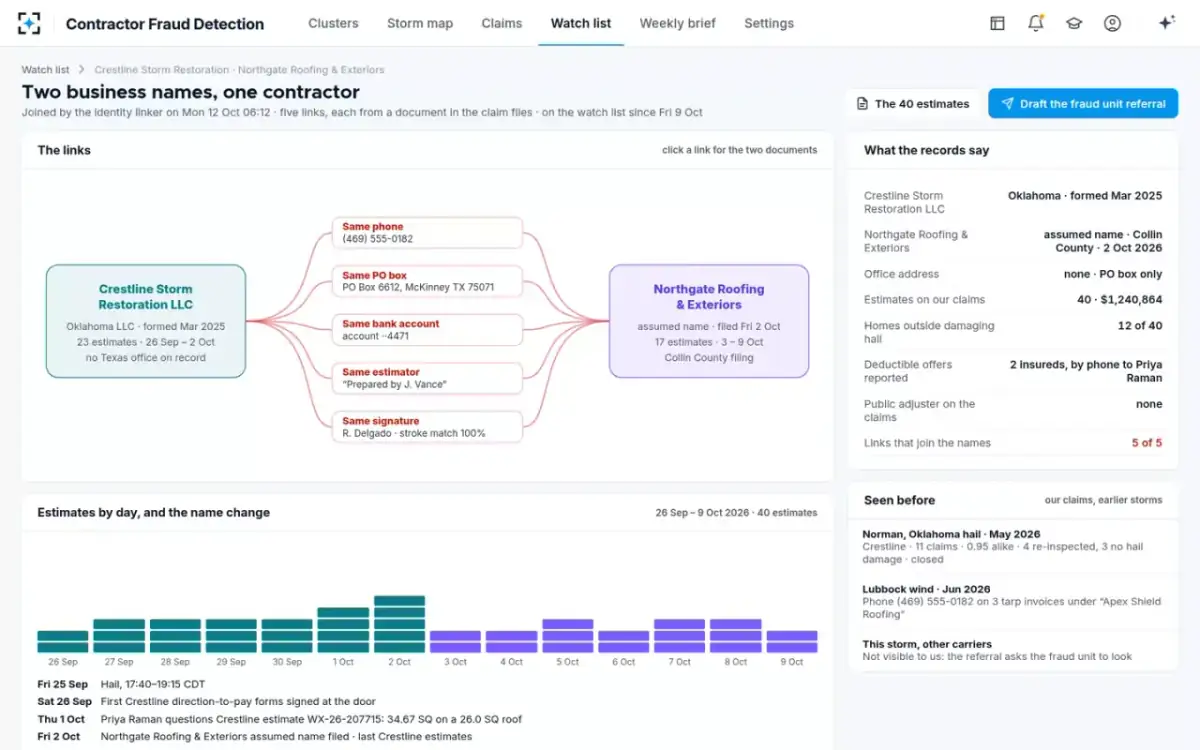
The storm chaser defeats the first job by design. A newly formed company, or an out-of-state company with no local office, can hold every registration a state requires on the day it starts knocking. In the fictional sample storm the solution runs on, the roofer behind forty copied estimates was an Oklahoma company formed six months earlier, with no Texas office listed, which traded under an assumed name filed the day after an adjuster questioned one of its estimates. A credentialing check would have passed both names. The cross-claim checks found them in a morning.
Insurers mostly buy rather than build this kind of model. In NAIC's survey of larger homeowners insurers, 42% used machine learning for fraud detection, and the fraud models were more often bought from outside vendors than built in-house (NAIC, 2022–23 homeowners survey). So the questions on this page are procurement questions as much as design ones.
How do insurers verify contractors on claims? Twelve checks, three of them decisions
Insurers verify a storm contractor by comparing what the contractor's documents say with outside sources and with each other. Nine of the twelve checks in the grid are reading and matching. Two depend on what a person hears from the homeowner. One is the decision. The order in which they run matters less than that they run on every claim in the footprint, not only on the claims someone already suspects.
The cross-claim checks carry most of the weight because the documents are where a contractor repeats itself. A phone number, a PO box, a bank account for the direction-to-pay check, the estimator's name and the rep's signature are printed on every form. A business can change its name in a day. Changing all five values on documents already filed is much harder, and the five together are what joined the two names in the sample storm.
Five links, each from a document: how two names became one contractor
How do you check a contractor licence for a claim? It depends on the state
You check the licence with the state that issues it, if the state issues one, and the answer differs sharply by state. Florida defines the roofing contractor as a licensed trade in chapter 489 (§489.105), and contracting without a licence is a crime that becomes a third-degree felony when committed "during the existence of a state of emergency declared by executive order of the Governor" (Fla. Stat. §489.127). Texas does not license roofers at all. A 2025 House committee analysis says so directly: "Texas does not currently require a state-issued license for reroofing contractors" (C.S.H.B. 3344 bill analysis), and the bill to create one went no further than the House Calendars Committee in May 2025 (bill history).
In a state without a licence, the business filings do the work a licence would. Texas requires an unincorporated person trading under an assumed name to file with the county clerk where it does business, and a company or out-of-state entity to file with the Secretary of State; both keep public indexes, and a certified copy is "presumptive evidence in any court in this state of the facts contained in the copy" (Tex. Bus. & Com. Code ch. 71). The filing date is the useful part. A name filed after the storm, by a company formed months earlier in another state, is not proof of anything, but it is exactly the kind of detail a referral needs and a desk adjuster rarely has time to look up.
Address history matters for a second reason in Texas. After a declared disaster, a remediation contractor that has not kept a physical business address for a year in the county or a neighbouring county may not require any payment before work begins (ch. 58). Whether the contractor on a claim falls under that rule is a question its own documents can answer.
Can software link renamed contractors? Yes, on values in documents, never on names
Software can link renamed contractors, and the safe way to do it is on values the documents share rather than on how the names look. Name similarity is the weakest evidence there is: honest firms share words like "Storm", "Roofing" and "Exteriors", and a renamed firm usually picks a name that looks nothing like the old one. In the sample storm, Crestline and Northgate share no word at all. The identity linker joins two names only when two or more values found in documents match, and each link opens the two documents that carry it.
This is the matching problem statisticians have worked on for decades, and the classic lesson is that a computer does the comparisons while people review the uncertain pairs. A U.S. Census Bureau research paper reports that in its 1992 farm count, computerised matching cut the clerical review from 75 clerks working three months to 6,500 hours, and the final file's duplication fell to 2% from 10% five years earlier (Winkler, U.S. Census Bureau, 2006). Contractor linking works the same way: agents compare every value on every form, and the fraud analyst reviews the links that would put a name in a referral. For linking people and businesses across claims at network scale, see the guide to entity resolution software.
Forty contractor signatures that are one image, beside forty that are not
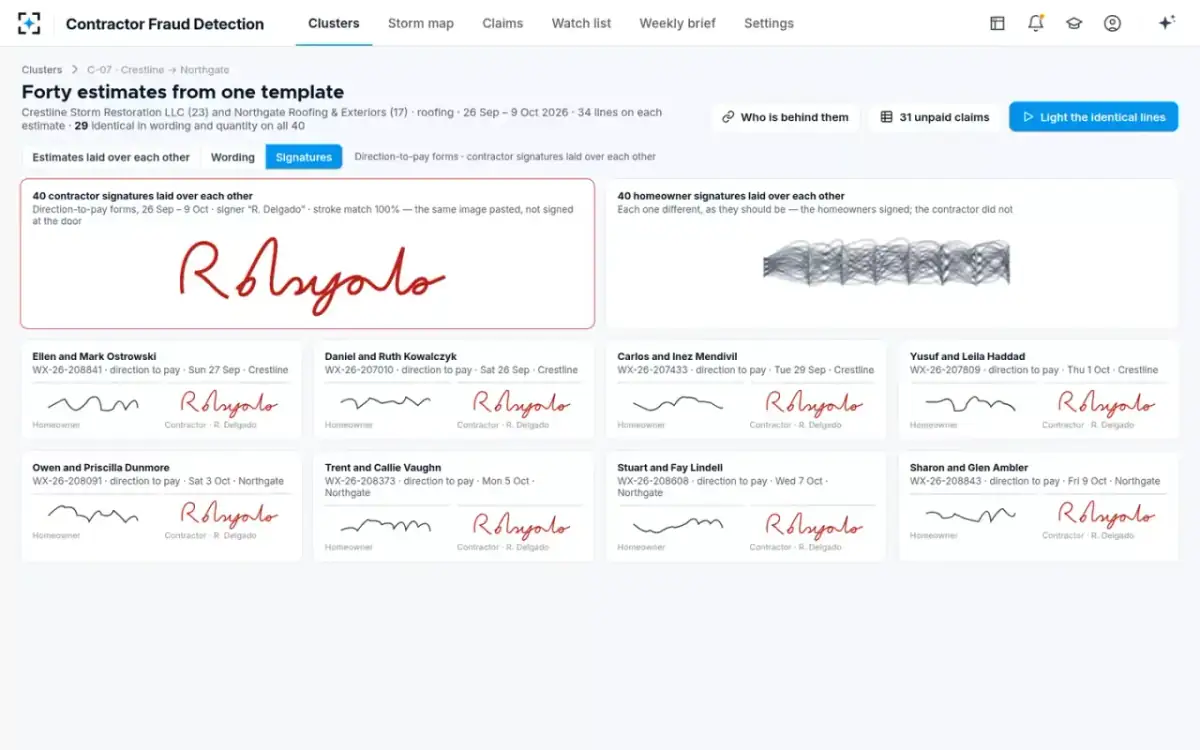
What is a contractor fingerprint? The estimate's wording and quantities, together
A contractor fingerprint is a compact summary of an estimate's lines, their wording and their quantities, that lets every estimate in a storm be compared with every other. The technique is borrowed from search engines, which break documents into overlapping runs of words, compare the sets and treat two documents as near duplicates when the overlap "exceeds a preset threshold" (Manning, Raghavan and Schütze, Stanford). The insurance twist is that wording alone means little, because many roofers price from the same estimating software and share a firm template. Quantities are what a copy gives away: the same 34.67 squares on roofs that measure 21.4 to 39.8.
The fingerprint therefore scores wording and quantities together, and a cluster needs both. A company template whose quantities follow each roof scores low; in the sample storm, one such roofer's 31 estimates scored 0.62 against a raising line of 0.85, and the fraud analyst cleared it. How that comparison is built, and where the line should sit, is the subject of insurance estimate comparison across claims.
Can AI hold a contractor payment? No: who decides to hold, and who co-signs
In Contractor Fraud Detection no agent can hold, stop or release a payment. The payment guard lists each cluster's open claims and queued payments and recommends hold and re-inspect, pay, or recovery review, with each claim's prompt-pay date. The SIU manager decides each hold; the catastrophe claims manager co-signs a hold on more than ten claims; a field adjuster re-inspects; the fraud analyst completes the referral. The flow below is the order those steps run in.
From a new estimate to a decision: agent steps, and the steps people sign
Agent
Storm footprint checkerTies the claim to the storm and reports the radar-estimated hail at the address, with a buffer around the swath.
Never: says whether a roof was damaged
Agent
Estimate readerReads the estimate, invoice and direction-to-pay form into lines, contacts, bank details and signatures.
Never: edits or rounds a figure
Agent
FingerprinterCompares the estimate with every other in the storm and clusters the look-alikes.
Never: flags on a name or calls a contractor fraudulent
Agent
Identity linkerJoins business names that share values in documents, each link with its two documents.
Never: links on a similar name
Agent
Payment guardLists the cluster’s unpaid claims and queued payments and recommends hold, pay or recovery review.
Never: holds or stops a payment itself
A person decides
SIU manager, co-signed above ten claimsDecides each hold as a re-inspection with a written reason to the insured, inside the prompt-pay date.
A person decides
Field adjuster and fraud analystRe-inspect the roofs; complete and file the referral to the state fraud unit.
The reason for drawing the line there is legal as well as practical. A hold delays money owed to a policyholder, and every prompt-pay statute measures the insurer, not its software. California also turns automated flags into obligations: its SIU rules require the unit to investigate every credible referral, and say in terms that this includes referrals a system generates (10 CCR §2698.36). A raising line set too low creates investigations someone must document. That makes the threshold a staffing decision for the SIU manager, not a vendor default.
Where an SIU's days go on one copied-estimate cluster, by hand and with agents
By hand: 46 days
- Noticing estimates repeat · 65%
- Listing claims · 11%
- Linking names · 11%
- Hail, referral · 13%
With agents: 3 days
- Reading and matching · 67%
- Referral, completed by the analyst · 33%
What to ask before you buy contractor verification software
Ask for evidence on your own storms, not a feature list. The questions below separate a tool that checks contractors from one that finds the contractor who passes every check.
Questions for any contractor verification software or service
- Does it compare estimates across claims, or check each claim alone?
A copied estimate is invisible on one claim. Ask how many estimates it compares each night and against which earlier storms.
- Does it score quantities, or only wording?
Shared templates and price lists are normal. Ask to see a template contractor it cleared and why.
- On what does it link two business names?
Values in documents, each openable, with a minimum number of links, or name similarity? The second will not survive a referral.
- Which state sources does it read?
Licences where they exist, business filings where they do not. Ask what it does in a state with no roofing licence.
- Who can hold a payment?
If the answer is the software, ask how a policyholder learns why, and how the prompt-pay date is protected.
- Can you replay last season?
Run it on a storm you already investigated: did it find the contractors you found, and which ones you missed?
- Are the thresholds yours?
The raising line, the smallest cluster and the hold authority should be settings you change and version, not constants.
- What does the referral contain?
The estimates, forms, link documents and re-inspections attached, in the format your state’s fraud unit asks for.
Where Contractor Fraud Detection fits, and where it does not
The solution fits between the claim system and the SIU: it reads the claims in the storm footprint, the contractor estimates and invoices, direction-to-pay and assignment forms, aerial roof measurements, weather event data and business filings, and turns them into clusters, links and recommendations a person decides on. It does not replace a credentialing programme or a licence service, and it does not adjust claims, deny them or contact contractors. Every view, hold, release and referral is logged with who and when, and every change to a setting is versioned and replayed on the last three storms.
A sensible first step is the one the checklist ends on: run it on the estimates from one of your own past storms and compare its clusters with what your SIU found. For the season-wide picture of how these contractors operate, see storm chasing roofing contractors: a hail season, desk by desk; for the go-live plan, insurance fraud prevention software, live before the next storm.
Questions people ask
What is the difference between a contractor verification service and software?
A service usually credentials contractors once, checking licences, insurance and registrations when they enrol. Software of the kind on this page runs on every claim and compares documents across claims. Many insurers need both; neither one replaces the other.
How do I look up a contractor's assumed name in Texas?
Search the county clerk's index for an unincorporated business and the Secretary of State's for a company or an out-of-state entity; Business and Commerce Code chapter 71 requires both offices to keep alphabetical indexes. The filing date tells you whether the name existed before the storm.
Is a PO box on a contractor estimate a red flag?
On its own, no; many small firms use one. It matters in combination: in the sample storm the same PO box appeared on both business names' estimates, and in Texas a contractor's lack of a year-old physical address in the county decides whether the disaster remediation rules on up-front payment apply.
How many links should it take to treat two businesses as one?
Contractor Fraud Detection requires two or more by default, each a value found in a document, and the setting can be raised to three. In the sample storm five values matched: phone, PO box, bank account, estimator and signature.
Does the software tell the contractor it has been flagged?
No. In the sample storm the reason letters go to the insureds, say the roof will be re-inspected and that the claim is not denied, and nothing goes to the contractor. California's claims rules likewise do not require an insurer to disclose information that would alert a claimant to a fraud investigation (10 CCR §2695.7(c)(2)).