Yes, in many states it is illegal for a roofer to pay your deductible. In Florida a contractor who pays, waives or rebates any part of a property insurance deductible commits a third-degree felony. In Texas it is a criminal offence for anyone selling goods or services paid from an insurance claim to promise or provide that, without the insurer's consent. Colorado, Minnesota and Oklahoma forbid roofers to advertise or promise it, and tell the insurer it need not consider that roofer's estimate. Where no specific statute exists, the offer is still a warning sign: the deductible is the homeowner's share of the loss, and a roofer who "covers" it usually recovers it by billing the insurer more. Insurers see these offers one phone call at a time; Botminds' Contractor Fraud Detection reads every estimate after a storm so the pattern behind them shows across claims.
The answer depends on where the house is, so the figure starts there. It covers the five states whose statutes we read in full for this guide, and one bill; it is not a list of every state.
Is it illegal for a roofer to pay your deductible? Five state laws and one bill
A contractor may not pay, waive or rebate any part of a deductible; may not offer a waiver, gift or cash for a roof inspection or a claim.
What followsThird-degree felony; contractor discipline and fines up to $10,000 a violation.
Fla. Stat. §817.234(7)(d), §489.147
A seller may not promise, pay, waive, absorb or rebate the deductible, or help the insured avoid paying it, without the insurer’s consent.
What followsClass B misdemeanour; contracts of $1,000+ must carry a deductible notice; the insurer may hold depreciation until the deductible is shown paid.
Bus. & Com. Code §27.02; Ins. Code ch. 707
A roofing contractor may not advertise or promise to pay, waive or rebate the deductible on a residential roof claim.
What followsThe insurer need not consider the contractor’s estimate; owner or insurer may sue for damages.
C.R.S. 6-22-105
A residential contractor may not advertise or promise to pay the deductible, or offer to compensate the homeowner for an inspection, a claim or a referral.
What followsThe insurer need not consider the estimate; private suit; state enforcement.
Minn. Stat. 325E.66
A roofing contractor may not advertise or promise to pay the deductible as an inducement.
What followsThe insurer need not consider the estimate; notice required with the first estimate.
59 O.S. §1151.30 (HB 1940, 2022)
H.4817 would bar residential builders and specialty contractors from promising to pay or rebate a deductible on roofing work.
What followsPassed the House; in the Senate when last updated. Not law.
H.4817 (2025–26)
Is it illegal for a roofer to pay your deductible in Florida? Yes, a felony
In Florida it is a crime for the contractor, not just a breach of contract. The insurance fraud statute says a contractor "may not knowingly or willfully and with intent to injure, defraud, or deceive, pay, waive, or rebate all or part of an insurance deductible applicable to payment to the contractor", and makes it a third-degree felony (Fla. Stat. §817.234(7)(d)). A separate contractor statute forbids offering a homeowner "a rebate, gift, gift card, cash, coupon, waiver of any insurance deductible, or any other thing of value" in exchange for a roof inspection or for making a roof claim, with fines up to $10,000 a violation (§489.147).
Florida also puts the warning in front of the homeowner. Any roof-claim advertisement, door hanger or flyer must state that the consumer pays the deductible and that waiving it is a felony, and a roof contract must say the contractor may not offer such inducements; a homeowner can void a contract that leaves that notice out within 10 days of signing (§489.147(1), (5)).
Can a roofing company waive my deductible in Texas, or "work it into the bid"?
No. Texas makes it an offence for a seller to advertise or promise that it will "pay, waive, absorb, or otherwise decline to charge or collect" the deductible, to give a rebate or credit that offsets it, or "in any other manner assist the insured in avoiding monetary payment of the required insurance deductible", unless the insurer consents; the offence is a Class B misdemeanour (Tex. Bus. & Com. Code §27.02). The Texas Department of Insurance names the bid version directly: a contractor who offers to waive the deductible or "work it into the bid" is breaking the law, and the homeowner should hire someone else (TDI fraud resources).
The statute also writes the warning into every large contract. A contract of $1,000 or more expected to be paid from a property claim must carry this notice in at least 12-point bold type.
"Texas law requires a person insured under a property insurance policy to pay any deductible applicable to a claim made under the policy. It is a violation of Texas law for a seller of goods or services who reasonably expects to be paid wholly or partly from the proceeds of a property insurance claim to knowingly allow the insured person to fail to pay, or assist the insured person's failure to pay, the applicable insurance deductible."
Texas Business and Commerce Code §27.02(b), the notice every covered contract must carry
The insurer has a matching tool. A Texas homeowner "shall pay any deductible applicable to a first-party claim", and an insurer with replacement-cost coverage may refuse to pay the withheld recoverable depreciation until it receives reasonable proof that the deductible was paid, such as a cancelled check or a financing agreement (Tex. Ins. Code §§707.002, 707.004). How that holdback works on a homeowner's second check is explained in the recoverable depreciation holdback guide.
Which states ban contractors paying deductibles? At least five, in different ways
Of the states covered here, Florida and Texas make the act a crime, and Colorado, Minnesota and Oklahoma ban the advertisement or promise and take away the contractor's leverage. In all three of the latter, if the roofer breaks the rule, "the insurer ... is not obligated to consider the estimate" it prepared, or words to the same effect (C.R.S. 6-22-105(2)(a); Minn. Stat. 325E.66(b); Okla. HB 1940). Minnesota and Oklahoma also require the contractor to give written notice of the rule with its first estimate, and the adjuster or insurer to give it in the insurer's first estimate. Oklahoma's bill was approved by the Governor on 26 May 2022 and took effect on 1 November 2022 (bill history).
South Carolina is the cautionary case for anyone reading summaries online. Its H.4817 would add a ban on residential builders and specialty contractors promising to pay or rebate a deductible on roofing work, and give the state's Insurance Fraud Division power to investigate. It passed the House and, as of October 2026, the General Assembly's site lists it as "Currently residing in the Senate" (H.4817). It is a bill, not law.
What happens if a contractor pays my deductible? Someone else pays it
If a contractor pays your deductible, the money comes from somewhere, and the usual source is the insurer, through a larger estimate. A roofer whose real price is the claim's full value cannot give up the deductible without either doing less work or billing more. The worked example below, with round numbers, shows the two ways it can go.
A $2,000 deductible on an $18,000 roof, paid honestly and 'absorbed'
Deductible paid by the homeowner: $18,000, the real price of the roof.
Deductible 'absorbed' by the roofer: $20,000, with $2,000 of extra squares or lines.
Deductible paid by the homeowner: $16,000 (estimate less deductible).
Deductible 'absorbed' by the roofer: $18,000, so the insurer funds the “free” deductible.
Deductible paid by the homeowner: $2,000.
Deductible 'absorbed' by the roofer: $0, and has signed a claim that overstates the loss.
Deductible paid by the homeowner: $18,000.
Deductible 'absorbed' by the roofer: $18,000, the same.
Deductible paid by the homeowner: —
Deductible 'absorbed' by the roofer: The roofer is $2,000 short and cheaper work or materials make up the difference.
For the homeowner, the right-hand column is not free. A claim supported by an estimate the homeowner knows is inflated can itself be insurance fraud: Texas, for example, makes it an offence to present a statement in support of a claim knowing it "contains false or misleading material information" (Tex. Penal Code §35.02). Whether anyone would be charged is a prosecutor's decision, but the risk sits with the person whose name is on the claim. For the insurer, the right-hand column repeated on every roof a contractor touches is what a copied-estimate cluster looks like; see inflated estimate meaning.
Can a roofer offer a rebate on an insurance claim, or a gift for an inspection?
In Florida and Minnesota, not in exchange for an inspection or a claim. Florida bars offering "a rebate, gift, gift card, cash, coupon, waiver of any insurance deductible, or any other thing of value" for letting the contractor inspect the roof or for making a roof claim (§489.147(2)(b)). Minnesota bars a residential contractor from offering to compensate a homeowner for an inspection, a claim or a referral (325E.66 subd. 1). Texas bars any rebate or credit that offsets the deductible (§27.02(c)). A sign-the-yard-sign discount that happens to equal the deductible is the same offer in different words.
Is it legal for a roofer to solicit door to door?
Door-to-door selling is generally lawful, but the content of the pitch is regulated, and local permit rules may add more. Florida defines soliciting to include contact "In person", and forbids soliciting a homeowner "by means of a prohibited advertisement": any door hanger, flyer, card or message urging a roof claim that lacks the required statements about the deductible and insurance fraud (§489.147(1)–(2)). Florida also lets a homeowner cancel a roof contract signed within 180 days of a declared state of emergency, within 10 days or by the official start date, whichever comes first (§489.147(6)).
In Texas, after a declared disaster, an out-of-area remediation contractor may not require payment before work begins, and TDI warns homeowners that out-of-town scammers are often first to knock after a disaster (TDI). How the door-knocking season plays out from the insurer's side is in storm chasing roofing contractors.
What to do with a deductible offer
- Do not sign on the strength of it
TDI’s advice is to hire a different contractor.
- Read the contract for the notice
Texas (contracts of $1,000+) and Florida (roof contracts) require one; in Florida a contract without it can be voided within 10 days.
- Tell your insurer or adjuster
It changes how the estimate is read, and in Colorado, Minnesota and Oklahoma whether it is considered at all.
- Keep proof you paid the deductible
In Texas the insurer may hold recoverable depreciation until it sees it.
- Report the contractor
Texas: the attorney general, at the number TDI publishes. Florida: the Department of Financial Services’ Division of Criminal Investigations for insurance fraud. Minnesota: the commissioner of labor and industry enforces the statute.
Who do I report a roofer to?
Report it to your insurer and to the state body the statute names. In Texas, TDI tells consumers to report deductible-waiver offers to the attorney general at 800-621-0508 (TDI, Roofing and insurance: know the law). In Florida, suspected insurance fraud goes to the Department of Financial Services' Division of Criminal Investigations, which investigates fraudulent insurance acts and violations of §817.234 (Fla. Stat. §626.989), and contractor violations of §489.147 are subject to licence discipline. Minnesota's statute is enforced by the commissioner of labor and industry (325E.66 subd. 3).
What adjusters and SIU teams do with a deductible offer, and how Contractor Fraud Detection helps
For an adjuster, a reported offer is evidence about the contractor, not just the claim, and it belongs where the next adjuster will see it. In the fictional sample storm the solution runs on, two insureds told the desk adjuster by phone that the roofer had offered to cover their deductible; the note sits on the contractor's profile beside the other evidence: forty copied estimates under two business names, five document links, twelve homes under damaging hail. The weekly report to the catastrophe claims manager listed the offer among four signs for adjusters to watch.
Two reported deductible offers, on the contractor's profile in Contractor Fraud Detection
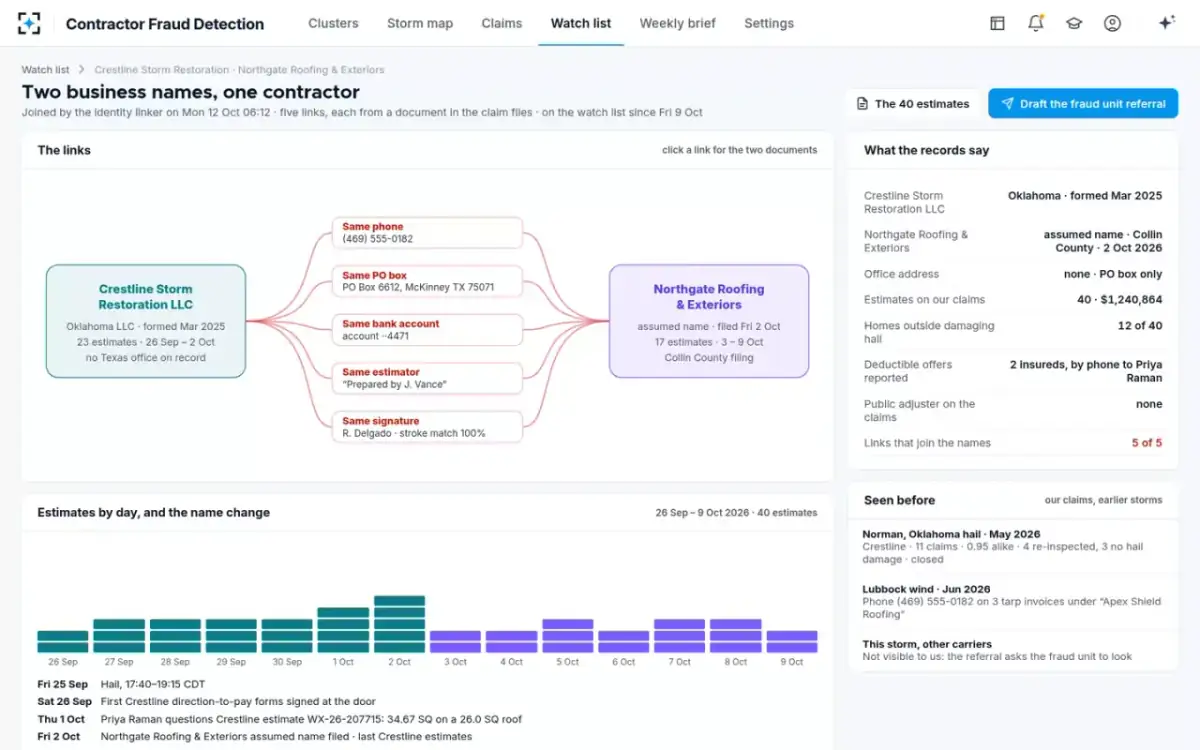
The solution does not decide what an offer means. The SIU manager weighs it with the estimates and decides whether to hold and re-inspect; in Colorado, Minnesota and Oklahoma the claims team and counsel decide whether to rely on the statute and set the contractor's estimate aside. What the solution adds is the view across claims, so that two phone calls on two desks become one line on one profile.
Questions people ask
Is waiving a deductible insurance fraud?
In Florida, a contractor's knowing waiver or rebate of a property deductible is insurance fraud and a third-degree felony under §817.234(7)(d). In Texas it is a separate Class B misdemeanour, and an estimate inflated to cover the deductible can also be a false statement under the insurance fraud statute.
Can my roofer give me a discount equal to my deductible?
In Texas, a rebate or credit that offsets the deductible is prohibited unless the insurer consents, and Florida bans offering any thing of value for a roof inspection or claim. A genuine price cut on work you pay for yourself is different from a discount tied to the insurance deductible.
Can the insurer ask for proof that I paid my deductible?
In Texas, yes: an insurer with replacement-cost coverage may withhold recoverable depreciation until it receives reasonable proof, such as a cancelled check, money order receipt, credit card statement or financing agreement (Ins. Code §707.004).
Does a deductible offer make my claim invalid?
Not by itself; the claim for real storm damage remains yours. In Colorado, Minnesota and Oklahoma the insurer may decline to consider the offending roofer's estimate and price the damage another way.
Is it legal in South Carolina for a roofer to pay my deductible?
South Carolina's H.4817, which would ban the promise, is a bill that passed the House and sat in the Senate as of October 2026; it is not law. General insurance fraud law still applies to any claim that misstates the loss.