Storm chasing roofing contractors are roofers who travel to a hail or wind area after the storm, knock on doors, sign homeowners to repair contracts and direction-to-pay forms, and file estimates with the homeowners' insurers. Following storms is not itself illegal, and many travelling crews do honest work. The fraud risk sits in what some of them do next: waive deductibles, copy one estimate onto dozens of roofs, bill squares that were never measured, and change business names once an adjuster asks questions. The claims desk sees one estimate at a time, against a prompt-pay clock, so the pattern only shows across claims. Botminds' Contractor Fraud Detection reads every contractor estimate in a storm's footprint and raises the look-alike clusters before payment, for the SIU to decide.
The season is short and front-loaded. Across 2023 to 2025, three in four hail entries in NOAA's Storm Events Database fell between April and July, and the contractor's busiest week is the insurer's first week. The figure below puts the two calendars side by side for one hail storm, with the days an SIU spends finding a cluster by hand set against the days the solution is built to take.
The contractor's two weeks, the claim clock and the SIU's hunt, on one scale
- Door-knocking, forms signed3 d
- Estimates filed, one template11 d
- Acknowledge, request items15 days
- Accept or reject15 business days
- Catastrophe extension+15 days
- Noticing estimates repeat30 d
- Listing claims and payments5 d
- Linking names5 d
- Hail and referral6 d
- Cluster raised, referral drafted3 d
What are storm chaser contractors? Out-of-area crews that follow the hail
A storm chaser contractor is a roofing, tree, water or general contractor with no settled base in the area who arrives after a declared or widely reported storm to sell repairs that insurance will pay for. Texas wrote that distinction into law. Its disaster remediation statute applies to a contractor unless it has kept "a physical business address" for at least one year in the county of the property or a neighbouring county, and for everyone else it bars requiring any payment before work begins (Tex. Bus. & Com. Code ch. 58). The state's insurance regulator puts it more bluntly to homeowners: "Out-of-town scam artists may be the first to arrive at your front door after a disaster" (Texas Department of Insurance).
The trade has its own words for the roles. The door knocker, or canvasser, works a street the day after the hail, offering a free roof inspection. A sales rep follows with the contract and, very often, a direction-to-pay form that tells the insurer to put the contractor on the check. An estimator, sometimes hundreds of miles away, writes the estimate the insurer receives. None of those roles is a sign of fraud on its own. Together, they explain why one rep's signature and one estimator's template can appear on forty claims in a week.
Are storm chasers illegal? The travel is legal; specific conduct is not
Storm chasing is legal; several things storm chasers are known for are not, and the list changes at each state line. A desk adjuster does not need to know every statute, but the SIU and the catastrophe manager need the ones for the states their storms hit, because each prohibited act is also a red flag on the claim.
What five states forbid a storm contractor to do, in their own statutes
| State | What the contractor may not do | What follows |
|---|---|---|
| Florida | Solicit a homeowner with roof-claim advertising that omits the required fraud warnings; offer a deductible waiver, gift or cash for a roof inspection or a claim; adjust a claim unless licensed as a public adjuster | Paying, waiving or rebating a deductible is a third-degree felony (§817.234(7)(d)); fines up to $10,000 per §489.147 violation; unlicensed contracting during a declared emergency is a third-degree felony (§489.127) |
| Texas | Promise or provide a deductible waiver, rebate or credit; act as a public adjuster on a job it repairs; take payment before work if it is an out-of-area disaster contractor | Class B misdemeanor (Bus. & Com. Code §27.02); Ins. Code §4102.163; deceptive trade practice (ch. 58) |
| Colorado | Advertise or promise to pay, waive or rebate a deductible; act as a public adjuster | The insurer need not consider the contractor’s estimate; the homeowner may cancel within 72 hours of a denial (C.R.S. 6-22-104, -105) |
| Minnesota | Advertise or promise to pay a deductible, or offer to compensate the homeowner for an inspection, a claim or a referral; adjust a claim without a public adjuster licence | The insurer is not obliged to consider the estimate (Minn. Stat. 325E.66) |
| Oklahoma | Advertise or promise to pay a deductible, or offer to compensate the homeowner for a service, as an inducement | The insurer is not obliged to consider the estimate (HB 1940, 2022) |
Two of those rules matter on almost every storm claim. A contractor that offers to absorb the deductible is breaking the law in Florida, Texas, Colorado, Minnesota and Oklahoma, and three of those states tell the insurer it need not consider that contractor's estimate at all. Whether a roofer may pay your deductible, and what happens to the estimate when one does, is answered state by state in is it illegal for a roofer to pay your deductible. And a contractor that negotiates the claim for the homeowner, without a public adjuster's licence, is acting as one in breach of Florida §489.147(2)(d), Texas §4102.163 and the Colorado and Minnesota statutes.
How storm chasers work after a hail storm: the first two weeks
The pattern is visible in one storm's claims within days, if anyone reads them together. Take the fictional sample storm the solution runs on: hail up to 2.75 inches across Collin County, Texas, on the evening of Friday 25 September 2026. The insurer, the contractors, the homes and the people are invented; the timing and the documents are what a catastrophe team will recognise.
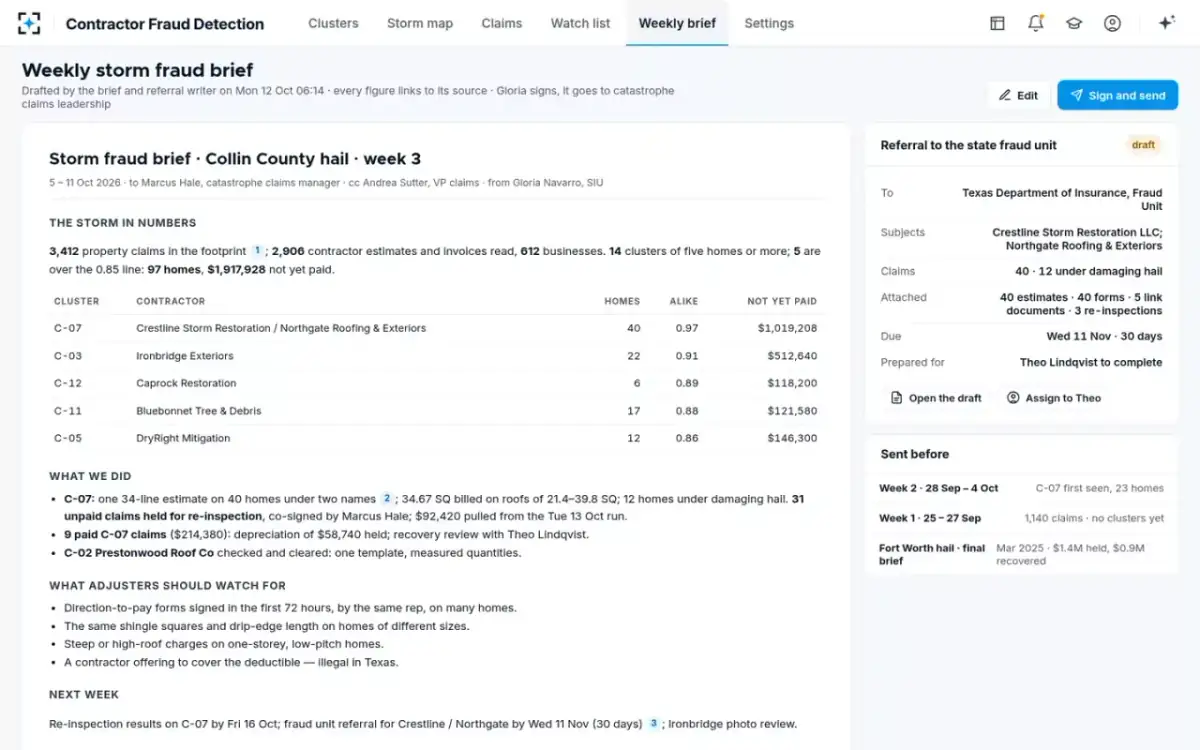
The first direction-to-pay forms were signed at front doors on Saturday 26 September, the day after the hail. By day 17 the storm had produced 3,412 property claims, 2,906 contractor estimates and invoices, 1,118 direction-to-pay forms and 612 business names. One roofer, Crestline Storm Restoration, filed 23 estimates in seven days, each 34 lines long, each billing 34.67 squares of tear-off. On Thursday 1 October a desk adjuster questioned one of them: 34.67 squares billed on a roof that measured 26.0. The next day an assumed name, Northgate Roofing & Exteriors, was filed, and the next 17 estimates arrived under it, with the same phone, PO box, bank account, estimator and rep signature.
Nothing in that sequence is hidden. Every detail sits in a claim file. It is simply spread across forty files, handled by different desk adjusters, each looking at a plausible roof estimate on its own. The weekly report the solution drafts for the catastrophe claims manager lists the four signs adjusters were asked to watch for that week.
Week three of the sample storm: five clusters, and four signs for adjusters
When does contractor fraud peak? In the same weeks the claim clocks start
Contractor fraud follows the storms: in the sample storm every copied estimate arrived within 14 days of the hail, and the storms themselves cluster in spring and early summer. Of the 29,907 hail entries in NOAA's Storm Events Database for 2023, 2024 and 2025, 74% began between April and July, and May alone held 26%. Texas recorded more hail entries than any other state in each of the three years, and had at least one on 95 to 113 days a year.
Three in four hail entries fall between April and July
Within a storm day, the damage is concentrated in time as well. NOAA's Storm Prediction Center found that on days with more than one severe hail event, the hail fell within a four-hour window 96.7% of the time (Wendt and Jirak, NOAA/SPC), and NOAA's severe storms laboratory says a hail swath can be anything from a few acres to a band ten miles wide and a hundred long (NOAA National Severe Storms Laboratory; reading a swath for one address is covered in the hail history report by address guide). One evening's swath can put thousands of claims into one insurer's queue by Monday, every one of them with a clock attached.
Those clocks start on the contractor's busiest days. Texas gives an insurer 15 days from notice to acknowledge a claim, start the investigation and ask for what it needs, then 15 business days from receiving those items to accept or reject (Tex. Ins. Code §§542.055–.056). Florida requires acknowledgement within 7 days, a physical inspection within 30 days of proof of loss and payment or denial within 60 days of notice (Fla. Stat. §627.70131). How the clocks compare across states is set out in the prompt payment laws by state guide. For fraud work, the point is simpler: the copied estimates arrive inside the same weeks, and an SIU that finds the pattern in week six is reading files that were paid in week three.
The season, desk by desk: who sees what
Each desk in a storm response sees a slice, and nobody's slice contains the pattern. The field adjuster sees one roof. The desk adjuster sees a queue of estimates, each plausible. The catastrophe manager sees volume and deadlines. The SIU sees referrals, one claim at a time, and the fraud analyst hears about a contractor when somebody happens to recognise a name. The figure follows the five people in the sample storm, and what changes when agents read every estimate in the footprint.
Five desks in one storm, and what each needs from the others
Today
Receives one red-flag referral on one claim at a time; hears about a contractor ring from a payments audit.
With agents
Sees the storm’s look-alike estimates as clusters each morning, with the evidence, and decides holds before the payment run.
Still theirs: every hold and every referral
Today
Runs 3,412 claims, 41 desk and 60 field adjusters against the prompt-pay clock, with no view of which contractors’ claims belong together.
With agents
Co-signs holds on more than 10 claims, each a re-inspection with a written reason, while every other claim is paid on time.
Still theirs: the co-signature and the storm’s staffing
Today
Approves contractor estimates one at a time; each looks like a normal roof estimate.
With agents
Sees on each claim whether its estimate is one of forty, with the roof measured against the squares billed.
Still theirs: the claim decision
Today
Builds contractor profiles by hand and needs the document behind every link, or the referral comes back.
With agents
Starts from the links between business names, each with its document, and a referral already drafted.
Still theirs: completing and filing the referral
Today
Re-inspects roofs from a file that shows one estimate at a time.
With agents
Goes out knowing the squares billed, the roof measured and the hail at the address.
Still theirs: the test squares on the roof
The gap is structural, not a matter of effort. NAIC's survey of larger homeowners insurers found 26 companies using machine learning to detect organised crime rings, and found that the models used to refer claims for investigation mostly supported an adjuster's decision rather than replacing it (NAIC, 2022–23 homeowners survey). A claim-level model still scores one claim at a time. A storm chaser's signature is in the relationship between claims: the same 29 lines on forty roofs of different sizes, the same bank account under two names.
How do insurers handle contractor fraud after a storm? Hold, re-inspect, refer
Insurers handle it in three moves: re-inspect before paying the unpaid claims, review the paid ones for recovery, and refer the contractor to the state. The order matters. A re-inspection with a written reason keeps the claim inside its clock; a referral starts a separate one. Texas requires a person who determines or reasonably suspects a fraudulent insurance act to report it in writing to the Department of Insurance's fraud unit within 30 days (Tex. Ins. Code §701.051), and the SIU has to be able to show the evidence behind it.
The other side of the hold is the homeowner, who in most of these files has done nothing wrong and signed a form at the door. In the sample storm, 12 of the 40 copied-estimate homes saw less than an inch of hail at the address, the solution's default setting for damaging hail, and 28 saw an inch and a quarter or more. Some of those roofs are damaged and some are not; the copied estimate says nothing either way, which is why the answer is a re-inspection, not a denial. The letters in the sample go to the insureds, not to the contractor, and say the claim is not denied. What a hold must contain to survive a complaint is the subject of hail damage insurance fraud: a payment hold that survives review.
Five checks a desk adjuster can make on any storm estimate in two minutes
- Measured squares against billed squares
A roof that measures well under the billed tear-off is the plainest sign the quantity was pasted; in the sample cluster, 36 of 40 roofs were smaller than billed.
- Pitch and storeys against steep and high-roof charges
A steep charge for 7/12 to 9/12 pitch on a 5/12 roof, or a two-storey charge on a bungalow, means the lines were not written for this house.
- The date and signer on the direction to pay
Forms signed in the first 72 hours by one rep on many streets are the canvassing pattern, not proof of anything, but worth a look at the estimate.
- Any offer about the deductible
A homeowner who mentions that the roofer will "take care of" the deductible is describing an offence in Texas, Florida, Colorado, Minnesota and Oklahoma.
- Who is talking to you about coverage
A contractor negotiating the claim without a public adjuster’s licence is a statutory breach in several states and a reason to slow down.
Who investigates storm chaser fraud? The SIU, then the state
The insurer's special investigations unit investigates first, and the state insurance fraud unit, the attorney general or a district attorney prosecutes. In Texas the Department of Insurance's Fraud Unit handles insurance fraud referrals and, after storms, "Sent Fraud Unit investigators to affected areas to help deter fraud and contractor scams" (TDI annual report, December 2025). Violations of the deductible statute go to the attorney general, whose number TDI publishes for consumers (TDI).
The state funnel is narrow, which is why the insurer's own evidence matters. California's Fraud Division, for example, reported 4,580 suspected fraud claims on property, life and casualty lines in fiscal 2023-24, from which it assigned 52 new cases and made 16 arrests (California Department of Insurance). A referral that arrives with the forty estimates, the measurement reports and the documents linking the business names is a case a fraud unit can open. A referral that says "this contractor seems suspicious" usually is not.
For a full picture of how such a ring is drawn and investigated across claims, the fraud ring detection guide covers organised rings, and SIU Case Management covers the case once it is opened.
Where Contractor Fraud Detection fits in the storm season
The solution works the days in between: after the estimates arrive, before the payment run. Six agents tie each new claim to the storm and the hail at its address, read every estimate and direction-to-pay form line by line, fingerprint wording and quantities together, cluster the look-alikes, link business names only on values found in documents, and list each cluster's unpaid claims with their prompt-pay dates. On the morning of day 17 in the sample storm, the field looked like this.
Day 17 in Contractor Fraud Detection: five clusters over the line, $1.9 million not yet paid
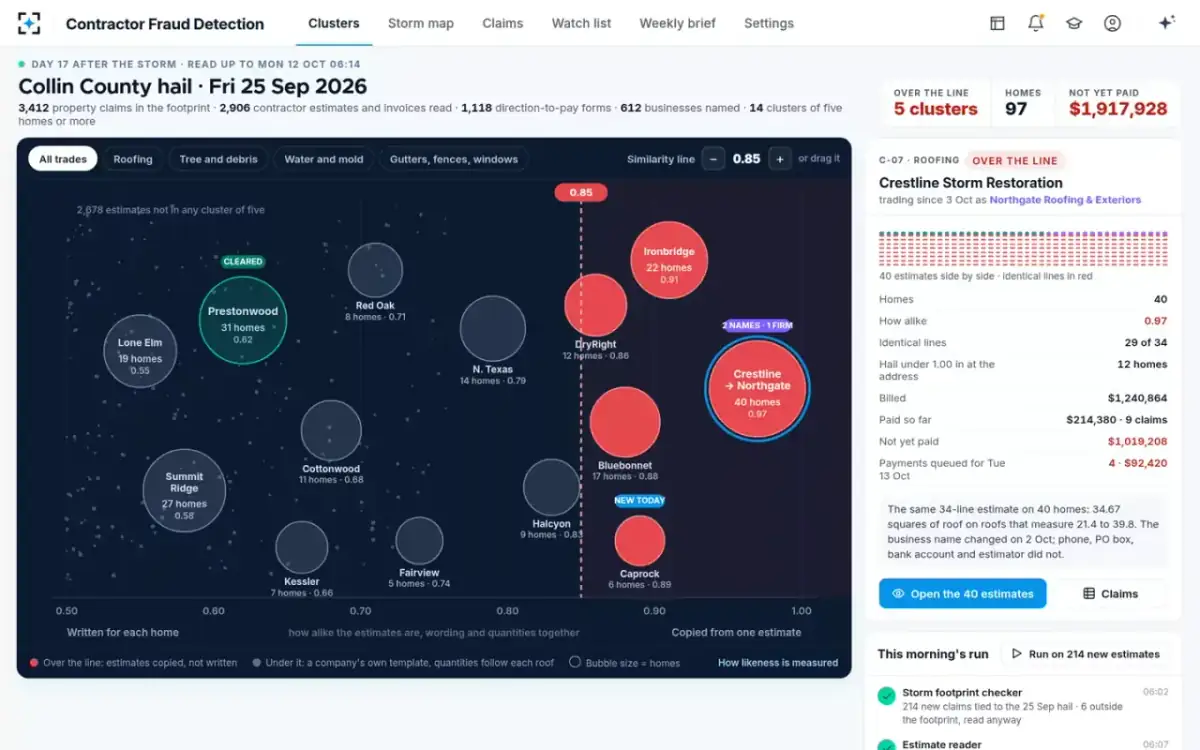
What it does not do matters as much. No agent holds or stops a payment, denies a claim, calls a contractor fraudulent or sends a referral. The SIU manager decides each hold, the catastrophe claims manager co-signs holds on more than ten claims, and the fraud analyst completes the referral. The day-17 flag is a design target, not a measured result: the aim is to raise clusters while the claims are open rather than months later in a payments audit. How each check is divided between agents and people is set out in contractor verification software, and the checks an adjuster keeps.
Questions people ask
What is a door knocker roofer?
A door knocker, or canvasser, is the salesperson who walks a storm-hit street offering free roof inspections and passes signed homeowners to a sales rep or estimator. Door knocking is not illegal in itself, but Florida bans offering a deductible waiver, gift or cash in exchange for letting the contractor inspect a roof or file a claim (§489.147(2)(b)), and local rules on soliciting vary.
How long do insurers have to pay a storm claim?
It depends on the state. In Texas the insurer has 15 business days after receiving everything it asked for to accept or reject, then five business days to pay, with 15 more days in a weather-related catastrophe; in Florida it must pay or deny within 60 days of notice. Either clock can be extended only on the grounds the statute allows.
Can a storm chaser contractor ask for money up front?
In Texas, not if a disaster has been declared and the contractor has not kept a physical business address for a year in the county or a neighbouring one: Business and Commerce Code chapter 58 bars any payment before work begins. A homeowner in Florida may also cancel a roof contract signed within 180 days of a declared emergency, within 10 days or by the official start date, whichever comes first (§489.147(6)).
Are all out-of-state roofers storm chasers?
No. Large storms outrun local capacity, and licensed out-of-state crews do much of the honest work. The red flags are conduct, not origin: deductible offers, estimates that do not fit the house, a new business name after an adjuster's question.
How many claims can one storm chaser file?
As many as it can sign. In the sample storm one contractor filed 40 copied estimates in 14 days under two names; in a federal case in Ohio, a roofing company owner pleaded guilty to a scheme in which at least 80 inflated invoices went to insurers over about two years (U.S. Attorney, S.D. Ohio). The count only becomes visible when estimates are read across claims.