An inflated estimate is a repair estimate that bills for more than the loss requires: quantities larger than the roof, line items the house does not need, prices above what is charged, or work that was never done. In insurance it becomes fraud when the person presenting it knows it contains false or misleading material information and means to deceive the insurer; an honest disagreement about scope is not fraud. After a hail or wind storm, inflation usually arrives in small amounts per claim, repeated across many claims by one contractor, so a desk that prices it one estimate at a time sees a few hundred dollars here and there. Botminds' Contractor Fraud Detection reads every estimate in the storm and prices the copied lines across the cluster, which is where the money is.
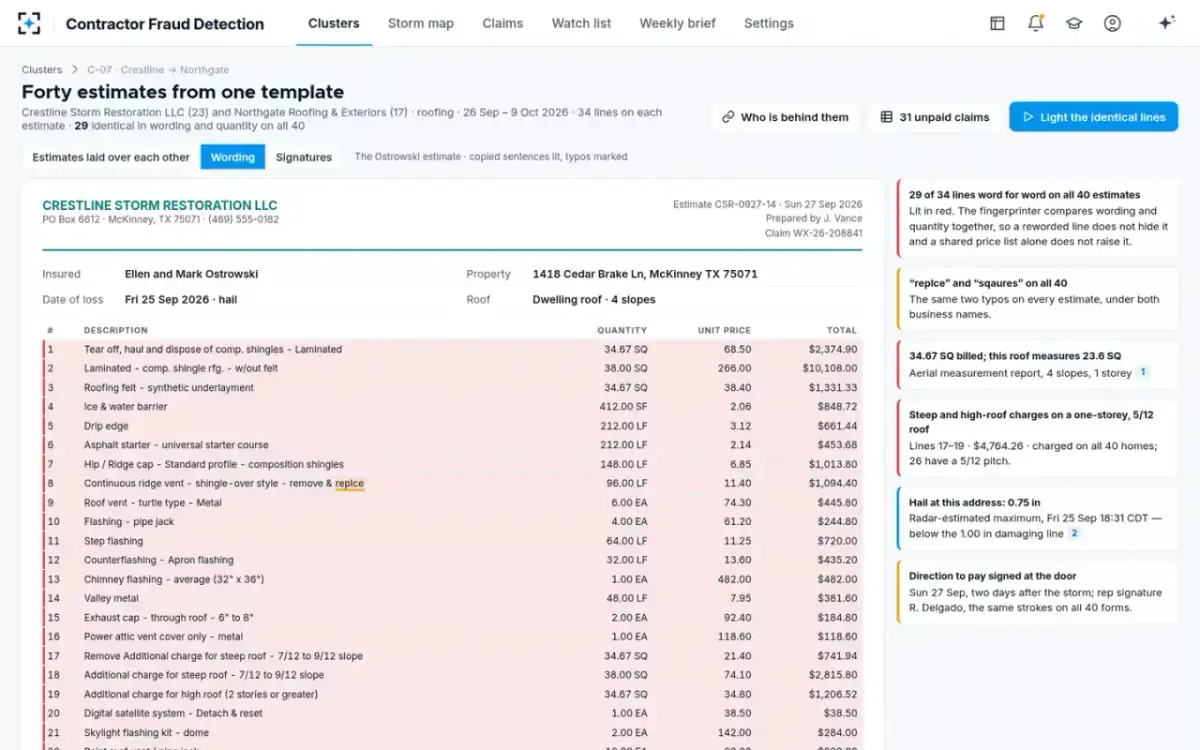
Take a fictional sample cluster the solution was run on: forty roof estimates after a Texas hailstorm, each 34 lines, each billing 34.67 squares of tear-off, on homes whose aerial measurements run from 21.4 to 39.8 squares. The figure puts a price on four of the pasted lines across the forty homes, using the estimates' own unit prices.
Four pasted lines across forty homes: about $200,000 of $1.24 million billed
What does inflated estimate mean? More than the loss needs, on purpose or not
An inflated estimate means one whose total is higher than the covered damage justifies. The word says nothing about intent, and that is the first thing a claims team has to keep straight. A contractor who measures a roof at 30 squares and bills 30 squares, where the adjuster's report says 28, has written a different estimate, not necessarily a dishonest one. A contractor who bills 34.67 squares on every roof in a subdivision, whatever each one measures, has not measured at all.
"Padding" is the everyday word for the same thing, and it is ambiguous too. In project management, padding an estimate means adding contingency so a budget is not overrun. On a claim, a padded estimate is one with extra quantity or extra lines added to raise the payment, which is the meaning this guide uses.
How do contractors inflate estimates? Five ways, each seen in a real or sample file
Contractors inflate estimates in five recurring ways, and each leaves a different trace. The first two are visible in the estimate itself; the last three need documents from outside it.
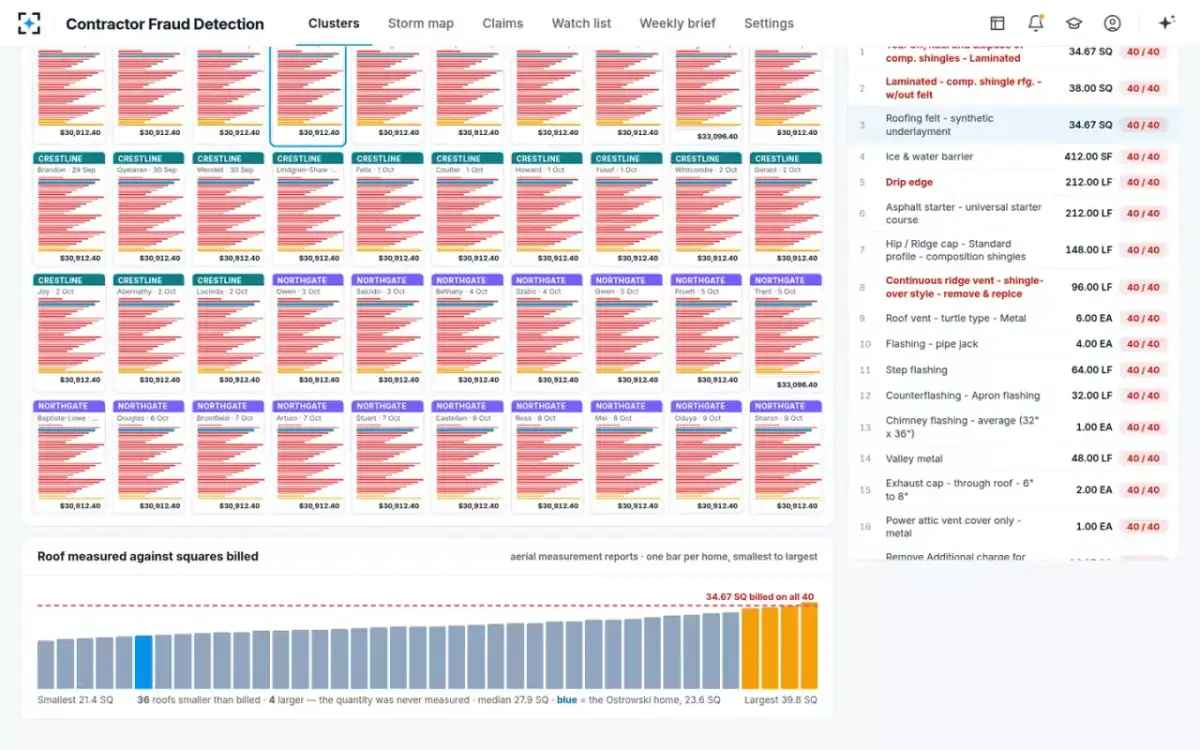
Pasted quantities. The quantities come from another job rather than this roof. In the sample cluster, 34.67 squares are billed on all forty homes; 36 roofs measure smaller and four larger, which is what a pasted number looks like against forty real ones.
Lines that do not fit the house. Charges for a steeper pitch, a second storey or features the home lacks. Each sample estimate bills steep-roof work for 7/12 to 9/12 pitch and a high-roof charge for two storeys or more, $4,764.26 for the three lines, on every home; 26 of the forty roofs are 5/12, and the Ostrowski home in the sample is a one-storey house.
Bills above what was charged. The insurer receives a different, larger invoice than the customer. The owner of an Ohio roofing company pleaded guilty to a scheme of sending insurers "dummy" or "duplicate" invoices with inflated amounts; at least 80 such invoices totalled about $1.369 million where the company had charged its customers about $1.24 million (U.S. Attorney, S.D. Ohio, January 2014).
Invented sub-bills and competing bids. The estimate leans on documents that were fabricated. The owner of a Washington restoration company "padded bills from sub-contractors, or submitted forged secondary estimates that appeared to be from competitors"; in one job he billed $84,000 for electrical work the named electrician had not done (U.S. Attorney, W.D. Wash., March 2010). How an altered invoice is caught is covered in inflated invoices.
Damage that was not the storm's. Old wear, another event, or damage made by hand, billed as this storm's. What it takes to hold such a claim properly is in hail damage insurance fraud: a payment hold that survives review.
One sample estimate in Contractor Fraud Detection: copied lines lit, arithmetic in the margin
Is inflating an insurance estimate fraud? When it is knowing and material
Inflating an insurance estimate is fraud when the inflation is a knowing, material misstatement made to deceive the insurer, and most state fraud statutes are written that broadly. Texas makes it an offence to prepare or present, with intent to defraud or deceive an insurer, "a statement that the person knows contains false or misleading material information" in support of a claim (Tex. Penal Code §35.02(a)). It also presumes, unless rebutted, that someone who submitted a bill for goods or services in support of a claim "caused the claim for payment to be prepared or presented" (§35.02(h)). The contractor cannot hide behind the homeowner's name on the claim.
Florida puts the warning on the contractor's own advertising. A roof-claim advertisement that does not state, in type at least half the size of its largest font, that "It is insurance fraud punishable as a felony of the third degree to intentionally file an insurance claim containing any false, incomplete, or misleading information" is a prohibited advertisement (Fla. Stat. §489.147). The same statute also draws the honest-difference line: a contractor must give a good faith, itemised estimate, and does not break the rule "if, as a result of the process of the insurer adjusting a claim, the actual cost of repairs differs from the initial estimate".
What is a padded estimate? Padded, disputed and supplemented are three different things
A padded estimate carries quantities or lines added to raise the payment; a disputed one reflects a genuine difference of measurement or method; a supplement adds work found once repairs begin. Claims teams that treat all three alike either pay the first or insult the second and third. The differences are visible in the documents.
Padded or honestly different: what each looks like in the file
Honest difference or supplement: Follow this roof, give or take a measurement method or waste factor.
Padded: The same on homes of different sizes, or above any measurement.
Honest difference or supplement: Match the house: pitch, storeys, features.
Padded: Include work the house cannot need, such as steep charges on a low-pitch roof.
Honest difference or supplement: The contractor can show photos, test squares or a code requirement.
Padded: No measurement or photo behind the number.
Honest difference or supplement: A supplement follows something found during the work.
Padded: The extra lines are there before anyone is on the roof.
Honest difference or supplement: Each estimate differs with its house.
Padded: The same lines and quantities recur across the contractor’s other claims.
What one copied line costs across forty homes
A copied line costs its overcharge on one home multiplied by the number of homes it is pasted onto, and the second number is the one that grows. On the Ostrowski home in the sample, the four lines in the opening figure plus the high-roof charge come to about $9,175 of a $30,912.40 estimate, by our arithmetic: 11.07 squares too many of tear-off, shingles and underlayment, and $4,764.26 of steep and high-roof work on a one-storey 5/12 roof. That is the size of overcharge a busy desk adjuster might negotiate down on one claim and move on.
The price of a copied line is a product, not a sum
| Factor | How it is counted | In the sample cluster | Who supplies it |
|---|---|---|---|
| Overcharge on one home | (billed − measured) × unit price | Ostrowski tear-off: (34.67 − 23.6) × $68.50 = $758 | Measurement report and the estimate |
| × homes it is pasted onto | Estimates in the cluster | 40, under two business names | Fingerprinter |
| × lines pasted the same way | Lines identical in wording and quantity | 29 of 34 | Fingerprinter |
| Still protectable | Unpaid claims plus withheld depreciation | $1,019,208 when the cluster was raised | Payment guard |
Across the cluster the four lines in the opening figure come to roughly $200,000, about 16% of the $1,240,864 billed, before the high-roof line and anything a re-inspection finds. The real-world cases have the same shape. In the Ohio case the inflation averaged roughly $1,600 per invoice, about $129,000 across eighty: unremarkable on any one claim, substantial in total. The Washington restoration owner overbilled an estimated $3.2 million across ten jobs.
Why the cluster, not the claim, is the unit to price
The cluster is the unit because that is how the money leaves, how the law grades it and how a hold protects it. Texas grades insurance fraud by the value of the claim, and it lets separate claims made "pursuant to one scheme or continuing course of conduct" be treated as one offence with their values added together (Tex. Penal Code §35.03). Where part of a claim was valid, only the difference counts as the claim's value (§35.02(g)). The table runs the Ohio pattern through those Texas grades, as an illustration only.
The same inflation, graded one invoice at a time and as one scheme (Texas grades, illustration)
| Counted as | Value of the false part | Texas grade under §35.02(c) |
|---|---|---|
| One typical invoice | about $1,600 | Class A misdemeanour ($750 to under $2,500) |
| Eighty invoices, one scheme | about $129,000 | Third-degree felony ($30,000 to under $150,000) |
| Forty sample estimates, four lines (our estimate above) | about $200,000 | Second-degree felony ($150,000 to under $300,000) |
The same arithmetic drives the insurer's own decision. Holding one claim over a $1,600 dispute is rarely worth the friction. Re-inspecting the 31 unpaid claims of a forty-home cluster, before a payment run, protects the unpaid part of the whole pattern: in the sample, $960,468.40 of unpaid estimates and $58,740 of withheld depreciation on claims already paid at actual cash value.
How do insurers spot inflated roof estimates? Measure, fit, compare
Insurers spot inflated roof estimates in three moves: measure the roof independently, check that every line fits the house, and compare the estimate with the same contractor's other estimates. The first two are standard desk review, and an estimating review team does them well; Botminds' Estimate and Supplement Review covers that one-estimate work. The third needs every estimate in the storm side by side, which is what a copied line cannot survive.
Forty roofs, one billed number: 36 smaller than billed, 4 larger
Signs of an inflated roof estimate a reviewer can check
- Billed squares against a measurement
Aerial report, field sketch or the insurer’s own estimate; the waste allowance should be stated, not hidden in the squares.
- Pitch and storey charges against the house
Steep and high-roof lines need a pitch and a storey count to match.
- Round or repeated quantities
The same drip-edge length or vent count on houses of different shapes.
- The same typos and notes
In the sample, the same two misspellings appear on all forty estimates under both business names.
- Invoices against what the homeowner was charged
In the Ohio case the insurer copy was larger than the customer’s.
- Sub-contractor and competing bids
Confirm with the named firm before they move the price.
Can an adjuster reject a contractor estimate? Yes, with reasons
An adjuster can decline to pay a contractor's estimate as written and pay what the covered damage costs; the insurer's obligation is to the policy, not to the estimate. A rejection has to be explained: in Texas a notice rejecting a claim "must state the reasons for the rejection" (Tex. Ins. Code §542.056(c)). Three states go further against a contractor that advertised or promised to pay the deductible: Colorado, Minnesota and Oklahoma say the insurer is not obliged to consider its estimate at all (C.R.S. 6-22-105; Minn. Stat. 325E.66).
The cleaner path on a suspected copy is the re-inspection: the field adjuster's test squares and measurements replace the pasted quantities with real ones, and the claim is paid on those. That is the recommendation the solution's payment guard makes on each unpaid claim in a cluster. It never rejects an estimate itself; the SIU manager decides each hold, and the catastrophe claims manager co-signs holds on more than ten claims.
What Contractor Fraud Detection prices, and what it leaves to you
The solution prices the pattern: which lines are identical in wording and quantity across a cluster, how far the billed squares sit from the measured ones, which homes saw damaging hail, and how much of the cluster is unpaid. It does not set the price of a roof; your estimating standards and your field adjusters do. It does not call a contractor fraudulent; the fingerprinter's rule is that a shared price list or template alone never raises a cluster. How it tells a firm's template from a copy is set out in insurance estimate comparison across claims.
Questions people ask
What is a copied estimate?
A copied estimate is one whose lines and quantities were pasted from another job instead of measured on this house. Its signature is the same quantities on homes of different sizes; in the sample cluster, 29 of 34 lines were identical in wording and quantity on all forty estimates.
How much do inflated estimates cost insurers?
No published source we can rely on measures it across the industry. Individual cases show the scale: about $129,000 across 80 invoices in an Ohio roofing case, and an estimated $3.2 million across ten jobs in a Washington restoration case. In the fictional sample cluster, four pasted lines account for roughly 16% of what was billed.
Is a supplement an inflated estimate?
Not by itself. A supplement adds work found once repairs begin, and Florida's contractor statute expressly allows the actual cost to differ from the first estimate as the claim is adjusted. A supplement becomes a problem when it adds work the house could not need or repeats across the contractor's other claims.
Who is liable for an inflated estimate, the homeowner or the contractor?
Whoever knowingly presented the false information. Texas presumes that a person who submitted a bill in support of a claim caused the claim to be prepared or presented, so the contractor cannot rely on the homeowner's name being on it; a homeowner who knew nothing is a victim.
Does Florida law require a contractor to give an itemised estimate?
Yes. In Florida a contractor may not hand an insured an agreement authorising repairs under a property claim unless it comes with a good-faith, itemised estimate of labour and materials (Fla. Stat. §489.147(2)(e)).