Insurance estimate comparison usually means setting one repair estimate against a price database, the insurer's own estimate or a second bid. That catches a high price. It does not catch the storm contractor whose prices are ordinary and whose estimates are copies: the same lines, the same quantities and the same notes on forty homes of different sizes. Comparing estimates across claims does, provided it can tell a copy from a template, because honest contractors reuse their own wording every day. Botminds' Contractor Fraud Detection compares every estimate in a storm with every other, scores wording and quantities together and raises only the groups above a line the insurer sets.
Two contractors from the fictional sample storm the solution runs on show the difference. Both use a template. One measured every roof.
A firm's template and a copied estimate, line by line
Template: Prestonwood Roof Co, 31 estimates: Company template; lines read alike across all 31.
Copy: Crestline and Northgate, 40 estimates: 29 of 34 lines word for word on all 40.
Template: Prestonwood Roof Co, 31 estimates: From 18.2 to 41.6, following each roof.
Copy: Crestline and Northgate, 40 estimates: 38.00 on every home.
Template: Prestonwood Roof Co, 31 estimates: From each eave length.
Copy: Crestline and Northgate, 40 estimates: 212 LF on every home.
Template: Prestonwood Roof Co, 31 estimates: Where the roof needs them.
Copy: Crestline and Northgate, 40 estimates: On every home; 26 of 40 roofs are 5/12.
Template: Prestonwood Roof Co, 31 estimates: Vary with the writer.
Copy: Crestline and Northgate, 40 estimates: The same two typos on every estimate, under both names.
Template: Prestonwood Roof Co, 31 estimates: 0.62, under the 0.85 line.
Copy: Crestline and Northgate, 40 estimates: 0.97, over it.
Template: Prestonwood Roof Co, 31 estimates: Checked by the fraud analyst and cleared.
Copy: Crestline and Northgate, 40 estimates: Unpaid claims held for re-inspection.
How do you compare estimates across claims? Line by line, every pair, by quantity
You compare estimates across claims by breaking each into its lines, comparing every estimate with every other in the storm, scoring how much of the wording and the quantities they share, and grouping the ones that score high. The method is borrowed from web search, where engines find near-copies of pages by cutting text into short overlapping runs of words and comparing the sets: "two documents are near duplicates if the sets of shingles generated from them are nearly the same" (Manning, Raghavan and Schütze, Introduction to Information Retrieval, Stanford). The insurance version adds the column search engines do not have: the quantity on each line, which has to change with the house.
At storm scale the arithmetic is large but routine. In the sample storm, one morning's run compared 188 new estimates with 2,718 earlier ones, read 6,214 lines and found a new six-home cluster. By hand, an analyst notices repeats when a name or a number rings a bell, which in our estimate takes about 30 days on a cluster like the largest one in the sample.
Why do contractors reuse estimates? A template is normal
Contractors reuse estimates because writing every roof from scratch is slow and most roofs need the same kinds of work. Estimates are commonly written in estimating software with standard line items, and a firm's own template carries its usual notes, materials and order of lines. A federal case in Washington even describes an insurer authorising a contractor's estimating program that "built in 20% profit and overhead" (U.S. Attorney, W.D. Wash.). Identical wording across one contractor's estimates is therefore expected, and a comparison that flags it will drown the SIU in honest firms.
Florida's contractor statute points to the part that should not repeat. A contractor must give the homeowner "a good faith estimate of the itemized and detailed cost of services and materials" for the repairs (Fla. Stat. §489.147(2)(e)). Itemised costs for this house mean quantities measured on this house.
What is a copied estimate? Same quantities on different houses
A copied estimate is one whose lines and quantities were pasted from another job, so the quantities do not follow the house. Wording alone cannot show it; quantity can. In the sample cluster, 34.67 squares of tear-off were billed on all forty homes while aerial measurements ran from 21.4 to 39.8 squares, median 27.9. Thirty-six roofs were smaller than billed and four were larger, which is the tell: a padded estimate is too high, a copied one is wrong in both directions. How much a copied line costs across a storm is worked through in inflated estimate meaning.
Forty estimates laid over each other in Contractor Fraud Detection
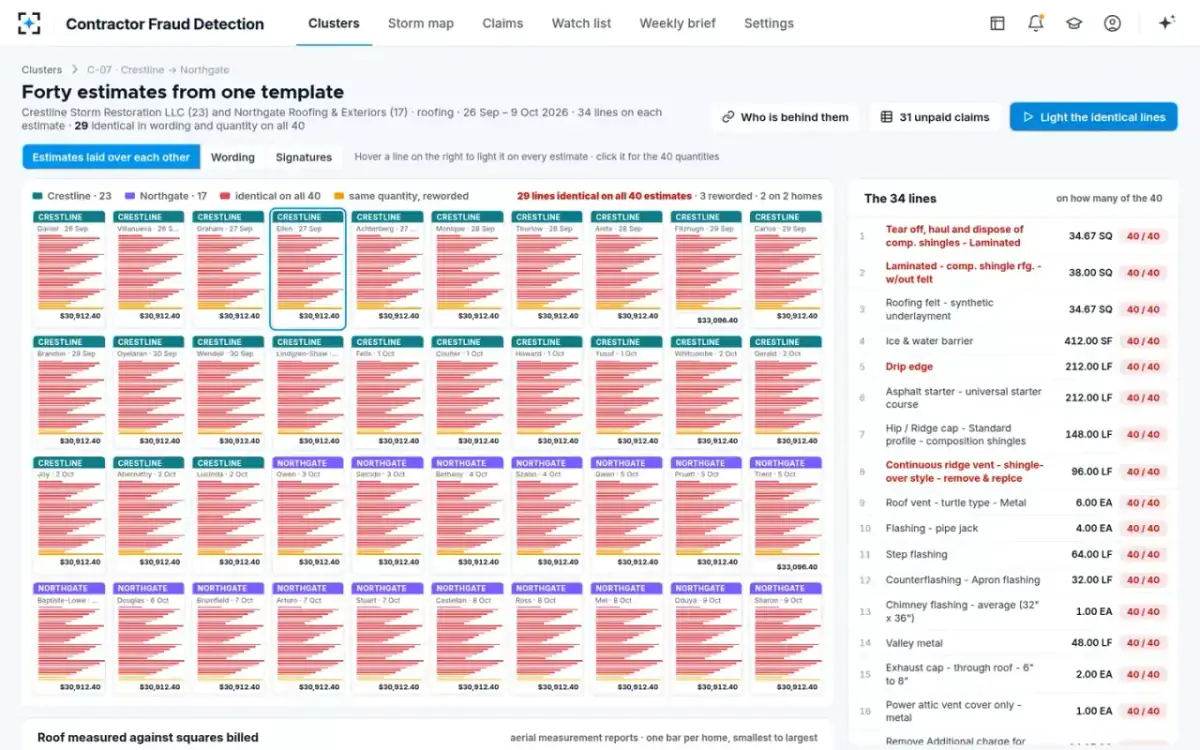
How similar can two roof estimates be? Very, in wording; rarely, in quantities
Two honest estimates from the same firm can share almost all their wording; they should rarely share all their quantities, because roofs differ in area, pitch, eaves, valleys and penetrations. That is why a useful similarity score combines the two, and why the solution's fingerprinter has a rule that "a shared price list or template alone never raises a cluster". The scores of every contractor group in the sample storm with five homes or more show how that plays out.
Fourteen contractor groups in one storm, by how alike their estimates are
What is an estimate fingerprint? A compact summary that can be compared at scale
An estimate fingerprint is a compact representation of an estimate's lines, wording and quantities, built so that millions of pairs can be compared quickly. The Stanford text describes the classic trick: hash each short run of words and keep a small sample of the hashes, so that the share of matching samples estimates how much two documents overlap. For estimates, the runs include the quantity and unit with the words, so "34.67 SQ tear-off" and "23.6 SQ tear-off" are different shingles even though the description is identical.
The same idea applies beyond roofs, and the sample storm's watch list shows what it finds in other trades. The evidence differs; the pattern does not.
The same comparison, four trades: what a copy looks like in each
| Contractor (sample) | Trade | Strongest evidence | Status |
|---|---|---|---|
| Ironbridge Exteriors | Roofing | The same test-square photo on 6 roofs, rotated | Investigating |
| Bluebonnet Tree & Debris | Tree removal | One $8,940 invoice on 17 homes; 5 with no tree on the roof | Investigating |
| DryRight Mitigation | Water and mould | The same moisture readings, to the decimal, in rooms of different sizes | Investigating |
| Lakeshore Tree Pros | Tree removal | Invoices matched crew logs and photos | Cleared |
What is a similarity threshold, and who sets it?
A similarity threshold is the score at or above which a group of estimates is raised to the SIU, and the SIU and catastrophe leadership should set it, not the vendor. In Contractor Fraud Detection it is a setting, 0.85 by default and adjustable from 0.70 to 0.95, alongside the smallest group raised (five homes by default) and the number of document links needed to treat two business names as one contractor (two by default). Every change is versioned and replayed on the last three storms, so moving the line shows its effect in clusters, homes and dollars on storms the team already knows.
Where the line sits has consequences beyond workload. In California the SIU must investigate every credible referral, including those generated by a system, and when it closes one at preliminary review it must write down why (10 CCR §2698.36). A line set too low turns templates into investigations that each need a written reason; a line set too high lets a clever copy, with a few quantities nudged, pass. The Halcyon group in the sample, at 0.83, is the kind a team watches rather than raises.
Can software detect copied estimates? What to test before you buy
Software can detect copied estimates reliably when it compares across claims and scores quantities; the way to know whether a particular product does is to run it on a storm you have already worked. NAIC's antifraud plan guideline already treats doctored estimates as evidence of suspected fraud, and asks insurers to describe the detection technology they use (NAIC Antifraud Plan Guideline, GL-1690), so the test results are also what an examiner may ask to see.
Questions to put to any estimate comparison tool
- Does it compare across claims, or only against a price list?
A price check finds expensive estimates; a cross-claim comparison finds copied ones.
- Does the score use quantities?
Ask to see a template contractor it scored low, and why.
- Does it read estimates as written?
Typos, notes and rounding are evidence. A tool that cleans them first throws evidence away.
- Does it work across business names?
A renamed contractor’s estimates should still cluster, because the lines did not change.
- Who sets the line, and can you replay it?
Thresholds should be your settings, tested on your past storms.
- What does a raised group show?
The identical lines lit on every estimate, the measured roofs and the documents behind any name link.
- What can it not do?
It should never call a contractor fraudulent, hold a payment or flag on a name.
Where comparison stops: the person who decides, and the names behind the copies
Comparison finds the group; it does not decide what the group means. In the solution, a raised cluster goes to the SIU manager with the evidence: the identical lines, the measured roofs, the hail at each address and the unpaid claims with their prompt-pay dates. The identity linker then shows whether different business names on the estimates are one contractor, linking only on values found in documents, such as a phone number, a bank account or a signature, and never on a similar name. Record-matching statisticians have long worked this way, with computers doing the comparisons and people reviewing the uncertain pairs (Winkler, U.S. Census Bureau, 2006).
The people make the decisions that touch money: the SIU manager decides holds, the catastrophe claims manager co-signs holds on more than ten claims, field adjusters re-inspect, and the fraud analyst clears a template or completes a referral. How those checks divide between agents and people is laid out in contractor verification software, and how a cluster becomes a hold that survives review in hail damage insurance fraud.
Where Contractor Fraud Detection fits in estimate review, and where it does not
The solution sits beside estimate review, not in place of it. A desk adjuster or an estimating team still checks whether an estimate's scope and prices are right for the loss; Botminds' Estimate and Supplement Review is built for that one-estimate work. Contractor Fraud Detection answers a different question: whether this estimate is one of many, written once and pasted across a storm. It reads contractor estimates and invoices as they arrive, in whatever format the contractor sends, keeps every line exactly as written, typos included, and never edits or rounds a figure.
What it hands over is a group, not a verdict. Each raised cluster shows the lines that are identical on every estimate, the roofs measured against the squares billed, the hail at each address, the names on the estimates and any document links between them, and the claims still unpaid with their prompt-pay dates. It does not price a roof, decide coverage, hold a payment or contact a contractor. In buying terms, the honest test is the one in the checklist above: give it the estimates from a storm your SIU has already worked, and compare what it raises, and when, with what your team found by hand.
The comparison also has a limit worth stating. It finds estimates that resemble each other; a contractor who writes every estimate from scratch and inflates each one differently will not cluster, and needs the measured-against-billed and line-fit checks a reviewer applies to a single estimate. Those checks are listed in inflated estimate meaning, and the season in which all of this happens in storm chasing roofing contractors.
Questions people ask
How do insurers compare contractor estimates?
Usually one at a time, against the insurer's own estimate or a pricing database, which catches high prices. Comparing each estimate with every other in the storm catches copies; in the sample storm, 29 of 34 lines were identical in wording and quantity on forty estimates.
Is it fraud if two estimates are identical?
Not by itself. Identical wording from one firm's template is normal; identical quantities on homes of different sizes mean the quantities were not measured. Whether that is fraud depends on intent, which is for investigators, not for a similarity score.
What score means an estimate was copied?
There is no universal number. In the sample storm the line is 0.85 on a 0 to 1 scale; the five groups at or above it were raised, and a firm template at 0.62 was checked and cleared. Each insurer should set its line from replays on its own storms.
Can a contractor beat the comparison by changing a few numbers?
It can lower the score, which is why the line should be tested and why other evidence matters: measured against billed squares, the same typos, the same bank account on the direction-to-pay forms. A group just under the line, like Halcyon at 0.83 in the sample, is worth watching.
Does estimate comparison work for water mitigation and tree removal?
Yes. The evidence changes by trade: the same moisture readings to the decimal in rooms of different sizes, or the same invoice for tree removal on homes without a tree on the roof, as on the sample storm's watch list.