The difference between an assignment of benefits and a direction to pay is who owns the claim. An assignment of benefits (AOB) transfers some or all of the homeowner's right to the policy's post-loss benefits to the contractor, who can then deal with the insurer, and sue it, in its own name. A direction to pay (DTP) leaves the claim with the homeowner and instructs the insurer to put the contractor on the payment. Florida made the distinction decisive: for residential and commercial property policies issued on or after 1 January 2023, a post-loss assignment is void. After a storm both forms arrive by the thousand, often signed at the door. Botminds' Contractor Fraud Detection reads them as part of the evidence on each claim, because the payee and the bank account on the form tell the insurer who is really behind an estimate.
Assignment of benefits vs direction to pay, row by row
Assignment of benefits: Transfers the homeowner’s right to post-loss benefits, in whole or in part, to the contractor.
Direction to pay: Tells the insurer to pay the contractor, or to name it on the check; the claim stays the homeowner’s.
Assignment of benefits: The contractor, as assignee, for the assigned benefits.
Direction to pay: The homeowner, who remains the claimant.
Assignment of benefits: The contractor, in its own name, if the assignment is valid.
Direction to pay: The homeowner; the contractor has no claim under the policy of its own.
Assignment of benefits: Void, invalid and unenforceable (§627.7152(13)).
Direction to pay: Not addressed by §627.7152, unless it works as an assignment in substance.
Assignment of benefits: Valid only if it meets §627.7152(2): 14-day rescission, itemised per-unit estimate, notice to the insurer within 3 business days.
Direction to pay: Not addressed by §627.7152, unless it works as an assignment in substance.
Assignment of benefits: Litigation by the assignee; costs the homeowner cannot see.
Direction to pay: Payment to an account the homeowner did not choose; a “direction” that is really an assignment.
What is the difference between assignment of benefits and direction to pay?
An assignment moves a right; a direction to pay moves a payment. Florida's statute defines an assignment agreement broadly, as "any instrument by which post-loss benefits under a residential property insurance policy or commercial property insurance policy ... are assigned or transferred, or acquired in any manner, in whole or in part, to or from a person providing services" such as inspecting, repairing or mitigating damage (Fla. Stat. §627.7152(1)(b)). Once the contractor holds the right, it stands in the homeowner's place for those benefits.
A direction to pay does none of that. In the case described below, Florida's Fifth District Court of Appeal described the homeowner's "Direction of Payment" as instructing the insurer "to make Noland's Roofing a payee on any disbursement check" (Holding Ins. Cos. Accountable v. Am. Integrity, 5th DCA, 2025). The contractor gets paid through the claim; it does not get the claim.
What is an AOB in insurance? A transfer of the claim, now heavily regulated
An AOB is an assignment of insurance benefits after a loss, most often to a water-mitigation firm, roofer or restoration contractor. Florida's regulator documented how they spread before the reforms. Its 2017 data call found AOB use had risen "from 12.8% of water claims to 17.0% of water claims" since 2015, and that claims with an assignment had a higher severity than those without, "generally at least 85% more" (Florida OIR, 2017 AOB data call).
Florida before and after: claims, suits and assignments
17.0%
of water claims carried an assignment by mid-2017, up from 12.8% in 2015
85%+
higher severity on claims with an assignment than without
9.73%
of US homeowners claims opened in Florida in 2023
71.59%
of US homeowners suits opened in Florida in 2023
Why did Florida ban assignment of benefits? Litigation, in four steps
Florida restricted and then voided post-loss assignments as part of a series of reforms aimed at property insurance litigation. Its regulator's own account starts with 2019 legislation "curbing excessive litigation associated with the use of Assignment of Benefits (AOBs)", followed by SB 76 in 2021, SB 2-D and SB 2-A in 2022 and HB 837 in 2023 (Florida OIR, January 2026). SB 2-A did two things at once for policies issued from 2023: it prohibited post-loss assignments and cut the time to pay or deny a claim "from 90 to 60 days" (Florida Senate bill summary).
Florida's AOB rules, from data call to ban
- 2017 data call: AOBs rising2017–18
- 2019: AOB conditions2019–20
- 2021–22: SB 76, 2-D, 2-A2021–22
- 2023: AOBs void, HB 8371 Jan 2023+
The 2019 statute did not ban assignments; it attached conditions. An assignment had to be in writing, give the homeowner 14 days to rescind without penalty, include "a written, itemized, per-unit cost estimate", reach the insurer within 3 business days and carry an 18-point notice that begins "YOU ARE AGREEING TO GIVE UP CERTAIN RIGHTS YOU HAVE UNDER YOUR INSURANCE POLICY". An emergency assignment was capped at the greater of $3,000 or 1% of Coverage A, and an assignee had to give 10 business days' notice before suing (§627.7152(2), (9)). Those rules still govern assignments under policies issued between 1 July 2019 and 31 December 2022.
Is assignment of benefits legal in Florida? Not under policies issued from 2023
For a residential or commercial property policy issued on or after 1 January 2023, no. The statute says a policyholder "may not assign, in whole or in part, any post-loss insurance benefit", and that an attempt to do so "is void, invalid, and unenforceable" (§627.7152(13)). A few transfers are outside the rule: an assignment to someone who buys the property after the loss, a power of attorney to a management company or family member, and liability coverage (§627.7152(11)).
The reform is showing in the data the regulator tracks. Florida OIR reports that residential lawsuits served on insurers fell 23% from 2023 to 2024, and 26% in the first eleven months of 2025 against the same period of 2024 (Florida OIR, January 2026). That figure covers all the reforms together, not the assignment ban alone.
Does a direction to pay give the contractor my claim? Not by itself
A direction to pay, on its own, leaves the claim with the homeowner; but a document labelled a direction to pay, or paired with one, can still be treated as an assignment. In a January 2025 decision, a homeowner had signed a direction to pay in favour of his roofer, then assigned his benefits to a company that would sue the insurer, signing a form that said he wanted it to ensure the direction to pay was honoured. The court held that this "mandatory passthrough of benefits" to the roofer placed the assignment "within the broad reach of section 627.7152"; it did not comply, so the company had no standing (5th DCA, 2025). The court added that a "boilerplate disclaimer" saying the assignee provided no repair services "does not sanitize" the arrangement.
For an adjuster, the lesson is to read the form, not its title. A form that only names a payee is a direction. A form that gives the contractor the right to negotiate, settle, sue or receive the benefits is an assignment, whatever it is called, and in Florida it is void for most current policies.
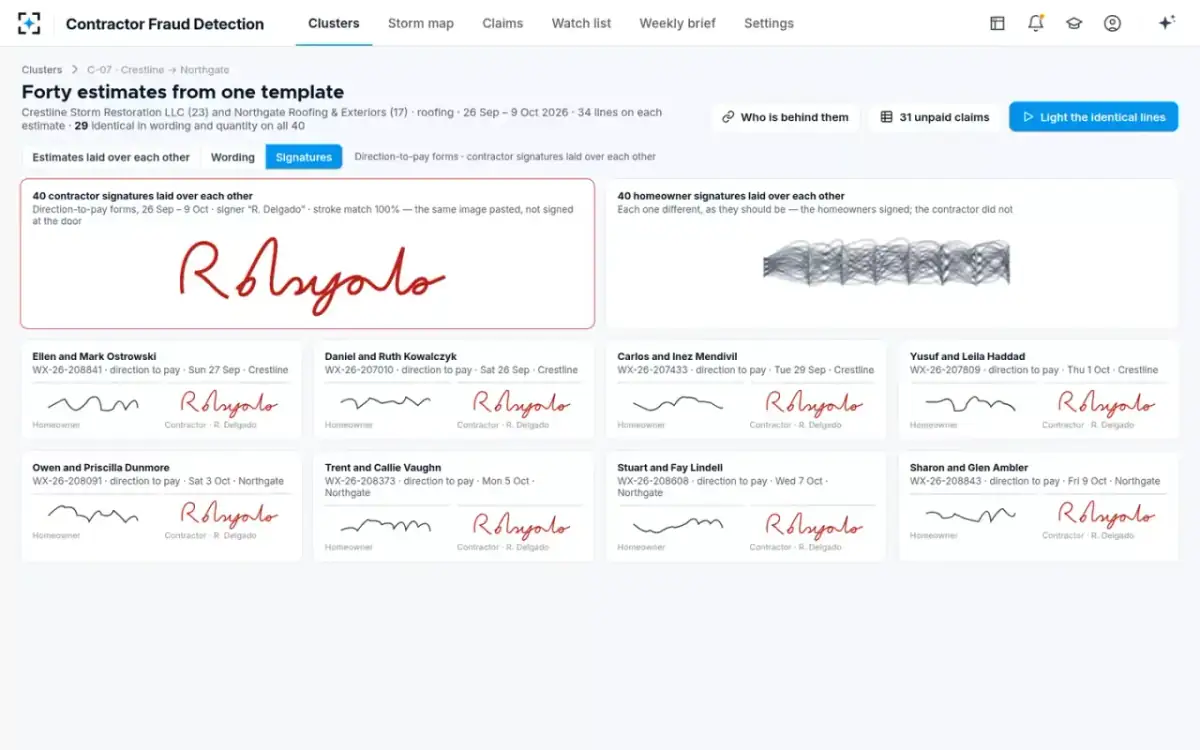
Direction-to-pay forms read by Contractor Fraud Detection: one pasted contractor signature
Beyond Florida: Minnesota's copayee rule, and Texas and Colorado on adjusting
Other states regulate the same problem differently. Minnesota did not ban post-loss assignments to residential contractors in 2023; it shrank them to something close to a direction to pay. Such an assignment "must only authorize a residential contractor to be named as a copayee", must itemise the work, materials and price, must reach the insurer within five business days, and may be cancelled within ten business days; and it "must not prevent or inhibit an insurer from communicating with the named insured" (Minn. Stat. 325E.67).
Four states, four answers to the contractor who wants the claim
| State | Assignment of benefits | The contractor acting for the homeowner |
|---|---|---|
| Florida | Void for residential and commercial property policies issued on or after 1 Jan 2023 | May not adjust a claim unless licensed as a public adjuster (§489.147(2)(d)) |
| Minnesota | Allowed only as a copayee assignment, itemised, cancellable within 10 business days | May not adjust or advise on coverage without a public adjuster licence (325E.66) |
| Texas | No statute read here addresses the assignment itself | A contractor may not act as public adjuster on a property it repairs, even under a power of attorney or other agreement (Ins. Code §4102.163) |
| Colorado | No statute read here addresses the assignment itself | May not act as a public adjuster, but may discuss the scope of repairs with the insurer under a valid contract (C.R.S. 6-22-105(3)) |
Texas's rule matters for directions to pay in particular. A contractor that holds a direction to pay still may not "act as a public adjuster or advertise to adjust claims" for a property it repairs, "regardless of whether the contractor ... is authorized to act on behalf of the insured under a power of attorney or other agreement" (Tex. Ins. Code §4102.163). Texas regulators also warn homeowners against contracts that promise the contractor "every penny" of the insurance payment (TDI).
Can a contractor sue my insurer?
Only if it holds a valid assignment of the benefits, or the homeowner sues and the contractor's bill is part of the claim. With a direction to pay, the contractor is a payee, not a party to the policy. In Florida, for policies issued from 2023, an attempted assignment is void, so a contractor generally cannot sue the insurer in its own name under that policy. Florida's 2022 reforms also removed one-way attorney fees in property insurance suits, which changed the economics of the suits that remain (SB 2-A summary).
Should I sign a direction to pay? What to read before you do
Whether to sign is the homeowner's decision, and a lawyer's question if the form is unusual; what can be said in general is what to read. The checklist covers the points the statutes on this page turn on.
Reading a direction-to-pay or assignment form
- Does it transfer rights, or name a payee?
Words like assign, transfer, negotiate, settle or sue make it an assignment, whatever its title.
- Whose bank account will receive the money?
A form that sends the whole payment to the contractor, before work, removes your leverage over the job.
- Is there an itemised estimate attached?
Florida and Minnesota require one for an assignment; it is good practice for any form tied to a claim.
- Does it promise the contractor all of the insurance proceeds?
Texas regulators tell homeowners never to sign that language.
- Can you cancel it, and how?
Minnesota gives ten business days for a copayee assignment; Florida gave 14 days under its 2019 rules.
- Does it stop your insurer from talking to you?
Minnesota forbids that in a copayee assignment; you remain the insurer’s customer.
A thousand forms signed at the door: how Contractor Fraud Detection reads them
After a storm, the forms are evidence as well as instructions. In the fictional sample storm the solution runs on, 1,118 direction-to-pay forms arrived with 2,906 contractor estimates and invoices; the first were signed the day after the hail. The estimate reader takes the signer, the date signed and the bank details from each form. Across a copied-estimate cluster, the same bank account and the same pasted contractor signature on forty forms, under two business names, are two of the five links that showed the names were one contractor.
The solution does not decide whether a form is a valid assignment; claims counsel does. It does show which forms send money to which accounts, and that is often the fastest route from a cluster of estimates to the people behind it. How those links are drawn is set out in contractor verification software, and the deductible rules that often travel with these forms in is it illegal for a roofer to pay your deductible.
Questions people ask
What is a direction to pay form?
It is a short instruction from the homeowner to the insurer to pay a named contractor, or to add it as a payee on the claim check. It does not transfer the claim; in the 2025 Florida case, the court described one as instructing the insurer to make the roofer "a payee on any disbursement check".
What is the new Florida assignment of benefits law?
Since SB 2-A of December 2022, post-loss assignments under residential and commercial property policies issued on or after 1 January 2023 are void (§627.7152(13)). Assignments under policies issued from 1 July 2019 to the end of 2022 must still meet the 2019 conditions.
Is an assignment of benefits the same as a direction to pay in Minnesota?
Not quite, but close: since 2023 a post-loss assignment to a residential contractor may only make the contractor a copayee, must be itemised and can be cancelled within ten business days (Minn. Stat. 325E.67).
Can a public adjuster take an assignment of benefits in Florida?
The assignment statute's definition excludes "fees collected by a public adjuster" under Florida's public adjuster law, so a public adjuster's fee agreement is treated separately from a contractor's assignment (§627.7152(1)(b)).
Does a direction to pay let the contractor talk to my insurer?
It lets the insurer pay the contractor, not negotiate with it on your behalf. Florida, Minnesota and Colorado bar contractors from adjusting claims without a public adjuster licence, and Texas bars it even under a power of attorney; Colorado lets a contractor with a valid contract discuss the scope of repairs.