Inflated invoices are bills that charge for more than was actually done or supplied: a line for work never performed, more storage days or labour hours than the job took, a unit price above the going rate, or a total typed over the true sum of the lines. In insurance claims they are the most ordinary document fraud, because the loss is real and only the amount is padded, so the claim passes every check that asks whether something happened. What an inflated invoice costs the insurer depends on one fact: whether the extra line is found before the payment or after it. Before, it costs an adjuster's question. After, it costs a recovery attempt, a referral and, unless it is recovered, the money itself. Document Fraud Detection is Botminds' solution for testing claim documents before they are paid. It recomputes every invoice, checks it against the claim, the price list and the vendor register, and pins each finding on the page for the adjuster to decide.
The same inflated line, found after payment and found before
Found after payment: A referral, an investigation, and a demand or a court order to get money back.
Found before payment: An adjuster’s question, or a hold on one line while the vendor is asked.
Found after payment: The extra amount, already in someone else’s account.
Found before payment: The extra amount, still in the insurer’s account.
Found after payment: The SIU, the state fraud bureau, a prosecutor and a court, in that order.
Found before payment: The adjuster, with the finding in front of her.
Found after payment: Whatever was kept, and a vendor who now knows there is a question.
Found before payment: The document as received, with its fingerprint, and a vendor who has not yet been asked.
Found after payment: Not affected, but premiums carry what is never recovered.
Found before payment: Paid the true amount, with a short delay on one line.
Found after payment: $37,570 paid on altered invoices in a California case; restitution depends on a conviction.
Found before payment: A $5,000 typed-over total held on the sample invoice.
What is an inflated invoice? Five ways a real bill gets bigger
An inflated invoice is a real bill made larger, rather than a bill invented from nothing. That distinction matters because the checks that catch a fake vendor or a non-existent loss pass an inflated invoice straight through: the tow truck came, the car was stored, the water was dried out. The padding hides in the arithmetic, the units and the dates. Public enforcement cases show five patterns, and each needs its own check.
Five patterns of inflation, with a case for each and the check that catches it
| Pattern | A case on the record | The check that catches it |
|---|---|---|
| Phantom line | A $4,250 towing invoice with a $500 "clean up" fee and a $750 "special equipment" fee; video and witnesses indicated neither was used (North Carolina, charged July 2026). | Lines against the job: what the claim, photos and approved estimate say was needed |
| Extra days | An invoice billing 35 days of storage at $75 a day, part of an alleged attempt to obtain $6,875, while licence-plate readers saw the car outside the lot several times (North Carolina, charged August 2026; an accusation, not a conviction). | Days billed against claim facts: tow date, release date, sightings, citations |
| Extra hours or units | Body labour billed at 7.5 hours against 5.5 approved, 2.0 hours at $64.00 = $128.00 (fictional sample). | Units against the approved estimate and the regional price list |
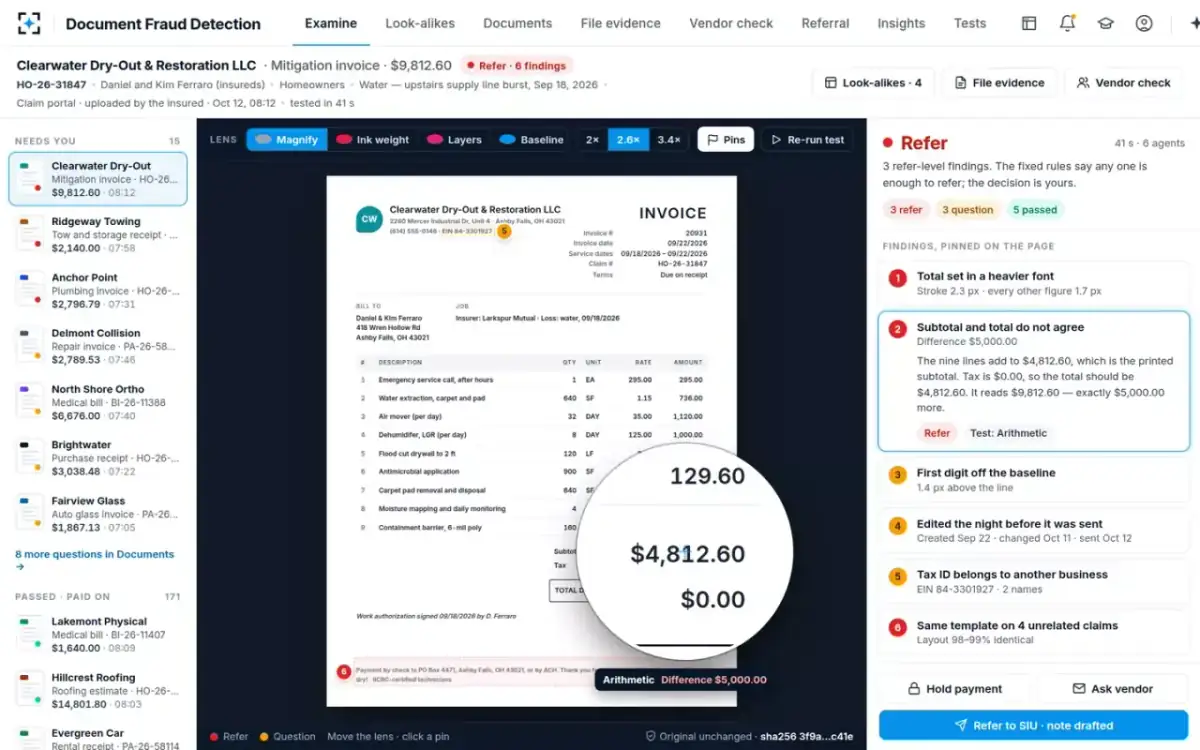
| Typed-over total | A total of $9,812.60 on nine lines that add to $4,812.60 (fictional sample). | Arithmetic: lines, subtotal, tax, total recomputed |
| Inflated and fictitious, together | $19,719.71 in fictitious and inflated auto repair invoices on an engine claim after a minor parking-lot accident (North Carolina, charged October 2026). | Vendor register, repair against damage, and the same documents on other claims |
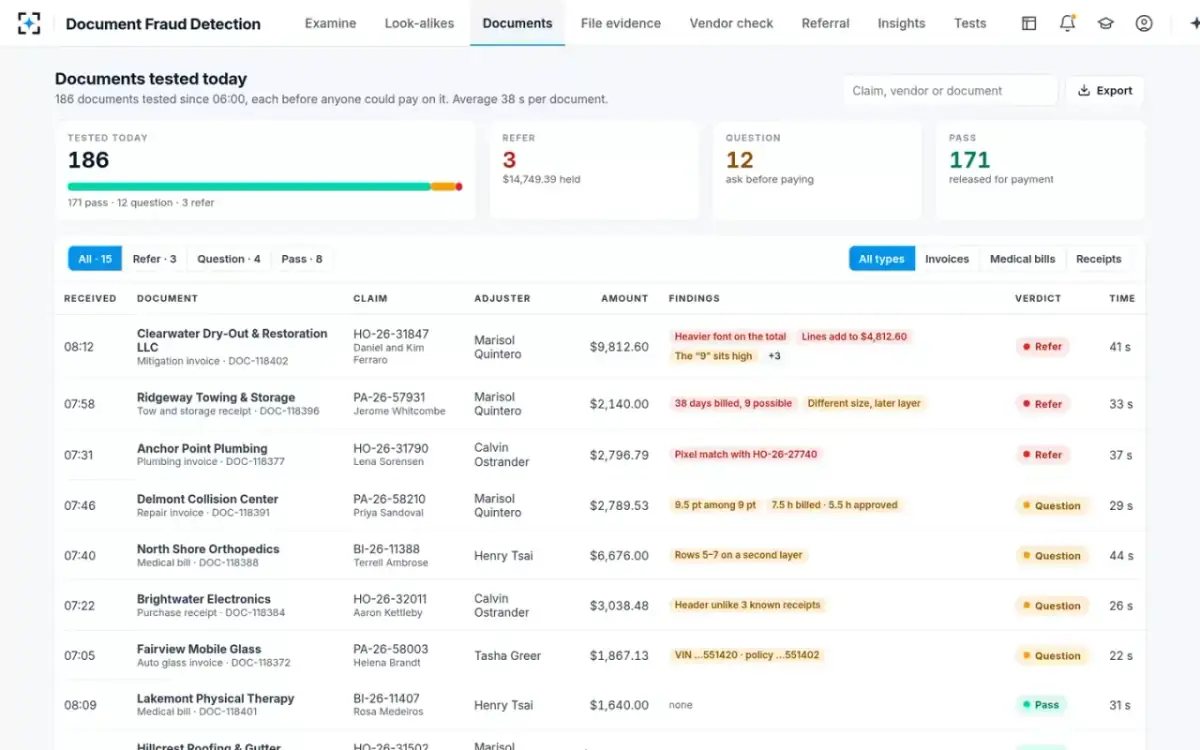
The storage case shows why a claim document has to be tested against the claim, not only against itself. A storage invoice for 35 days at $75 a day is arithmetically perfect. What exposed it, according to the arrest warrants, was outside data: plate-reader sightings, photos showing the bumper intact, and a driver cited twice during the days the car was supposedly locked up (NCDOI). The sample solution runs the same kind of comparison against claim facts. On the sample morning, a tow-and-storage receipt was flagged "38 days billed, 9 possible".
Is inflating an invoice fraud?
Yes, when it is done knowingly to get paid more. State fraud statutes reach the written statements that support a claim, not only the claim itself. Florida makes it insurance fraud to present a statement in support of a claim "knowing that such statement contains any false, incomplete, or misleading information concerning any fact or thing material to such claim" (§ 817.234). A line for work not done is false; a total above the sum of the lines is misleading; both are material because they set the payment.
The penalties scale with the amount, so the size of the padding changes the charge. New York grades insurance fraud by the property wrongfully taken or attempted: over $1,000 is a class E felony, over $3,000 a class D, over $50,000 a class C and over $1 million a class B. Florida grades by the value involved, from a third-degree felony under $20,000 to a first-degree felony at $100,000 or more. California's felony for false claims and the writings behind them carries a fine of up to $50,000 or twice the amount of the fraud, if that is more (Penal Code § 550(c)(1)).
How three states grade insurance fraud by the amount
| State | Amount | Grade |
|---|---|---|
| New York | Any fraudulent insurance act | Fifth degree, class A misdemeanor |
| New York | Over $1,000 taken or attempted | Fourth degree, class E felony |
| New York | Over $3,000 | Third degree, class D felony |
| New York | Over $50,000 | Second degree, class C felony |
| New York | Over $1,000,000 | First degree, class B felony |
| Florida | Less than $20,000 | Third-degree felony |
| Florida | $20,000 to under $100,000 | Second-degree felony |
| Florida | $100,000 or more | First-degree felony |
| California | False claim, or a writing prepared to support one | Felony: two, three or five years; fine up to $50,000 or double the fraud |
One detail in the New York ladder matters for timing. Each degree covers property the person "wrongfully takes, obtains or withholds, or attempts to wrongfully take, obtain or withhold" (§ 176.20). An inflated invoice caught before payment is still the same crime. Catching it early does not let anyone off; it only changes whether the insurer has to chase its money.
What happens if an inflated invoice is paid? The insurer starts to chase
Once an inflated invoice is paid, the insurer's only route to the money is recovery: a demand, a referral, and in the end a court's restitution order. The Government Accountability Office has a name for this, written for federal programs but exact for claims: "“Pay-and-chase” refers to the practice of detecting fraudulent transactions and attempting to recover funds after payments have been made." Its framework concludes that preventive activities "generally offer the most cost-efficient use of resources" (GAO-15-593SP).
California shows what the chase looks like. After a sprinkler claim at a family motel, the owner's son submitted invoices and estimates totalling $50,325, and the insurer paid $37,570. Investigators then contacted the vendors and found the documents "were not legitimate or were altered"; one vendor denied producing an estimate at all. The case ended with a no-contest plea to felony accessory counts, probation, $25,500 in fines and an agreed $50,000 donation to a homeless centre (CDI). The vendors were asked only once fraud was suspected; a call to the vendor before payment is the cheapest version of the same check.
Paid first, examined later: what inflated and altered invoices obtained in recent cases
$37,570
paid on $50,325 of invoices and estimates later found not legitimate or altered
California, sentenced 2021
$43,097
obtained with forged rental invoices for a home the claimant was not living in
North Carolina, charged 2026
$13,505
in two settlements on altered chiropractic and massage invoices
North Carolina, charged 2026
$5,000
typed over the sum of nine lines, held before payment
Fictional sample invoice
Can an insurer recover money paid on a fake invoice?
Sometimes, slowly, and rarely in full. The main route is criminal restitution, which follows a conviction. California's statute is mandatory once there is one: "Restitution shall be ordered for a person convicted of violating this section" (Penal Code § 550(c)(4)). Ordered is not collected. Texas reported that its Fraud Unit's investigations led to $50.9 million in court-ordered restitution in fiscal 2025, a figure for orders, not for money returned (TDI).
The New Jersey case announced in October 2026 shows the timeline. Fabricated mitigation and restoration invoices, attributed in part to a business with no filings or registrations in state records, allegedly drew about $108,000 in payments between April 2022 and May 2023, with a claims examiner approving them. The indictment came in October 2026. For the examiner, who pleaded guilty, the state will recommend probation "with restitution" (NJ OAG). About four and a half years separate the first of those claims from the family's indictment. A civil suit or a demand on the vendor is faster only if the vendor is real, solvent and reachable, which an invented restoration business is not.
What does an inflated invoice cost an insurer? Price the line three ways
Price an inflated line three ways: the amount itself, what it costs to find, and what it costs to recover once paid. The first is on the invoice. The second is small before payment and large after. The third is often the whole amount, because what is not recovered is simply lost. California's fraud referral regulation asks for exactly the figures that make this calculation: the total potential loss on the claim before fraud was identified, the total paid to date, and the suspected fraudulent amount actually paid (10 CCR § 2698.38(d)).
Take the sample invoice through the solution. Clearwater Dry-Out & Restoration LLC billed $9,812.60 on a water claim, uploaded at 08:12 on a Monday. Its nine lines add to $4,812.60, the printed subtotal; tax is $0.00. The extra $5,000.00 sits in the total alone, typed over in a heavier font on a layer added the night before. Caught at intake, the inflated amount is $5,000.00 and nothing has been paid on it.
The sample invoice's $9,812.60 total: what the lines support, and what was typed over
Clearwater invoice 20931, fictional sample
- Nine lines, as printed in the subtotal ($4,812.60) · 49%
- Typed over the total ($5,000.00) · 51%
The third price appears when the same invoice shows up elsewhere. The solution's look-alike search found the Clearwater layout on four unrelated claims under four other business names: $40,365.00 invoiced, of which $19,150.00 had already been paid on two claims handled by other adjusters. So the honest cost of the template is not one inflated total. It is $50,177.60 invoiced across five claims, with $19,150.00 already in the chase column before anyone knew the template existed. How that search works, and why ordinary duplicate checks miss it, is the subject of duplicate invoice detection software.
The Document Fraud Detection arithmetic finding: nine lines, $5,000.00 short
How do insurers detect inflated invoices? The checks in Document Fraud Detection
Insurers detect inflated invoices by testing each one against things the invoice cannot change: its own arithmetic, the approved estimate, the regional price list, the claim's dates and facts, the vendor's identity and past documents from the same source. A desk adjuster can do each by hand. The problem is doing all of them on every invoice, before payment, while the claim is also being handled.
The solution splits the work. The consistency checker recomputes every line, subtotal, tax and total; compares units and rates with the regional price list and the approved estimate; and checks dates, parties and vehicles against the claim. The vendor check looks up the register and the state contractor registration. The look-alike finder searches past claim documents for the same template or identifiers. Over 30 days on the sample carrier, arithmetic alone raised 118 findings and claim-facts checks 77. For water-mitigation bills specifically, equipment days against the drying goal are covered in water mitigation invoice review.
A morning's invoices, each with the finding that matters
How common are inflated repair invoices?
No public source we can rely on measures it, and claims that put a percentage on it should be read with care. What regulators publish is the volume of suspected fraud they receive and its potential loss. California's Department of Insurance, for its property, life and casualty program, reported 4,580 suspected fraud claims identified in fiscal year 2023-24, with a potential loss of $362,155,588 (CDI). That counts referrals the department received, not how often invoices are padded.
A carrier can measure its own rate, and a test before payment is how. In the sample carrier's last 30 days the solution tested 4,972 documents: 72 were refer-level, with $412,860 held, and 389 raised a question, with $199,620 asked about before paying. Those are fictional sample figures, but a real carrier's equivalents are the first honest measure of inflation in its own book, by vendor type and line.
Who is liable for an inflated invoice?
Whoever knowingly prepares or presents it. The statutes reach both the person who writes the document and the person who submits it, so a vendor who pads a bill and a claimant who knowingly hands it in can each be liable. California covers anyone who knowingly prepares or makes a written statement intended for an insurer, knowing it contains false or misleading information about a material fact, as well as anyone who presents one (Penal Code § 550(b)). Knowledge is the hinge. An insured who forwards a contractor's invoice without knowing it was padded is in a different position from one who helped write it.
For the insurer, that is a reason to keep findings factual. The solution's referral says what the document shows and what has and has not been done, and never says who is to blame; the SIU works that out. Storm-season contractor schemes, where the vendor is often the source, are covered in what an inflated estimate means, and the four seats that handle a finding are described in the document fraud investigation process.
Questions people ask
What does inflated invoice mean?
An invoice that charges more than the goods or work justify: extra lines, extra units or days, higher prices, or a total above the sum of its lines. In insurance it usually means a real loss with a padded bill, which is soft fraud rather than an invented claim.
Is an inflated invoice a crime if it is never paid?
It can be. New York's insurance fraud degrees cover property a person attempts to take as well as property taken, and Florida's statute covers presenting a false or misleading statement in support of a claim. Catching an invoice before payment protects the money; it does not erase the attempt.
Can an insurer refuse to pay an inflated invoice?
It can refuse the inflated part and pay what the evidence supports, subject to the policy and the state's claim-handling rules. The safest record is a finding with its measurement, the amount in question, and a note of what was paid and why.
How do insurers recover money paid on inflated invoices?
Mostly through restitution after a conviction, which California makes mandatory once a person is convicted under its false-claims statute, and sometimes through a civil demand on the vendor. Restitution ordered is not restitution collected, and fictitious vendors rarely have assets.
What is the difference between an inflated invoice and a fake invoice?
An inflated invoice starts from real work and adds to it; a fake invoice describes work or goods that never existed, or comes from a business that does not. Arithmetic, price lists and claim facts catch the first; vendor registration and cross-claim searches catch the second, and many cases mix both.