Document fraud detection software tests the documents a claim is paid on, such as invoices, medical bills, repair estimates and receipts, for signs that they were altered or made up. Products differ in which of four approaches they use. Some read the page like an adjuster would, now often with a language model. Some check the document's sums against its lines and its vendor against a register. Some examine the file itself for edits. A few search other claims for the same document under another name. Each approach catches things the others cannot, and the clearest way to see that is to run one altered invoice through all four. Document Fraud Detection is Botminds' software for claim documents. It runs all four checks on every document over a threshold before payment, and pins each finding where it sits on the page for an adjuster to decide.
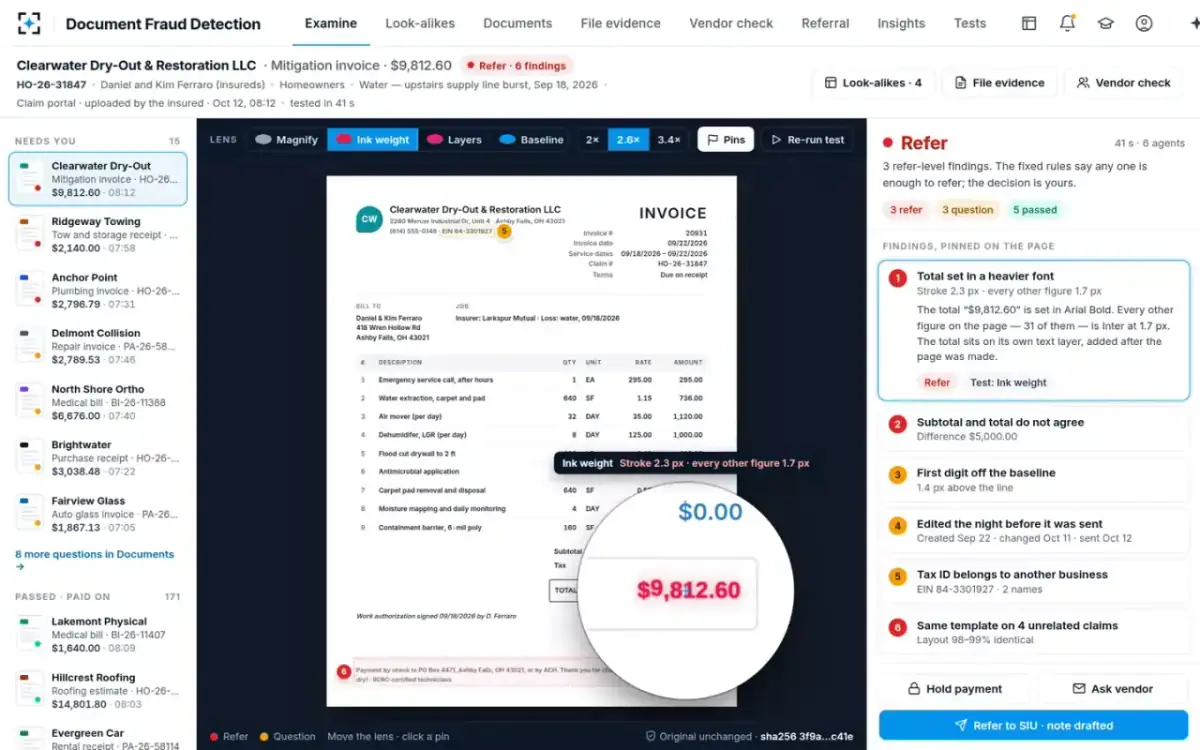
The invoice is sample data on fictional companies: a $9,812.60 water-mitigation invoice from Clearwater Dry-Out & Restoration LLC on a homeowners claim. The solution found six things wrong with it. The matrix below shows which approach can find each one.
Six findings on one invoice, and which of four approaches can catch each
What is document fraud detection software? Four approaches, sold under one name
The category covers four different jobs. Reading tools extract the text and judge whether it looks right, which is what a person does and what general AI assistants are now asked to do. Consistency tools recompute the arithmetic and compare names, tax IDs, prices and dates with registers and the claim. Forensic tools read the file or image for traces of editing. Cross-document tools fingerprint layouts and identifiers and look for them on other claims. Most products are strong in one of these and light in the rest.
For an insurer the question is not which approach is best but which edits you can afford to miss. A claimant who changes a receipt total, a vendor who reuses a template under new names and a forger who rebuilds a file from scratch are three different problems, and no single approach catches all three.
How does document fraud detection software work? Check one: reading the page
Reading the page catches what a careful person would catch: a total that does not match its lines, a date that cannot be right, a vendor nobody has heard of. It fails on edits made to look right, which are the ones that matter. On the sample invoice a reader might add up the lines; nothing else on the page looks wrong, because the edit was made to look like the rest.
General AI assistants do no better at this than people, and sometimes worse. Researchers at the University of La Rochelle asked ChatGPT, in January 2023, to read each of 218 test receipts and say whether it was fraudulent; 35 of them had been forged by volunteers. For 113 receipts the answers did not lean either way, and only seven answers explicitly said a receipt could be fraudulent. Two of those seven were legitimate receipts, flagged for an unusual company name and a discount. It did find real price discrepancies on two receipts (Martínez Tornés et al.). Asking a chatbot whether a document is fake is a reading check, and it inherits the reading check's blind spot.
A general chatbot, asked whether each of 218 receipts was fraudulent
Check two: the sums, the prices and the vendor
Consistency checks recompute what the document claims and compare it with sources the document cannot change. On the sample invoice they catch two findings outright: the nine lines add to $4,812.60, not $9,812.60, and the vendor is not on the carrier's register and has no state contractor registration under its name. They are the cheapest checks to run and the easiest to explain, which is why the sample makes arithmetic a refer-level test.
Their blind spot is the careful forger. A forger who changes a line and the total together keeps the sums consistent, and forgers aim at money: in the La Rochelle receipt set, 234 of the 455 altered areas were the total or payment information (Martínez Tornés et al.). A real, registered vendor whose invoice was altered by someone else passes the register check. Consistency is necessary and not sufficient.
Check three: the file itself
File forensics reads what the page does not show: revisions, fonts, layers, digit alignment and compression. On the sample invoice it catches three findings no reader would see: the total alone in Arial Bold at a heavier stroke, the leading 9 sitting 1.4 px above the line, and a second save in a desktop editor ten hours before the upload. On traditional edits it also has published results to point to. On the same receipt set, a method that detects double JPEG compression in edited regions reached 79.41% precision, against 30 to 40% for simple text and image classifiers (Martínez Tornés et al.).
Its blind spots are files with no history to read: a page printed to a fresh PDF, a scan of a printout, and increasingly an AI-edited photo. The PDF forensics guide in this series sets out how that file evidence is read, and how to test a tool's claims about it.
Findings from three checks on one page
Check four: the same template on other claims
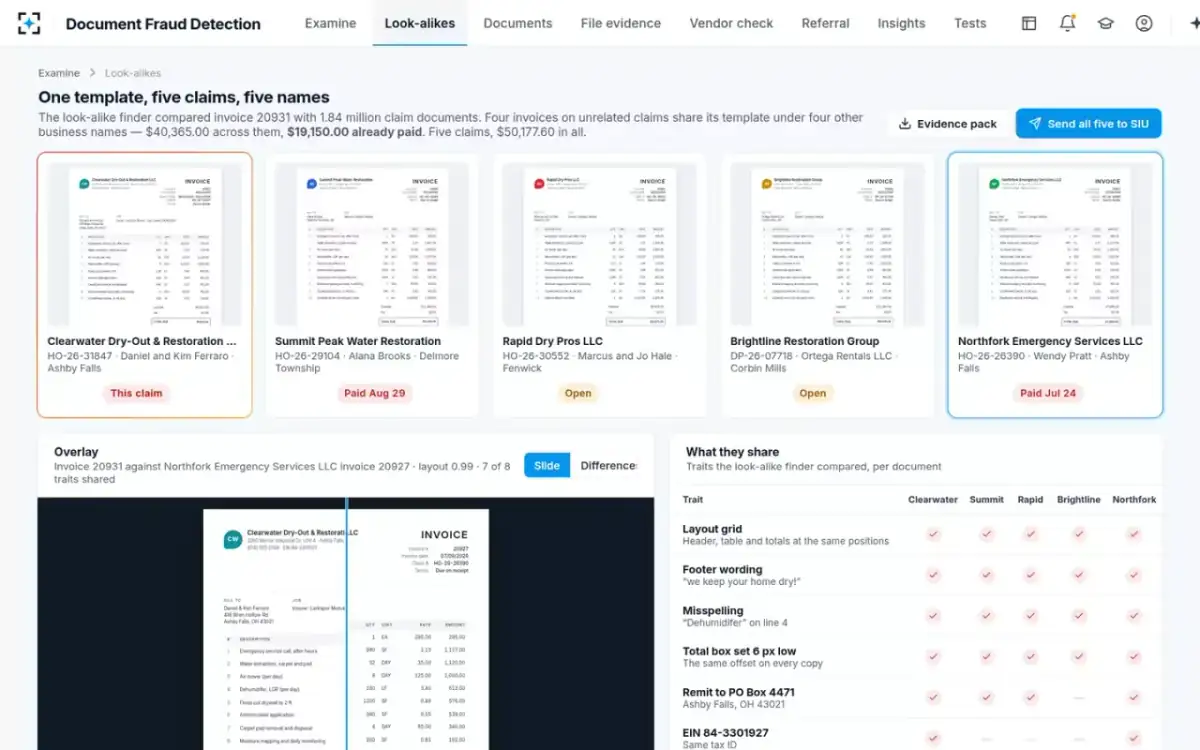
Only a search across claim documents finds the sixth problem. The Clearwater layout, footer wording, a misspelling of "Dehumidifer" and a total box set 6 px low appear on four unrelated claims under four other business names, handled by three other adjusters. $40,365.00 was invoiced across them and $19,150.00 had already been paid. No check of one document can see that, and it is the finding that turns one altered invoice into a case.
Ordinary duplicate-payment checks do not find it either, because nothing is a duplicate: names, invoice numbers and amounts all differ. The search has to compare layout and identifiers, and it has to be careful, because honest vendors use templates too. The solution never links claims on a name alone and shows every shared trait. The method, and why it beats duplicate detection, is the subject of duplicate invoice detection software.
One template, five claims, five names
Can document fraud software detect AI edits?
Pixel-level detectors largely cannot yet; the other three checks still can. Benchmarks published in 2026, preprints not yet peer reviewed, found detectors that score well on traditional forgeries falling close to chance on numbers changed by image-generation models, and found calibration problems even on older edits. The authors of one, which ran 14 methods across eight datasets, concluded that "no evaluated method works reliably out-of-the-box on diverse document types" (DOCFORGE-BENCH). The detail on AI-made receipts is in can AI make fake receipts.
An AI model can make a changed total look right. It cannot make the lines add up to it unless the forger changes them too, cannot put the business on a register, cannot move the claim's loss date and cannot stop the same layout appearing on another claim. That is the practical case for buying all four checks: the approaches that do not look at pixels are the ones AI editing does not defeat.
Is document fraud detection software accurate? Ask for accuracy by edit kind
Accuracy is meaningful only per kind of edit and on documents like yours. Tools generally do what they are built to do; NIST's review of digital forensics reports that "Extensive testing of over 250 widely used digital forensic tools showed that most tools perform their intended functions with only minor anomalies." (NIST IR 8354). The buyer's risk is not that a tool does its job badly. It is that the job it was built for is narrower than the edits arriving in your claims.
So ask for results by edit kind: incremental saves, rewritten files, reprinted pages, AI-edited photos, inflated lines, swapped vendors, reused templates. Better, run a seeded test on your own past documents before buying; the method is in document tampering detection datasets. A vendor that will not run on your documents is asking you to trust its test set over your claims.
Does document fraud detection work on scanned receipts?
Yes, with different evidence. A scanned or photographed receipt has no file history, so the tests move to the image and the content: compression, alignment, stroke weight, the arithmetic, the merchant and the claim. Scans also vary more than people expect. The receipt images behind the La Rochelle set came from several scanners and used 41 different JPEG quantization tables (Martínez Tornés et al.). A tool tuned on one scanner's output will see artefacts in another's. Ask how the tool handles a receipt photographed on a phone, a scan of a printout and a fax, and test it on all three.
Receipts are also where honest edits are common: handwritten notes, highlighted totals and stamps. In the sample, a purchase receipt from an electronics retailer raised a question because its header was unlike three known receipts from the same store, which an adjuster can clear with one call. In February 2020 California arrested members of a family ring accused of submitting digitally altered receipts for child car seats averaging $950 each, which by the Department's account made up $77,897 of one insurer's loss (CDI). Receipt testing pays for itself on cases like that.
How much does document fraud detection software cost?
There is no public price list for claims document testing, so compare on what drives cost. The main drivers are how many documents you test (set by the threshold), how many sources must be connected, how large an archive of past documents the cross-claim search covers, and whether the vendor processes documents inside your controls. In the sample, a $1,000 threshold meant 186 documents tested between 06:00 and 08:12 on one Monday.
Set that against the cost of not testing, which is the pay-and-chase route: money already paid, recovered only after an investigation and a conviction, if at all. A useful pricing question for any vendor is what one test costs at your threshold, and how many of your paid documents last year would have crossed it.
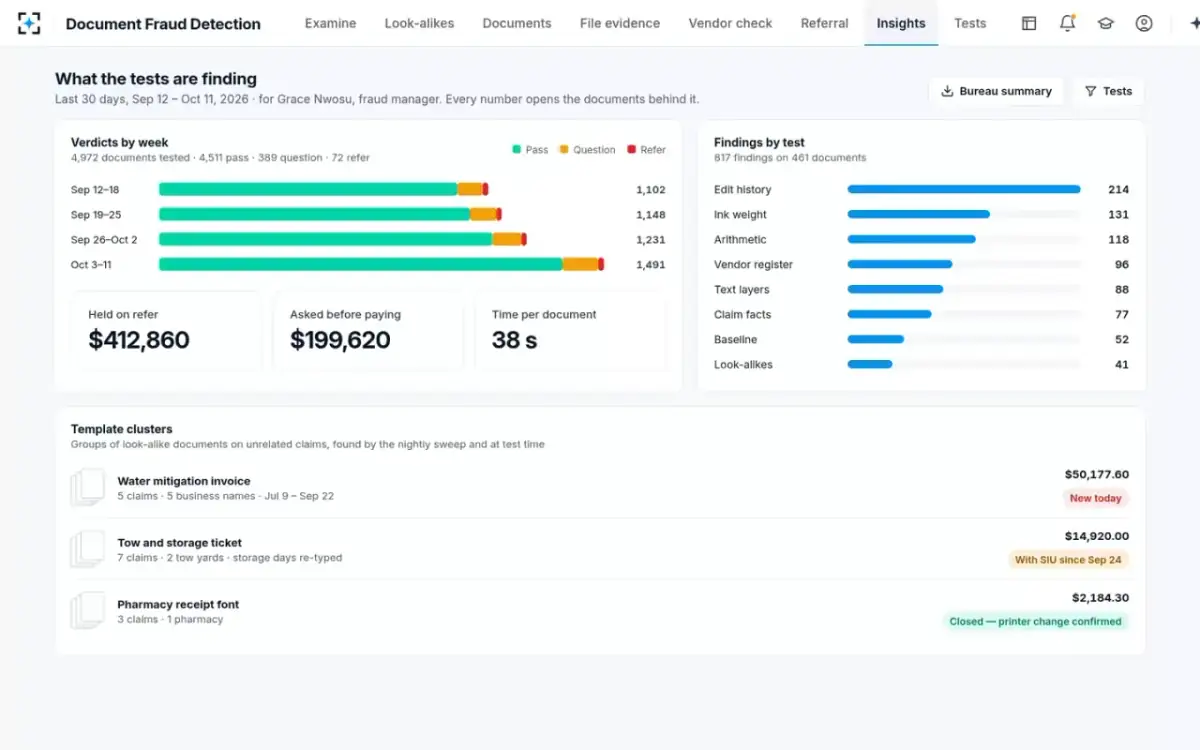
Thirty days of Document Fraud Detection at a $1,000 threshold, on sample data
4,972
claim documents tested before payment
461
documents with at least one finding
$412,860
held on refer-level findings
38s
average time per document
The fraud manager's 30-day view
What is the best document fraud detection software? The one that shows its evidence
The best software for claims is the one whose findings your adjusters can check and your SIU can cite, across all four approaches, on your own documents. A high score in a demonstration on the vendor's samples is not evidence. A finding pinned on your invoice, with its measurement, is.
What to accept, what to ask for, and how Document Fraud Detection answers
Often offered: A risk score from 0 to 100.
Ask for: Findings with a test, a level, a measurement and a place on the page.
Often offered: Strong in one approach: forensics, or reading, or rules.
Ask for: All four: reading, sums and vendor, the file, and other claims.
Often offered: Automatic holds above a score.
Ask for: Fixed verdict rules; people hold, refer and pay.
Often offered: Screens in the vendor’s portal.
Ask for: The original, fingerprinted, and a referral the SIU can sign.
Often offered: Accuracy on the vendor’s test set.
Ask for: Results by edit kind on your own past documents.
Often offered: Rules updated by the vendor.
Ask for: Your fraud manager’s thresholds, published as dated versions.
The fit is honest in both directions. Document Fraud Detection is built for property and casualty claim documents: invoices, medical bills, repair estimates, tow and storage tickets, auto glass invoices and purchase receipts. It is not an identity-document checker for onboarding, and it is not built for lending documents; banks verifying pay stubs or factored invoices are better served by tools for that work, such as those described in how to identify fake pay stubs. Within claims, it does not decide anything: the agents test and explain, the adjuster decides, the SIU accepts, and paying against a refer needs the fraud manager's second approval.
Ten questions for any document fraud detection vendor
- Which of the four checks does it run on every document?
Reading, sums and vendor, the file, other claims.
- Show me a finding on my invoice.
With the measurement and its place on the page.
- What happens with a scan, a phone photo and a reprinted PDF?
Each needs different evidence.
- How does it handle AI-edited images?
Look for an answer that does not rely on pixels alone.
- Can it search our past claim documents for the same template?
And does it refuse to link claims on a name alone?
- What does it do on its own?
It should not hold payments, contact anyone or refer.
- Is the original kept unchanged, with a hash?
Evidence has to survive to court.
- Who sets the thresholds, and are changes versioned?
Your fraud manager, with dates.
- What does it cost per document at our threshold?
And how many documents would have crossed it last year?
- Will you run it on our past documents first?
Results by edit kind, with honest documents counted too.
Questions people ask
Is there free document fraud detection software?
Free tools exist for single checks: metadata viewers, PDF structure parsers and image-forensics utilities. They suit an investigator examining one file. They do not run on every claim document, check the vendor or the claim, or search other claims, and online versions send the document to a third party.
Can ChatGPT detect a fake invoice?
Not reliably. In a 2023 test on 218 receipts, ChatGPT explicitly flagged only seven as possibly fraudulent, two of them legitimate, and gave no leaning on 113. A 2026 preprint found a GPT-4o judge at an AUC of 0.509 on AI-edited receipts, essentially chance.
What documents can fraud detection software check?
Any document a claim is paid on, if the software reads its kind: invoices, medical bills, repair estimates, receipts, tow and storage tickets and glass invoices are typical in property and casualty claims. The tests differ by kind, such as billed hours against the approved estimate on a repair invoice, or a VIN against the policy vehicle on a glass invoice.
Does document fraud detection replace the SIU?
No. It replaces the manual testing that rarely happens before payment, and hands the SIU a referral with cited evidence. In the solution the SIU accepts or declines each referral and runs the investigation.
How long does document fraud detection take per document?
In the sample, an average of 38 seconds across 186 documents in a morning, and 41 seconds for the invoice on this page, most of it spent on file forensics and the search of 1.84 million past claim documents.