Duplicate invoice detection software finds invoices that have already been paid: the same invoice number, vendor, amount and date, matched exactly or nearly. It is a good control against paying one bill twice, and accounts-payable teams depend on it. It is the wrong control for a different duplicate that claim fraud relies on: not a repeated invoice but a repeated template. One invoice design is used under several business names, on unrelated claims, handled by different adjusters, with different numbers, amounts and dates. No field repeats, so nothing matches. Finding it means fingerprinting what does repeat: the layout, the fixed wording, the typography and the identifiers such as tax ID, remit-to address and phone. Document Fraud Detection is Botminds' solution for testing claim documents before payment; its look-alike finder compares each document's layout and identifiers with every past claim document, and shows each shared trait to the adjuster.
One template, five business names: a family found by Document Fraud Detection
The template
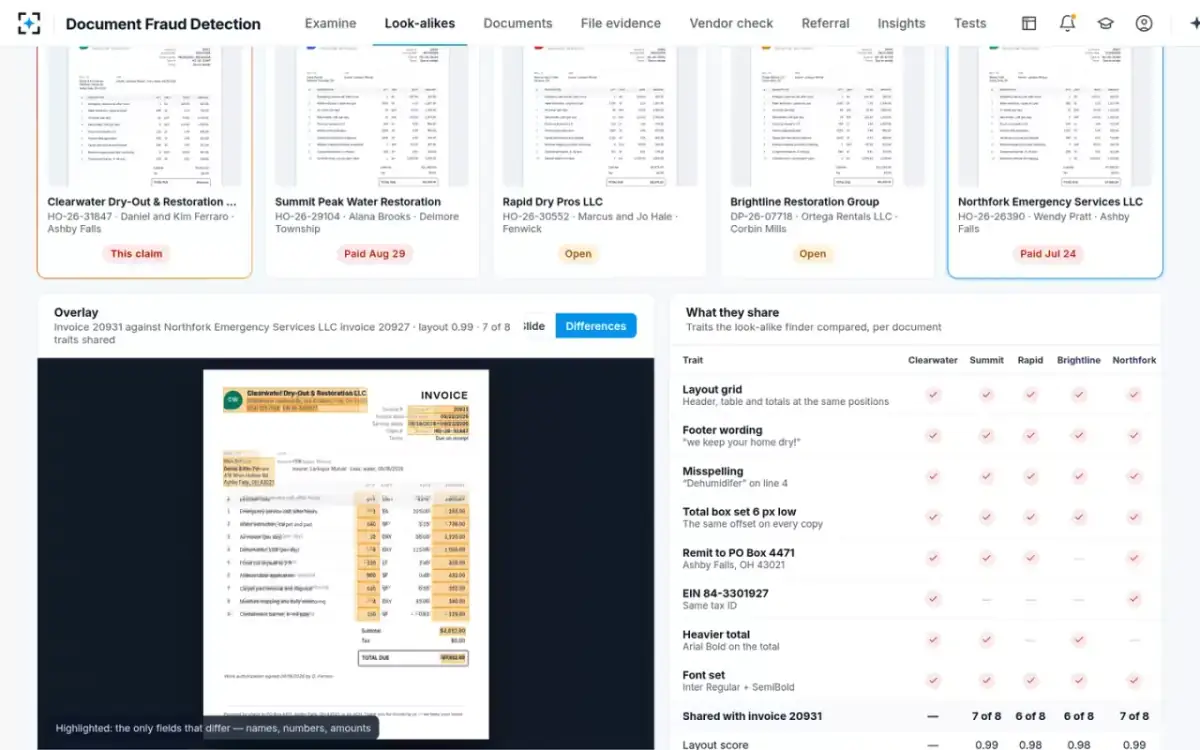
Same layout grid · footer “we keep your home dry!” · misspelling “Dehumidifer” on line 4 · total box set 6 px low · the same two fonts
Clearwater Dry-Out & Restoration LLC
HO-26-31847 · $9,812.60
This claim · held
PO Box 4471 · EIN 84-3301927
the document under test
Summit Peak Water Restoration
HO-26-29104 · $11,460.00
Paid Aug 29
PO Box 4471
7 of 8 traits · layout 0.99
Rapid Dry Pros LLC
HO-26-30552 · $8,975.00
Open
PO Box 4471
6 of 8 traits · layout 0.98
Brightline Restoration Group
DP-26-07718 · $12,240.00
Open
no shared identifier
6 of 8 traits · layout 0.98
Northfork Emergency Services LLC
HO-26-26390 · $7,690.00
Paid Jul 24
PO Box 4471 · EIN 84-3301927
7 of 8 traits · layout 0.99
What is duplicate invoice detection software, and what does it compare?
It is software that compares each new invoice with invoices already received or paid and flags matches before payment. The usual keys are the vendor, the invoice number, the amount and the date, matched exactly or with tolerance for small differences such as a transposed digit or a reformatted number. It catches honest double submissions, invoices sent through two channels, and a vendor billing the same work twice.
The US Government Accountability Office described the standard design in a June 2026 report on a Veterans Affairs travel program. According to program officials, the payment system is meant to "automatically archive invoices as duplicates, if information in certain fields exactly matches invoices that have already been paid", while potential duplicates go to manual review (GAO-26-107596). That is duplicate detection as most buyers know it: field matching, with people resolving the near misses.
How does duplicate invoice detection work, and where does it fail?
It works by matching fields, and it fails when the duplicate does not share the fields, or sits in a system it cannot see. The same GAO report shows the second failure at scale. The VA program took claims through two systems that, officials said, "do not integrate directly to identify potential duplicates"; a daily report compared new and historical transactions instead. When GAO tested the data, it found potentially duplicate items in both systems and between them.
Potential duplicates GAO found in one program's payment data
Most of the dollars were in the gap between the systems. Insurers have the same gap at a larger scale: invoices arrive through a claim portal, email, vendor uploads and bill feeds, are filed on different claims, and are read by different adjusters. A duplicate check that runs inside one channel or one claim cannot see the copy in the next. And when the copy has a new name, a new number and a new amount, no field-matching check can see it at all.
Can duplicate invoice software find altered copies?
Only if the altered copy keeps the fields it matches on. Change the invoice number, the vendor name and the amount, and an exact-match check passes it; a fuzzy match on vendor names passes it too if the names are different words. That is precisely what a template scheme changes. California's fraud statute names the simpler version: it is a crime to "Knowingly present multiple claims for the same loss or injury, including presentation of multiple claims to more than one insurer, with an intent to defraud" (Penal Code § 550(a)(2)). When the copies go to different insurers, no single insurer's duplicate check can see them.
Real cases show how easily a document's identity is changed. North Carolina in 2024 charged a claimant accused of submitting "false invoices under a fictitious business name" for damage to a pool different from the one she owned (NCDOI). In October 2026 the same department charged a man accused of providing false documentation to two insurers to support claims made to both (NCDOI). New Jersey's October 2026 indictment alleges invoices for mitigation work attributed to a business with no filings or registrations in state records (NJ OAG). A name costs nothing to invent; a duplicate check keyed on names is checking the cheapest part of the forgery.
What is template fraud?
Template fraud is the reuse of one invoice, estimate or receipt design across claims under different business names, so that each document looks like a different vendor's. It can be one operator billing under several names, a fabricated set of businesses, or a real business lending its format to others. Each document on its own may pass every check: a plausible business, believable lines, arithmetic that holds. The fraud is only visible across documents.
Regulators expect insurers to look across claims. The NAIC's antifraud plan guideline, after listing the documents that may be doctored, adds: "An identifiable pattern in a claim history may also suggest the possibility of suspected fraudulent claims activity." (GL-1690). A template is that pattern in its most concrete form. In the sample, the Clearwater invoice under test shares its layout with four invoices on unrelated claims, under four other business names, handled by three other adjusters. Two of them, $19,150.00, had already been paid.
The template's $50,177.60 across five claims: already paid, and still stoppable
Five invoices on one template, fictional sample
- Paid before the template was found ($19,150.00) · 38%
- Open or held when it was found ($31,027.60) · 62%
How do you find the same fake invoice on different claims? Fingerprint the layout, not the name
You find it by comparing what a forger keeps and a vendor name does not: the position of every block on the page, the fixed wording, the fonts, small quirks such as a misspelling or an offset box, and the identifiers that have to be real for the money to arrive. The solution's look-alike finder fingerprints each claim document's layout and searches every past claim document for the same template and for the same tax ID, PO box, phone or bank details on unrelated claims. In the sample it compared the Clearwater invoice with 1.84 million past claim documents in 15.4 seconds.
A duplicate check and Document Fraud Detection's template search, on the same five invoices
Duplicate invoice check: Vendor, invoice number, amount and date.
Template and identifier search: Layout grid, fixed wording, fonts, quirks, tax ID, remit-to, phone and bank details.
Duplicate invoice check: Usually one payment system or one claim.
Template and identifier search: Every past claim document, whatever channel it came in by.
Duplicate invoice check: No match: five names, five numbers, five amounts, five dates.
Template and identifier search: Four matches at layout 0.98 to 0.99, sharing 6 or 7 of 8 traits.
Duplicate invoice check: The same invoice paid twice.
Template and identifier search: One template under five names; a tax ID on two businesses.
Duplicate invoice check: Exact or near field matches.
Template and identifier search: Never links on a name alone; needs a high score on two or more unrelated claims, and shows every shared trait.
The adjuster sees the evidence, not a score. She can slide an overlay between her invoice and a look-alike and switch to a view that highlights only what differs: on the Clearwater family, names, numbers and amounts. A grid lists each trait the finder compared and which invoice shares it.
Only the names, numbers and amounts differ
What is invoice fingerprinting?
Invoice fingerprinting means describing a document by features that identify its source, so that other documents from the same source can be found. There are two kinds, and they answer different questions. A file fingerprint, a cryptographic hash, identifies one exact file; courts accept identical hash values as showing that two files are the same (FRE 902, 2017 committee note). Change one byte and the hash changes, so it finds only identical copies. A layout fingerprint describes the design: where the blocks sit, which fonts and wording repeat, which quirks recur. It finds documents that were made from the same template even when every value on them differs.
The solution keeps both. Document intake records a SHA-256 hash of each original as it arrived, which proves later that the evidence is unchanged and catches exact resubmissions. The look-alike finder uses the layout fingerprint and the identifiers to find relatives. Only the second finds the Clearwater family.
Can one vendor submit the same invoice under different names?
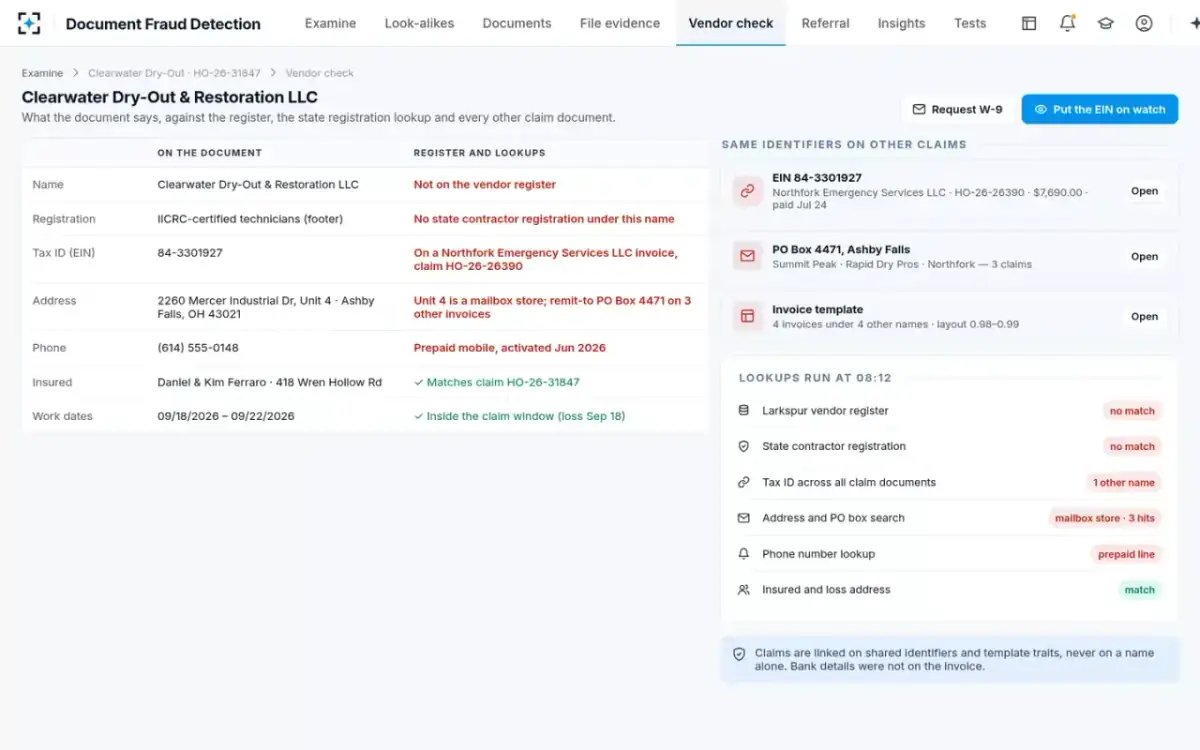
Yes, and the identifiers usually give it away. A business can be renamed in seconds; a tax ID, a bank account, a remit-to address and a phone number have to work for the money to arrive, so they tend to be reused. On the sample invoice, the vendor check found Clearwater's tax ID on a Northfork Emergency Services invoice already paid on another claim, its remit-to PO box on three other invoices, its street address at a mailbox store, and its phone a prepaid mobile activated in June.
The identifiers that tie different names together
Care runs the other way as well. Many small vendors use the same invoicing apps, and those apps produce similar layouts, so a layout match alone is not proof of anything. That is why the solution never links claims on a name alone, sets its look-alike threshold at a score of at least 0.95 on two or more unrelated claims, and shows every shared trait. In the sample carrier's 30-day view, one cluster of three receipts from one pharmacy with an unusual font was closed after a printer change was confirmed: a false link, found and recorded as one.
How do insurers stop duplicate claim payments?
With three controls in sequence. First, exact and near duplicate checks across every intake channel, not within each, which catches the honest double submission. Second, a template and identifier search before payment on every claim document over a threshold, which catches the same document under new names. Third, one referral for the whole family when a template is found, so that the SIU opens one case instead of five and the open invoices are held before they are paid. In the sample, the adjuster sent the Clearwater referral covering all five claims, and the SIU accepted it as one case 15 minutes later. When the identifiers lead to people and businesses linked across many claims, mapping that network starts with entity resolution.
Template clusters across the book, with their status
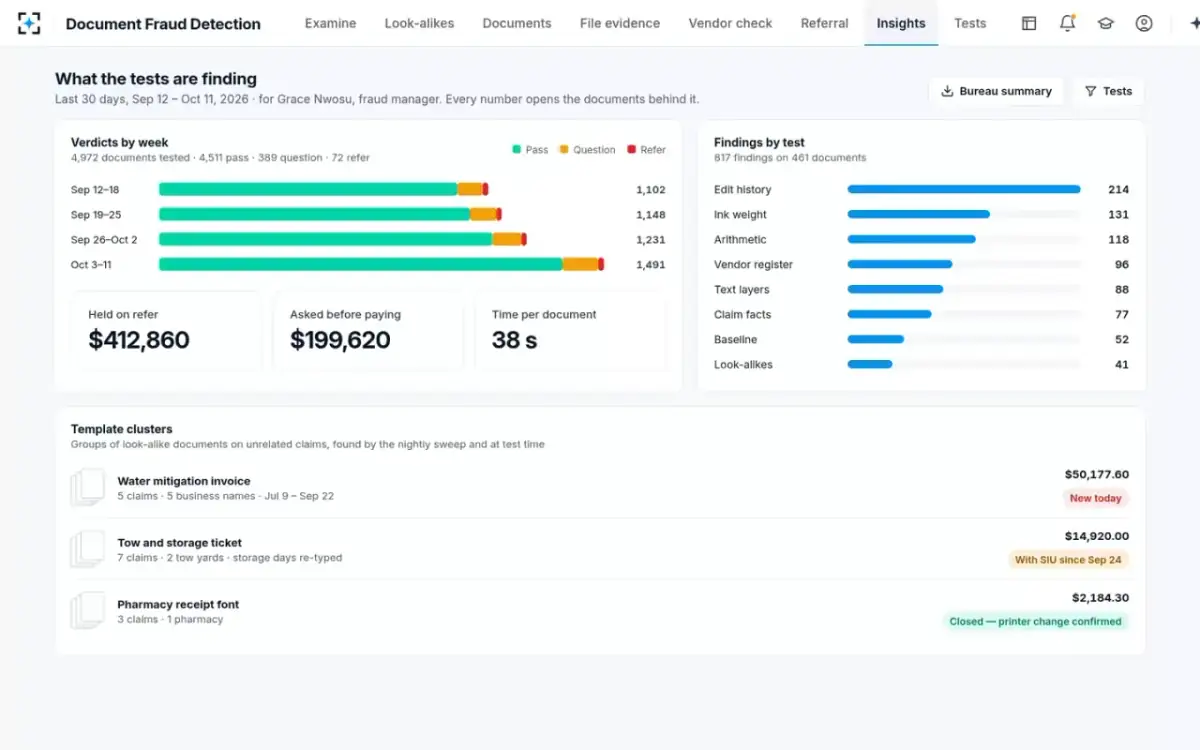
A template found after payment is still worth finding. The tow-and-storage cluster in the sample, seven claims and two tow yards with storage days re-typed, had been with the SIU since 24 September. But the order matters: every day the search runs before payment moves money from the paid column to the stoppable one. What an inflated or altered line costs once it is paid is set out in inflated invoices.
Buying duplicate invoice detection for claims: what to ask
Ask whether the product finds documents that share a design, not only documents that share values, and whether it shows why. An accounts-payable duplicate checker answers a different question from a claims template search, and both have a place. Botminds' Document Fraud Detection does the claims side: it tests claim documents before payment and searches past claim documents for templates and identifiers. It is not a replacement for a carrier's accounts-payable controls, and for reviewing independent adjusters' own invoices, the right tool is invoice auditing software for adjuster bills.
Eight questions for any duplicate or look-alike invoice tool
- Does it match on layout and identifiers, or only on fields?
Field matching misses a copy with a new name, number and amount.
- Does it search across every channel and claim?
Portal, email, vendor uploads and bill feeds, every line of business.
- How big is the archive it searches, and how far back?
A template paid last spring is invisible to a search of last month.
- Does it run before payment?
After payment it starts a recovery, not a hold.
- Does it show each shared trait?
A similarity score alone cannot be checked or cited.
- How does it avoid false links?
Never on a name alone; a threshold on unrelated claims; honest shared templates cleared and recorded.
- Does it check identifiers against registers?
Tax ID, registration, address, phone, bank details.
- Can it hand the SIU one case for the whole family?
Five referrals for one scheme waste five investigators’ time.
Questions people ask
What is a duplicate invoice?
An invoice that has already been submitted or paid, sent again: the same bill through a second channel, a re-issued copy, or the same work billed twice. Duplicate checks catch it by matching vendor, number, amount and date.
How do you identify duplicate invoices?
Match new invoices against everything already received on vendor, invoice number, amount and date, exactly and with tolerance for small differences, across every channel the invoices arrive by. GAO's 2026 review of a VA program found most potential duplicates sat between two systems that did not check each other.
Can a layout match be innocent?
Yes. Small vendors often use the same invoicing apps, which produce similar layouts. A layout match should be combined with shared identifiers and quirks, required on two or more unrelated claims, and shown trait by trait before anyone acts on it.
Does duplicate detection work on scanned and photographed invoices?
Field matching works if the fields can be read; a layout fingerprint needs the page's structure, which a reader can recover from a scan or photo by placing each field on the page. Exact file hashes will not match a re-scanned copy at all.
Is billing the same invoice to two insurers illegal?
Knowingly presenting multiple claims for the same loss with intent to defraud is a crime in many states; California's statute expressly includes presenting them to more than one insurer.