Yes, AI can make fake receipts, and it now does the hardest part well: changing one number on a real receipt so that it matches the surrounding print. A 2026 benchmark from researchers at Duke University and three other universities, a preprint not yet peer reviewed, used two consumer image-editing services to change the totals, dates and numbers on 4,061 real receipt and form images. The authors report that each edit takes under a second and costs about a cent. The same study found that the best detector it tried scored well below its usual accuracy, and that a GPT-4o judge did no better than chance. For an insurer, that means the eye, and a chatbot asked to look, no longer catch a changed receipt. What still catches it is everything that is not pixels: whether the items add up, whether the merchant and its receipts look like this one, whether the purchase fits the claim, and whether the same receipt appears elsewhere. Document Fraud Detection, Botminds' solution for testing claim documents before payment, is built on those checks.
What one AI-edited receipt costs to make, and how little of it changes
<1s
to replace a number in a document photo with a consumer image model
$0.01
approximate cost per edit, as the authors estimate it
0.92%
median share of the image’s pixels that the edit changes
0.509
AUC of a GPT-4o judge asked to spot the edit; 0.5 is chance
Can AI make fake receipts that pass a close look? The 2026 evidence
Yes. The AIForge-Doc authors took real receipts and forms from four public datasets in nine languages, chose one numeric field on each (a total, a date, a phone number, a quantity) and asked an image model to replace it with a plausible new value while keeping the font, weight, spacing and baseline. Only the field's own pixels were pasted back, so the rest of the document is untouched. In their example images the forged and authentic versions sit side by side, and only the mask shows which number moved.
The capability is narrower than it may sound, which matters for spotting it. The authors prototyped seven image models and kept two; the other five produced garbled or wrong digits or blurred text, whatever the prompt. Both models that worked combine image generation with language understanding, which is what lets them render a specific number in a specific font. A general-purpose image model asked for "a receipt" is a different and easier problem to catch: its invented store, layout and prices can be checked against the real merchant.
Can AI-generated receipts be detected? Not reliably by their pixels
Not by the pixel-level detectors tested so far. The benchmark ran three kinds of detector on its forged receipts and forms without retraining them: a leading general-purpose forgery detector, the best published detector built for documents, and GPT-4o prompted as a forensic document analyst. Each did far worse than on the edits it was designed for. In the authors' summary, the results confirm "that AI-forged values are indistinguishable to automated detectors and VLMs" (AIForge-Doc).
Detector accuracy on AI-edited receipts and forms, against their accuracy on the edits they were built for
The reasons are physical, and they are why older advice fails. Photo-editing forgeries leave seams where a pasted patch was compressed differently, repeated patterns where pixels were cloned, and noise that does not match the camera. The authors list why AI edits avoid all three: the model generates new pixels with no compression seam, copies nothing, and produces noise that matches the surrounding image. The edited region is also tiny, a median of 0.92% of the image, so a detector that averages over the whole picture barely sees it.
What a hand-edited receipt leaves behind, and what an AI-edited one does not
Edited by hand in a photo editor: The pasted digit was compressed once, the rest twice: a seam a detector can find.
Edited by an image model: New pixels generated in place, with no seam at the edge.
Edited by hand in a photo editor: A digit cloned from elsewhere on the receipt repeats a pixel pattern.
Edited by an image model: Nothing is copied; the digit is drawn fresh.
Edited by hand in a photo editor: Noise inside the patch differs from the camera’s noise.
Edited by an image model: Noise closely matches the surrounding area.
Edited by hand in a photo editor: Often a near miss: a different weight or spacing.
Edited by an image model: Matched to the neighbouring digits on purpose.
Edited by hand in a photo editor: Everything on the right, plus the pixel traces.
Edited by an image model: The sums, the merchant, the claim and other claims.
Can AI edit photos for insurance claims? One state has already charged a claimant
Yes, and it has reached the courts. In June 2026 North Carolina's Department of Insurance announced five felony counts of insurance fraud and five of attempting to obtain property by false pretense against a claimant who had filed claims in November 2025 saying her items were damaged. The department's agents accuse her of using an AI application to make the items look severely damaged and of pulling images of damaged items from the internet, seeking $4,876 in settlements (NCDOI). These are charges, not a conviction.
The claimant "is accused of using an artificial intelligence (AI) application to make the items appear to have severe damage as well as pulling images from the internet of damaged items."
North Carolina Department of Insurance, announcing the charges on 19 June 2026
Two details in that case are useful to an adjuster. The AI part was the damage, not a document, so receipts and photos need the same scrutiny. And the second technique, an image copied from the internet, is the easier one to catch, because a copied image exists somewhere else. Regulators are now warning consumers directly. Oklahoma's Insurance Department told policyholders in July 2026: "Never alter claim photos. Even small edits to enhance may trigger fraud alerts." and "Keep original documents and receipts." (Oklahoma Insurance Department).
Are AI fake receipts illegal? Using one in a claim is insurance fraud
Making a fake receipt is not, by itself, the offence the insurance statutes target; presenting one to support a claim is. The statutes do not care what tool made the document. California makes it a crime to "Knowingly prepare, make, or subscribe any writing, with the intent to present or use it, or to allow it to be presented, in support of any false or fraudulent claim", a felony carrying two, three or five years (Penal Code § 550(a)(5)). An AI-edited receipt is such a writing the moment it is uploaded to a claim.
Claim forms say so in advance. New York requires the standard warning that anyone who knowingly files a statement of claim "containing any materially false information, or conceals for the purpose of misleading, information concerning any fact material thereto, commits a fraudulent insurance act, which is a crime" (11 NYCRR 86.4). Altered receipts have been charged long before AI: in 2020 California arrested seven people in a family ring accused of using "digitally-altered receipts" for child car seats averaging $950 each, which made up $77,897 of an insurer's loss (CDI).
How do insurers spot AI-generated receipts? Test what the model cannot fake
Insurers spot them by moving the test from the image to the facts around it. An image model can make a changed total look printed. It cannot make the items and tax add up to it unless the forger edits those too, cannot give the merchant a receipt format it never uses, cannot move the purchase before a loss that happened after it, and cannot keep the same image from turning up on another claim. A US Treasury alert about AI-made documents in banking gives the same advice in its own field: institutions can examine "an image’s metadata" or use detection software, but the indicators are "not conclusive of inauthentic documents", and no single red flag decides (FinCEN Alert FIN-2024-Alert004).
Six checks for a receipt that may have been AI-edited
- Recompute it
Quantities times prices, tax at the local rate, total. A model that changes the total alone breaks the sums.
- Compare it with the merchant’s own receipts
Header, layout, register format and tax ID against other receipts from the same store in your claim files.
- Fit it to the claim
Purchase date before the loss, the item on the inventory, the price within range for the item.
- Search for the same image elsewhere
On other claims, and for photos, on the open web. The North Carolina case alleges images pulled from the internet.
- Read what the file says about itself
Camera data and edit history where present. Treat it as one indicator, never as proof either way.
- Ask for the payment record, not a better photo
A card statement line or the merchant’s copy cannot be regenerated by the claimant’s phone.
In the sample solution, a purchase receipt from an electronics store raised a question because its header was unlike three known receipts from the same store; the other checks passed. A question is the right level: an adjuster can clear it with a call to the store or a look at the card statement, and the honest claimant waits a day, not a month.
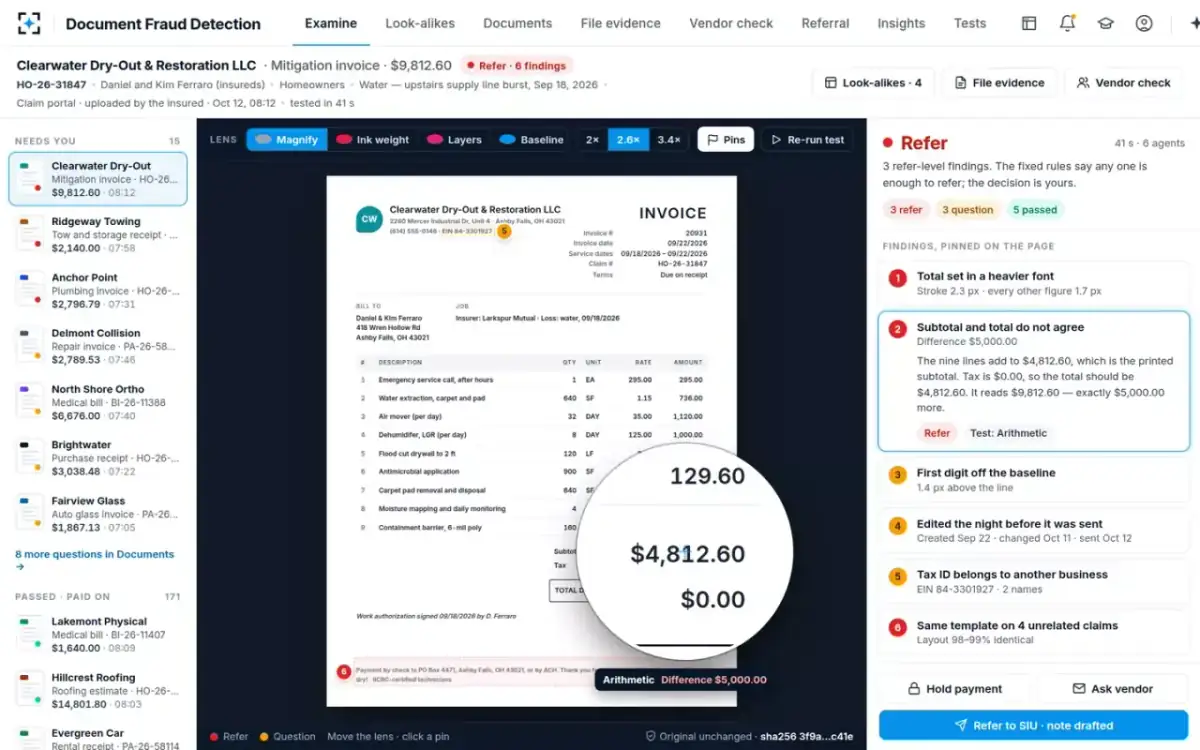
In Document Fraud Detection, arithmetic is the check an image model does not pass by accident
Can ChatGPT make a fake receipt, and can it spot one?
A general assistant can describe or lay out a receipt, and the newest image models can render one; whether a given product will is a matter of its own rules, which change. The research question that matters to insurers is the other one: can it spot a fake? On the evidence so far, no. In the 2026 benchmark, GPT-4o asked whether any number had been digitally altered scored an AUC of 0.509. A 2023 study that asked ChatGPT to judge 218 receipts, summarised in document fraud detection software compared, found it explicitly flagged only seven, two of them legitimate.
The benchmark also tried an image model from the same company as a forger and rejected it: at the resolution it worked at, its digits came out in mismatched sizes and weights that failed the authors' human review. That is today's limit, not a permanent one. A claims process that depends on a model's current weaknesses will need changing every few months; one that depends on arithmetic and outside records will not.
What happens if you submit a fake receipt to an insurer?
The item is not paid, the claim is referred to the insurer's special investigations unit, and the insurer may report it to the state fraud bureau, which can bring charges. Each state sets its own clock for that report: California expects a referral within 60 days of the insurer's determination, Texas and New York within 30. In the cases above, the North Carolina claimant faces ten felony counts over $4,876, and the California car-seat case began with a tip from the insurer.
For the insurer the order matters. Testing the receipt before payment means the question is asked while the money is still in the account, and the referral carries findings with measurements rather than suspicion. How an altered document moves from the adjuster to the SIU is set out in the document fraud investigation process.
Where a pixel test still earns its place in Document Fraud Detection
None of this makes file and image forensics useless. Most altered documents in claims today were edited by people with ordinary software, and those edits still leave the traces forensics reads: a later revision in a PDF, a total in a heavier font, a digit off its baseline. In the sample carrier's 30 days, edit-history and ink-weight tests raised 345 of 817 findings. The shift is in how they are weighed. A forensic finding raises a question; a broken sum, an unknown merchant or a template seen on other claims can stop a payment for a referral.
The same template on other claims: a check AI editing does not defeat
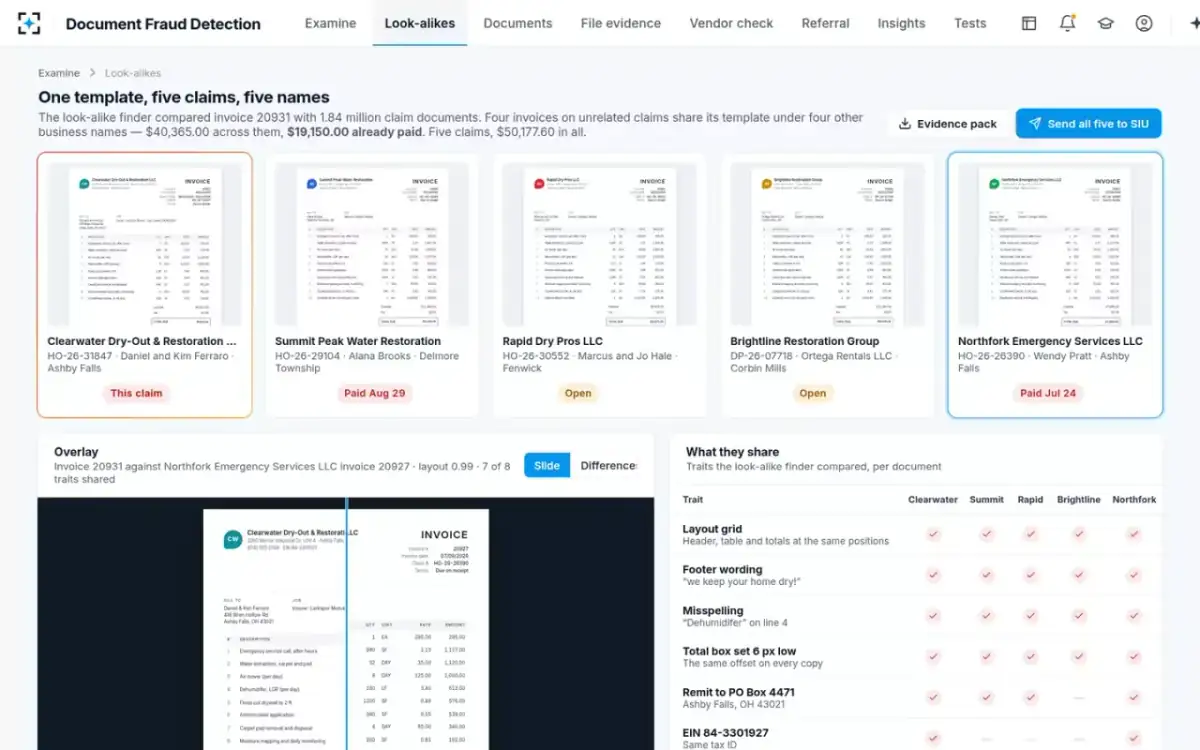
That is the design of the solution: six agents test every claim document over the threshold, the verdict follows fixed rules, and the adjuster decides. The look-alike search, which compares a document's layout and identifiers with every past claim document, is described in duplicate invoice detection software.
Questions people ask
Is using an AI receipt for an insurance claim fraud?
Yes, if it is used knowingly to support a claim. Insurance fraud statutes cover false writings presented in support of a claim regardless of how they were made; California's, for example, makes it a felony to prepare such a writing with the intent that it be presented.
Can insurers tell if a photo was edited with AI?
Sometimes, but not reliably from the pixels alone; detectors in a 2026 preprint fell close to chance on AI-edited documents. Insurers have better odds with outside facts: whether the image exists elsewhere, whether its details fit the claim, and what the file's camera data says, read as one indicator among several.
What makes an AI-edited receipt hard to detect?
The model generates new pixels that match the font and noise around them, without the compression seams or copied patches that older detectors look for, and the changed area is under 1% of the image in the median case. The tell has to come from the content: sums, merchant, dates and other claims.
Should I keep original receipts for an insurance claim?
Yes. Regulators advise keeping original documents and receipts, and not editing claim photos even to enhance them. An original, or the matching card statement, settles a question faster than any explanation.
Are there apps that detect fake receipts?
Several claim to. Ask any of them how they score on AI-edited receipts specifically, and whether they check the arithmetic and the merchant as well as the image; on the 2026 evidence, image-only detection is not enough on its own.