Fake insurance claim documents are the papers a claim is paid on that have been made up or altered: purchase receipts, repair estimates and invoices, medical bills, police and accident reports, and rental or living-expense invoices are the kinds that recur in regulators' cases. The NAIC's model antifraud guideline names most of them in its definition of suspected insurance fraud, and state insurance departments charge people over each kind every year. They are faked in different ways. A receipt usually has a number changed; a repair invoice gains lines; a medical bill gains dates; a police report is altered or invented; a rent invoice describes a home the claimant never lived in. So no single check catches them all, and an adjuster who knows only one test misses four kinds of fraud. Document Fraud Detection is Botminds' solution for testing claim documents before they are paid; it runs a different set of checks on each kind and pins each finding on the page for the adjuster.
Five kinds of claim document, how each is faked, and the check Document Fraud Detection runs
1Purchase receipts
How it is faked
A price or total changed; a receipt for an item never owned; an image regenerated with a new figure.
What catches it
Sums and tax; the merchant’s own receipt format; purchase before the loss; the payment record.
2Repair estimates and invoices
How it is faked
Lines added, hours raised, a total typed over; invoices from a business that does not exist.
What catches it
Approved estimate and photos; regional prices; shop registration; the same document on other claims.
3Medical bills and provider invoices
How it is faked
Dates of service added or moved; treatment never given; a provider invented.
What catches it
Provider registration and NPI; dates against the claim; codes; text added on a later layer.
4Police and accident reports
How it is faked
Details altered on a real report, or a report for a collision that never happened.
What catches it
The report obtained from the agency itself; report number, officer, date and place against the claim.
5Rental and living-expense invoices
How it is faked
Rent invoiced for a home the claimant does not live in; landlords who do not exist.
What catches it
The landlord’s identity; the insured’s address history; the lease and the payments.
What documents are commonly faked in insurance claims?
The NAIC's antifraud plan guideline, the model state regulators use for insurers' antifraud plans, lists them in its definition of suspected insurance fraud. The facts that may show it "include but are not limited to evidence of doctoring, altering or destroying forms, prior history of the claimant, policy holder, applicant or provider, receipts, estimates, explanations of benefits (EOB), medical evaluations or billings, medical provider notes, police and/or investigative reports" (GL-1690). Every document on that list is one a claimant, a vendor or a provider produces and an insurer pays on.
Enforcement cases fill in the rest. In the last few years, state insurance departments and prosecutors have announced charges over digitally altered receipts, fictitious and inflated repair invoices, altered chiropractic and massage invoices, forged medical billing records, altered police collision reports, forged rental invoices and AI-altered damage photos. The amounts are rarely large on their own. What they share is that each turned on a document that looked acceptable when it arrived.
What recent cases involved, by document
Fake or altered? Two problems that need different checks
A fabricated document describes something that never existed: a business, a purchase, a treatment, a collision. An altered document starts as a real one and is changed. The distinction matters because the checks are different. A fabricated invoice fails on its source: the business is not registered, the tax ID belongs to someone else, the address is a mailbox. An altered invoice from a real vendor passes every source check and fails on its content: the sums, the dates, the font of one figure.
A fabricated document and an altered one fail different tests
Fabricated: Estimates and invoices for mitigation work credited to a business with no filings or registrations in New Jersey records (charged, 2026).
Altered: A chiropractic invoice for services not provided on the date shown (North Carolina, charged 2026).
Fabricated: Missing from registers; identifiers shared with other names.
Altered: Real and registered; the check passes.
Fabricated: Often clean: made once, in one tool.
Altered: Often shows a later save, a second layer, a different font.
Fabricated: May be internally consistent.
Altered: A date, line or total that does not fit the rest or the claim.
Fabricated: Registration, tax ID and the same template on other claims.
Altered: File forensics, arithmetic and claim facts.
Many cases mix both. North Carolina in October 2026 charged a man accused of submitting $19,719.71 in "fictitious and inflated auto repair invoices" for engine repairs after a minor parking-lot accident (NCDOI). The damage itself is the first check: engine work does not follow from a parking-lot scrape. In 2024 the same department charged a woman accused of submitting invoices under a fictitious business name for damage to a swimming pool different from the one she owned, a $5,199.90 claim (NCDOI).
1. Purchase receipts: one number, changed
Receipts support contents, theft and personal-property claims, and they are the easiest document to alter: a short, regular layout with one number that matters. In 2020 California arrested seven people in a family ring accused of filing 32 false claims, some for accidents that never happened, and of padding them with digitally altered receipts for high-end child car seats averaging $950 each. The seats accounted for $77,897 of a $179,106 insurer loss (CDI).
The checks that work are the ones a receipt cannot fake on its own: whether quantities, prices and tax add up to the total; whether the merchant's real receipts look like this one; whether the purchase predates the loss and the item is on the inventory; and whether a card or bank record shows the payment. Image models can now change a receipt's total convincingly, which shifts the weight further onto those checks, as set out in can AI make fake receipts.
2. How do insurers check repair estimates and invoices?
Insurers check repair documents against the damage and the approved estimate first, then against prices and the shop. A repair invoice should match the photos, the appraiser's approved estimate and the regional labour and parts rates; its shop should be registered and known. The faked versions add lines, raise hours or invent the shop. In the New Jersey case announced in October 2026, prosecutors allege fabricated estimates and invoices for emergency mitigation or restoration work purportedly performed by a business with no filings or registrations in New Jersey records, with about $108,000 approved by an insurer's claims examiner who took a share (NJ OAG).
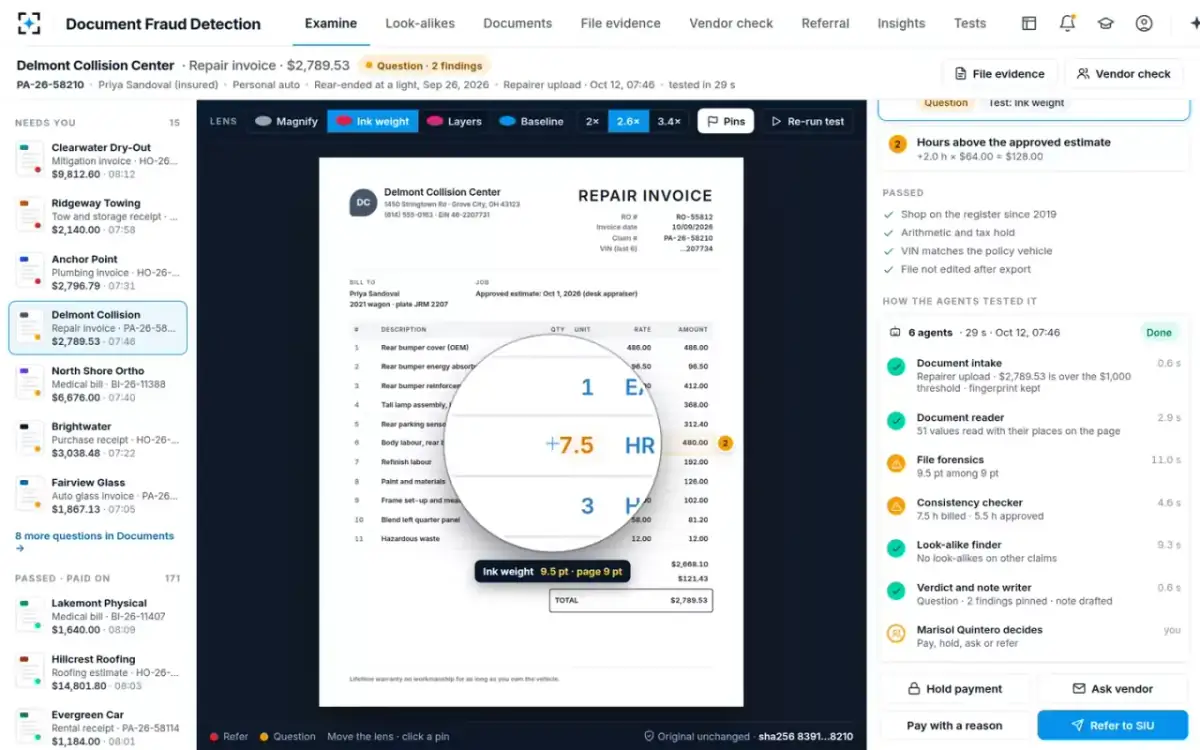
In the sample solution, a body-shop invoice raised a question rather than a refer: the labour line was set in 9.5 pt among 9 pt type, and it billed 7.5 hours against 5.5 approved, $128.00 more at $64.00 an hour. The shop was on the register, the arithmetic held and the VIN matched the policy vehicle. A question is the right weight: the adjuster asks the shop about two hours. Reading an estimate line by line is covered in how to read a body shop estimate.
A repair invoice with one line set apart, and billed above the approval
3. Can a fake medical bill be detected?
Yes, usually through its dates and its provider rather than its codes. A medical bill can be coded correctly and priced to the fee schedule and still bill for treatment that never happened. The Texas Department of Insurance reported in its 2025 annual report that a claimant "pled guilty to third-degree felony theft for sending forged medical billing records to her insurer for medical treatments she didn’t receive", and was ordered to pay restitution of over $120,000 (TDI). In North Carolina in June 2026, two people were charged, accused of using altered chiropractic and massage invoices for services not provided on the dates listed to obtain settlements of $4,500 and $9,005; the charges are accusations, not convictions (NCDOI).
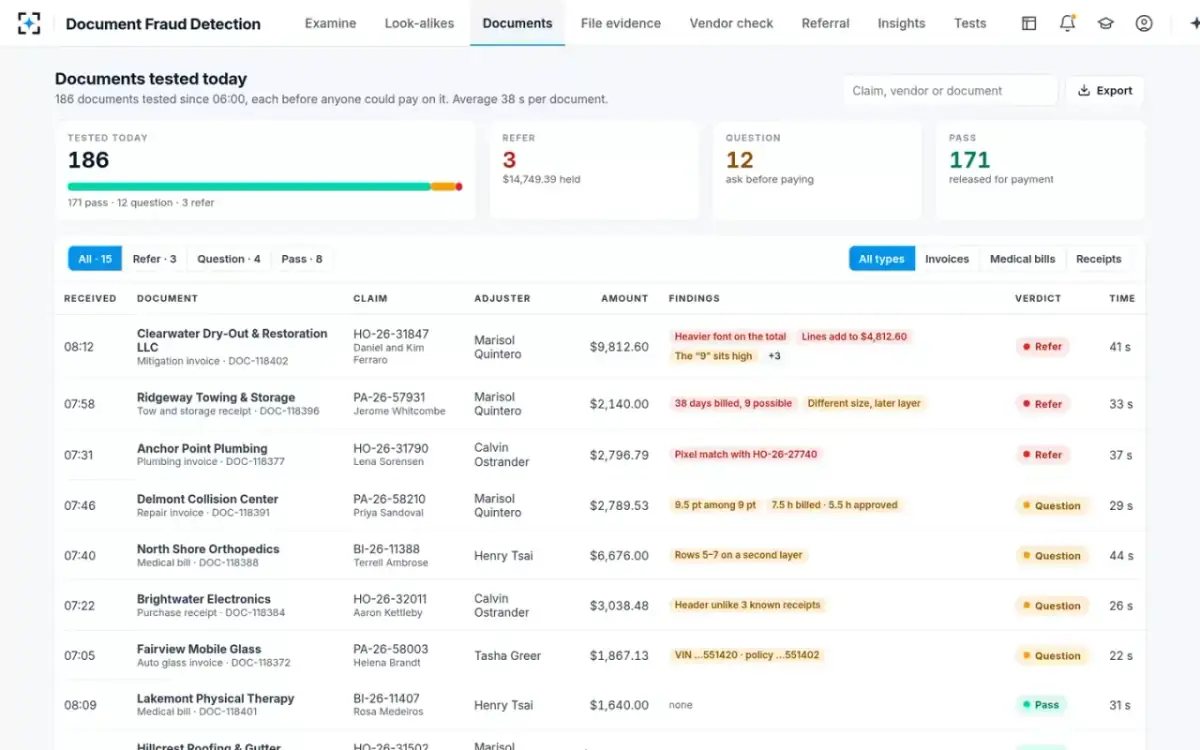
The checks: is the provider registered, with a valid NPI, at that address; do the dates of service fall inside the claim and the treatment plan; and was any part of the bill added after it was produced? In the sample, a medical bill from an orthopedic practice raised a question because rows 5 to 7, three dates of service, sat on a second text layer added after the bill was made. Every medical bill over $500 is tested that way, alongside the coding review. How a medical line in a demand travels back to its bill is covered in medical specials, traced.
4. Do insurers check police reports? They should get their own copy
Many do not, and the cases show why they should. In August 2022 California announced 39 felony counts against the alleged leader of a "paper collision" ring in the Inland Empire. The Department of Insurance explained the term: "In a “paper collision” the accidents never occurred and perpetrators use false documents to commit fraud." The ring is accused of submitting fictitious medical records and altered California Highway Patrol collision reports, and of collecting over $80,000 (CDI).
The check is simple and often skipped: obtain the report from the agency rather than from the claimant, and compare the report number, officer, date, location and parties with the claim. A report that the agency cannot find, or that differs from the agency's copy, ends the question. Staged and paper collisions usually involve several claims and people, so the ring is found across claims rather than in one report.
5. Rental and living-expense invoices: a home on paper
When a covered loss makes a home uninhabitable, policies pay additional living expenses, and the documents are leases and rent invoices. They are easy to forge because the insurer rarely knows the landlord. In June 2026 North Carolina charged a man with insurance fraud, obtaining property by false pretense and common law forgery, accusing him of obtaining $43,096.84 from his insurer by forging rental invoices "for a residence he was not living in at the time of the claim" (NCDOI).
The checks: does the landlord exist and own the property; does the insured's address history fit; do the lease, the invoices and the payments agree; and does the same landlord or template appear on other claims? Each is a source outside the document.
And the photos behind them
Photos are not on the NAIC's list, but they now carry as much weight as any document in a property claim, and they can be altered too. In June 2026 North Carolina charged a claimant with five counts of insurance fraud, accusing her of using an AI application to make items look damaged and of pulling images of damaged items from the internet (NCDOI). Photos get the same treatment as documents: what the file records about itself, whether the image appears elsewhere, and whether what it shows fits the claim.
One morning in Document Fraud Detection: each document tested its own way
Is submitting a fake receipt to insurance a felony?
In most states it can be, and the grade usually depends on the amount. California treats a writing prepared to support a false claim as a felony punishable by two, three or five years. New York makes a fraudulent insurance act a class A misdemeanor, rising to a class E felony when more than $1,000 is taken or attempted. Florida grades insurance fraud as a third-degree felony below $20,000, rising with the amount. Forgery charges can come on top: the North Carolina man accused of forging a towing invoice to show an inflated $1,581.06 charge was charged with common law forgery and uttering as well as insurance fraud (NCDOI). The full ladders are set out in inflated invoices.
What happens if you submit fake documents to insurance?
The document is not paid on, the claim goes to the insurer's special investigations unit, and the insurer may report it to the state's fraud bureau, which can investigate and refer it for prosecution. In the cases above, the routes ran through arrests, pleas, restitution orders and probation. A claim with a fake document in it can also fail as a whole under the policy's fraud condition, which is a matter of the policy wording and state law. How the insurer's side of that process works is set out seat by seat in the guide to the document fraud investigation process.
Teaching the five to a claims team
Training regulations already expect this. California, for example, requires an anti-fraud orientation for newly hired employees within 90 days, and annual in-service training for claims staff that covers recognising red flags and emerging fraud trends (10 CCR § 2698.39). A red-flag list helps; a check per document helps more, because it tells the adjuster what to do when a flag appears.
One check per document type, for the desk
- Receipt
Add it up, compare it with the merchant’s other receipts, and ask for the card statement line before arguing about the image.
- Repair estimate or invoice
Lay it against the approved estimate and the photos; question hours and lines that exceed them.
- Medical bill
Check the provider’s registration and the dates of service against the claim, not only the codes.
- Police or accident report
Get your own copy from the agency and compare number, officer, date and place.
- Rental or living-expense invoice
Confirm the landlord and the insured’s address; match the lease, invoices and payments.
- Any of them
Look at the file: saved again before upload, a figure in its own font, text on a later layer.
Questions people ask
What is a fake insurance claim document?
A document submitted to support a claim that has been made up or altered, such as a receipt with a changed total, an invoice from a business that does not exist, or a medical bill for treatment never given. Insurance fraud statutes cover these as false written statements made in support of a claim.
How do insurers verify medical records?
By checking the provider's registration and NPI, comparing dates of service with the claim, requesting records directly from the provider when there is a question, and looking for text added after the bill was produced. Coding review alone does not catch a date that was moved.
Can insurers tell if a receipt is fake?
Often, by checking it against things the receipt cannot change: its own arithmetic, the merchant's real receipt format, the purchase date against the loss, and the payment record. Image checks help with older edits but struggle with AI-edited receipts.
Do insurers check repair shop invoices against the estimate?
They should, line by line: hours, parts and rates against the approved estimate and the photos. In the sample, a repair invoice billing 7.5 hours against 5.5 approved raised a question for the adjuster.
Are altered documents always fraud?
No. Vendors and providers correct and re-issue documents, and receipts carry handwritten notes. Fraud requires a knowing intent to deceive; a finding that a document was altered is a reason to ask, not a conclusion.