Insurance subjectivities are the "subject to" conditions an underwriter writes on a quote or a bound slip: a signed statement of values, a survey, a completed questionnaire, a plan the underwriter must approve. Each should say what is required, by when, and what happens if it is not met. On a London market slip they sit in their own section, and they are one of the places a contract stays unfinished after binding. The work they create splits cleanly in two. Lifting each subjectivity off the slip, turning "within 14 days of inception" into a date and time, and drafting the broker chaser when one lapses is maker work, mechanical and checkable. Checking that the chaser quotes the right clause, the right date and the right consequence before it goes, and deciding whether evidence meets the condition, is checker work. Botminds' Contract Certainty Management gives the first job to agents and keeps the second with people, and the agent that drafts a chaser can never be the one that releases it.
The examples come from a fictional London market insurer, Marlowgate Specialty, on Monday 12 October 2026. For the US retail broker's view of subjectivities, the pre-bind and post-bind conditions on competing quotes, see insurance quote subjectivities; this guide is about what happens to them after the slip is bound.
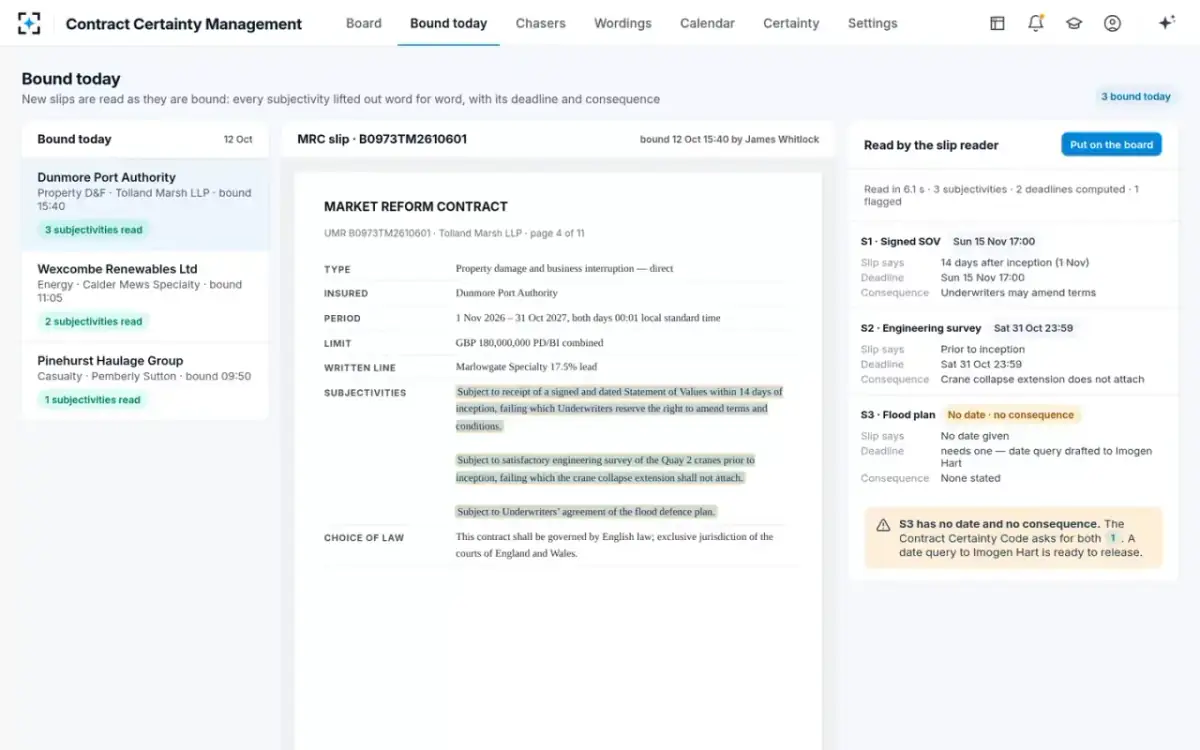
Three subjectivities on one bound slip, taken apart
| On the slip | Deadline | Consequence | What the reader flags |
|---|---|---|---|
| S1 · "Subject to receipt of a signed and dated Statement of Values within 14 days of inception, failing which Underwriters reserve the right to amend terms and conditions." | Relative: 14 days after the 1 Nov inception, read as 17:00 on Sun 15 Nov | Underwriters may amend terms | Nothing: requirement, deadline and consequence all stated |
| S2 · "Subject to satisfactory engineering survey of the Quay 2 cranes prior to inception, failing which the crane collapse extension shall not attach." | Before inception: Sat 31 Oct 23:59 | One extension falls away; the rest of the cover stands | Nothing; "satisfactory" is the underwriter’s call when the survey arrives |
| S3 · "Subject to Underwriters’ agreement of the flood defence plan." | None stated | None stated | No date and no consequence: a date query to the broker is drafted |
What does a subjectivity on an MRC slip say?
A well-formed subjectivity on a market reform contract slip says four things: the requirement, the evidence that proves it, the deadline, and the consequence of missing it. The first sample subjectivity above has all four. The third has a requirement and nothing else, which leaves the insurer unable to say when it is late or what being late means.
Each of the four parts fails in a typical way. The requirement is vague ("satisfactory" survey, "agreement" of a plan) and needs the underwriter's judgement later. The evidence is unstated, so a draft arrives and someone must decide whether an unsigned version counts. The deadline is relative ("within 14 days of inception", "prior to inception") and has to be turned into a date and time before anyone can count down to it. And the consequence is either drastic, missing or quietly different from what the underwriter would actually do.
A subjectivity's consequence is the part that decides how much it matters. "Failing which Underwriters reserve the right to amend terms and conditions" leaves cover in place and gives the underwriter an option. "Failing which the crane collapse extension shall not attach" removes one piece of cover automatically. A subjectivity worded as a condition of the whole cover would make the insurer's position at a loss depend on it entirely, which is why it pays to read the consequence first.
What is a subject to clause, and can it be a warranty?
"Subject to" is the market's shorthand for a condition, and the legal effect depends on the words that follow, not on the label. Under English law a requirement framed as a warranty is governed by the Insurance Act 2015. For contracts made since 12 August 2016 a breach no longer discharges the insurer; instead the insurer has no liability for loss occurring, or attributable to something happening, between the breach and its remedy, and is liable again once it is remedied (Insurance Act 2015, s.10(2); the Insurance Act 2015 warranties guide reads old wordings against it).
The Act has a rule written for exactly the shape of most subjectivities. Where a warranty "requires that by an ascertainable time something is to be done (or not done), or a condition is to be fulfilled", and that is not done, the breach counts as remedied only "if the risk to which the warranty relates later becomes essentially the same as that originally contemplated by the parties" (s.10(5)(a) and (6)). A signed statement of values delivered late does not undo the lateness; it ends the period in which the insurer is off risk.
A second section limits what a missed condition can do at a loss. For a term whose compliance "would tend to reduce the risk" of loss of a particular kind, at a particular location or at a particular time, the insurer cannot rely on non-compliance if the insured shows that the breach could not have increased the risk of the loss that actually happened, in the way it happened (s.11). The question becomes whether the missed condition could have mattered to the loss that actually happened. None of this is legal advice; the point for the person tracking subjectivities is that the slip's wording, not the tracker's spreadsheet, sets the stakes.
Who tracks subjectivities after binding?
On the insurer's side, a contract-certainty analyst or an underwriting assistant; on the broker's side, whoever services the placement. In the sample market Hannah Mercer, Marlowgate's contract-certainty analyst, had been keeping around 60 open bound risks in a spreadsheet, typing each subjectivity in by hand and finding out that one had lapsed when she happened to open the file. That is the maker work.
The maker work is mechanical in a precise sense: it has one right answer that can be checked against the slip. A deadline of "within 14 days of inception" on a policy incepting at 00:01 on 1 November has one date, Sunday 15 November; the hour has to be fixed once and applied the same way every time, and the sample reader uses 17:00 London time, the hour written into the dated Harwell Quay subjectivity on another of Marlowgate's slips. Even the clock matters: UK summer time ends "at one o'clock, Greenwich mean time, in the morning of the last Sunday in October" (Summer Time Order 2002, art. 2), which in 2026 is 25 October, so a deadline set at 17:00 on 12 October is British Summer Time and one at 17:00 on 15 November is Greenwich Mean Time. A broker in New York working from either needs the right offset.
A new slip read as it is bound, with the undated subjectivity flagged
How are subjectivities chased?
In stages: a reminder before the deadline, a chaser at it, and an escalation if the chaser goes unanswered. Marlowgate's sample settings send a reminder to the broker three days before each deadline, drafted at 09:00; a chaser at the deadline that quotes the slip word for word; escalation to the underwriter two working days after the chaser; and to the head of underwriting operations after five.
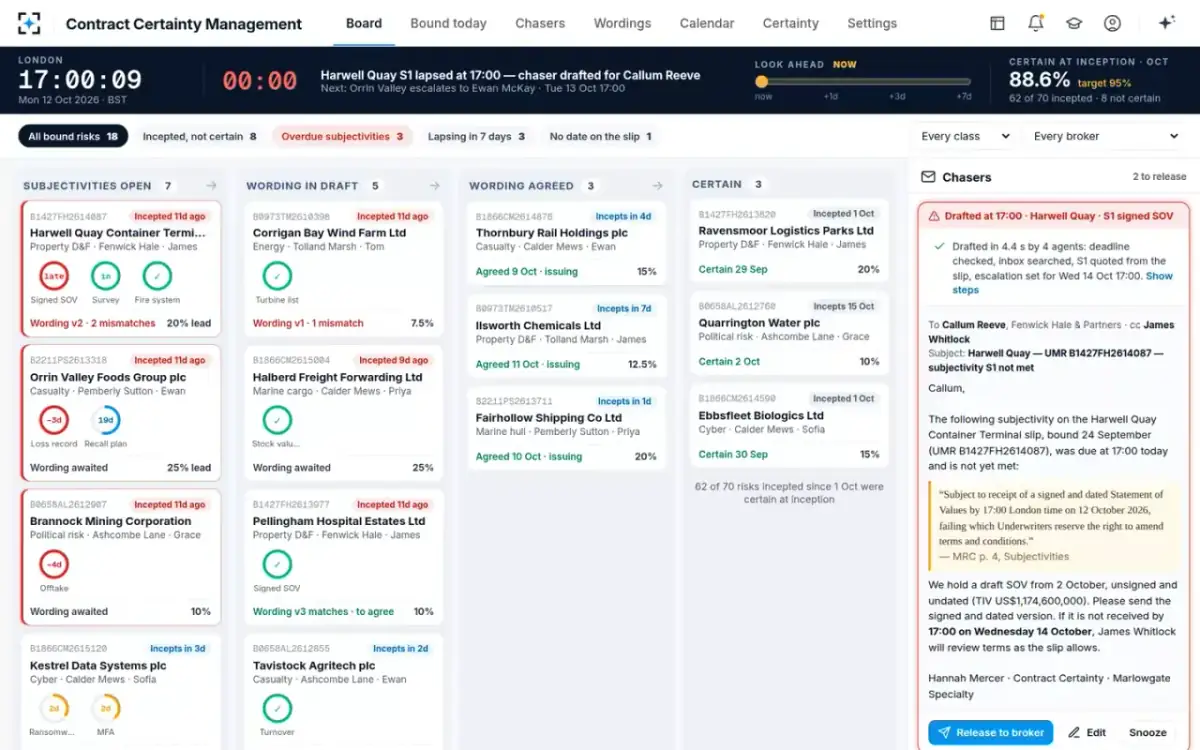
What a chaser says decides whether it works. The sample chaser for Harwell Quay, drafted at 17:00 when its statement of values lapsed, quotes the subjectivity with its slip page ("MRC p. 4, Subjectivities"), says what Marlowgate holds (a draft statement of 2 October, unsigned and undated) and what is missing (the signed and dated version), and names the date after which the underwriter "will review terms as the slip allows". The broker's reply came two minutes after release: "Apologies — signed SOV attached."
The chaser drafts itself at the deadline, and waits for a person
Drafting a chaser and checking it are two jobs
The maker produces a draft that should be right; the checker confirms it is right before it reaches a broker. The two must be different hands, for the same reason a payment is keyed by one person and approved by another: the person who made an error is the least likely to see it. When the maker is an agent, the case is stronger, because an agent that drafts and sends has no one between its mistake and the market.
Maker, checker, decider: how Contract Certainty Management splits a subjectivity
Agent
Slip reader (maker)Lifts each subjectivity word for word with its page, computes the deadline in London time, states the consequence and the evidence needed.
Never: guesses a missing date; it flags it
Agent
Subjectivity tracker (maker)Counts down, queues the reminder 3 days ahead, marks the subjectivity overdue the moment it lapses with no evidence in.
Never: extends a deadline
Agent
Chaser writer (maker)Searches the placement inbox, drafts the chaser to the broker on the slip, quotes the subjectivity and sets the escalation date.
Never: sends; the quoted slip text cannot be edited
A person decides
Analyst (checker)Checks the clause, the date and the consequence against the slip page, then releases the chaser or holds it.
Agent
Document matcher (maker)Matches each reply’s attachment to the open subjectivity, checking it is signed, dated and for the right site, and says why.
Never: clears; it proposes
A person decides
Class underwriter (decider)Clears the subjectivity with a signature whose meaning is recorded: the subjectivity is met as worded on the slip.
Two design rules make the check fast enough to be real. Every subjectivity carries its slip page, so the checker compares the draft with one paragraph, not the whole slip. And the quoted text in the chaser cannot be edited: if the quote is wrong, the fix is to the slip reading, which is then right for every later chaser on that risk, not just this one.
What the maker produces, and what the checker asks of it
Maker output (agent): S1 quoted from MRC p. 4
Checker question (person): Is this the subjectivity that lapsed, and the latest slip version?
Maker output (agent): 17:00 London time, 12 October 2026
Checker question (person): Did the slip say that, or did the firm’s setting supply the time?
Maker output (agent): “failing which Underwriters reserve the right to amend terms and conditions”
Checker question (person): Does the escalation line in the chaser promise more than that?
Maker output (agent): Draft SOV of 2 October, unsigned and undated
Checker question (person): Is the inbox search complete, or did the signed version go to someone else?
Maker output (agent): Broker contact on the slip, underwriter copied
Checker question (person): Is that contact still handling the placement?
When the evidence comes back: matching is maker work, accepting is not
The reply to a chaser is a second maker-checker step. Matching an attachment to the open subjectivity, and checking that it is signed, dated and for the right site, is mechanical; deciding that it satisfies the condition is not. On the sample Harwell Quay risk the placement inbox already held a statement of values from 2 October, and the document matcher held it against S1 as unsigned and undated rather than treating its arrival as compliance. The signed version that came in at 17:02 on 12 October was matched and marked ready to clear, with its reason: signed and dated that day by the insured's chief financial officer, inside the slip's tolerance.
The survey shows where checking turns into judgement. S2 asked for a "satisfactory risk survey within 30 days of inception; survey recommendations to be agreed by Underwriters." The report from the fictional Halden Risk Engineering arrived on 8 October with four recommendations, none critical. An agent can say that the report exists, is for the right site and lists four recommendations. Whether that is satisfactory, and whether the underwriter agrees the recommendations, is the underwriter's decision, and the matcher only proposes.
What should a subjectivity say? A drafting checklist for underwriters
Most chasing problems start at the slip, so the cheapest fix is upstream. A subjectivity drafted with these six elements can be tracked, chased and cleared without anyone interpreting it later.
Six things every subjectivity should state
- The requirement, specifically
Not "survey" but "engineering survey of the Quay 2 cranes".
- The evidence that proves it
Signed and dated, by whom, for which site; say whether a draft counts.
- A deadline with a date, a time and a time zone
Or a relative deadline with its anchor ("14 days after inception"), so it can be computed once.
- The consequence of missing it
Amend terms, an extension falls away, or something else; never left blank.
- Any tolerance
For example how far a signed statement of values may differ from the draft before terms are reviewed.
- Who decides it is met
Name the underwriter; on a subscription slip, say whether followers are bound by the leader’s decision.
The fifth element is the one most slips leave out and most disputes turn on. The sample Harwell Quay statement of values arrived signed by the insured's chief financial officer, with total insured values of US$1,187,400,000, 1.1% above the draft. Because the slip set a 10% tolerance, the document matcher could say it was inside it; without one, someone would have had to decide.
Who clears a subjectivity?
The underwriter, and in the sample setup nobody else; on a subscription slip, whether the followers are bound by the leader's decision depends on what the slip says. Clearing is a decision that the condition is met as the slip worded it, and it changes what the insurer has agreed. In the sample setup the document matcher proposes a match with its reason, the underwriter sees the slip's exact words beside the evidence, and the signature records its meaning.
Clearing with a signature that says what it means
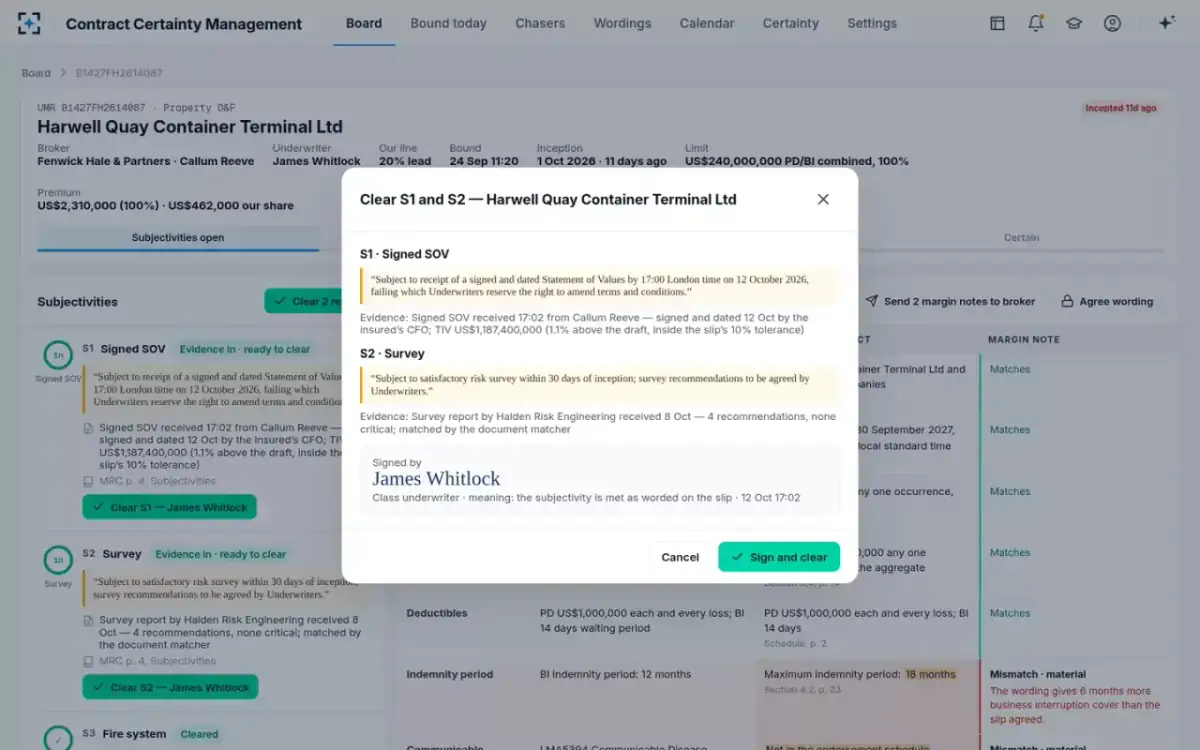
A signature with a stated meaning closes a gap that spreadsheets leave open. "Cleared" in a tracker column can mean the document arrived, the analyst looked at it, or the underwriter accepted it. Only the last changes the contract, and only the last should move a risk towards certain. How long each open subjectivity costs while it waits for that signature is worked through in binding subjectivities.
Questions people ask
What is the difference between a subjectivity and a condition precedent?
A subjectivity is a market label for a "subject to" requirement on a quote or slip; a condition precedent is a legal classification of a term whose fulfilment must come before something else, such as the insurer's liability. A subjectivity can be drafted as a condition precedent, a warranty or a plain term, and the words decide which. Under the Insurance Act 2015, section 11 can apply to any such term, whatever it is called, if compliance would tend to reduce the risk of loss of a particular kind, at a particular location or at a particular time.
Is cover in force while a post-bind subjectivity is open?
That depends on the consequence the slip states. The sample Harwell Quay slip kept cover in force and gave the underwriters the right to amend terms if the signed statement of values was late. A subjectivity worded as a warranty would instead suspend cover for losses after the breach until it is remedied, under section 10 of the Insurance Act 2015.
Can a broker agree to extend a subjectivity deadline?
Not on the insurer's behalf. The deadline is a term of the contract, so moving it needs the insurer's agreement, which the underwriter gives. In the sample setup the subjectivity tracker never extends a deadline, and every step on a risk, by an agent or a person, is on its run log with the time and who did it.
How many subjectivities does a slip usually have?
Insurers don't publish counts, so measure your own book. In the fictional sample market, the three slips bound on 12 October carried three, two and one subjectivities, and the October board showed seven risks still in the subjectivities-open lane out of 18 bound risks being tracked.
Should an agent ever send a chaser on its own?
Not in this design. A chaser speaks for the insurer to the broker and may set a date after which terms are reviewed, so a person reads and releases each one. Contract Certainty Management lets a firm turn the release step off, but the sample setting keeps it on, and every chaser on the chasers screen shows who released it and when.