Contract certainty deadlines are the dates by which each part of a bound insurance contract must be closed: every subjectivity by the date the slip gives it, the wording agreed by inception if the risk is to count as certain, evidence of cover within the firm's reading of "promptly", and, for US surplus lines business, the statutory filing that must reach the regulator or stamping office within a fixed number of days whether or not the policy has been issued. They are not all the same kind of clock. Some are law and cannot be moved by anyone at the firm; some are terms of the contract and move only by agreement; some are the firm's own policy, set by a head of operations and changeable by an approved decision. Botminds' Contract Certainty Management turns each one into a date and time on a board, reminds before, chases at the deadline and escalates on a clock, so the hard ones are never missed and the soft ones are changed on purpose rather than by drift.
The examples come from the solution's fictional sample market, where Marlowgate Specialty writes London market lines, and from the statute books of Texas, New York, California and Florida and the FCA Handbook, quoted or linked where used.
The deadline ladder: days allowed, each counted from its own starting event
What are contract certainty deadlines?
They are every date on which some part of a bound contract becomes late. On a London market risk the first may be a subjectivity due before inception; the defining one is inception, the minute at which the risk is either certain or not; and the last is the documentation period after it. On US surplus lines business, statutory filing deadlines sit beside them and do not wait for the wording.
The FSA put the shape of the main clocks in shorthand when it opened its contract certainty work in 2004: a wording agreed at or before inception, written as "i", and policies issued promptly after it, written as "i + # days" (FSA, record of the industry meeting of 20 December 2004). The number of days was left to be filled in. It still is, for each firm.
Which clocks are hard and which are soft?
A hard clock is one the firm cannot move on its own: a statute or a term of the contract. A soft clock is one the firm sets for itself and can change by its own decision. Both matter; the difference is who can change them and what happens when they are missed.
Every contract certainty clock, by who sets it and whether it moves
| Clock | Set by | Hard or soft | If missed |
|---|---|---|---|
| US surplus lines filing (TX 60 days, NY 45, CA 60) | State statute | Hard: only the legislature moves it | Late fees, disciplinary action, depending on the state |
| Florida quarterly affidavit | State statute | Hard | A breach of the statute for that quarter |
| Subjectivity deadline on the slip | The contract (underwriter and insured) | Hard for the firm: moves only by agreement | The slip’s stated consequence; for a warranty, suspension under Insurance Act 2015 s.10 |
| Wording agreed by inception | The firm’s definition of certain | Fixed by the test; the firm defines the test | Risk counted not certain at inception |
| Evidence of cover after inception | FCA guidance says "promptly"; the firm sets the days | Soft in number, hard in principle | A documentation failure; a weak answer to Principle 7 |
| Reminders, chasers and escalation | The firm’s own process | Soft | Deadlines above are missed more often |
The soft clocks are not unimportant; they are the ones the firm controls, which makes them the levers on the hard ones. A reminder three days before a subjectivity deadline, a chaser at it and an escalation two working days later are all house policy, and they decide how many hard deadlines pass unnoticed.
When must the wording be agreed?
By inception, if the risk is to be certain at inception, because that is what the test measures. No statute in the UK says a wording must be agreed by a given day; the deadline comes from the definition the firm, and the market before it, adopted. The London market's 2005 definition required every term, signed down lines included, to be finally agreed between the insured and its insurers before inception (Market Reform Group, progress report to the FSA, 5 July 2005).
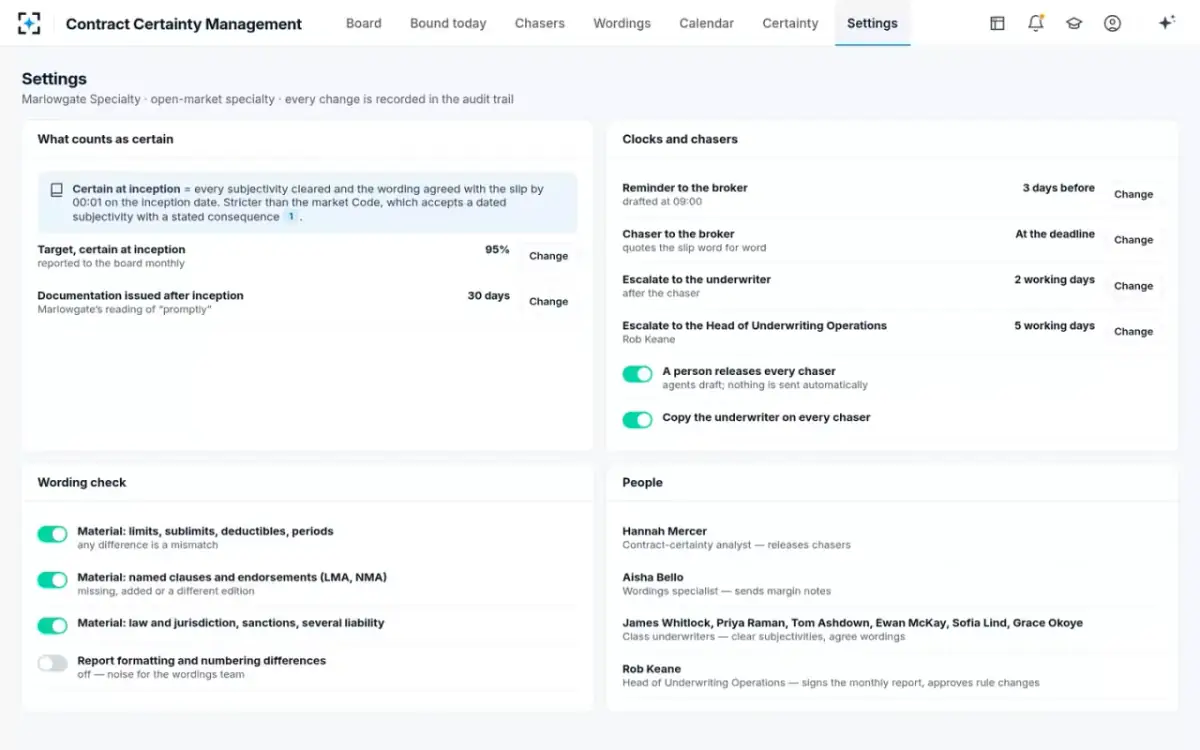
That makes inception the hardest soft clock there is. A firm can change its definition, but it cannot change when its risks incept, and a wording agreed at 00:02 on the first day of the period fails a test taken at 00:01. In the sample market, Marlowgate's setting reads "every subjectivity cleared and the wording agreed with the slip by 00:01 on the inception date", and the wordings screen shows each wording on its own clock: "before inception" for risks still to incept, "day 11 of 30" for those already running.
How long do you have to issue policy documents?
In the UK, "promptly", in a number of days the firm sets; in US surplus lines, the state's filing period, which can be met with a certificate or cover note if the policy is not ready. The FCA's guidance asks for evidence of cover promptly after inception, with the type of customer in mind (ICOBS 6.1.11G), and repeats the expectation for larger commercial customers and specialist risks; the wording is read in FCA contract certainty requirements. The London market agreed in 2005 to issue evidence of cover within 30 days of inception, and Marlowgate's sample setting adopts the same 30 days.
US statutes are more specific about the document than about the wording. Texas requires the surplus lines agent to file with the stamping office within 60 days after the later of the effective date or the issue date, and if the policy has not been issued, to file the certificate, cover note or other confirmation of insurance delivered instead (Tex. Ins. Code § 981.105). California's 60-day report likewise includes "a copy of the declarations page of the policy or a copy of the surplus line broker's certificate" (Cal. Ins. Code § 1763). A US filing deadline can therefore be met while the wording is still unfinished, which is precisely why it is no evidence that the contract is certain.
What is a subjectivity deadline?
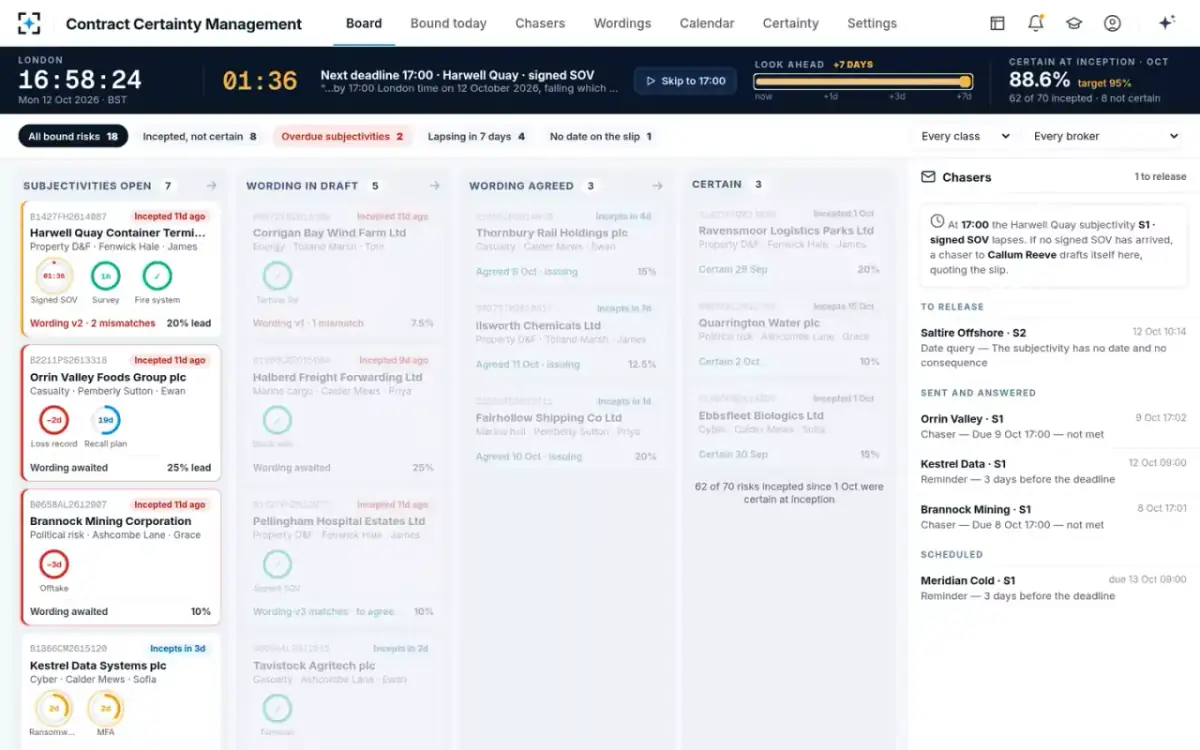
It is the date and time, written on the slip or computed from it, by which the insured must meet a condition, with the consequence the slip states if it does not. Some are absolute ("by 17:00 London time on 12 October 2026"); some are relative ("within 14 days of inception", "prior to inception") and have to be turned into a date once, correctly, for everyone who will chase them. Some are missing altogether, which makes them unenforceable as deadlines until someone asks for one.
A subjectivity deadline is hard for the firm because it is a term of the contract, and moving it means agreeing a change with the insured. Under English law, if the subjectivity is worded as a warranty to be done "by an ascertainable time", missing it suspends the insurer's liability for losses until the breach is remedied (Insurance Act 2015, s.10). The full treatment of what a subjectivity should say is in insurance subjectivities on a London slip.
Every subjectivity on the board, counting down to its deadline
What is the filing deadline for surplus lines policies?
It depends on the insured's home state; in the four states here the periods run from 45 to 60 days today, with New York moving to 30 in 2029. Texas allows 60 days after the later of the effective or issue date. New York allows 45 days after a policy is procured for submitting the declarations page or cover note to the excess line association, and the version of its law that takes effect on 1 July 2029 requires filing with the superintendent within 30 days (N.Y. Ins. Law § 2118). California allows 60 days of placing. Florida requires each surplus lines agent to file a quarterly affidavit within 45 days after the quarter ends, stating that all its surplus lines business for the quarter has been submitted (Fla. Stat. § 626.931; the surplus lines filing requirements by state guide sets the four clocks side by side).
Texas also prices lateness. Under § 981.105 a policy filed late but within 180 days draws a per-policy fee that doubles if more than 5% of the agent's filings were late the previous year, and a higher fee applies between 180 and 365 days for agents with a low prior-year late rate. Surplus lines filing is a discipline of its own, and the Texas ladder is priced case by case in surplus lines late filing fees; for contract certainty the point is that these clocks run on the documents, regardless of whether the contract is finished.
London market and US surplus lines: where the hard clocks sit
London market risk (UK law): Subjectivities due "prior to inception"; wording agreed for the risk to be certain
US surplus lines risk: Pre-binding conditions; home-state diligent-search rules where they apply
London market risk (UK law): Subjectivities on the slip’s own clocks
US surplus lines risk: Subjectivities on the binder’s own clocks
London market risk (UK law): Evidence of cover "promptly" (FCA); firm sets the days
US surplus lines risk: Statutory filing within 45–60 days (New York 30 from 2029), by policy or certificate
London market risk (UK law): Agreed per the slip; documented by the firm
US surplus lines risk: Texas: each endorsement filed promptly
London market risk (UK law): Few: the general law of contract and the Insurance Act 2015
US surplus lines risk: Many: each home state’s surplus lines code
What happens when a contract certainty deadline is missed?
What happens depends on the clock. A missed statutory filing exposes the agent to fees or discipline. A missed subjectivity triggers whatever the slip says, which may be an option to amend terms, a piece of cover falling away, or for a warranty a suspension of cover. A wording not agreed by inception means the risk is counted not certain, permanently, for that period. Late evidence of cover is a documentation failure that the firm's own reporting should show.
The common thread is that nothing happens unless someone sees the deadline pass. A missed statutory date is found by the regulator; a missed subjectivity, unless the firm is watching, is found at the next review or at a claim. That is the case for counting down every clock in one place, rather than in a spreadsheet column that only matters when someone opens it.
Who sets contract certainty deadlines?
Four parties, each for its own clocks. Legislatures set the surplus lines filing periods. The underwriter sets subjectivity deadlines when writing the slip, and the insured accepts them by binding. The firm sets its definition of certain, its documentation period, and its reminder, chaser and escalation timings. And the market set a reference point in 2005 with its 30-day evidence-of-cover agreement, which a firm may adopt or tighten.
The firm's own clocks should be visible, owned and changeable only by decision. In Marlowgate's sample settings, every value, from the 30-day documentation period to the five working days before escalation to the head of underwriting operations, can be changed only by a proposal that the head of underwriting operations approves, and every change is kept in the audit trail. A deadline nobody owns is a deadline nobody enforces.
The firm's own clocks, in one place, changed only by approval
The zero-tolerance list
Some deadlines should never be missed, because missing them cannot be repaired afterwards. A firm should know which of its clocks are on that list and watch them hardest.
Deadlines a certainty team should treat as zero-tolerance
- Statutory filing dates
Fees and discipline follow automatically in some states, and the clock does not wait for the wording.
- Subjectivities due before inception
After inception the insurer is on risk and its leverage falls.
- Wording agreement before inception
Missing it fails the certainty test for good; nothing done on day two repairs it.
- Subjectivities worded as warranties
Missing one can suspend cover for losses until it is remedied.
- Undated subjectivities, queried on the day of binding
A condition without a date can never be late, so it can never be chased.
- Signed lines before inception
In a subscription placement the definition counts them.
Questions people ask
Is there a legal deadline for agreeing an insurance wording in the UK?
No general statutory deadline applies. The deadline that matters for certainty comes from the firm's definition of certain at inception and from the contract itself; the FCA's guidance applies to evidence of cover, which it says should come promptly after inception.
Does the 30-day evidence of cover period come from the FCA?
No. The FCA says "promptly". Thirty days is the period the London Market Reform Group agreed in 2005 and reported to the FSA, and it is the period the sample market's settings use. A firm may choose a shorter one.
What time of day is a subjectivity due if the slip gives only a date?
Whatever the firm fixes, applied the same way every time and stated in the chaser. The sample market's dated subjectivities fall due at 17:00 London time; whichever hour is chosen, it should be computed once, in the right time zone, rather than by each person who reads the slip.
Can a broker extend a contract certainty deadline?
Not a hard one. A statutory filing period moves only by law, and a subjectivity deadline only by agreement with the insurer. A firm's own soft deadlines, such as when a chaser goes, are the firm's to change, which in the sample setup means an approved proposal.
How far ahead should a certainty team look?
Far enough to act before the earliest hard clock. The sample board's look-ahead runs to seven days, enough to see four risks with subjectivities lapsing within the week and the reminders already queued three days before each deadline.