Contract certainty in the London market means that, by the time a risk incepts, every insurer that wrote a line on the slip is bound to the same agreed terms and knows the share it finally carries, and that the documents follow promptly. In a single-insurer placement that is one negotiation; in the London subscription market it is several, because one contract is shared among a leader and followers, each line can be signed down after the slip closes, and the broker's wording has to be accepted on behalf of all of them. The UK regulator saw this from the start: when the FSA opened its contract certainty work in 2004, the meeting agreed the difficulties were "more acute in the subscription market". The slip is agreed and the risk is bound, but the contract is not finished until those extra pieces close too. Botminds' Contract Certainty Management tracks two of them, the slip's subjectivities and the wording each broker version must match, on every bound risk, and names each risk that was not certain at inception.
The worked examples come from the solution's fictional sample market, where Marlowgate Specialty writes London market lines, and from one illustrative slip of our own. The regulator's texts and a US appeals court are quoted where they are used.
What must close before inception: one insurer at 100%, or a subscription slip
One insurer writing 100%: One underwriter
A subscription slip: a leader and followers: The leader, and each follower to the extent the slip requires
One insurer writing 100%: 100%, known at binding
A subscription slip: a leader and followers: Written lines known at binding; signed lines settled when the slip closes
One insurer writing 100%: One insurer
A subscription slip: a leader and followers: Every insurer on the slip, directly or through the slip’s agreement provisions
One insurer writing 100%: Agreed with one insurer
A subscription slip: a leader and followers: Agreed with the leader, and with others where the slip requires
One insurer writing 100%: Issued for one insurer
A subscription slip: a leader and followers: One document that must be right for every insurer on the slip
One insurer writing 100%: One contract
A subscription slip: a leader and followers: Each insurer’s own line and what it accepted
What is contract certainty in the London market?
It is the market's own definition, agreed in April 2005 by the London Market Reform Group and presented to the FSA that July: every term, signed down lines included, finally agreed between the insured and all its insurers before the risk incepts (Market Reform Group, progress report to the FSA, 5 July 2005; the exact words are read in what is contract certainty in insurance). Two words in it are specific to subscription. "Insurers", plural, because every line is a party. And "signed down lines", because a contract whose shares are not yet settled is not finished.
The FSA took the problem to both halves of the UK market at once. Its 2006 briefings were aimed at senior managers "within general insurance firms and intermediaries operating in both the Subscription Market (Lloyd's and London Market) and Non-subscription Market (retail and commercial business)" (FSA, Contract Certainty Briefings, 2006). The same challenge applied to both; the London subscription market simply had more to close.
Why is contract certainty harder in the subscription market?
Because each extra insurer adds a party who must accept the terms, a share that must be settled and a source of change after binding. The FSA's 2004 meeting record says it directly: "It was agreed the difficulties with contract certainty are more acute in the subscription market, but are also present in the non-subscription market as well."
The US has its own example of what a many-insurer placement does when the wording is unfinished. The World Trade Center's property programme was bound in July 2001 with about two dozen insurers. When the towers were destroyed in September, only one of those insurers had issued a final policy, so the Second Circuit had to work out, insurer by insurer, what each binder said (345 F.3d 154, 2003). Some insurers had bound on the broker's draft form; one had put forward its own form. The answer for each depended on which document that insurer had in front of it when it bound. A subscription slip that leaves the wording to be agreed later creates the same question on every line.
What are signed lines, and why does certainty wait for them?
A written line is the share an insurer writes on the slip; a signed line is the share it finally carries once the placement closes. If insurers write more than 100% in total, the lines are reduced so the total is exactly 100%, and each insurer's exposure is not known until that happens. The FSA's chief executive named this in his December 2004 speech as one of the things an insurer did not know: how much of each risk every insurer had finally taken, its signed line exposure.
An oversubscribed slip: written lines total 125%, signed lines 100%
Signing down leaves the rate alone but changes each insurer's exposure and premium, so it is an open item until it is done, and the 2005 definition counts it. The Market Reform Group's progress report to the FSA listed among its unresolved points the "Method of communicating signed lines to underwriters prior to inception". If signed lines are only communicated after inception, every risk on the slip fails that definition, however good its wording.
Does every insurer on the slip have to agree the wording?
Every insurer is bound by the wording only to the extent it agreed to it, either directly or through the agreement provisions on the slip that let the leader, or the leader and named followers, agree on behalf of the others. Which route applies is a term of the slip, and certainty means knowing which one each line accepted.
The London market's 2005 approach acknowledged that wordings move after the leader writes the slip: "Wordings can evolve after leader scratch, subject to leader agreement", and "Changes to contract after inception normally to be processed as endorsements" (Market Reform Group, progress report to the FSA, 5 July 2005). Both are reasonable; both create work. A wording that evolves after the slip is written has to be checked against the slip again, version by version, and every endorsement after inception is a change that must be agreed and documented.
Where a subscription contract can still be open after binding
| Open item | Who must close it | What certainty needs |
|---|---|---|
| Subjectivities on the slip | Insured supplies; leader (or each insurer) clears | Each cleared, or dated with a consequence, by inception |
| Wording drafted after the slip | Broker drafts; leader agrees, followers as the slip requires | One agreed version, matching the slip, before inception |
| Signed lines | Placement closed; each insurer told its share | Every insurer’s final share known before inception |
| Endorsements after binding | Leader, and followers where the slip requires | Each agreed and added to the documents |
| Evidence of cover | Prepared once for every insurer on the slip | Issued within the firm’s period after inception |
What does the leader agree on behalf of followers?
Whatever the slip's agreement provisions allow, and no more. Some changes can be agreed by the leader alone for everyone; others need named followers or every insurer. For contract certainty the consequence is practical: a follower is bound to changes it may not have read, and an insurer measuring its own certainty needs to know which agreed version of the wording it is on. How a follower reads and accepts the leader's changes is set out in the guide to the General Underwriters Agreement, which covers what a leader may agree for its followers.
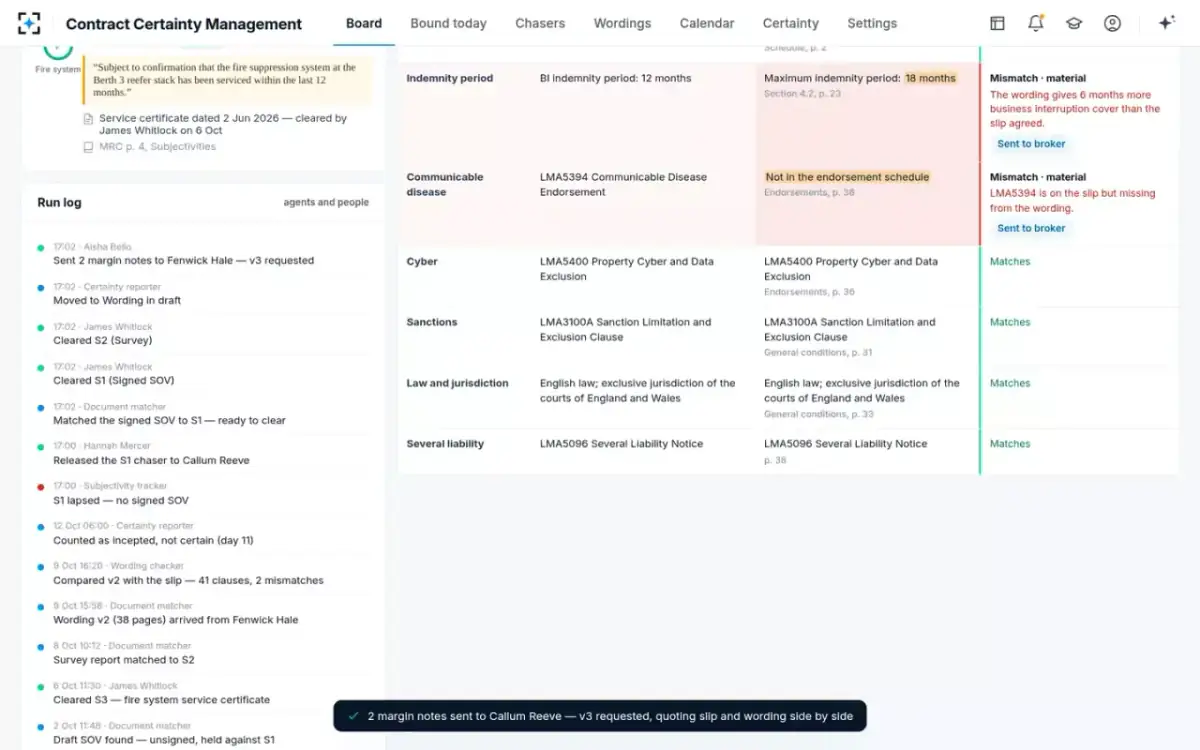
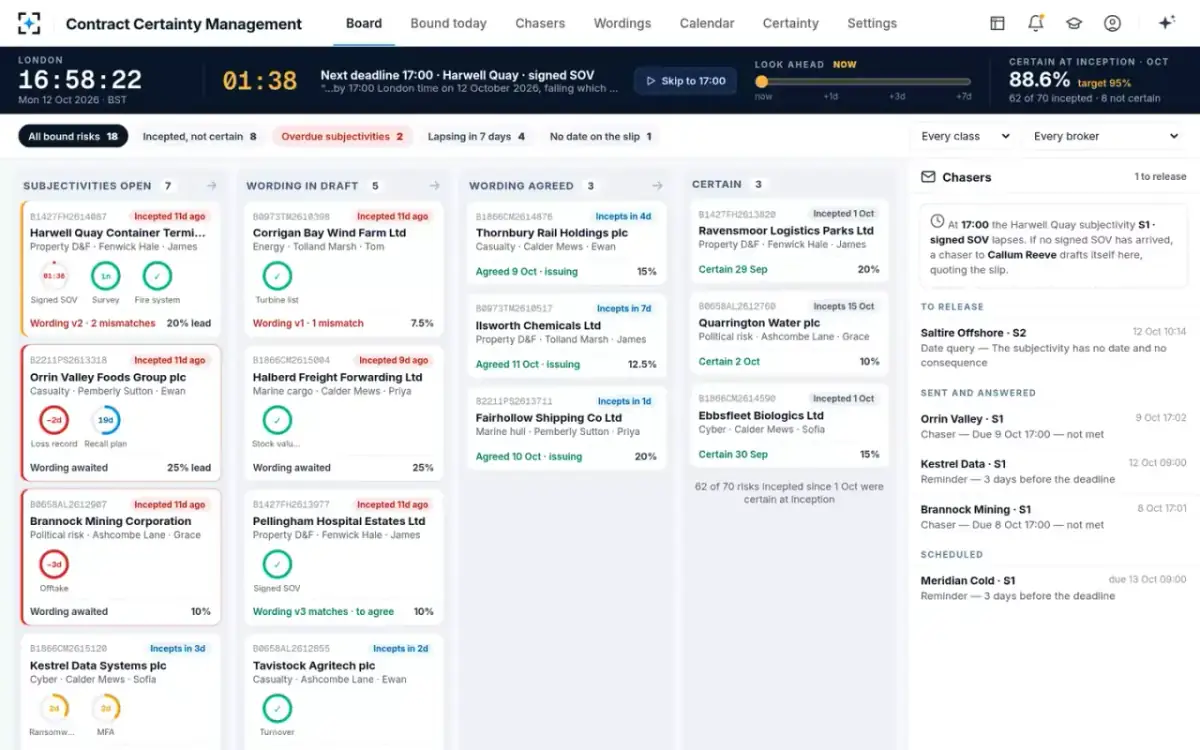
The leader's position also concentrates the work. In the sample market, Marlowgate writes lead lines, 20% on Harwell Quay and 17.5% on Dunmore Port Authority, and its class underwriter is the one who clears subjectivities and agrees wordings. A lead insurer whose certainty process is slow makes every follower's contract uncertain too.
The leader's view: the wording against the slip, with the run log beside it
What was the London market contract certainty challenge?
It was the FSA's December 2004 demand that the market end "deal now, detail later" within two years, without new rules if the market could do it itself. The record of the industry meeting on 20 December 2004 gave the market two years to find its own solution, and kept regulation in reserve if it could not deliver (the challenge is quoted in what is contract certainty in insurance).
The London market's contract certainty challenge, as the FSA's own texts record it
| When | What happened | Where it is recorded |
|---|---|---|
| 13 December 2004 | The FSA chief executive calls for an end to "deal now, detail later" | FSA speech, New York |
| 20 December 2004 | The FSA sets the industry a two-year challenge for a market-driven solution | FSA meeting record |
| April 2005 | The market agrees its definition, including signed down lines | Market Reform Group report to the FSA |
| 5 July 2005 | Progress reported to the FSA; evidence of cover within 30 days agreed | Market Reform Group report to the FSA |
| May 2006 | FSA briefings for senior managers in both the subscription and non-subscription markets | FSA briefing notice |
| December 2006 | The deadline the FSA set for contract certainty | FSA briefing notice |
The record also shows how the work was meant to be governed: "a senior group of industry leaders, with an independent chairperson, to provide strategic oversight, supported by an operational group", with the London Market Reforms already under way to form part of the programme. Today's expectations come through the FCA's general rules rather than a contract certainty rule, as set out in FCA contract certainty requirements. For London market firms one detail matters: the FCA's insurance conduct sourcebook does not apply to the Society of Lloyd's itself, but what it says of an insurer applies to a managing agent too, unless the context requires otherwise (ICOBS 1 Annex 1).
Endorsements after inception: certainty has to be won again
Every endorsement agreed after inception is a small new contract, and on a subscription slip it carries the same questions as the original: who must agree it, which version of the wording it amends, and whether every insurer's documents now say the same thing. The 2005 market approach routed changes after inception through endorsements precisely so that each one would be a discrete, agreed document rather than a drift in an unsigned wording.
English law treats a variation as a contract for the purposes that matter here. The Insurance Act 2015's rules on terms that put a business insured in a worse position than the Act apply to variations in the same way as to the contract itself (s.16(3)), and its duty of fair presentation applies to a variation agreed since August 2016 even when the contract is older (s.22(1)). US surplus lines law puts the same documents on a clock: a Texas surplus lines agent must promptly file every endorsement, like the policy, certificate or cover note it amends, with the stamping office (Tex. Ins. Code § 981.105(b)).
For the certainty team the practical rule is that the comparison never stops at the first agreed wording. Each endorsement is checked against the agreed contract it amends, agreed by whoever the slip requires, and added to the documents every insurer holds. A risk that was certain at inception can become uncertain in month four if an endorsement is agreed by the leader, sent to the insured and never reaches a follower's file.
Measuring certainty when you write a line, not the whole risk
An insurer on a subscription slip measures certainty on its own lines, but the causes can sit outside its control: the broker's wording, the leader's agreement, the signing of lines. The useful report therefore cuts the failures by who could have fixed them. In the sample market, the eight risks not certain at inception in October included wordings differing from the slip and subjectivities overdue or undated, and the broker cut showed two brokers below 85%.
A follower and a leader should read the same failure differently. For the leader, an unagreed wording is its own open item. For a follower, it is a dependency on the leader and the broker, and the question is whether the follower's agreement provisions mean it is already bound to whatever the leader agrees. Contract Certainty Management counts each risk under the firm's own definition and names the reason, so either can see which failures it can fix and which it can only chase. How the count is taken is set out in the contract certainty checklist.
Every bound risk on one board, with Marlowgate's lead lines
Questions people ask
Does contract certainty apply at Lloyd's?
Yes: the FSA's 2006 briefings named "Lloyd's and London Market" as the subscription market it was addressing. Lloyd's also sets its own requirements for its managing agents; read the current version on Lloyd's own site. The test underneath is the same: terms, including signed lines, agreed by inception, documents promptly after.
How does Lloyd's measure contract certainty?
Lloyd's publishes its own requirements for managing agents, and they are the authority on what Lloyd's measures. Whatever the format, a managing agent's figure rests on the same count: risks incepting in a period, how many were certain at inception under a stated definition, and how many were documented within the agreed period, with the failures named.
Is a follower responsible for contract certainty if the leader agrees the wording?
A follower is responsible for knowing what it is bound to. If the slip's agreement provisions let the leader agree the wording on its behalf, the follower is certain when the leader agrees; if not, it must agree itself. Either way the follower's own certainty report should show which it relied on.
When are signed lines known?
When the broker closes the placement and signs the lines down, which should be before inception for the contract to be certain under the London market's 2005 definition. The Market Reform Group listed the method of communicating signed lines before inception as an open point in its July 2005 report to the FSA.
What is the difference between the subscription and non-subscription market?
In the subscription market several insurers each take a share of one risk on one slip; in the non-subscription market one insurer writes the whole risk, in the words of the FSA's 2004 meeting "covering 100% of a customer's risk". The FSA's 2004 meeting found contract certainty difficulties in both, but "more acute in the subscription market", because there are more parties, shares and agreements to close.