A Lloyd's contract certainty tool is software that tracks each risk bound in the Lloyd's and London market from the moment the slip is stamped to the moment its contract is certain: every subjectivity met, the wording agreed with the slip, evidence of cover issued, and the certainty rate counted. There are three broad ways to do it: a spreadsheet and an inbox, a portal where brokers upload documents, or software agents that read the slip and the wording themselves. Each covers a different part of the job, and the difference shows up on the afternoon a subjectivity lapses. Botminds' Contract Certainty Management is the third kind: agents read each bound slip, count subjectivities down, draft the broker chaser at the deadline and compare the wording with the slip clause by clause, while the analyst releases, the underwriter clears and agrees, and the head of underwriting operations signs the rate.
The worked example follows one fictional risk from the solution's sample market, Harwell Quay Container Terminal, insured by the fictional Marlowgate Specialty, through all three approaches. Lloyd's is named here as the market the tool serves; nothing on this page describes Lloyd's own systems.
One lapsed subjectivity, three tools: how long until anyone notices
- Lapsed, unnoticed until the next weekly reviewup to 7 days
- Nothing uploaded; nobody has read the slip’s dateup to 3½ days
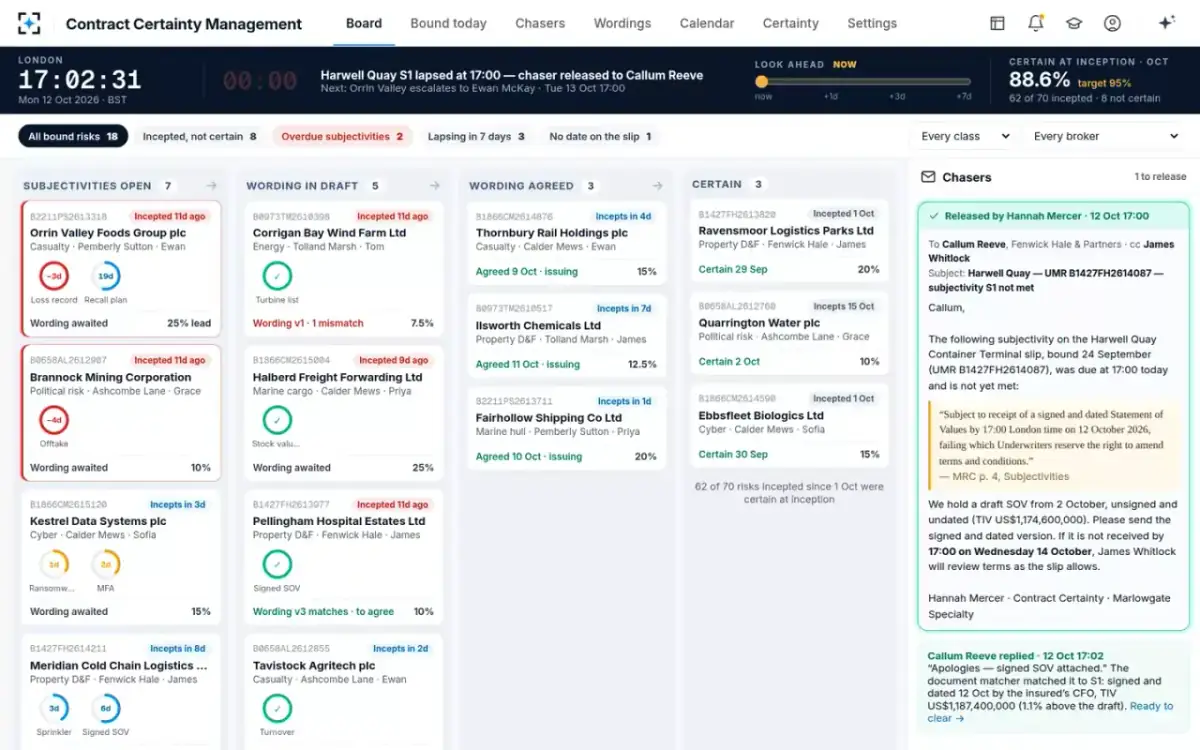
- Overdue at 17:00; chaser drafted, released and answered by 17:02 (2 minutes)
What is contract certainty software?
Contract certainty software holds every bound risk with what is still open on it, and tells the team what to do next. At minimum it must know each subjectivity's words, deadline and consequence; each wording version and how it differs from the slip; the documentation clock; and the firm's definition of certain at inception, so it can count the rate. Anything less is a list of risks, not a certainty tool.
The idea that technology belongs in the answer is as old as the problem. When the FSA met the market in December 2004, the meeting agreed that the key to contract certainty lay partly in "standardisation of process delivered by technology" (FSA, record of the industry meeting of 20 December 2004). Its chief executive had said the week before: "Automation is a key factor, but process simplification, integration and discipline are needed badly if this significant problem is to be resolved." More than twenty years on, the second half of his sentence is still the hard part, and it is the part a tool should be judged on.
What does a contract certainty tool track?
It tracks the objects that can leave a contract unfinished, each with the date by which it must be closed and the person who closes it.
What a contract certainty tool has to hold for each bound risk
| Object | What must be held | Who closes it |
|---|---|---|
| Subjectivity | Exact slip words and page, deadline in London time, consequence, evidence needed, evidence received | Class underwriter clears |
| Wording | Each broker version, its date and pages, and every difference from the slip | Wordings specialist sends notes; underwriter agrees |
| Endorsements and clauses | Each named clause and its edition, on the slip and in the wording | Underwriter agrees |
| Documentation | Evidence of cover and policy issue dates against the firm’s period | Operations |
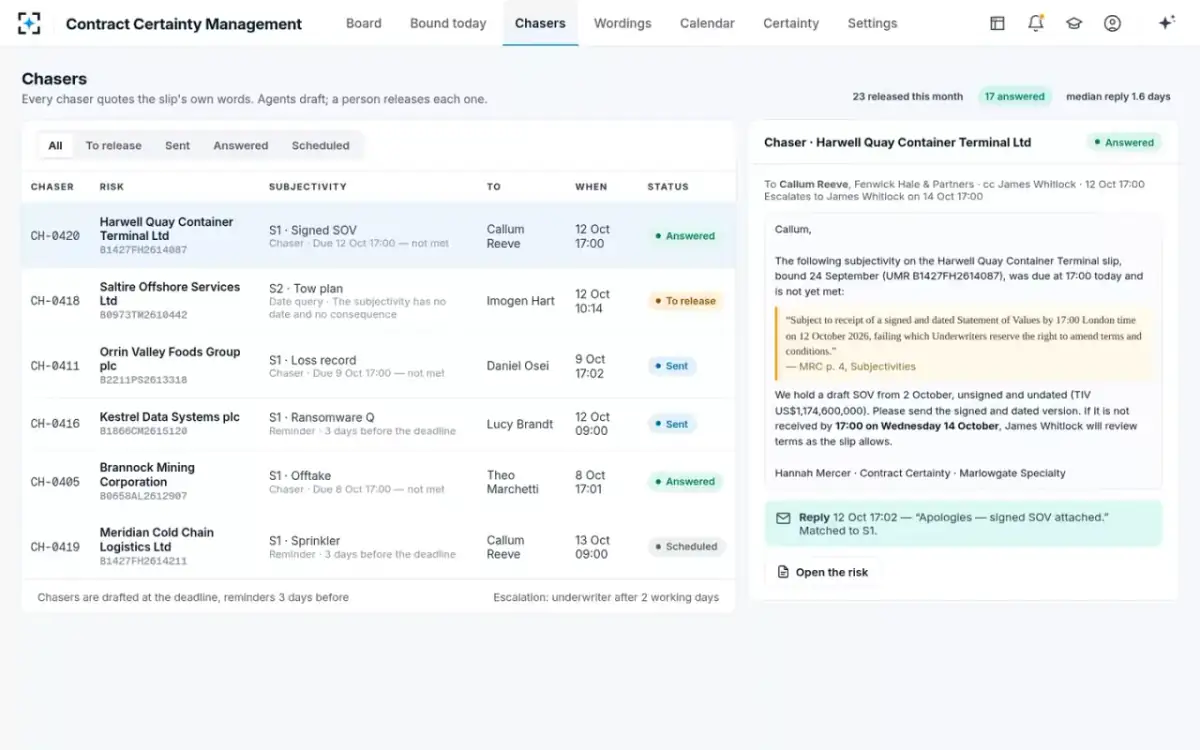
| Chasers | What was sent, to whom, quoting what, and the reply | Analyst releases |
| Certainty status | Certain or not at inception, under the firm’s definition, with the reason | Head of operations signs the report |
Spreadsheet, portal or agents: one risk through each
Each approach can hold the list above; they differ in who reads the documents and who notices time passing. The spreadsheet relies on a person to type every subjectivity in and look at the dates. The portal moves documents to one place but does not read them. Agents read the slip and the wording, and still leave every decision to a person.
Three approaches to contract certainty, row by row
Spreadsheet and inbox, or a document portal: Typed by hand from each slip, or not at all in a portal
Agents that read slip and wording (Contract Certainty Management): Lifted word for word with page and deadline as each slip is bound
Spreadsheet and inbox, or a document portal: Noticed if the person typing it notices
Agents that read slip and wording (Contract Certainty Management): Flagged on the day, with a date query drafted for release
Spreadsheet and inbox, or a document portal: Found at the next review
Agents that read slip and wording (Contract Certainty Management): Marked overdue at the minute; chaser drafted quoting the slip
Spreadsheet and inbox, or a document portal: Someone opens the attachment and decides
Agents that read slip and wording (Contract Certainty Management): Matched to the subjectivity with a reason; underwriter clears
Spreadsheet and inbox, or a document portal: Read against the slip by hand, or stored unread
Agents that read slip and wording (Contract Certainty Management): Compared clause by clause; material differences listed with both texts
Spreadsheet and inbox, or a document portal: Counted from a sample, or not at all
Agents that read slip and wording (Contract Certainty Management): Every incepted risk, every morning, failures named
Spreadsheet and inbox, or a document portal: Cell edits and sent mail
Agents that read slip and wording (Contract Certainty Management): A run log of every agent and person step on every risk
The portal deserves fairness. For brokers and insurers that exchange many documents, a single place to upload and find them is a real improvement over email. Its limit is that it knows a file arrived, not what the file says. A portal will show that a statement of values was uploaded on 2 October; it will not notice that it was unsigned and undated, which is exactly what the sample document matcher flagged. What agents add beside a portal, without replacing it, is the subject of the contract certainty portal guide.
Can contract certainty be automated?
The reading, counting and drafting can; the decisions should not be, and regulators expect the insurer to answer for the software either way. Three parts of the job are mechanical with a right answer: what the slip says, when a deadline falls, and whether a wording's clause matches the slip's. Three are judgements: whether evidence meets a condition, whether a difference is material, and whether to send a chaser that may set a date after which terms are reviewed.
Supervisors have said where accountability sits when a third party builds the tool. New York's Department of Financial Services, writing about AI in underwriting and pricing in July 2024, says insurers retain responsibility for understanding any such tools developed or deployed by third-party vendors and for ensuring they comply with applicable law (Insurance Circular Letter No. 7, 2024). In the UK, the Bank of England and FCA's 2024 survey found that a third of all AI use cases in UK financial services were built by third parties (Bank of England and FCA, November 2024). A certainty tool bought from a vendor is the insurer's tool for every practical purpose, so it must show its work.
What should contract certainty software report?
The rate under a stated definition, the trend, and every risk not certain with its owner and reason, cut by class, broker and underwriter; the documentation rate beside it; and an audit trail from each number back to the slip page or wording section it rests on. A rate without names cannot be acted on, and a name without a citation cannot be checked.
Every chaser in one place: what it quoted, who released it, what came back
What should you ask a contract certainty software vendor?
Ask to see it work on your own documents, and ask questions whose answers can be checked on the spot. A demonstration on a vendor's clean sample proves little; a run on twenty of your bound slips and their broker wordings proves most of what matters.
Questions to put to any contract certainty tool, and what a good answer looks like
| Ask | Why it matters | A good answer |
|---|---|---|
| Show me each subjectivity from my slip, with the page | Summaries lose the words that decide what is owed | Exact slip text, page reference, deadline in London time |
| What do you do with a subjectivity that has no date? | A tool that guesses a date creates a false deadline | Flags it and drafts a date query for a person to send |
| Compare this broker wording with its slip | Most uncertainty hides in the wording | Clause-by-clause differences, with both texts and the wording page |
| Who can send a chaser, clear a subjectivity, agree a wording? | These decisions change the contract or speak to the market | Named people only; the software drafts and proposes |
| Change my definition of certain | The rate depends on it | A setting changed by an approved proposal, with the change logged |
| Count last month’s rate and name the failures | A rate you cannot trace is a rate you cannot defend | Every incepted risk, each failure with owner and reason |
| Show me what an agent did on this risk | You answer for the software | A run log with each step, its time and who or what did it |
How do you replace a contract certainty spreadsheet?
Run the new tool beside the spreadsheet until the two agree, then retire the spreadsheet. Switching on a date, with the spreadsheet frozen and the tool assumed correct, is how a certainty team loses track of the very subjectivities it was trying to watch.
A switch plan that keeps the old register running until the new one agrees
- Write the definition of certain and the clocks down first
What counts as certain at inception, the documentation period, reminder, chaser and escalation timings. The tool takes them as settings.
- Load every open bound risk, not just new ones
Feed the slips and current wordings of everything still open, so nothing in flight is left in the spreadsheet alone.
- Reconcile the two lists line by line
Every subjectivity in the spreadsheet should appear in the tool with the same deadline; every one the tool finds that the spreadsheet lacks is a finding in itself.
- Run in parallel through real deadlines
Keep both until a meaningful number of deadlines have passed and the tool flagged each one the team expected, and any it found that the team missed were real.
- Compare the rate for the same month both ways
Count one month by the old method and the new; explain every difference before trusting the new number.
- Turn the spreadsheet read-only, not off
Keep it as the history for the months before the switch; the run log starts on the day of cut-over.
The reconciliation step is worth doing for its own sake. A spreadsheet typed by hand can have deadlines computed differently by different people, subjectivities missing because a slip was amended, and wordings marked agreed on the strength of an email. The tool will have its own errors, which the parallel run exists to find. Each difference is resolved by going back to the slip, and the slip is the only authority both sides accept.
How long does it take to implement a contract certainty tool?
There is no public benchmark, so estimate it from the work rather than the vendor's slide. Three things set the time: how quickly the firm can agree its definition and clocks, which is a decision rather than a build; access to the bound slips, the broker wordings and the shared placement inbox; and the length of the parallel run, which should cover enough deadlines and wordings to test the tool on the firm's real mix of classes and brokers.
Contract Certainty Management is configured from the firm's own requirements and documents: its slips, its wordings and the rules it works to. It reads mail only from the shared placement inbox the firm designates, not from individual mailboxes, which narrows the access question. The honest answer to "how long" is the time the firm needs to decide what it counts, plus a parallel run long enough to believe the count.
Where Contract Certainty Management fits, and where it does not
It fits a team that binds open-market risks on slips, receives broker wordings to agree, and wants every risk counted rather than sampled. It does the first read on every slip and wording, keeps the clocks and drafts the chasers; it never sends, clears or agrees. It is built to sit alongside the systems that hold the policy, not to replace them; reading documents from a particular portal is something to test in a trial.
It is the wrong tool if the gap is elsewhere. It cannot fix placements that are bound late, because a risk whose terms are agreed after inception fails the test regardless; it will name the brokers and classes where that happens. It does not decide what is material in a wording; the rules are the firm's settings. And it cannot help with risks whose documents never reach the firm in a form it can read. A firm whose real problem is one of those should fix that first; the FSA's 2004 warning that automation needs "process simplification, integration and discipline" beside it still applies.
The chaser released, and the reply matched as it arrives
Questions people ask
Is Excel good enough for contract certainty?
For a small book with a disciplined analyst it can be, as a list. It cannot read slips, notice a deadline passing or compare a wording with a slip, so every one of those depends on someone's attention on the right day. The sample analyst kept around 60 open bound risks in a spreadsheet and found lapses when she happened to open the file.
Do brokers have to use a portal?
No UK or US rule we know of requires one; brokers send slips, evidence and wordings by whatever route the parties agree, such as a shared placement inbox. A certainty tool should therefore read documents from where they actually arrive. Contract Certainty Management reads the shared placement inbox the firm designates.
What is the difference between a contract certainty tool and a policy administration system?
A policy administration system holds the policy, the premium and the transactions once a contract exists. A contract certainty tool watches the gap before that point is finished: open subjectivities, wording drafts, documentation clocks and the certainty rate. The two sit side by side; neither replaces the other.
Can the tool send chasers automatically?
It can be set up to, but the sample settings require a person to release every chaser, because a chaser speaks for the insurer to the broker and may set a date after which terms are reviewed. Contract Certainty Management drafts at the deadline, quoting the slip; the analyst releases.
How do we test a tool before buying it?
Give it twenty of your own bound slips and their broker wordings, including some you know have problems, and compare its findings with your reviewers'. Ask it to compute last month's rate and name the failures. A tool that finds what your best reviewer finds, cites the page each time and never acts on its own is worth a parallel run.