A head of underwriting operations runs everything between an underwriter's decision and a finished contract: processing slips and endorsements, tracking subjectivities, getting wordings agreed and documents issued, keeping the data clean, and reporting how much of the book was certain at inception. It is the seat the board asks when a claim turns on terms nobody agreed. Botminds' Contract Certainty Management changes what the seat spends its week on. Agents read each bound slip, count the subjectivities down, draft the broker chasers and compare wordings with slips; the analyst releases, the underwriter clears and agrees, and the head of underwriting operations receives the certainty rate every morning at 06:00, by class, broker and underwriter, with every uncertain risk named.
The examples come from a fictional London market insurer, Marlowgate Specialty, whose head of underwriting operations, Rob Keane, is a character in the solution's sample market. The rules and research are quoted from the FCA, the PRA, the Bank of England and the US Bureau of Labor Statistics where they are used.
The operations team before and after agents prepare the work
By hand: Typed from each slip into a spreadsheet; deadlines worked out by the analyst
With Contract Certainty Management: Lifted off the slip word for word with a London date and time; the analyst checks the ones flagged
By hand: Found when someone opens the file; chaser written from scratch
With Contract Certainty Management: Drafted at the deadline, quoting the slip; the analyst reads and releases
By hand: Read against the slip by a specialist, page by page
With Contract Certainty Management: Compared clause by clause first; the specialist starts from the material differences
By hand: Counted once a quarter from a 10% sample of files
With Contract Certainty Management: Counted every morning from every incepted risk, each failure named
By hand: Assembles the report and explains the past quarter
With Contract Certainty Management: Approves the definition and the clocks, signs the report, acts on the names
What does a head of underwriting operations do?
The head of underwriting operations makes sure that what an underwriter agrees becomes a contract the insurer can rely on, on time and on the books correctly. In a specialty or London market insurer the work falls into four streams: risk processing (slips, endorsements, signings), contract certainty (subjectivities, wordings, documentation), data quality (what reaches pricing, reserving and the regulator) and reporting.
The seat became more visible after 2004 for a reason. When the FSA challenged the market to end "deal now, detail later", its meeting with the industry agreed that the key to contract certainty lay partly in "standardisation of behaviour delivered by management, measurement and incentives" (FSA, record of the industry meeting of 20 December 2004). Measurement and incentives are operations' tools. The industry's own steering committee, reporting to the FSA in January 2007, listed among the lasting effects "Greater emphasis on professionalism and efficiency of operations function" and "Back office functions more visible to firms' senior management."
In the sample market, Rob Keane's version of the job before the change was to report the certainty rate to the board monthly, counted once a quarter from a 10% sample. After it, he has the rate every morning by class, broker and underwriter, signs an audit-ready report, and approves every change to what counts as certain or when chasers go.
Who owns contract certainty in an insurer?
The board owns it, because the regulators put the duty on the firm; the head of underwriting operations is the natural seat to run it. The FCA's third Principle asks a firm to take reasonable care to organise and control its affairs responsibly and effectively, with adequate risk management systems (PRIN 2.1.1R). The PRA's Fundamental Rules 5 and 6 say the same in prudential terms (PRA Rulebook, Fundamental Rules); both are quoted rule by rule in FCA contract certainty requirements.
Neither rule mentions subjectivities. Both make it the firm's problem if it cannot say which of its contracts are agreed. In practice ownership splits along the chain: the underwriter owns whether each term is met and agreed, the broker owns drafting and collecting, and operations owns the count, the clocks and the escalation. A head of underwriting operations who owns the count without the power to change the clocks has the accountability without the lever, which is why the sample setup routes every rule change to that seat for approval.
What is a contract certainty analyst?
A contract certainty analyst tracks each bound risk from binding to certain: logging subjectivities and their deadlines, watching the placement inbox for evidence, chasing brokers, following each wording through its drafts and marking what is still open at inception. It is the role that knows, on any given afternoon, which contracts are not finished.
Four people carry a bound risk to certain
Today
Tracks around 60 open bound risks in a spreadsheet; finds a lapsed subjectivity when she happens to open the file.
With agents
Watches every subjectivity count down on one board and releases chasers already drafted, quoting the slip.
Still theirs: Releasing every chaser; nothing reaches a broker without her.
Today
Clears subjectivities and agrees wordings between meetings, from summaries in his inbox.
With agents
Sees each subjectivity in the slip’s words beside its evidence and clears it with a signature that records its meaning.
Still theirs: Every clearance and every wording agreement.
Today
Reads 30–40 page broker wordings against the slip by hand.
With agents
Starts from a clause-by-clause comparison and sends margin notes on what is material.
Still theirs: Deciding what is material and what goes back to the broker.
Today
Reports a rate counted once a quarter from a 10% sample.
With agents
Has the rate every morning at 06:00, every uncertain risk named, and signs the audit-ready report.
Still theirs: The definition of certain, the clocks and the target.
The analyst's seat is where the hours go. Before agents, most of them are spent on reading and watching: finding the dates in each slip, checking the inbox for documents, writing the same chaser for the fortieth time. After agents, the analyst's hours go on the exceptions the agents flag, a subjectivity with no date, a document that is signed but for the wrong site, and on the release decision itself.
How big is an underwriting operations team?
It depends on how many risks bind and how many hours each one takes after binding, and no regulator publishes a benchmark. The US Bureau of Labor Statistics counts 125,600 insurance underwriter jobs in 2025 but does not separate specialty, wordings or operations roles (BLS Occupational Outlook Handbook), and nothing comparable exists for London market operations staff. The way to size the team is to measure it.
The method is simple arithmetic. Count the open-market risks that bind each month, estimate the post-bind hours per risk by task, and divide by the productive hours of one analyst. Botminds estimates about 9.5 hours of post-bind work on one bound open-market risk done by hand, and about 1.7 hours once agents prepare it, split as below. At 70 inceptions a month, as in the sample market's October, that is roughly 665 hours by hand and 119 with agents. At an assumed 140 productive hours per analyst per month, the difference is between about four and three-quarter people and less than one. Those are our estimates on our assumptions; the useful number is the one a team gets by timing its own work for a month.
Where an analyst's hours go on one bound risk, by hand and with agents
By hand: about 9.5 hours
- Wording against the slip · 42%
- Watching deadlines and inbox · 21%
- Chasers and follow-ups · 16%
- Reading the slip, logging subjectivities · 11%
- Counting and reporting · 10%
With agents: about 1.7 hours
- Wording: reviewing material differences · 59%
- Chasers: reading and releasing · 18%
- Deadlines and inbox exceptions · 12%
- Checking flagged subjectivities · 6%
- Reviewing the report · 5%
The shape matters more than the total. By hand, the largest single block is reading wordings against slips, which is skilled work buried in mechanical comparison. With agents, the wording is still the largest block, but it is now the skilled part only: judging the two differences out of 41 clauses that matter. The team does not shrink to nothing; it becomes a team of reviewers.
What does underwriting operations measure?
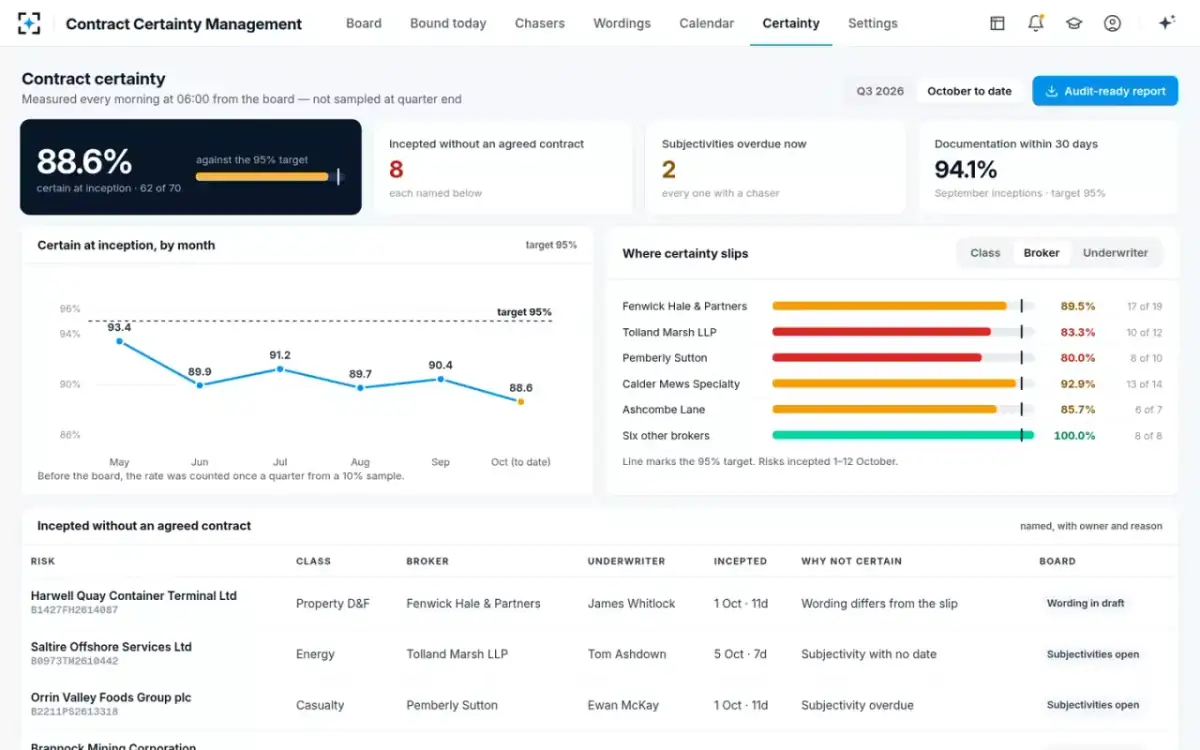
The core measures are the share of risks certain at inception, the share documented within the firm's period, the subjectivities overdue today, the wordings with open material differences, and how long brokers take to answer. Each should be cut by class, broker and underwriter, because a rate for the whole book hides where certainty slips.
Where certainty slipped in the sample market: certain at inception by broker
A broker cut is the one that changes behaviour, because brokers draft wordings and collect subjectivity evidence. In the sample, Pemberly Sutton's two failures were a loss record overdue and a condition survey still open; Tolland Marsh's included a subjectivity with no date on the slip. Those are three different fixes: a chaser, a survey booking and a slip-drafting habit. A rate alone would have called all of them "80%".
Two measures are easy to forget. The first is documentation: Marlowgate's sample shows 94.1% of September inceptions documented within 30 days, against a 95% target, which is a different failure from certainty at inception and needs a different owner. The second is reply time: the sample chasers screen shows a median broker reply of 1.6 days, which tells the head of operations whether escalation after two working days is set too tight or too loose.
Contract Certainty Management's certainty screen: the rate, the trend and every risk not certain
How should contract certainty be reported to the board?
As a rate under a stated definition, with its trend, and with every risk that failed named beside its owner and reason. The board needs to know three things: whether the firm is getting better, where the failures cluster, and whether any single uncertain contract is large enough to matter on its own. A percentage answers only the first.
What a board certainty report should carry
| Item | Why the board needs it | From the sample report |
|---|---|---|
| The definition in force | A rate is meaningless if what counts as certain changed between months | Every subjectivity cleared and the wording agreed with the slip by 00:01 on inception |
| Rate and target, with trend | Shows direction, not just level | 88.6% against 95%; six months from 93.4% in May |
| Every risk not certain, named | Lets the board ask about the large ones | 8 risks, each with class, broker, underwriter and reason |
| Where it slips | Points to the fix: a broker, a class, an underwriter | Two brokers below 85% |
| Documentation within the period | A separate failure with a separate owner | 94.1% of September inceptions within 30 days |
| Who signed it | Makes the number someone’s | Signed by the head of underwriting operations |
The definition row is the one most reports omit. Firms define certain at inception differently, some stricter, some looser, and a firm that loosens its definition can improve its rate without improving a single contract. Fixing the definition in a setting that can only be changed by an approved proposal, with every change logged, keeps the trend honest. How the count itself should be taken is the subject of the contract certainty checklist.
How does AI change underwriting operations?
It moves the team from preparing work to approving it, and it moves the head of operations from compiling a number to governing the software that compiles it. Insurers are already further down this road than the rest of finance: 95% of the insurers in the Bank of England and FCA's 2024 survey were already using AI, the highest share of any sector (Bank of England and FCA, November 2024). The same survey found that "55% of all AI use cases have some degree of automated decision-making", and that "A third of all AI use cases are third-party implementations."
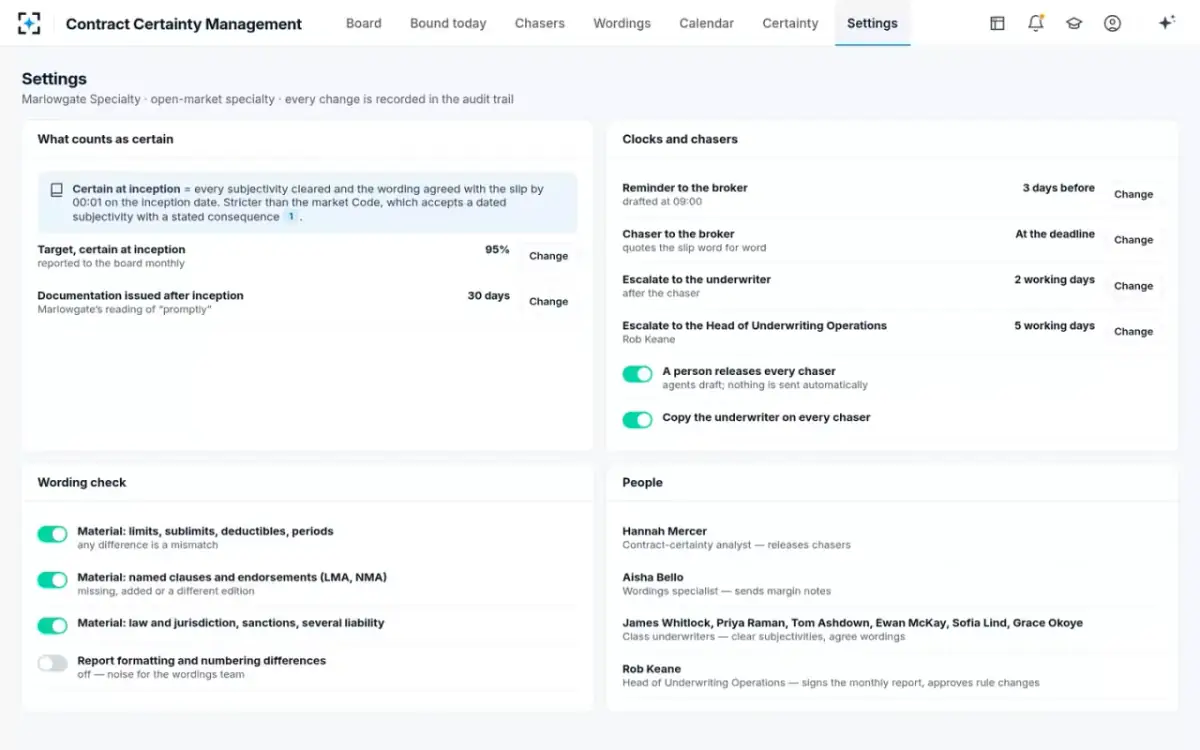
Both findings land on the operations seat. Automated decision-making in certainty work has to stop short of the decisions that change a contract, so the split of who decides must be written down. Third-party tools mean the insurer is answerable for software it did not write, so the head of operations needs to see what each agent did on each risk, and be able to change a rule without a vendor release. In the sample setup, every step by an agent or a person is on the risk's run log, and every change to a clock, a target or a wording rule is a proposal the head of underwriting operations approves.
The rules the head of operations owns: definition, clocks, wording check, people
The operations team after agents: approvers and configurers
The new job description has three parts. Configure: set what counts as certain, when reminders and chasers go, when to escalate and what the wording check treats as material. Approve: release each chaser, clear each subjectivity, agree each wording, sign each report. Investigate: work the exceptions the agents raise and the patterns the daily rate shows, a broker whose wordings keep arriving after inception, a class whose slips keep leaving subjectivities undated.
What the team should not do is check the agents' arithmetic by redoing it. If an analyst rereads every slip to confirm the deadlines, the hours come straight back. The control is narrower: every subjectivity and every wording difference cites the slip page or wording section it came from, so a reviewer checks the citation, not the whole document. The maker and checker split behind that is laid out in insurance subjectivities on a London slip.
Questions people ask
Is head of underwriting operations a senior role?
No regulator defines the title, and its seniority varies from firm to firm. Its weight comes from what it reports: the board reads the certainty rate and the exceptions through this seat, and the FCA's and PRA's rules on organising and controlling the firm's affairs land on the processes it runs.
What skills does a contract certainty analyst need?
Close reading of slips and wordings, knowledge of the market's standard clauses and their editions, and the persistence to chase brokers without souring the relationship. With agents doing the first read, the most valuable skill becomes judgement on the exceptions: whether an undated subjectivity needs a date query today or a call to the underwriter.
How often should the certainty rate be reported?
No rule sets a frequency. Daily inside operations becomes possible once the count is automated: Marlowgate's sample setup reports to the board monthly but computes the rate every morning at 06:00, so the eight risks behind a monthly figure are known while they can still be fixed.
Does an insurer need a separate contract certainty team?
No rule requires a separate team; the FCA's and PRA's rules on organising and controlling a firm's affairs attach to the firm, not to a job title. What matters is that one named person owns the count, the clocks and the escalation path, and that the analyst who chases and the underwriter who clears are different people.
What should operations never automate?
The decisions that change the contract or what the insured is told: clearing a subjectivity, agreeing a wording, sending a chaser and signing the report. In Contract Certainty Management agents never send, clear or agree; the quoted slip text in a chaser cannot be edited, and a wording with an open material difference cannot be agreed.